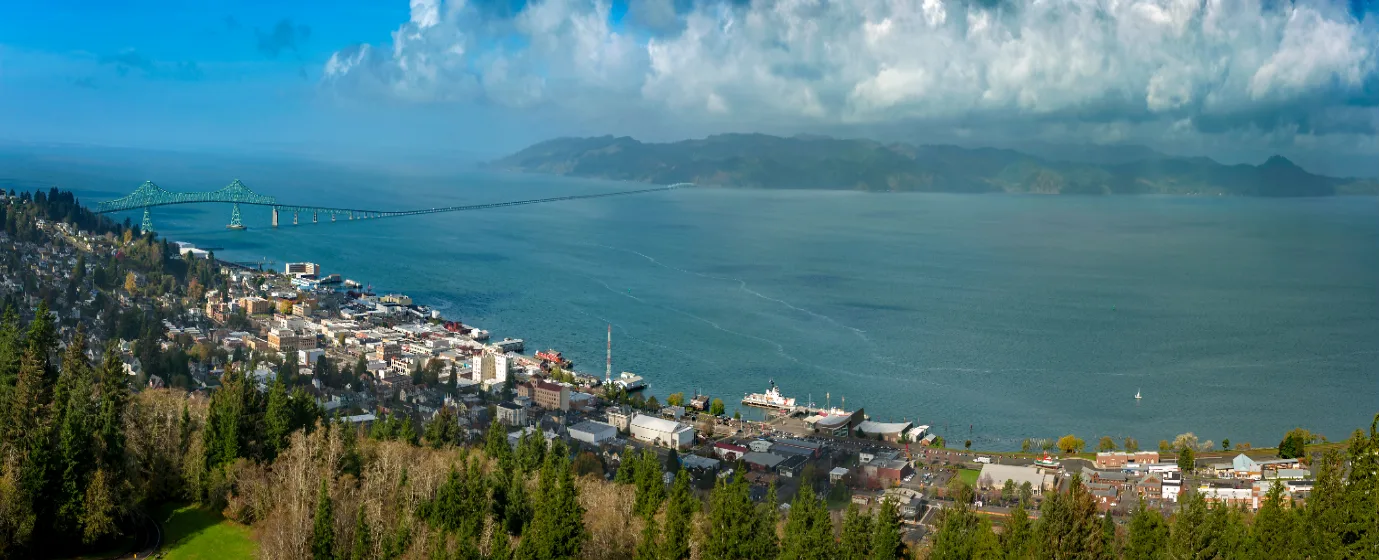
Most people picture retirement on the Oregon coast as a vague dream — oceanfront sunsets, quiet mornings, nowhere to be. Astoria makes it concrete, and occasionally complicated. The city sits at the mouth of the Columbia River where it meets the Pacific, connected to the outside world by US-101 and US-30 but genuinely separated from Portland by about 105 minutes of driving. That distance is the central fact of retirement planning here: Astoria offers a real small-city life with walkable streets, a hospital inside city limits, and a downtown that has operated continuously since 1811 — but if you need a regional medical center or a major airport, Portland International Airport (PDX) is roughly 95 miles away.
The city's population of 10,109 skews meaningfully older than the national average. Roughly 19 to 21 percent of residents are 65 or older, which is well above the national share, and that demographic weight shapes everything — the healthcare infrastructure, the social calendar, the pace of daily life. Columbia Memorial Hospital anchors the city's medical capacity in a way that most towns this size cannot claim, and Clatsop Community College keeps a stream of continuing-education and cultural programming running year-round. Retirees who land here tend to be people who wanted a genuine community, not a resort, and who were honest with themselves about trading urban convenience for a place that actually feels like somewhere.
The financial picture has real advantages for retirees. Oregon exempts Social Security income from state income tax entirely, and the effective property tax rate here is approximately 0.71% — a meaningful relief on a typical home price of $486,426 (July 2026) for buyers coming from California or Washington. There is no statewide sales tax, which matters on a fixed income more than most people calculate in advance. The honest caveat: Oregon's graduated income tax on pensions, IRA withdrawals, and 401(k) distributions runs up to 9.9%, so the tax picture depends heavily on where your income comes from.
Whether you're seriously planning a move or still in the early research phase, the sections below cover Astoria's retirement fit, healthcare depth, retiree budget math, walkability and community, downsizing options, and how the city stacks up against other nearby Oregon and Southwest Washington towns worth considering.

Why Retirees Are Choosing Astoria
Astoria fits a specific kind of retiree well: someone who wants a walkable downtown with actual history, a hospital that isn't a forty-minute drive away, and a community where people know each other. The Victorian architecture, the Columbia River Maritime Museum, the Liberty Theatre, and the Flavel House Museum aren't tourist props — they're the fabric of daily life here, and they give the city a density of character that newer planned communities rarely replicate.
The typical home price of $486,426 (July 2026) puts Astoria within reach for buyers coming from California markets — see the full cost-of-living breakdown — and the city's 127 sunny days a year aren't enough to sell everyone, but retirees who genuinely love Pacific Northwest weather, including the fog and the grey, find it one of the most beautiful places on the coast. The Astoria Sunday Market, the riverfront trolley, and a coffee culture centered around independent cafés make the texture of daily life richer than the population size would suggest.
Astoria is a worse fit if you depend on specialized medical care that requires regular trips to a major academic center, if you need to fly frequently (Portland International Airport is about 105 minutes away), or if you want a large amenity-heavy active-adult resort with a golf course and clubhouse. This is a real town with genuine tradeoffs, not a retirement community with a nature backdrop. The retirees who struggle here are usually the ones who underestimated the isolation that sets in after the honeymoon period ends — particularly in January and February, when the rain is relentless and the tourist energy that animates summer is gone entirely.
Healthcare & Medical Access in Astoria
Columbia Memorial Hospital (CMH) is the healthcare anchor most retirees weigh first, and it punches above its weight for a critical access facility. It operates as a 25-bed, not-for-profit Level III trauma center in partnership with Oregon Health & Science University (OHSU) — a partnership that gives it access to academic medicine resources unusual for a coastal town of this size.
The specialist roster covers the conditions that matter most to retirees: cardiology, orthopedics, oncology, urology, endocrinology, pulmonology, and a dedicated diabetes education program. Rehabilitation services and hospice are also available within the system. The emergency department handles approximately 17,000 visits annually, and CMH has earned national recognition as one of the country's more technologically advanced critical access hospitals, along with Planetree Gold Certification for patient-centered care.
What CMH Can and Cannot Do
For routine and moderate-acuity care — joint replacement, cardiac monitoring, cancer screening, outpatient rehab — CMH is a genuine asset. Where the picture changes is complex or high-acuity intervention: advanced cardiac surgery, comprehensive cancer treatment, or major neurosurgery realistically require a trip to Portland. OHSU's main campus is the regional reference point for cases beyond CMH's scope, and that drive takes about 105 minutes under normal conditions.
Providence Seaside Hospital, listed among the area's major employers, sits roughly 17 miles south in Seaside and provides an additional regional resource, though its capacity is similarly scaled to a coastal community. Retirees with existing chronic conditions that require frequent specialist contact should map out those visits honestly before committing to Astoria — the hospital here is good, but the distance to tertiary care is real and should be part of the calculus.
Senior Care Continuum
For retirees who eventually need more support, Astoria has licensed assisted living and memory care options within city limits. Clatsop Retirement Village serves up to 80 residents, Clatsop Care Center up to 71, and Astor Place offers 34 studio and one-bedroom apartments with amenities including a call pendant system and a regular social programming schedule. Oregon's Medicaid Aged and Physically Disabled waiver may provide cost assistance for qualifying residents 65 and older.

The Retiree Budget in Astoria
Oregon's Tax Posture for Retirees
Oregon's biggest retirement tax advantage is one of the cleanest: Social Security and Railroad Retirement benefits are fully exempt from state income tax, with no income ceiling on the exemption. For retirees whose income is primarily Social Security, this is a genuine and meaningful benefit.
The more complicated picture comes with other retirement income. Pensions, traditional IRA withdrawals, and 401(k) distributions are taxed at Oregon's graduated state rates, which run from 4.75% to 9.9%. A retiree drawing $30,000 from Social Security and $40,000 from a pension or retirement account sits in a very different tax position than one drawing purely from Social Security. Plan accordingly, and run the numbers with a tax professional before you move.
Oregon also offers a property tax deferral program for homeowners 62 and older with household income at or below the current qualifying threshold. Eligible residents who have occupied their home for at least five years may defer county property taxes until the home is sold — deferred taxes do accrue interest, but the cash-flow relief can be meaningful for fixed-income buyers. There is no statewide sales tax in Oregon, which saves fixed-income retirees a measurable amount annually compared to moving from a state with a general sales tax.
Property Tax Reality
The effective property tax rate in Astoria is approximately 0.71%, which is on the lower end for Oregon coastal towns. At that rate, the annual tax obligation on a typical home sits well below what buyers from California or Washington often expect — a structural advantage that compounds over a long retirement. For full details on groceries, utilities, and transportation costs on a fixed income, see the cost-of-living page.
Daily Cost of Living
Astoria is not an inexpensive town by rural Oregon standards, but it is considerably more affordable than the major metro markets most retirees are leaving. Grocery prices reflect the coastal location — shipping costs show up at the checkout — and dining out in the locally-owned restaurant scene runs toward mid-range rather than cheap. The absence of a sales tax on every transaction is a quiet but consistent budget benefit that retirees from sales-tax states notice quickly.
Looking to buy in Astoria? Estimate your payment.
Enter your numbers to see an estimated monthly mortgage payment.
Estimate only. Excludes HOA fees and mortgage insurance. The interest rate above is a starting point, not a quoted rate — replace it with your own to see real numbers. Insurance is a flat placeholder, not a Astoria quote.
Walkability, Community & Staying Active in Astoria
The Walkability Reality
Astoria's downtown core and waterfront are genuinely walkable — most daily errands can be handled on foot there — but that reputation comes with a significant asterisk: the city is built on steep hills. The Riverwalk and the flat blocks nearest the Columbia are genuinely accessible on foot, and most errands — coffee, groceries, banking, the post office — can be handled without a car if you're comfortable on uneven terrain.
The hills change the picture for retirees with mobility limitations. Streets climbing toward the South Slope, Hilltop, and upper residential neighborhoods involve real grade changes that many people find challenging in their 70s or beyond. If walkability matters to your daily routine, the flat blocks within a few blocks of the waterfront are the right target — and the 6.4-mile Astoria Riverwalk, served by a historic riverfront trolley, gives non-drivers a genuine car-free option for both recreation and basic access to downtown.
Where the Community Life Happens
The retiree social infrastructure here is built around the city's cultural institutions and outdoor rhythm rather than a formal senior center. The Columbia River Maritime Museum and the Liberty Theatre both draw regular audiences from the resident community — these aren't tourist-only destinations. The Astoria Sunday Market runs through the warm months and functions as the weekly gathering point where you run into the same neighbors every week.
Blue Scorcher Bakery & Café and Coffee Girl are both anchors of the local morning routine — good spots to understand who actually lives here versus who is passing through. Fort Stevens State Park, the Cathedral Tree Trail, Youngs Bay, and the forest trails above the city give active retirees genuine outdoor options within city reach, from flat waterfront walking to elevated forest paths.
Clatsop Community College adds a layer of programming — lectures, arts events, continuing education — that gives the intellectual end of retirement life here more depth than the city's size alone would generate. A city where 19 to 21 percent of the population is 65 or older naturally organizes around the interests and pace of that demographic, and that shows in what gets scheduled, what stays open, and what the community treats as worth sustaining.
The Seasonal Honesty
Summer in Astoria — roughly July through September — is when the city shows its best face. The Astoria Sunday Market is full, the Riverwalk is busy, and the cultural calendar is dense. With only 127 sunny days a year, the flip side is a long grey season that runs from October through June with real persistence. Retirees who have lived through Pacific Northwest winters elsewhere tend to adapt; those moving from California or the Southwest often don't fully believe how relentless it is until the second February.
Right-Sizing: Downsizing in Astoria
Downsizing in Astoria means navigating a housing stock that is older, characterful, and not always configured for single-level living. The city's Victorian-era and early 20th-century homes — the ones that give the Shively-McClure Historic District and Uppertown their visual identity — are typically two stories with basements, full of the architectural detail that draws buyers and the stair-climbing reality that becomes relevant in your 70s.
Single-Level and Low-Maintenance Options
Single-level homes exist in Astoria, particularly in the Alderbrook and Smith's Point areas and in some of the mid-century ranch stock scattered through the residential neighborhoods, but they represent a smaller share of the overall inventory than you'd find in a purpose-built retirement market. If a no-stairs floor plan is a firm requirement, expect to be patient or flexible on other features.
Condominiums and smaller patio-style homes offer the low-maintenance lifestyle that suits later-life downsizing, and there is some inventory in and around the downtown core — but Astoria is not a condo-heavy market by volume. What sells here tends to be single-family homes with history and character; buyers wanting a purpose-built low-maintenance unit will find fewer options than in larger coastal cities.
Active-Adult and Senior Living
Midway Village LLC is the verified 55-plus active-adult community operating in Astoria. The city's 55-plus inventory is modest in scale — there is no large, amenity-heavy resort-style development with a fitness center, pool, and clubhouse — but the assisted living and independent senior living options within city limits are meaningfully more numerous than in comparable-sized towns. Clatsop Retirement Village, Clatsop Care Center, and Astor Place each serve distinct points on the continuum from independent living to memory care, giving families a genuine range of options without leaving the city.
Retirees who want a larger active-adult campus environment with built-in amenities will find more choices in the Portland metro or in communities like Bend or Eugene than Astoria offers. The honest read is that Astoria's senior living infrastructure is sized to its population — adequate, with real options, but not deep or competitive in the way a larger city's market would be.
Astoria vs Nearby Retirement Destinations
| City | Cost vs Astoria | Primary Hospital | Walkability | Senior Living Depth | Overall Retirement Fit |
|---|---|---|---|---|---|
| Astoria, OR | Anchor | Columbia Memorial Hospital (Level III, OHSU partnership) | Very walkable downtown; hills limit access in upper neighborhoods | Modest — multiple licensed options, no large resort campus | Strong for community-oriented, culturally active retirees |
| Seaside, OR | About the same | Providence Seaside Hospital (17 mi south of Astoria) | Flat, walkable beachfront core | Limited — smaller senior living inventory | Good for beach-focused retirees; fewer cultural amenities |
| Gearhart, OR | Pricier | Same regional draw (Providence Seaside or CMH) | Quiet residential; minimal walkable errands | Very limited | Best for privacy-seeking retirees who own a car and don't need much infrastructure |
| Warrenton, OR | Noticeably cheaper | CMH in nearby Astoria | Car-dependent; limited on-foot access | Limited | Budget-conscious retirees willing to trade walkability and character for lower cost |
| Ilwaco, WA | Noticeably cheaper | Nearest acute care across the Astoria-Megler Bridge into Oregon | Very limited; small fishing town layout | Minimal | Fits self-sufficient retirees drawn to Washington's tax structure and quiet coastal living |
| Cannon Beach, OR | Pricier | No hospital in town; Providence Seaside is the nearest option | Compact and walkable in the village core | Very limited | Strong lifestyle appeal; poor fit for retirees who prioritize healthcare proximity |
Seaside offers the flattest terrain on this list — a genuine advantage for retirees who need low-grade walking — but its cultural scene is thinner than Astoria's, and both cities draw on the same regional hospital resources. Warrenton is the clearest cost play: appreciably less expensive than Astoria, only a few minutes away, and close enough to access CMH and downtown Astoria regularly — the compromise is that Warrenton itself offers very little within walking distance.
Ilwaco draws retirees interested in Washington's absence of a state income tax, which can matter significantly for retirees with large pension or investment income; the trade is minimal in-town infrastructure and a river crossing to reach any significant healthcare. Cannon Beach is the lifestyle trophy on this list, but its healthcare access is the weakest — the nearest acute-care facility is a meaningful drive south — and that gap makes it a difficult recommendation for anyone with serious chronic health needs. Astoria sits in the most defensible position for retirees who want community, walkability, and an actual hospital in the same city.

Local Expert Takeaway: Astoria's retirement case rests on three things that are genuinely hard to find together: a walkable historic downtown, a credentialed hospital inside city limits with an OHSU academic partnership, and home prices that are accessible relative to the California and Seattle markets most of its retirees are leaving. The city asks something in return — 127 sunny days a year, steep hills above the flat waterfront, and a 105-minute drive to Portland if you need what's there. Retirees who go in clear-eyed about those tradeoffs, who want to be embedded in a real working town rather than a resort community, and who will actually use the Riverwalk, the Sunday Market, and the Maritime Museum as part of daily life tend to find Astoria one of the better decisions they made. The ones who struggle are usually surprised by the winters and the distance — neither of which is a secret, but both of which are easier to accept in August than in February.
Quick Takeaways & FAQs
✅ Columbia Memorial Hospital operates as a Level III trauma center with an OHSU academic partnership — unusually strong healthcare infrastructure for a coastal city of 10,109.
⚠️ Oregon exempts Social Security income from state income tax entirely, but pensions and IRA withdrawals are taxed at rates up to 9.9% — the retirement tax picture depends heavily on your income sources.
📍 The Astoria Riverwalk's historic trolley route gives non-drivers a car-free connection along 6.4 miles of waterfront — genuinely useful for retirees who want to reduce car dependence in the flat downtown core.
Does Astoria have a hospital, and how good is it?
Is Oregon a good state for retirees from a tax standpoint?
Is Astoria actually walkable for older adults?
What are the 55-plus and senior living options in Astoria?
How does Astoria compare to Seaside or Cannon Beach for retirement?
Moving to Oregon?
Tell us what you need help with and we'll connect you with local resources.
