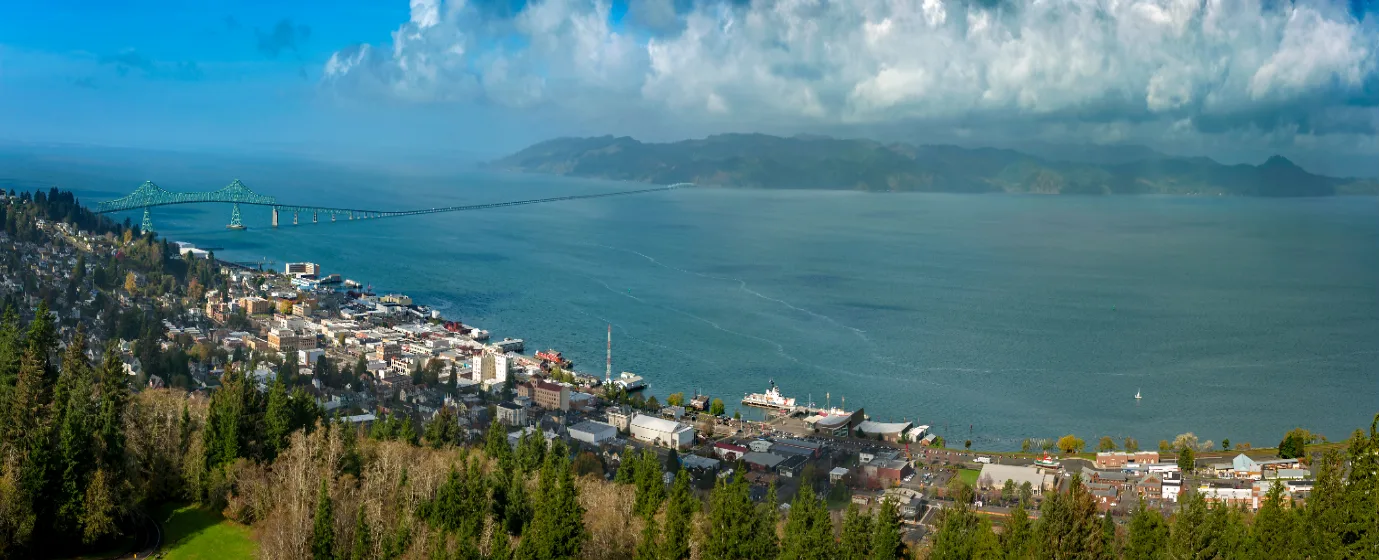
Astoria is one of those places where a first drive-through is genuinely disorienting. You expect a quiet coastal town and instead find a working city stacked vertically on a hillside above the Columbia River, with Victorian-era houses climbing the slopes, a historic waterfront that once housed more than a dozen salmon canneries, and an elevation change dramatic enough that two blocks in the wrong direction puts you in a completely different microclimate. The city of 10,109 sits where US-101 crosses from Oregon into Washington via the Astoria-Megler Bridge — the longest continuous truss bridge in North America — and that position at the mouth of the Columbia shapes everything about daily life here, from the fog patterns to the commute reality.
Astoria School District 1C, which holds a B- rating, according to Niche, serves 1,731 students enrolled in 2025-26 across a compact system where school boundaries don't vary much by neighborhood — the district is small enough that most kids end up at the same schools regardless of which hillside you buy on. Columbia Memorial Hospital is the city's anchor employer, alongside Clatsop Community College and the school district itself. The people who move here tend to fall into two camps: remote workers who have specifically chosen to live somewhere with genuine historic character and an unusually low cost of entry by Oregon coast standards, and people with deep roots in the fishing, maritime, or healthcare industries who never left.
The typical home price in Astoria sits at $486,426 (Zillow Home Value Index, July 2026) — noticeably below what you'd pay in coastal cities to the south like Cannon Beach or Manzanita, and a fraction of what Portland buyers are escaping. The full cost-of-living picture covers utilities, groceries, and the effective property tax rate of 0.71%. Day-to-day life here means the Astoria Sunday Market on weekends, the Astoria Riverwalk for morning runs, and the Cathedral Tree Trail for the kind of hike that reminds you why you moved to the coast in the first place. The catch that surprises newcomers: Astoria averages only 127 sunny days a year, and the marine fog is not a seasonal thing — it's a permanent feature of the geography.
Whether you're considering a move or still weighing your options, the sections below break down Astoria's eight neighborhoods, who each one suits, the mistakes buyers consistently make here, and where renters find the best options in a tight market.
The Astoria Reality
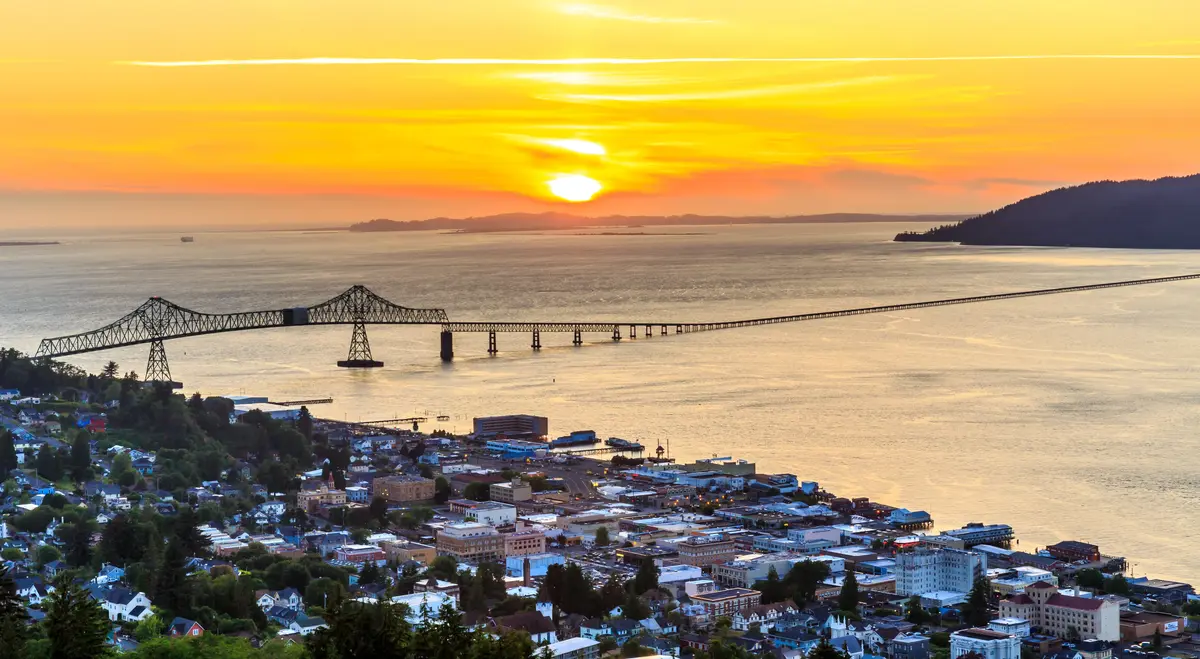
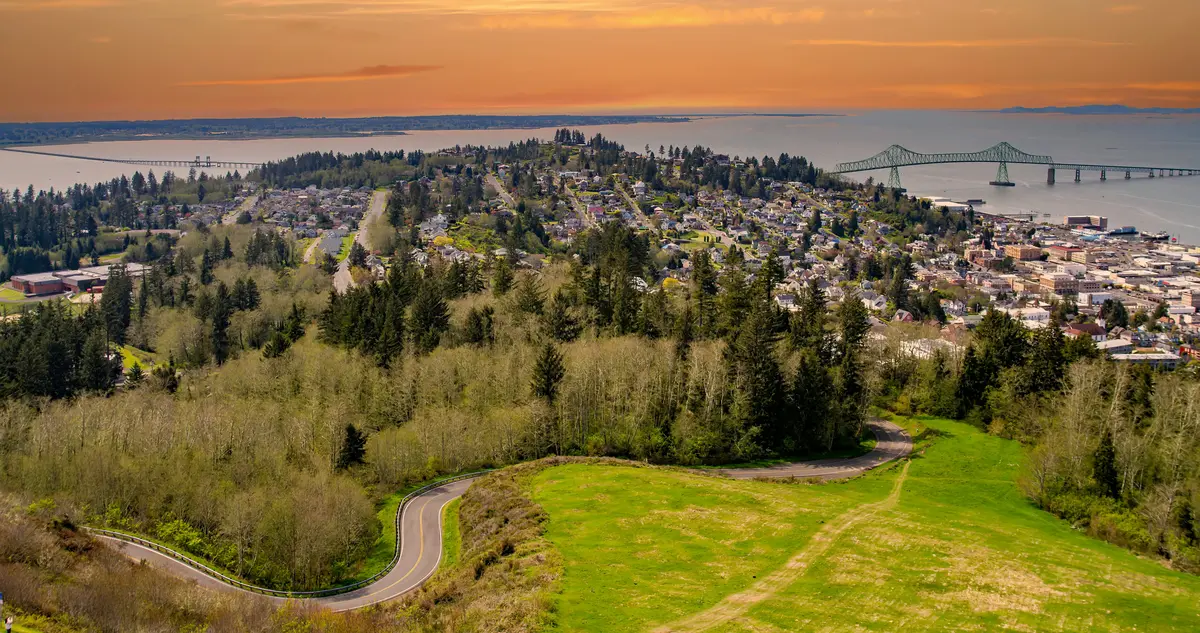
The single most important thing to understand about buying in Astoria is elevation. The city is essentially a hillside city, and every neighborhood is defined first by how high it sits — which determines views, fog exposure, driveway steepness, and walkability to the waterfront. Neighborhoods at or near water level, like Alderbrook and Uniontown, trade easy terrain for floodplain considerations and proximity to US-101 traffic. Neighborhoods on the upper slopes, like Hilltop and Emerald Heights, trade the walk-to-everything convenience for sweeping views and quieter streets — but a steep driveway in Astoria is not a minor inconvenience; in February, it is a genuine decision factor.
The east-west divide matters almost as much as elevation. Central Astoria — anchored by the Shively-McClure Historic District and the commercial corridors near downtown — is where walkability actually works. You can reach Fort George Brewery, Blue Scorcher Bakery & Cafe, the Columbia River Maritime Museum, and the Riverwalk on foot. As you move east toward Uppertown, Alderbrook, and Emerald Heights, the city stretches out and errands increasingly require a car. As you move west to Smith's Point, you gain dramatic dual-water views but accept that US-101 is your only arterial in and out of the neighborhood.
School boundaries are not the dividing line here — the district is small enough that the boundary question rarely determines which neighborhood you buy in. What drives that decision instead is the elevation-and-access trade-off: how much hill are you willing to manage daily, how close do you want to be to the waterfront energy of downtown, and how much does floodplain exposure concern you? Those three questions narrow the field faster than any other filter in this city.
Neighborhoods at a Glance
| Neighborhood | Best For | Vibe |
|---|---|---|
| Shively-McClure Historic District | Walkable Luxury | Grand Victorians and Craftsman homes within walking distance of downtown, restaurants, and the Riverwalk; the city's historic heart |
| Uniontown | Walkable Renter | Cannery-era cottages and converted industrial buildings near the Astoria-Megler Bridge; artisan and creative energy |
| South Slope | Families Quiet | Bungalows and newer construction south of the main residential grid; Columbia River views, less tourist traffic |
| Uppertown (Adair-Uppertown) | First-Time Value | Working-class Victorian vernacular east of 32nd Street; authentic, ungentrified, and the least polished of the historic neighborhoods |
| Alderbrook | Value Nature | Flat, low-lying, waterfront-adjacent on the eastern edge; older homes, minimal traffic, and a tight-knit neighborhood feel |
| Hilltop | Views Quiet | Single-family hilltop enclave with Tapiola Park nearby; no through streets, sweeping Columbia River panoramas |
| Smith's Point | Views Privacy | Westernmost peninsula tip with winding 1912-platted streets designed for water views; Columbia River and Youngs Bay from a single lot |
| Emerald Heights | Families Quiet | Former WWII Navy housing converted to a lush, forested residential area; a mix of families and retirees near the eastern city limits |
Astoria typical home price: $486,426 (Zillow ZHVI, July 2026). Typical rent: $1,644/mo (Zillow ZORI, July 2026). Neighborhood tiers on this page are relative to these figures.
Best Neighborhood by Buyer Type
| Buyer Type | Best Neighborhood | Why |
|---|---|---|
| First-Time Buyer | Uppertown (Adair-Uppertown) | The least-polished of the historic neighborhoods means more realistic entry-level pricing relative to the city median, without sacrificing the character that defines Astoria. |
| Luxury Buyer | Shively-McClure Historic District | Over 200 contributing historic structures — Queen Anne Victorians, Colonial Revivals, and Craftsmans — make this the only neighborhood where premium restoration commands a genuine premium at resale. |
| Walkability Seeker | Shively-McClure Historic District | Closest walk to the Riverwalk, the Sunday Market, Fort George Brewery, and the Columbia River Maritime Museum without a car. |
| Families with Kids | South Slope | Regarded as one of Astoria's more family-friendly areas, with Columbia River views, a quieter pace than downtown, and a mix of bungalows and newer construction. |
| Commuters | Alderbrook | Flat terrain and US-30 access make it the most practical base for the drive toward Portland — about 105 minutes to Portland — or across the bridge into Washington. |
| Large-Lot Buyers | Smith's Point | The 1912 replat created irregular, contoured lots designed for views and privacy that simply don't exist on Astoria's standard Victorian-era grid. |
| Renters | Uniontown | The highest density of converted historic structures — former boarding houses and working-class cottages — gives renters the most options closest to downtown's walkable core. |
Looking to buy in Astoria? Estimate your payment.
Enter your numbers to see an estimated monthly mortgage payment.
Estimate only. Excludes HOA fees and mortgage insurance. The interest rate above is a starting point, not a quoted rate — replace it with your own to see real numbers. Insurance is a flat placeholder, not a Astoria quote.
Most Popular Neighborhoods
1. Shively-McClure Historic District (Central Residential)
This is where Astoria started — platted in 1846, designated on the National Register of Historic Places in 2005, and home to 243 historic properties spanning Gothic vernacular, Craftsman, Queen Anne Victorian, and Colonial Revival styles. Walking these streets, you pass the site of the first post office west of the Rockies and houses that once belonged to cannery barons and immigrant workers alike. The trade-off is real: historic designation means restoration costs are higher than anywhere else in the city, and a fixer-upper here demands respect for the architecture or a budget that reflects it.
Best for: buyers who want the most walkable, historically significant address in Astoria and are prepared for the maintenance that comes with pre-1940 construction.
2. Uniontown
Uniontown sits near the Astoria-Megler Bridge on the southeastern waterfront, where the city's Finnish, Chinese, and other immigrant cannery workers once lived in boarding houses that now house artisan studios and independent shops. The Uniontown-Alameda Historic District has been on the National Register since 1988, giving it credibility that newer buyers sometimes underestimate. The catch is proximity to US-101 traffic and the industrial waterfront — the character is genuine, but the noise from the bridge approach is a daily reality you should experience before signing anything.
Best for: renters and creative types who want historic waterfront character at prices that don't require a restoration budget, and who don't mind the bridge-adjacent ambient noise.
3. South Slope
South of Niagara Avenue, the residential grid quiets down considerably — fewer tourists, less through traffic, and Columbia River views from a neighborhood that feels genuinely residential rather than commercial-adjacent. The housing mix ranges from older bungalows to more recent construction, which means you're not always locked into the renovation calculus that defines the central historic neighborhoods. The downside is that South Slope sits farther from the walkable downtown core, so the Riverwalk and the Sunday Market are a drive or a real uphill walk away.
Best for: families with school-age children and remote workers who want river views and a quieter pace without paying the premium of the central historic district.
4. Uppertown (Adair-Uppertown)
Colonel John Adair settled east of 32nd Street in 1849 because he couldn't get land in central Astoria — and that origin story still captures something true about Uppertown: it's always been the neighborhood for people who arrived a little later and had to make the most of what was left. The vernacular Victorian architecture is authentic and largely unrestored, which makes it one of the more affordable entry points into Astoria's housing market relative to the city-wide figure. A corner building here was used as the 'Stop and Snack' store in the opening of The Goonies — local trivia that residents mention with genuine pride, and that explains some of the foot traffic you'll see from out-of-towners.
Best for: first-time buyers who want genuine historic character without the Shively-McClure premium, and buyers who appreciate a neighborhood that hasn't been fully polished for resale.
5. Alderbrook
Alderbrook runs along the Columbia River waterfront from roughly 41st to 54th Streets, topographically low and intentionally quiet — no meaningful through traffic, a neighborhood hall and park, and older single-family homes with some duplexes mixed in. The floodplain issue is real and not a footnote: portions of Alderbrook sit in the 100-year floodplain, which means flood insurance is a line item in your ownership budget that you need to price out before falling in love with a listing. That risk is part of why this neighborhood tends to sit at the more accessible end of Astoria's price spectrum.
Best for: buyers who prioritize waterfront proximity and flat, easy terrain, are comfortable researching flood zone status for specific parcels, and want a neighborhood with minimal outside traffic.
6. Hilltop
Hilltop does exactly what the name promises — single-family homes on the upper elevation, multi-family permitted on the lower hillside transitional zones, and no through streets to push commuter traffic past your front door. Tapiola Park anchors the neighborhood's open space, and the Columbia River views from the upper streets are among the widest in the city. The honest limitation is access: getting groceries uphill in a coastal winter storm is a different experience than it is in July, and buyers who visit in summer sometimes underestimate what the driveway situation looks like in February.
Best for: view seekers and buyers who want a genuinely quiet residential setting with no cut-through traffic, and who've actually visited in winter before committing.
7. Smith's Point
The western tip of the Astoria peninsula was deliberately replatted in 1912 to replace the standard grid with winding streets that follow the hillside contours — the whole point was to maximize water views, sunlight, and breeze from every lot. Named for Samuel C. 'Ticky' Smith, who claimed this land in 1843, the neighborhood offers something rare in a small coastal city: views of both the Columbia River and Youngs Bay from a single address. US-101 swings around Smith's Point at the entrance to Youngs Bay, which means the highway is your main artery in and out — a limitation worth understanding before you buy at the end of a peninsula.
Best for: buyers who specifically want dual-water views and a sense of geographic distinction, and who have made peace with US-101 as their daily on-ramp to everywhere else.
8. Emerald Heights
What is now a quiet, lush residential neighborhood between Leif Erikson Drive and the forested Land Reserve once housed US Navy personnel during World War II — the bones of the neighborhood reflect that utilitarian origin, even as the greenery and the views have long since transformed the character. It draws a mix of families and retirees, sits close to US-30 toward the eastern city limits, and benefits from the forested buffer that gives the neighborhood its name. The trade-off is that it's the farthest from downtown Astoria's walkable core, so daily life here is fundamentally car-dependent in a way the central historic neighborhoods are not.
Best for: families and retirees who want green surroundings, relative quiet, and easy US-30 access, and who don't need to walk to the waterfront on a Tuesday morning.
Common Mistakes Buyers Make in Astoria
Treating the City as Flat When It Isn't
Buyers who research Astoria online and visit only in summer often buy on the upper slopes without fully appreciating what a steep driveway means in a coastal Oregon winter. The elevation difference between Alderbrook at water level and Hilltop or Smith's Point above it isn't a minor inconvenience — it's a physical reality that shapes daily life from November through March. Visit in January, not July, before you make an offer on anything above the mid-slope mark.
Underestimating the Floodplain in Alderbrook
Alderbrook's position between Leif Erikson Drive and the Columbia River waterfront means some parcels sit in the 100-year floodplain. Buyers drawn to the neighborhood's waterfront proximity and accessible price point sometimes skip the flood zone research until they're already in contract. Check FEMA flood map status for any specific parcel in that stretch before you get attached to a listing — flood insurance costs can materially change the monthly ownership picture.
Buying Historic Without Pricing the Restoration
The Shively-McClure Historic District's 243 contributing structures are genuinely beautiful, and the National Register designation is a point of pride. It's also a constraint: restoration work on contributing properties must meet historic preservation standards, which limits materials and contractors and adds cost. Buyers who buy a Craftsman or Queen Anne in the district expecting to renovate it on a standard remodeling budget routinely discover the gap between that expectation and the actual quote. Budget the restoration before you make the offer, not after.
Assuming the Drive to Portland Is Manageable Daily
Astoria's position at the coast makes the commute to Portland — about 105 minutes to Portland under normal conditions — a real commitment. US-30 and US-101 are the routes, and neither one has a fast alternative when weather closes in or there's a slowdown near the Columbia River crossing. Buyers who plan to commute even a few days a week from Astoria to Portland consistently underestimate how the drive feels in month three compared to how it felt during the house-hunting weekend.
Best Areas to Rent in Astoria
| Area | Ideal For | Trade-off |
|---|---|---|
| Shively-McClure / Central Downtown | Renters who want walkability to the Riverwalk, restaurants, and the Sunday Market | Highest demand, lowest vacancy — units move fast and competition is real |
| Uniontown | Creative renters who want historic character and a waterfront-adjacent address | Bridge noise from the US-101 approach is an ambient constant |
| South Slope | Families and remote workers who want Columbia River views and a quieter residential pace | Car required for most daily errands; the walk to downtown is genuinely uphill |
| Hilltop / Upper Slopes | View-seekers and people who prioritize quiet over walkability | Steep access in wet weather; multi-family units are concentrated on the lower hillside transitional zones |
| Alderbrook / Emerald Heights | Renters who want more space, minimal through traffic, and proximity to US-30 | Farthest from downtown's walkable energy; some Alderbrook units carry floodplain insurance requirements |
Astoria's rental market is tight for a city of its size — the city-wide typical rent figures reflect a coastal market where inventory is genuinely limited and turnover is low. Renters looking for longer-term stability tend to find it in Uniontown and the upper-slope neighborhoods, where the converted historic stock provides variety that the newer construction elsewhere in coastal Oregon rarely matches.

Local Expert Takeaway: Astoria rewards buyers who understand the elevation before they fall for the architecture. The Shively-McClure Historic District gives you the most walkable address in town, but a historic Queen Anne on a steep lot comes with real restoration costs — price the work before the offer, not after. Alderbrook is the most accessible entry point in the city, but flood zone status varies parcel by parcel along the Columbia waterfront, and skipping that research is the most expensive shortcut buyers take here. If you're drawn to the views and the quiet of Smith's Point or Hilltop, visit in a January fog before you commit — the drive back up from US-101 on a wet Wednesday tells you more about those neighborhoods than any summer open house ever will.
Quick Takeaways & FAQs
✅ Astoria's typical home price of $486,426 (July 2026) sits well below comparable Oregon coast markets, making it one of the most accessible historic coastal cities in the state.
⚠️ The drive to Portland — about 105 minutes to Portland — makes Astoria a genuine choice for remote workers but a difficult one for anyone planning a regular Portland commute.
📍 Alderbrook sits partly in the 100-year floodplain, and flood zone status varies by individual parcel — always check before going under contract in that neighborhood.
What is the most walkable neighborhood in Astoria?
Which Astoria neighborhoods have flood risk?
What is the most affordable neighborhood in Astoria?
Is Astoria a good place to live if you work remotely?
How do Astoria's neighborhoods differ for families with kids?
Moving to Oregon?
Tell us what you need help with and we'll connect you with local resources.
