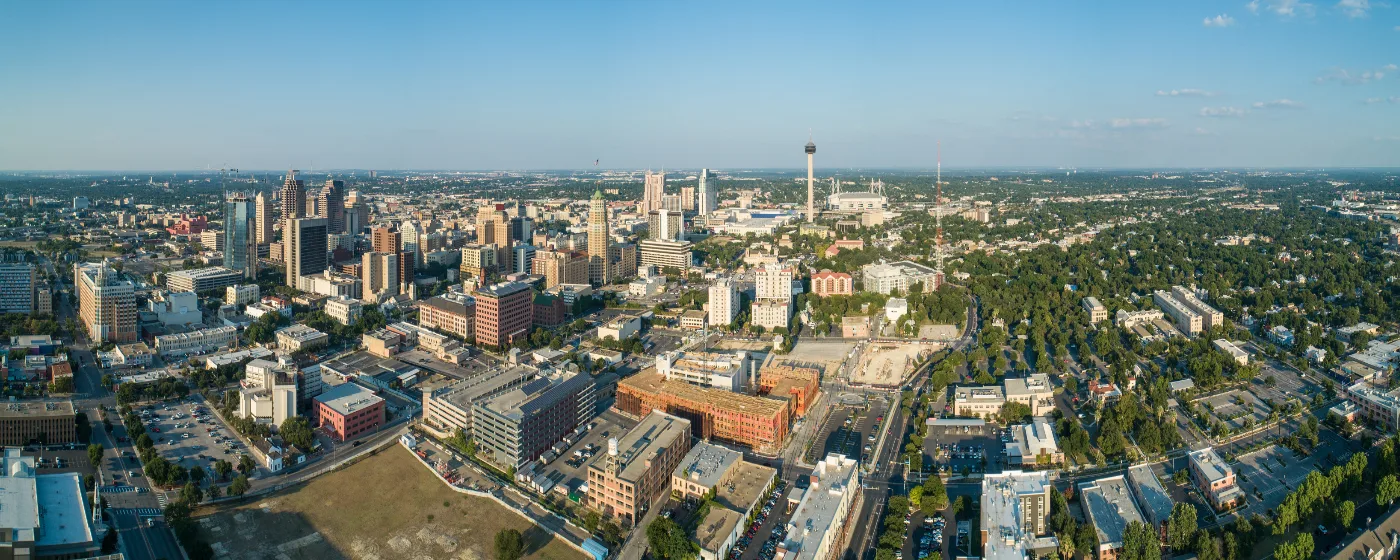
What Is Living in San Antonio, Texas Like?
San Antonio is one of the few major American cities where a $249,689 typical home price and a genuinely diverse, 300-year-old culture coexist in a metro that is still growing faster than almost anywhere in the country. The 2nd-largest incorporated city in Texas — with a population of 1,548,422 — San Antonio sits at the crossroads of I-10, I-35, and I-37, with Loop 1604 defining the outer ring and Loop 410 threading the inner city together. This is a place where the freeway network is not background infrastructure — it is how you live. Understanding which loop you are buying inside or outside shapes commute times, neighborhood character, and access to work more than almost any other single factor.
The economic backbone here is unusually broad for a city this size. Joint Base San Antonio — the largest military installation complex in the world by acreage — anchors government employment and generates an outsized share of the metro's economic output. H-E-B, headquartered here, employs thousands of San Antonians and operates as a civic institution as much as a grocery chain. USAA gives the city a white-collar financial-services presence that is easy to overlook from the outside. Toyota's manufacturing plant on the south side and a major regional health system round out a job market that is more diversified than the city's tourism reputation suggests. San Antonio Independent School District, which holds a C rating according to the Texas Education Agency, serves the urban core with 42,548 students enrolled in 2025-26; families with school-age children frequently look toward surrounding suburban districts as they get closer to purchase.
The cost of living here is the headline that draws relocating buyers — particularly those arriving from California, the Northeast, and other major Texas metros. A typical home price of $249,689 (July 2026, Zillow Home Value Index) sits well below what comparable square footage costs in Austin or Dallas, and a typical city-wide rent of $1,390 per month gives renters room to save. Texas has no state income tax, and the metro's gross metropolitan product hit $192.8 billion in 2024. The honest catch: average wages have not kept pace with that output growth, and the effective property tax rate of approximately 1.55% is a real line item in any monthly budget. San Antonio is affordable by major-metro standards — but it is not effortlessly affordable, especially for buyers whose household income sits near the local median of $65,056.
Whether you are weighing a military assignment, a corporate transfer from out of state, or simply a desire to own a home without stretching into panic, this guide covers San Antonio's neighborhoods, housing market, daily life, commute reality, local favorites, and the honest tradeoffs that most relocation websites skip.
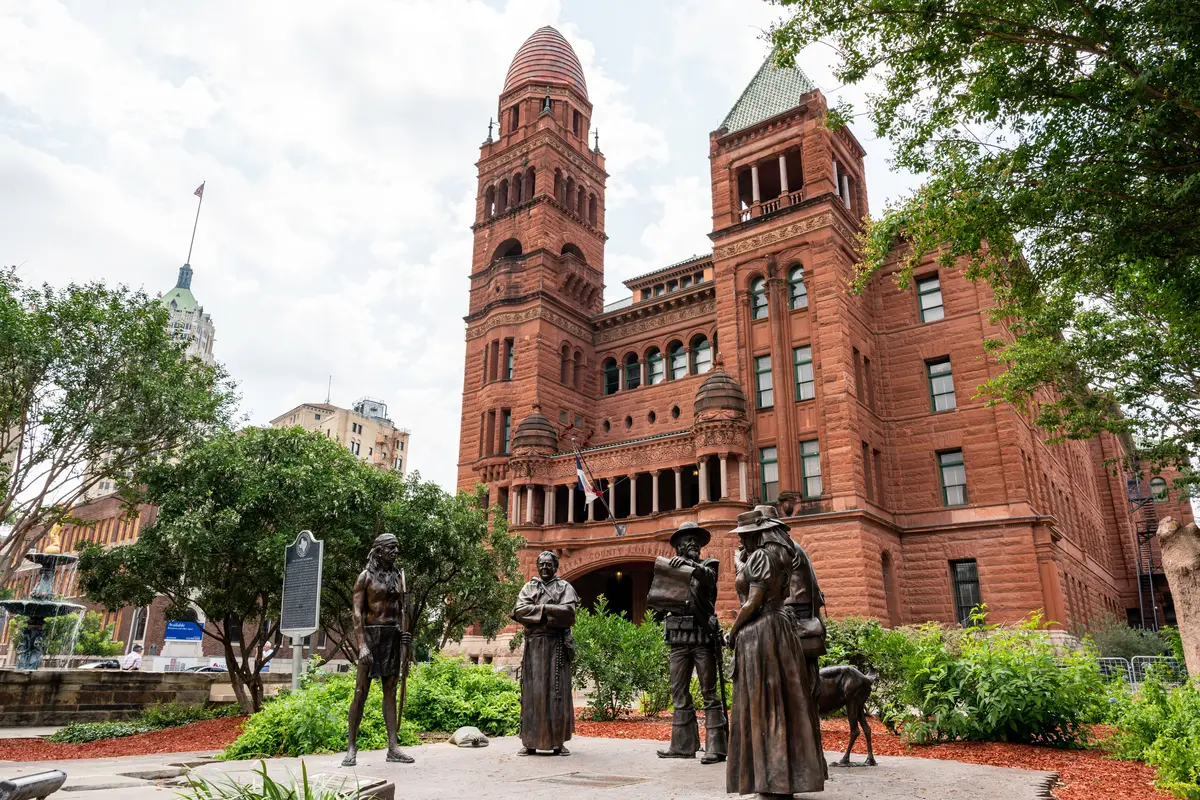
San Antonio at a Glance
Looking to buy in San Antonio? Estimate your payment.
Enter your numbers to see an estimated monthly mortgage payment.
Estimate only. Excludes HOA fees and mortgage insurance. The interest rate above is a starting point, not a quoted rate — replace it with your own to see real numbers. Insurance is a flat placeholder, not a San Antonio quote.
Why Are People Moving to San Antonio?
San Antonio added approximately 24,000 people between July 2023 and July 2024 alone — the fourth-highest numeric gain of any large city in the nation during that period. The metro as a whole grew by nearly 205,000 people between April 2020 and July 2024, and more than 121,000 of those arrivals came from other U.S. states. That is not the growth pattern of a city accidentally getting bigger — it is a place people are actively choosing.
The Military Anchor
Joint Base San Antonio is the single most important economic fact about this city for a relocating buyer to understand. The installation complex — spanning Lackland, Randolph, and Fort Sam Houston — accounts for roughly 15% of the metro's real economic output and drives a permanent, recession-resistant demand for housing across the south, east, and northeast sides. If you are PCS-ing here, you already know this. If you are a civilian buyer, it matters because military families cycle in and out continuously, which shapes the resale market in predictable ways.
Corporate and Financial Services Depth
H-E-B's corporate headquarters brings a concentration of professional employment that is easy to underestimate — it is not just a grocery company but one of the largest private employers in Texas by any measure. USAA adds a financial-services cluster that draws actuarial, tech, and finance professionals to the northwest side near the Medical Center corridor. Toyota's manufacturing presence on the far south side rounds out an employer mix that spans blue-collar production, professional services, and federal government in roughly equal measure.
The Affordability Pull
For buyers priced out of Austin — where typical home prices run noticeably higher — San Antonio is the most common landing spot. The same holds for remote workers arriving from California: the price gap between what they left behind and what they find here is significant enough to reset expectations entirely. That in-migration has kept demand steady even as construction accelerates in the outer suburbs. Neighboring New Braunfels, Schertz, and Boerne all carry typical home prices noticeably higher than San Antonio itself, which means the city core and its established inner suburbs remain the entry point for buyers who want a real house at a real price. See the full cost-of-living breakdown for how taxes, groceries, and utilities stack up.
Culture and History No Other Texas City Replicates
Approximately 64% of San Antonio's population identifies as Hispanic, and the city's founding in 1718 as a Spanish colonial outpost left an architectural, culinary, and civic identity that runs deeper than tourism. The San Antonio Missions National Historical Park — a UNESCO World Heritage Site — is not a backdrop; it is an active part of how the south side organizes itself. Newcomers from cities with a blander cultural texture tend to notice this within the first few months, and most consider it the city's most underrated selling point.
What Daily Life Feels Like in San Antonio
The Scale Takes Adjustment
San Antonio has 1,548,422 residents and the footprint to match. If you move here expecting the density and walkability of a midsize city, month three will be the adjustment. Most of the city's residential fabric is low-density and car-dependent — a morning run to the coffee shop is a drive, not a walk, for most neighborhoods. The downtown core, Southtown, and the Pearl District are genuine exceptions, but they represent a small slice of where most people actually live.
Summer Is a Real Commitment
San Antonio gets more than 220 sunny days a year, and from June through September, many of those days push past 100°F. Longtime residents structure summer life around air conditioning, early-morning outdoor time, and the River Walk's shade. Newcomers from the Pacific Northwest or the Midwest often underestimate this — not just the heat itself, but the way it compresses outdoor activity into the early morning and fall months. The flip side is that winters here are mild by any national standard, and that shoulder-season stretch from October through April is genuinely excellent.
Where Families Actually Gather
Brackenridge Park, which anchors the northern edge of the Museum Reach section of the River Walk, is the city's most consistent gathering place — weekend mornings bring families, cyclists, and dog walkers in numbers that reflect how central it is to north-central San Antonio life. McAllister Park on the northeast side draws the trail-running and mountain-biking crowd. Government Canyon State Natural Area on the far northwest is where people go when they need to feel like they have actually left the city.
Food, Coffee, and the Day-to-Day Texture
The independent dining scene here is one of the strongest in Texas for a city at this price point — a function of both the culinary traditions rooted in the city's Hispanic heritage and the influx of professional residents who expect more than chain restaurants. The Pearl Farmers Market runs through the warm months and draws a cross-section of the city's food culture in a single location. Independent coffee shops have expanded significantly across the midtown and north-central corridors in recent years, filling in a gap that chain options used to own by default.
The School Picture for Families
San Antonio Independent School District holds a C rating according to the Texas Education Agency, with 42,548 students enrolled in 2025-26. On 2024-25 state assessments, 27% of students reached math proficiency and 37% reached reading proficiency — figures that prompt many families with school-age children to research boundary lines carefully before buying. Several neighboring suburban districts consistently post stronger results; families weighing schools heavily often end up in communities like Schertz or along the northeast corridor. The full picture is on the schools page.
The San Antonio Housing Market Right Now
The typical home price in San Antonio sits at $249,689 (July 2026, Zillow Home Value Index) — a figure that still draws genuine surprise from buyers arriving from Austin, Dallas, or any coastal market. At the same time, the median household income of $65,056 falls short of what is needed to carry that purchase comfortably, so affordability here is real but not frictionless. For buyers whose income sits near that median, the math requires attention to property taxes — the effective rate runs approximately 1.55% — and the gap between qualifying and truly comfortable monthly payments.
What the Price Buys
At the city-wide typical price, buyers generally find a three-bedroom house on a reasonable lot in an established neighborhood — the kind of purchase that in Austin or Denver would require a dramatically higher budget. Entry-level buyers can find older construction in the south and east sides below the city median. Areas like Stone Oak, Monte Vista, and the Midtown cluster run above that figure, reflecting proximity to employers, walkability, and historic character respectively. The neighborhoods page walks through the character of each area in detail.
The Rental Market
City-wide typical rent runs $1,390 per month — a number that gives many arriving renters more breathing room than they expected. The rental stock is concentrated in midtown, the Medical Center corridor, and the newer apartment developments along the Loop 1604 outer ring. Demand from the consistent military rotation keeps the market from softening dramatically even during slower sales periods.
New Braunfels, Schertz, and the Suburban Premium
Buyers who widen their search to the suburbs quickly find that the affordability picture shifts. Both New Braunfels and Schertz carry typical home prices noticeably higher than San Antonio's city-wide figure — as does Boerne to the northwest. The suburban premium reflects newer construction, stronger school districts in some cases, and lower density. Whether that premium is worth it depends entirely on your employer, your commute tolerance, and whether school boundaries are a deciding factor for your household. The cost-of-living comparison is detailed on the cost-of-living page.
A Note on Safety
San Antonio carries a violent crime rate of 5.94 per 1,000 residents and a property crime rate of 46.24 per 1,000 residents — both above state and national averages. Those city-wide averages mask significant variation by neighborhood — the safety page breaks down where those numbers concentrate and which areas many buyers consider among the safer parts of the city.
San Antonio Neighborhoods
San Antonio has several distinct areas — each with its own character and appeal. Here’s a breakdown to help you narrow down where to focus your home search.
🏡 Stone Oak
Stone Oak is the north side's most established suburban enclave — planned, polished, and built around convenient access to the Medical Center corridor via US-281. It draws families focused on school district access and professionals who want newer construction without leaving the city limits.
🏠 Southtown / King William Historic District
Southtown anchors San Antonio's arts and independent dining identity, and the King William Historic District within it — 25 blocks of 19th-century architecture — gives it a physical character unlike anywhere else in the city. It suits buyers who want walkability, cultural texture, and older homes with genuine architectural detail.
🌳 Alamo Ranch
Alamo Ranch is the northwest side's primary new-construction destination — a master-planned community with a suburban infrastructure that draws families and first-time buyers who want modern floor plans and a shorter drive to the city's major theme-park corridor. The trade-off is a longer commute to downtown or the Medical Center.
🏘 Monte Vista
Monte Vista is one of San Antonio's most architecturally significant historic neighborhoods, with early 20th-century homes on tree-lined streets just north of downtown. It runs above the city median and attracts buyers who want proximity to the urban core without sacrificing lot size or neighborhood character.
🏔 Midtown (Tobin Hill / Five Points / Beacon Hill / Alta Vista)
The Midtown cluster sits directly north of downtown and has been the focal point of San Antonio's urban reinvestment — older bungalows and craftsman homes alongside the Pearl District's gravitational pull. It runs above the city median and draws younger professionals and buyers who prioritize on-foot access and neighborhood energy over suburban square footage.
🌆 The Pearl District
The Pearl District is built around the adaptive reuse of a historic brewery complex along the River Walk's Museum Reach, and it functions as the city's most concentrated live-work-dine neighborhood. It suits buyers and renters who want a genuinely walkable daily life and are willing to pay above the city median for it.
Pros & Cons of Living in San Antonio
The Pros
- Lower cost of living than Austin or Dallas with no state income tax
- Diverse job base anchored by military, healthcare, and financial services
- Deep cultural heritage, food scene, and year-round outdoor festivals
- Strong population and job growth
The Cons
- Property tax burden is among the higher combined rates in Texas
- Long, hot, humid summers with frequent 90s-plus highs
- Certain neighborhoods report violent and property crime rates above the national average
Getting Around & Commuting in San Antonio
The Freeway Reality
San Antonio's highway network is the skeleton the city is built around. I-35 carries the north-south spine, connecting the city to Austin and Laredo. I-10 runs east-west through the heart of the metro. I-37 angles southeast toward the port corridor. Loop 410 is the inner ring that most residents use for cross-city trips, and Loop 1604 is the outer ring that now functions as the main artery through the growing northwest and northeast suburbs. US-281 is the primary route through Stone Oak and toward the Medical Center; US-90 carries west-side traffic. The practical reality is that knowing your nearest on-ramp and your employer's location on this grid is one of the first things to figure out before you decide where to live.
Where the Congestion Actually Builds
The interchange where I-35 and I-10 meet near downtown is the city's most reliable chokepoint — weekday morning and evening rush hours there are not a surprise, they are a scheduling constraint. The stretch of US-281 through Stone Oak running south toward the Medical Center and downtown backs up predictably during school-year mornings. Buyers who work on the northwest side and consider buying in Stone Oak frequently discover that what looks like a short distance on a map translates to a frustrating daily grind.
VIA Metropolitan Transit
VIA Metropolitan Transit operates an extensive bus network across the city, with service concentrated along the corridors that matter most to commuters — downtown, the Medical Center, and the university campuses. The system is genuinely useful for workers whose employers sit along high-frequency routes. VIA has also planned a bus rapid transit expansion that, when complete, will link San Antonio International Airport through downtown in dedicated transit lanes — a project that broke ground in January 2025 and is intended to function as true rapid transit rather than a bus in mixed traffic.
The Airport
San Antonio International Airport (SAT) sits 8 miles from downtown — one of the shorter airport-to-downtown distances of any major Texas city — and handles direct service to most domestic hubs. Most residents on the north and northwest sides find it genuinely convenient. The airport's proximity also matters for the military population, which travels frequently on orders.
Commute Benchmarks
The reference commute from most residential neighborhoods to downtown is about 24 minutes under normal conditions — a figure that understates peak-hour reality on the most congested corridors but is reasonably accurate for mid-day or reverse commutes. Buyers choosing between inner-loop neighborhoods and the outer suburbs should add fifteen to twenty-five minutes to that baseline for anything beyond Loop 1604, particularly in the northwest growth corridor.
Schools in San Antonio
Families relocating to San Antonio have public, private, and higher-education options nearby. Here’s a quick overview.
🎓 School District
San Antonio Independent School District serves K–12 students across San Antonio and the surrounding area. Rated C (source: Texas Education Agency, 2025 A-F accountability rating (2024-25 school year)).
🏆 Graduation Rate
The 4-year high-school graduation rate here is approximately 85.5%.
📚 Higher Education
Texas’s public universities — the University of Texas at Austin, Texas A&M University, and the University of Houston — offer four-year degrees statewide, with one of the largest community college systems in the country (50+ public community college districts) providing two-year and workforce programs.
🌐 Online Learning
UT Austin Online and Texas A&M University Online offer fully accredited online degrees for remote learners across the state.
Safety in San Antonio
A quick look at how San Antonio compares on the numbers that matter most when weighing a neighborhood or a move.
🛡 Violent Crime
Approximately 5.94 per 1,000 residents.
🔒 Property Crime
Approximately 46.24 per 1,000 residents.
Compared to the most recent national figures from the Bureau of Justice Statistics (2024), San Antonio’s violent crime is above the national average (about 3.7 per 1,000), and property crime is above the national average (about 18.4 per 1,000).
Against Texas as a whole, San Antonio’s violent crime is about one and a half times the state average, and property crime is about double the state average (Bureau of Justice Statistics, Crime Known to Law Enforcement, 2024 (tables 2 and 3)).
Crime rates can vary a lot within a single city, so the citywide numbers above are only a starting point. Some neighborhoods in San Antonio run well below these averages, while others run higher — the kind of block-by-block detail that matters most when you’re actually choosing where to live. The full guide below breaks it down neighborhood by neighborhood.
Working in San Antonio
San Antonio’s largest employers span several industries — here are some of the anchors of the local job market.
🏛 Joint Base San Antonio
Military
🛒 H-E-B
Retail, corporate headquarters
🏦 USAA
Financial services
🏥 University Health
Healthcare
🏥 Methodist Healthcare System
Healthcare
🏭 Toyota Motor Manufacturing Texas
Automotive manufacturing
Parks & Recreation in San Antonio
Some of the outdoor spaces that shape everyday life in San Antonio.
🌱 San Antonio River Walk
🌱 San Antonio Missions National Historical Park
San Antonio residents don’t have to go far for green space — spots like San Antonio River Walk and San Antonio Missions National Historical Park are part of everyday life here, whether that’s a morning walk, a weekend hike, or just somewhere to unwind outside. The full guide below covers more of what San Antonio has to offer for parks and outdoor recreation.

Retiring in San Antonio
San Antonio draws retirees for its balance of amenities, outdoor access, and cost. Here’s what to weigh.
🌤 Climate
San Antonio gets more than 220 sunny days a year, with mild winters that rarely see freezing temperatures for more than a few days at a stretch. Summers run long and hot — June through September regularly pushes past 100°F — but the spring and fall shoulder seasons from October through April are genuinely comfortable and draw retirees outdoors consistently.
🍴 Lifestyle
The River Walk, the Missions, Brackenridge Park, and the Pearl District give retirees a daily activity circuit that most cities can't match at this price point. The independent dining scene runs deep, and the city's Hispanic cultural heritage means a food and festival calendar that stays active year-round. A major regional arts and museum presence anchors the Museum Reach corridor.
🏚 55+ Communities
No 55+ communities were found in San Antonio. Retirees here typically choose among established single-family neighborhoods, midtown condos, or newer construction on the outer ring — often in areas like Stone Oak or the northwest corridor — rather than age-restricted developments.
✈ Getting Around
Most daily mobility in San Antonio requires a car, though the inner-city neighborhoods and River Walk corridor are genuinely manageable on foot. San Antonio International Airport sits just 8 miles from downtown and handles direct service to most major domestic hubs — a meaningful convenience for retirees who travel to see family.
🏛 Texas Taxes for Retirees — What to Know
- No state income tax — Texas has no personal income tax — constitutionally protected under Article VIII, Section 24. Social Security, pensions, 401(k)/IRA withdrawals, and annuity payments are all untaxed at the state level, with no state return to file.
- Sales tax is the tradeoff — The state sales tax is 6.25%, and local add-ons bring the combined rate in San Antonio to 8.25% (Texas Comptroller of Public Accounts, city sales and use tax rates, July 2026). Groceries and prescription drugs are exempt.
- Property taxes — the real tradeoff — Texas’s effective property tax rate averages about 1.40%, among the highest in the country, since property tax (not income tax) funds most local government and schools.
- Over-65 homestead exemption and school-tax freeze — Homeowners 65+ (or disabled) get an additional $60,000 exemption from their home’s value for school district taxes, on top of the general homestead exemption — $200,000 off school taxable value combined, following November 2025’s Proposition 11 (SB 23), which raised the over-65 exemption to $60,000, and Proposition 13 (SB 4), which raised the general homestead exemption to $140,000. Once claimed, your school district tax bill is frozen at that year’s amount and cannot increase as home values rise, and the ceiling can transfer if you move to a new home within Texas.
- Deferral option if cash is tight — Homeowners 65+ can defer property tax payment entirely for as long as they live in the home, rather than paying it currently — interest accrues, but no forced sale.
- No estate or inheritance tax — Texas has no estate tax, no inheritance tax, and no gift tax.
- No separate capital gains tax — Because Texas has no state income tax, capital gains — including on investments and home sales — are not taxed at the state level at all, unlike states such as Washington that tax capital gains separately from income.
Tax laws change frequently and individual situations vary. This is general information, not tax advice — always consult a qualified Texas tax professional or CPA for personalized retirement tax planning.
Weekends & Local Favorites in San Antonio
The River Walk and the Missions
The San Antonio River Walk is not merely a tourist attraction — it is where a significant portion of the city's dining, evening, and weekend social life happens, and it connects the Museum Reach to the south without requiring a car. Locals who claim to be over it usually end up back there by October, when the weather returns and the crowds thin. The San Antonio Missions National Historical Park gives the south side an anchor that most neighborhoods in American cities would envy — walking or cycling the Mission Reach section of the River Walk between Mission Concepción and Mission Espada is one of the city's genuinely great free afternoons.
Parks That Go Beyond the Obvious
Brackenridge Park is the city's central green space, and it earns the reputation. Eisenhower Park on the northwest side offers limestone canyon trails that feel nothing like the flat Texas stereotype. Government Canyon State Natural Area, farther northwest, is where hikers and trail runners go when they want mileage and solitude. McAllister Park on the northeast side has become the de facto mountain biking destination for the city's growing cycling community.
Where to Eat and Drink
Mi Tierra Cafe y Panaderia has operated in Market Square for decades and remains the city's most iconic around-the-clock dining institution — the kind of place that has fed multiple generations of San Antonio families and has the bakery cases to prove it. Boudro's on the Riverwalk is the local benchmark for upscale Texas cuisine on the river, known specifically for its tableside guacamole. Chama Gaúcha Brazilian Steakhouse brings the full churrascaria experience and draws a consistent crowd from the military and professional communities alike. Domingo Restaurant represents the more contemporary, ingredient-focused side of San Antonio's dining scene.
Coffee Worth Knowing
Local Coffee has become the city's most consistent independent café brand, with multiple locations across the north side and midtown. Early Bird Coffee draws the pre-work crowd with a strong espresso program. What's Brewing Coffee Roasters brings a roaster-focused sensibility to the scene, and Theory Coffee Company has built a following among the creative and tech-adjacent professional community. PRESS Coffee @ The Boardwalk fills a distinct niche at the development anchoring the northwest growth corridor.
The Pearl
The Pearl District — anchored by the Pearl Farmers Market — has become the clearest sign of how much San Antonio's urban core has changed in the past decade. The market itself draws a weekly cross-section of the city's food culture, and the surrounding development has brought independent restaurants, coffee, and retail into a walkable cluster that the city's neighborhoods page covers in detail. For buyers considering a move to San Antonio, spending a weekend morning at the Pearl before committing to a neighborhood is genuinely informative — the crowd alone tells you something about who the city is becoming.
Local favorites in San Antonio
Restaurants
- Mi Tierra Cafe y Panaderia
- Chama Gaúcha Brazilian Steakhouse - San Antonio
- Rainforest Cafe
- Domingo Restaurant
- Boudro's on the Riverwalk
Outdoors
- San Antonio River Walk
- Brackenridge Park
- Government Canyon State Natural Area
- McAllister Park
- Eisenhower Park
Coffee
- Early Bird Coffee
- Local Coffee
- PRESS Coffee @ The Boardwalk
- What's Brewing Coffee Roasters
- Theory Coffee Company
Farmers Markets
- Pearl Farmers Market
Top Things Locals Say About San Antonio
The best intel about a city comes from the people who actually live there. Here’s what San Antonio residents say when newcomers ask the questions everyone’s thinking.
“I knew San Antonio was affordable, but I didn't expect Loop 410 to feel like the dividing line it does. Everything inside it has a different energy from what's outside — and I bought outside without fully understanding what that meant for my daily drive until I was already doing it.”
— Recent San Antonio home buyer
“What's the most surprising thing about living in San Antonio?”
How different the sides of the city feel from each other. The northwest side around the Medical Center and Stone Oak operates almost like a separate city from the south side near the Missions. People who move here thinking they're buying into one San Antonio discover pretty quickly that where you land on the Loop 410 and Loop 1604 grid shapes almost everything about your daily life — where you shop, where your kids go to school, how long your commute is.
“What do locals love most about San Antonio?”
The food culture and the history, in that order. Mi Tierra at Market Square at midnight, the Mission Reach trail on a cool October morning, the Pearl Farmers Market on a weekend — those are the things that make people who left actually miss the city. There is also something genuine about a place where 300 years of history is not curated for visitors but is just how the city is built.
“What should newcomers to San Antonio know?”
Research your school district boundaries before you pick a neighborhood, not after. The difference between one side of a street and another can mean a completely different district, and San Antonio ISD's performance metrics are noticeably different from several of the surrounding suburban districts. Also: the summer heat is longer and more intense than people expect — late May through early October is the real stretch, not just July and August.
“How much do you need a car in San Antonio?”
For almost everything outside the River Walk, Pearl District, and Southtown, you need a car. Most errands, school runs, and commutes require one. VIA's bus network covers a lot of ground and is genuinely useful for certain downtown and Medical Center commutes, but the city's residential footprint is sprawling enough that daily life for most households means a car in the driveway.
Cities Near San Antonio
Other communities near San Antonio worth a look — each with its own character and price point.
| City | Distance | Best For | Vibe | Median Rent | Median Buy |
|---|---|---|---|---|---|
| New Braunfels | 30 mi | Families, river lifestyle, newer homes | Fast-growing, Hill Country edge, spacious | $1,566 | $351,190 |
| Schertz | 20 mi | Military families, suburban amenities | Established, northeast corridor, quiet | $1,942 | $315,578 |
| Boerne | 32 mi | Hill Country feel, professionals, retirees | Scenic, small-town texture, upscale | $1,501 | $562,046 |
More Helpful Guides for San Antonio
Going deeper on San Antonio? Our blog series covers everything from first-time buying to retiring here — explore the guides below.
Local Expert Takeaway: San Antonio's affordability advantage is real — a typical home at $249,689 (July 2026) in a city of 1.5 million with a diversified employer base is genuinely rare in modern Texas. But the city rewards buyers who do their homework on three specifics: which side of Loop 1604 they are buying on and what that means for their commute, which school district boundaries their address falls inside, and whether their household income sits comfortably above what the mortgage and 1.55% property tax rate actually require each month. Get those three right and San Antonio delivers on its promise. Skip them and the monthly budget surprise arrives around month four.
Quick Takeaways & FAQs
✅ San Antonio's typical home price of $249,689 (July 2026) is one of the lowest among major Texas metros, making ownership genuinely accessible compared to Austin or Dallas.
⚠️ Property crime runs well above both state and national averages city-wide — neighborhood selection matters significantly more here than in most comparable metros.
📍 Joint Base San Antonio is the city's largest economic anchor, and its influence on neighborhood demand, resale velocity, and renter composition is felt across the south, east, and northeast sides.
Is San Antonio affordable compared to other Texas cities?
What are the best neighborhoods in San Antonio for families?
How bad is traffic in San Antonio?
What is the job market like in San Antonio?
Does San Antonio have public transit?
Helpful Links for Moving to San Antonio
Moving to Texas?
Tell us what you need help with and we'll connect you with local resources.
