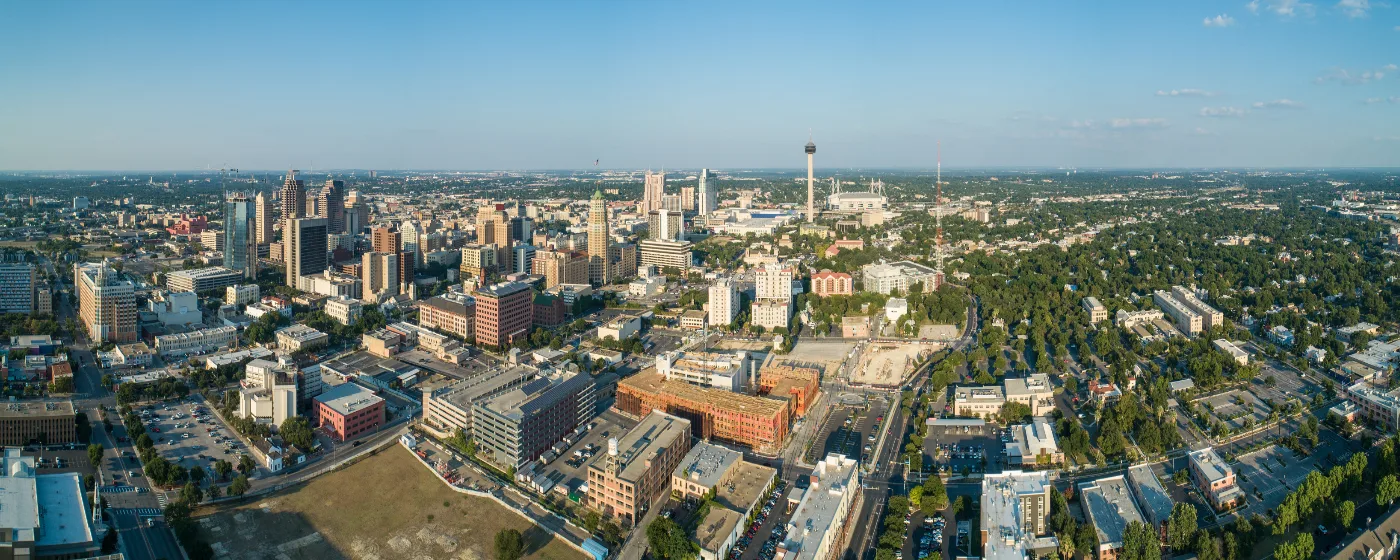
If you're choosing between staying in California and making the move to San Antonio, the decision usually comes down to one thing: how much of your income you want to keep. The tax math is stark — Texas has no state income tax, period, written into the state constitution — and the home price gap is the kind of number that makes Californians pull out their calculators and double-check it. But the move is not just a financial arbitrage. San Antonio is a city of 1,548,422 people, the 2nd-largest incorporated city in Texas, sprawling across Bexar County with five interstates and multiple loops threading through it. The highways, the heat, the scale of the place — none of it feels like the California you left.
The economic base here is unlike anything in the California markets most people are moving from. Joint Base San Antonio anchors a massive federal and military presence. H-E-B, the regional grocery giant, is headquartered downtown and is a genuine civic institution. USAA runs its financial services operations out of the city. Toyota assembles trucks here. That employment diversity is one reason San Antonio's job market has stayed relatively stable — and why the city keeps drawing relocating families, remote workers cashing out California equity, and retirees looking to stretch a fixed income considerably farther. The San Antonio Independent School District, with 42,548 students enrolled in 2025-26, holds a C rating, according to the Texas Education Agency, which matters for families with school-age children considering the move.
The typical San Antonio home was priced at $249,689 (Zillow ZHVI, July 2026). Set that against California's statewide typical home value of $773,735 and you're looking at a gap that changes what kind of house you can buy, how large a down payment you can carry, and how much financial flexibility you have after closing. Renters see the same dynamic: San Antonio's city-wide typical rent runs at $1,390 per month, roughly half the California statewide average on the same Zillow basis. The trade-off — and there is one — is that San Antonio's property tax rate at 1.55% effective is meaningfully higher than what California homeowners were paying, which adjusts the monthly ownership math more than the purchase price alone suggests.
Whether you're weighing a relocation offer, escaping California's cost structure, or simply doing the research before making a decision, the sections below break down the home price and tax comparison, what the daily lifestyle shift actually looks like, what the climate will do to your routine, where people tend to land in the city, and what Californians consistently say they didn't expect after six months here.

The Home Price and Tax Math: What California Buyers Find Here
The number that stops most Californians mid-sentence is the home price. San Antonio's typical home was priced at $249,689 as of July 2026 — measured on the Zillow Home Value Index, the same series as California's statewide typical home value of $773,735. That is not a comparison between different data sources or different months. These figures come from the same methodology, and the gap between them is real.
What that means practically: California equity — even from a modest starter home — can often land you a significantly larger or better-located property in San Antonio outright, or with a much smaller loan. Neighborhoods running above the city median, like Stone Oak in the far north or Monte Vista near the urban core, still sit at a level that many Californians find reasonable against what they were spending in the Bay Area, San Diego, or Los Angeles.
The Property Tax Reality Check
Here is the adjustment Californians consistently underestimate. California's effective property tax rate of 0.71% — held low by Proposition 13's assessed-value limits — is less than half of San Antonio's effective rate of 1.55%. On a $249,689 home, that difference is real money every year, and it narrows the monthly cost advantage that the purchase price alone implies. You are not paying California property taxes on a $773,735 home, but you are paying a meaningfully higher rate on whatever you buy here. Factor that into your budget before you fall in love with the sticker price.
Income Tax: The Number That Surprises Everyone
Texas levies no state income tax — it is constitutionally prohibited. California's top state income tax rate of 13.3% applies only to the highest earners, but even at moderate incomes the difference is significant: a household earning $100,000 saves roughly $5,200 per year in state income tax by moving to Texas. For dual-income households or anyone in a professional role, the annual savings compound quickly.
Sales Tax: Closer Than You'd Think
San Antonio's combined sales tax rate is 8.25%, built from Texas's 6.25% state base plus local and transit add-ons. California's statewide base sales tax rate of 7.25% can reach 10.75% with local add-ons — above San Antonio's ceiling. Groceries and most prescription medications are exempt from Texas sales tax, which matters for family budgets. Gas is where the gap is most visible day-to-day: California charges roughly 70.9 cents per gallon in state gas tax versus roughly 20 cents in Texas. In a car-dependent city where you will be driving the interstates and loops regularly, that differential adds up fast.
| Category | San Antonio, TX | California Statewide |
|---|---|---|
| Typical home value | $249,689 (Zillow ZHVI, July 2026) | $773,735 (Zillow ZHVI, statewide) |
| Effective property tax rate | 1.55% | 0.71% |
| State income tax | None (constitutionally prohibited) | Top rate 13.3% |
| Base sales tax rate | 8.25% combined (groceries exempt) | 7.25% base (up to 10.75% with local add-ons) |
| Gas tax per gallon | ~$0.20 | ~$0.71 |
| Typical city-wide rent | $1,390/mo (Zillow ZORI, July 2026) | ~$2,695/mo (Zillow basis, statewide avg) |
The overall picture is a genuine cost-of-living reduction for most California households. Health insurance premiums tend to run noticeably below California levels as well, though the trade-off is that access to certain specialist care may require more planning than you were used to.
What the Climate Will Actually Do to You
Most Californians moving to San Antonio are prepared for heat in the abstract. They are not prepared for what 116 days per year at or above 90°F feels like when the humidity arrives. San Antonio's climate is humid subtropical — January highs average around 64°F and winters are mild by almost any standard — but summers are a different category of experience than dry inland California heat or coastal marine layer.
August highs peak near 96–97°F, and the humidity makes the air feel heavier and the heat more draining than the same temperature on a California thermometer. Californians who grew up in Sacramento or the Inland Empire have some reference point. Those coming from San Francisco or coastal San Diego are in for genuine culture shock from roughly May through September.
What the Rainfall Means for Your Routine
San Antonio averages about 34 inches of rainfall per year, concentrated in May and September. Thunderstorms arrive fast, dump hard, and move on — not the slow coastal drizzle some Californians expect from "rain." The city's drainage system has improved, but heavy rainfall events can flash-flood low-lying roads quickly, and knowing which routes to avoid in a downpour is the kind of local knowledge that takes one bad experience to learn.
The honest upside: San Antonio averages 220 sunny days a year. Winters are genuinely pleasant, and the spring and fall shoulder seasons — roughly March through April, and October through November — are when the city is at its best. Outdoor life shifts around the calendar in a way Californians tend to find unfamiliar at first and then quietly appreciate.
What Surprises People After Six Months
The thing most California transplants don't mention in the early weeks but bring up consistently later: you stop going outside in the middle of the day from June through August. Not because there's nothing to do — Brackenridge Park, McAllister Park, Government Canyon State Natural Area, and Eisenhower Park all exist — but because the heat window in high summer shrinks the outdoor day to early morning and after 7 p.m. Planning around that rhythm takes adjustment for anyone used to California's year-round outdoor access.
Daily Life and Getting Around San Antonio
San Antonio is built for driving. The highway grid — I-10, I-35, I-37, US-281, Loop 410, and Loop 1604 — connects the city's sprawl, and most residents structure their lives around car access rather than walkable streets. If you're coming from a California neighborhood where you walked to coffee and groceries, adjusting to this takes longer than the financial adjustment does.
The flipside is that San Antonio International Airport (SAT) is 8 miles from downtown, which is the kind of proximity that makes spontaneous travel genuinely easy. You will not spend 90 minutes fighting your way to a major airport the way many Californians do.
Childcare, Groceries, and the Everyday Budget
For families with young children, the childcare cost difference is one of the largest line-item changes in the budget. Infant center-based care in Texas averages roughly $900–$1,500 per month, compared with $1,700–$2,200 per month in California. Annualized, that gap funds a meaningful portion of a mortgage payment or a school savings account.
Groceries in San Antonio benefit from H-E-B's market dominance in ways that are genuinely hard to explain to someone who hasn't shopped there. The chain is headquartered here, takes the local market seriously, and keeps prices competitive. It is not the same experience as a California chain, and most transplants say so unprompted by six weeks in.
The Neighborhoods California Buyers Land In
Stone Oak in the far north draws families with school-age children looking for newer construction and quieter streets — it runs above the city median and is one of the most popular landing spots for relocating households. Monte Vista, which also runs above the city median, and the Midtown cluster (Tobin Hill, Five Points, Beacon Hill, Alta Vista) appeal to buyers who want older architecture, walkable streets within their immediate block, and proximity to the urban core. Alamo Ranch on the northwest side and the Northwest Side near the medical district offer more entry-level options at or closer to the city-wide typical price. The Dominion, in the northwest, is the city's high-end enclave. For a fuller breakdown of where each neighborhood sits and who it suits best, see the San Antonio neighborhoods guide.
Looking to buy in San Antonio? Estimate your payment.
Enter your numbers to see an estimated monthly mortgage payment.
Estimate only. Excludes HOA fees and mortgage insurance. The interest rate above is a starting point, not a quoted rate — replace it with your own to see real numbers. Insurance is a flat placeholder, not a San Antonio quote.
The Cultural and Lifestyle Shift Californians Don't Anticipate
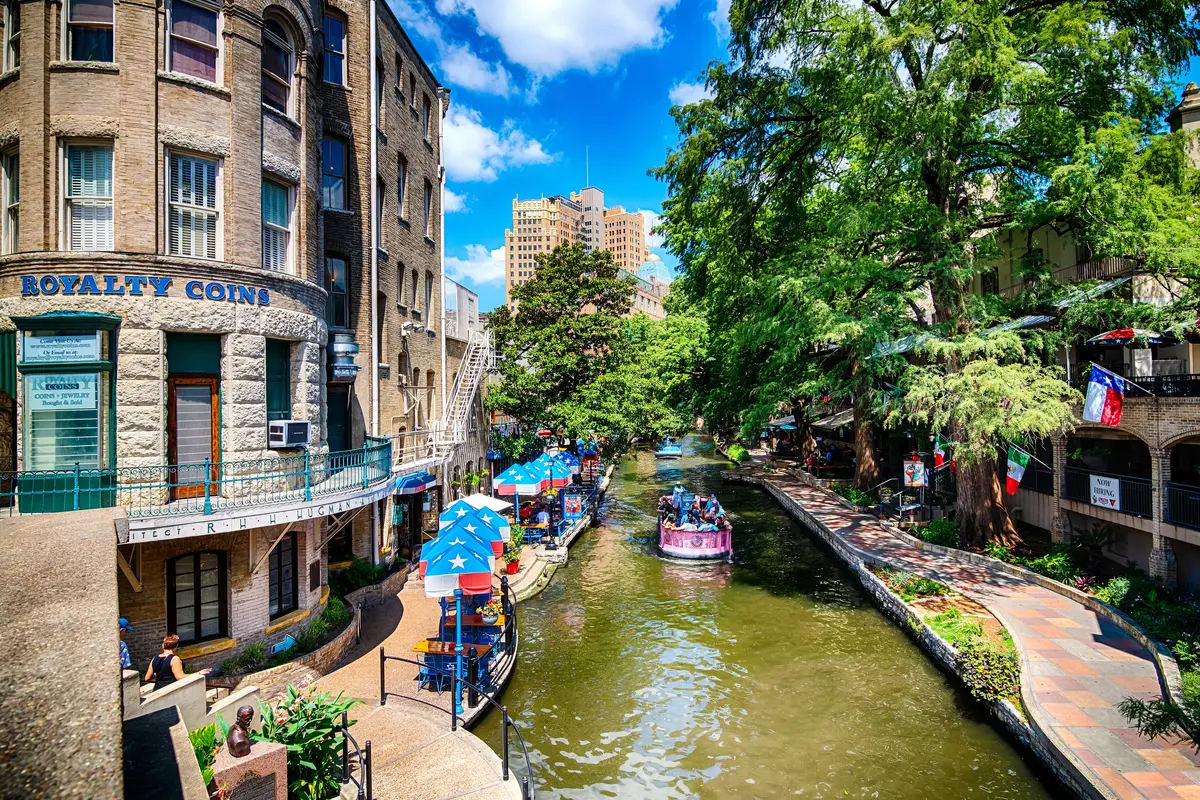
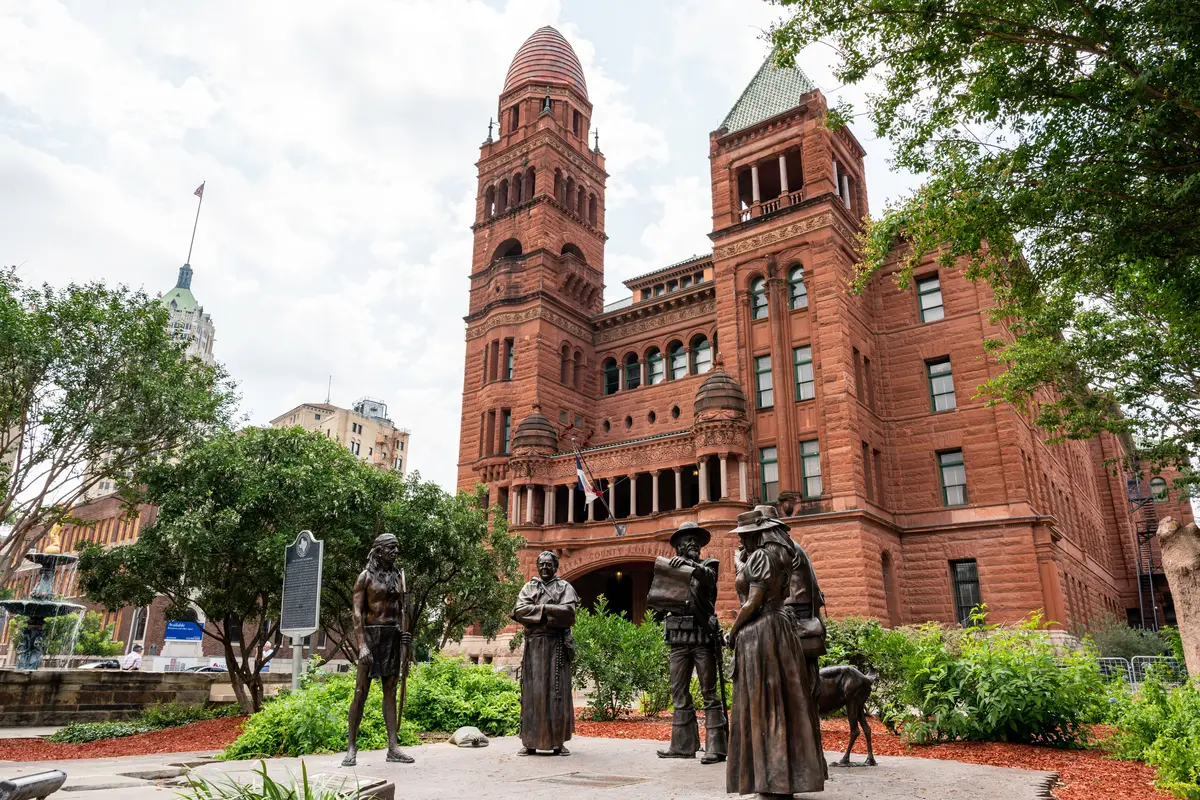
San Antonio is not Austin. That distinction matters more than it might seem from a California vantage point. Where Austin markets itself on counterculture and newness, San Antonio's identity runs through military history, deep Mexican-American cultural roots, and civic institutions that predate Texas statehood. The Alamo sits in the middle of downtown. San Antonio Missions National Historical Park stretches along the river. The River Walk is not a theme park addition — it is genuinely where the city gathers, and the Pearl District nearby has become a civic anchor in its own right.
Expect a slower pace in the way people move through the day, a genuinely warm default friendliness, and a food culture that doesn't feel like it needs to explain itself to anyone. Mi Tierra Cafe y Panaderia has been open around the clock for decades and functions as a civic institution as much as a restaurant. Boudro's on the Riverwalk, Chama Gaúcha Brazilian Steakhouse, Domingo Restaurant — the dining scene spans registers. The independent café scene is well established, and the Pearl Farmers Market is where a significant cross-section of the city shows up on weekend mornings through the growing season.
What Californians Say They Didn't Expect
The political and cultural environment in Texas is genuinely different from California — not in ways that are hard to summarize, but in ways that take daily texture to feel. Gun culture, the pace of government services, the size and scale of the evangelical church presence, the way Friday night UIL football operates as a community event rather than a spectator sport — these aren't talking points, they're the background of daily life here. Most California transplants say they adjusted faster than they expected. Some don't adjust at all and move back. Being honest with yourself about which category you're in before the move costs less than discovering it after.
Why People Move Back to California
The people who leave San Antonio after a year or two usually cite one of two things: the summers turned out to be more limiting than anticipated, or the cultural distance from California's coastal environment — the arts scene, the outdoor recreation variety, the proximity to the ocean — was larger than the financial savings felt worth. Neither is a failure of San Antonio. They are honest mismatches, and knowing about them before you move is exactly the point.
What the Job Market Looks Like for California Transplants
San Antonio's employment base is unusually diversified for a Texas metro. Joint Base San Antonio supports a sprawling military and federal contractor ecosystem that insulates the local economy from private-sector cycles in ways other Texas cities don't have. USAA runs significant financial services and technology operations here. The Toyota manufacturing plant in the north of the city represents a major industrial anchor. Regional health systems add substantial institutional employment. For a full breakdown of the employer landscape, the living in San Antonio hub goes deeper on the job market.
The metro unemployment rate stood at 4.7% as of July 2026. Texas A&M projected San Antonio to lead major Texas metros in job additions for 2025, with education and health services, construction, and government as the lead sectors.
For Remote Workers and California Equity Buyers
A substantial share of California transplants arrive not because of a local job offer but because they're bringing a remote income and want to deploy California equity into a meaningfully lower cost base. The math supports it clearly. What the math doesn't tell you is that remote work in a car-dependent city with hot summers requires intentional community-building — the casual geographic proximity that made California's coffee-shop-and-park social life work doesn't replicate automatically here. The people who build a life in San Antonio quickly are usually the ones who attach themselves to something — a neighborhood, a civic institution, a church, a sports league — rather than waiting for the city to come to them.
Families with school-age children face one genuine consideration: the San Antonio Independent School District holds a C rating, according to the Texas Education Agency, and on 2024-25 state assessments, 27% of students reached math proficiency and 37% reached reading proficiency. Many relocating families land in Stone Oak or Alamo Ranch partly because those areas fall under different district boundaries with different performance profiles. The San Antonio schools guide maps the district boundaries and what they mean for buyers in specific neighborhoods.
Local Expert Takeaway: The financial case for moving from California to San Antonio is real and substantial — no state income tax, a typical home price at $249,689 (July 2026) against California's statewide typical home value of $773,735, and a gas tax less than a third of what you were paying. The adjustments that catch people off guard are not the ones on the spreadsheet: it's the August humidity at 97°F that shrinks your outdoor day, the property tax rate that lands higher than California's Prop 13 baseline, and the cultural distance from the coastal California environment that some transplants find they miss more than they expected. Go in with clear eyes on both columns, and San Antonio is one of the most livable large cities in the country at this price point.
Quick Takeaways & FAQs
✅ Texas has no state income tax — a household earning $100,000 saves roughly $5,200 per year compared to California, and the savings compound significantly at higher incomes.
⚠️ San Antonio's effective property tax rate of 1.55% is more than double California's effective rate of 0.71%, which meaningfully adjusts the monthly ownership cost beyond what the purchase price alone suggests.
📍 The Pearl Farmers Market, the River Walk, and the city's deep Mexican-American food culture give San Antonio a civic identity that takes time to find but rewards the effort — this is not a city that feels like a generic suburb once you know where to look.
How much cheaper is it to buy a home in San Antonio compared to California?
Do I really save that much on income taxes by moving from California to Texas?
What is the climate like in San Antonio for someone moving from California?
Which San Antonio neighborhoods do California transplants typically consider?
What do California transplants say they didn't expect about living in San Antonio?
Moving to Texas?
Tell us what you need help with and we'll connect you with local resources.
