Willamette Valley · Cost of Living · 2026
Cost of Living in Willamette Valley, Oregon: Every City Ranked
Ranked by how far a dollar stretches across housing, wages, and everyday expenses in each Willamette Valley community.
Ranked by how far a dollar stretches across housing, wages, and everyday expenses in each Willamette Valley community.
If you're weighing a move to the Willamette Valley, you've probably already noticed that 'Oregon is expensive' and 'Oregon is affordable' are both true at the same time, depending entirely on which city you're looking at. The valley stretches from the Clackamas County foothills south past Eugene and Lane County's agricultural edge, and it includes state-capital amenities, university towns, wine-country cachet, and small working cities that most out-of-state buyers have never heard of. The interstate and a web of state highways tie them together, but the cost gap between towns is far wider than the geography suggests.
What drives cost here is less about square footage and more about what surrounds a city: proximity to Salem's government employment, Eugene's university economy, the Willamette wine country pull on places like McMinnville, and the simple rural-town reality of cities like Lebanon, Cottage Grove, and Stayton. Towns with fewer services, smaller job bases, and longer commutes to major employment tend to carry lower home prices — though that trade-off shows up clearly in daily life. The sections below break down what each city actually costs, who tends to thrive there, and what the real financial picture looks like beyond the headline number.
All prices reflect 2026 market data sourced from Zillow and cross-referenced with our individual city guides. County tax rates are verified effective rates.
Ranked by overall affordability. Click any city to jump to the full breakdown.
| # | City | Home Price | Monthly PITI | Income to Buy | Est. Rent |
|---|---|---|---|---|---|
| 1 | Lebanon Linn County | $397,559 | $2,472/mo | $106,322/yr | $1,450/mo |
| 2 | Cottage Grove Lane County | $405,035 | $2,485/mo | $107,637/yr | $1,400/mo |
| 3 | Independence Polk County | $430,520 | $2,684/mo | $108,599/yr | $1,750/mo |
| 4 | Stayton Marion County | $471,759 | $2,902/mo | $109,484/yr | $1,273/mo |
| 5 | Woodburn Marion County | $429,908 | $2,698/mo | $111,202/yr | $1,617/mo |
| 6 | Springfield Lane County | $421,652 | $2,587/mo | $111,222/yr | $1,450/mo |
| 7 | Albany Linn County | $439,047 | $2,767/mo | $113,911/yr | $1,476/mo |
| 8 | Dallas Polk County | $481,280 | $2,973/mo | $114,644/yr | $1,300/mo |
| 9 | Salem Marion County | $440,726 | $2,711/mo | $116,793/yr | $1,400/mo |
| 10 | Keizer Marion County | $453,552 | $2,824/mo | $117,901/yr | $1,500/mo |
| 11 | McMinnville Yamhill County | $488,040 | $2,966/mo | $122,953/yr | $1,484/mo |
| 12 | Monmouth Polk County | $480,666 | $2,969/mo | $123,673/yr | $1,400/mo |
| 13 | Junction City Lane County | $489,162 | $3,001/mo | $125,997/yr | $1,450/mo |
| 14 | Eugene Lane County | $482,062 | $3,030/mo | $128,282/yr | $1,795/mo |
| 15 | Molalla Clackamas County | $499,534 | $3,144/mo | $134,640/yr | $1,550/mo |
| 16 | Philomath Benton County | $529,921 | $3,331/mo | $136,897/yr | $1,560/mo |
| 17 | Newberg Yamhill County | $535,028 | $3,251/mo | $140,037/yr | $1,650/mo |
| 18 | Corvallis Benton County | $565,289 | $3,553/mo | $143,870/yr | $1,800/mo |
| 19 | Silverton Marion County | $557,308 | $3,428/mo | $145,506/yr | $1,560/mo |
| 20 | Dundee Yamhill County | $598,118 | $3,635/mo | $162,276/yr | $1,650/mo |

#1 Most Affordable · Linn County
Best for buyers who want real affordability and a working-town pace.
Lebanon sits along US-20 (Santiam Highway) and OR-34 (Corvallis-Lebanon Highway) in Linn County, a working-class small city with a manufacturing and timber heritage that still defines its economic identity. A $397,559 typical home price reflects a place where locals work in trades, light industry, and healthcare support roles — not a bedroom community that borrowed affordability from a larger neighbor. The flip side is limited in-town amenities and a job market that rewards blue-collar skills more than white-collar credentials.
Lebanon suits buyers who want genuine affordability and don't need to be within walking distance of much. It tends to attract tradespeople, retirees on fixed incomes, and buyers priced out of Albany or Corvallis who are willing to drive for work or shopping. If your income is local and your expectations are practical, Lebanon delivers.
#2 Southern Valley Mill Town · Lane County
Best for remote workers and retirees who want small-town Lane County.
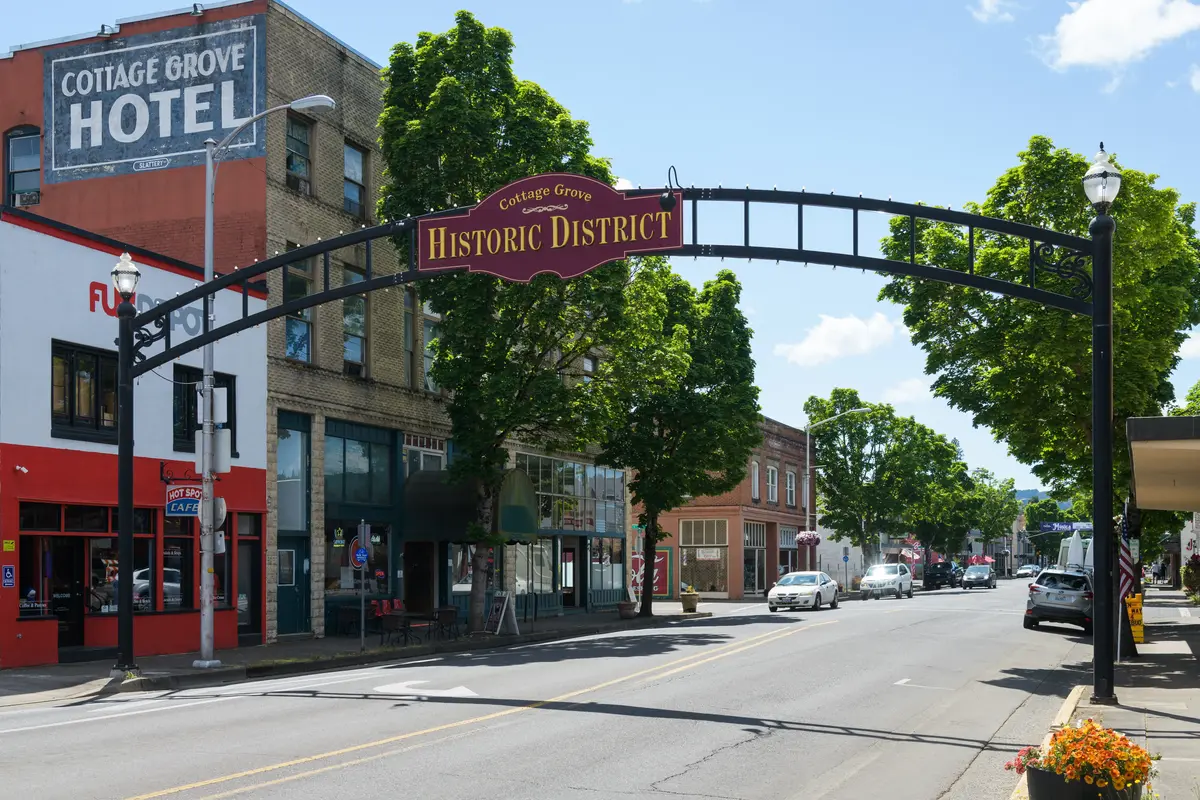
Cottage Grove anchors the southern end of Lane County along I-5 and OR-99 (Pacific Highway), close enough to Eugene's economy to benefit from it but far enough to hold onto its own slower pace and working-town identity. A $405,035 typical home price is driven by a mix of retirees, remote workers, and tradespeople who'd rather not pay Eugene prices for a house they'll mostly use as a home base.
The honest trade-off is that Cottage Grove's own job market is thin — most professional employment means commuting north. But for buyers who work remotely, or who have a job already lined up in Eugene, the cost difference compared to living in-city is meaningful and the small-town environment is genuinely appealing.

#3 Hop Country River Town · Polk County
Best for buyers who want a walkable river-town feel at a mid-range price.
Independence is a compact Polk County river town on OR-51, with a genuine downtown, a hop-farming history, and an increasingly artisan economic character that makes it feel a little different from its neighbors. A $430,520 typical home price sits above the valley's most rural towns, reflecting a community that has invested in its walkable core and draws buyers who want small-town livability without complete isolation.
Independence tends to suit buyers who value a real sense of place over pure cost efficiency — a walkable main street, proximity to Salem's employment, and a community identity that feels intentional rather than incidental. It compares favorably to nearby Monmouth for buyers who want more life outside the house, and to Dallas for those who want to stay connected to the mid-valley's cultural spine.
#4 Lowest Rent · Marion County
Best for buyers seeking Cascade foothills quiet with Salem within reach.
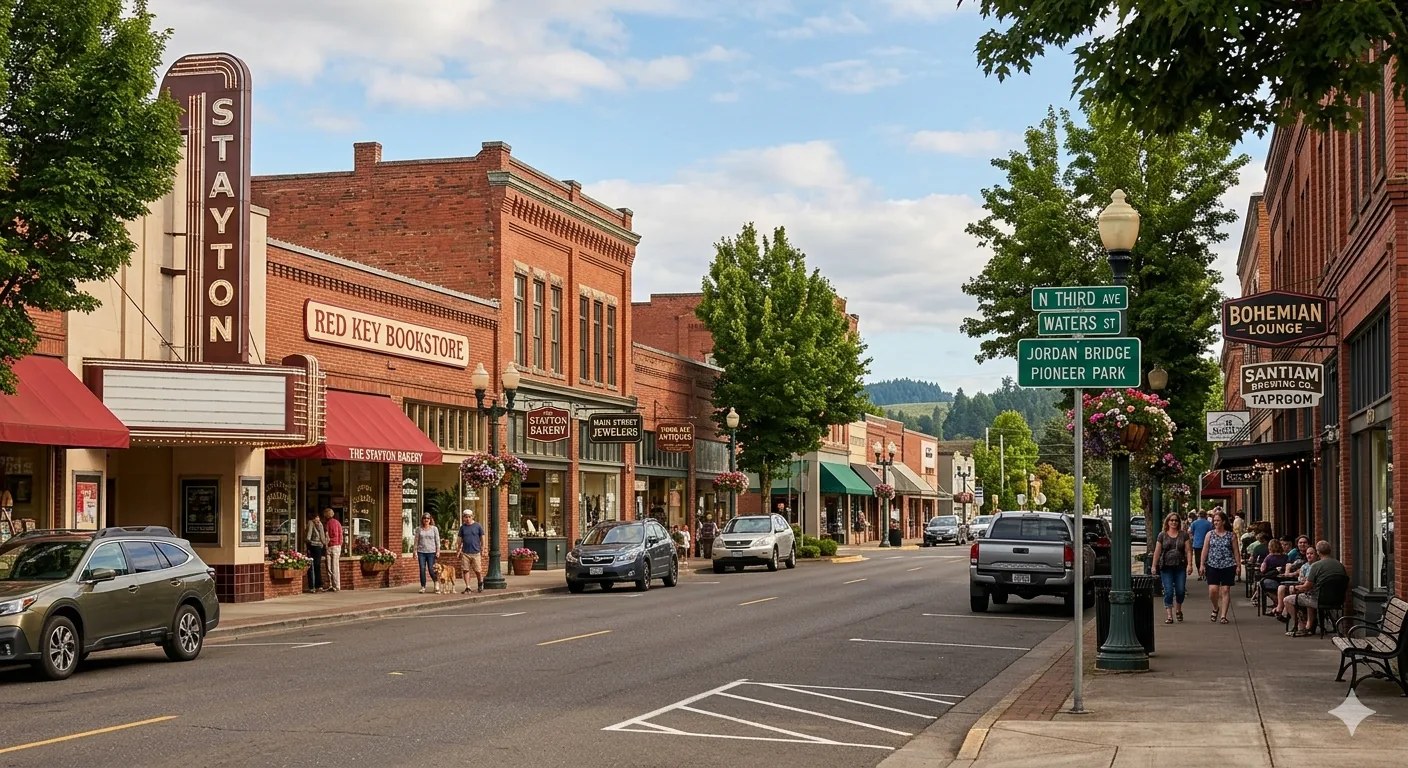
Stayton is a quiet Marion County town at the edge of the Cascade foothills, reached via OR-22 (North Santiam Highway), with a small-town fabric built around agriculture, a regional hospital, and steady family households. A $471,759 typical home price reflects a place that draws buyers for its pace and foothills proximity rather than its services — Stayton delivers meaningful space and a slower rhythm compared to Salem, which is the reason most buyers consider it.
This is a town that suits buyers who genuinely want out of the urban orbit without giving up access entirely. OR-22 keeps Salem commutable, and the Cascade foothills are right there when the weekend arrives. It rewards patience and self-sufficiency more than any city in this group that has walkable retail.

#5 Interstate Crossroads City · Marion County
Best for commuters and retirees drawn to an established 55+ community.
Woodburn is a mid-size Marion County city at the I-5 interchange, anchored by a strong Latino community, an outlet shopping district, and a location that keeps Portland and Salem both within reasonable commuting distance. A $429,908 typical home price reflects a city that punches above its size in employment diversity and services. Senior Estates Golf & Country Club is one of the valley's most established 55+ communities and draws retirees specifically for its price point and amenities.
Woodburn tends to suit buyers who need an interstate location without metro pricing, and retirees looking for an established age-qualified community. It offers more in-town commercial activity than most cities at this price point — the trade-off is that it lacks the scenic or artisan character that draws lifestyle buyers to towns like Independence or McMinnville.
#6 Mid-Valley Metro Partner · Lane County
Best for buyers who want Eugene's metro at a lower cost of entry.
Springfield is one of Oregon's larger cities, sharing a metro area with Eugene along I-5, I-105 (Eugene-Springfield Highway), and state routes including OR-126 (McKenzie Highway). A $421,652 typical home price gives buyers access to Eugene's hospitals, university economy, and transit network at a meaningfully lower cost of entry — which is exactly why Springfield draws buyers who want urban access without urban pricing.
Springfield suits buyers who want the full Eugene metro experience — employers, services, full-service hospital care, and a regional transit network — without stretching for Eugene's own home prices. It is less walkable in character than Eugene's core neighborhoods, leaning more toward a practical, auto-oriented grid, but the trade-off works for most households prioritizing value over walkability.

#7 Historic Mid-Valley Hub · Linn County
Best for buyers who want a real mid-valley city with a historic downtown.
Albany is one of Oregon's larger mid-valley cities, a Linn County hub where I-5 (Pacific Highway), US-20 (Santiam Highway), and OR-99E (Pacific Highway) converge, creating a natural crossroads between Salem, Corvallis, and Eugene. A $439,047 typical home price lands in the middle of the valley's range, fitting for a city that offers genuine amenities — a historic downtown, rail access, and a diversified employer base — without requiring the trade-offs of a purely rural location.
Albany tends to suit buyers who want a real city with a downtown, reasonable access to multiple larger employment centers, and a home price that doesn't demand two professional incomes to sustain. It sits in a comfortable position between the valley's most rural affordable towns and its university-driven or wine-country markets.
#8 Polk County Seat Town · Polk County
Best for retirees and Polk County buyers who want county-seat character.
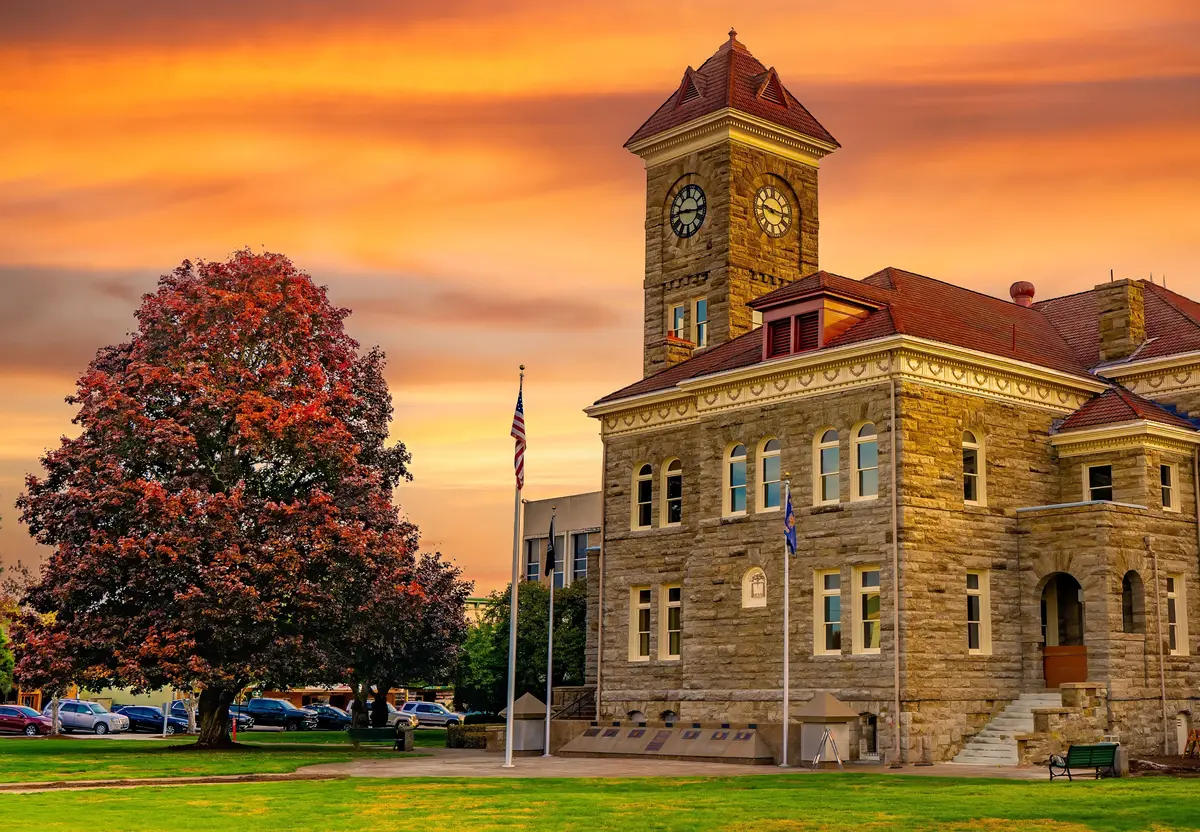
Dallas is the Polk County seat, reached by OR-223 (Kings Valley Highway), a small city that feels genuinely self-contained — county government, local schools, and a compact downtown — while carrying a home price that surprises buyers who expect a purely rural price tag. A $481,280 typical home price reflects the draw of Polk County character and the county-seat stability that underpins its local economy. Ceres Gleann and Eden Gleann are the two named 55+ communities here, drawing retirees specifically for the quieter pace.
Dallas suits buyers who want the Polk County lifestyle — proximity to Salem without being absorbed into it, a small-town feel with county-seat services, and access to the 55+ communities that make it one of the more intentional retirement destinations in the mid-valley. It rewards buyers who specifically sought it out rather than settled for it.
#9 State Capital City · Marion County
Best for buyers who want full state-capital urban amenities at valley prices.
Salem is one of Oregon's largest cities and the state capital, connected by I-5, OR-22 (North Santiam Highway), and a network of state routes that make it the functional hub of the mid-Willamette Valley. A $440,726 typical home price is the figure that surprises most out-of-state buyers: state government, a major university, and full urban services at a cost that most Pacific Coast capital cities would not allow. Salemtowne is the notable 55+ community for retirees looking for an established, full-service option within the city.
Salem suits buyers who want real urban infrastructure — employment, healthcare, arts, transit — without paying Portland or Bend prices. The trade-off is that Salem's scale comes with genuine city dynamics: traffic, neighborhood variation, and the complexity of choosing the right part of a city that spans many square miles. Buyers who do that homework tend to be satisfied.
#10 Suburban River Community · Marion County
Best for families who want Salem employment with a quieter suburban feel.
Keizer sits immediately north of Salem along I-5 and OR-99E, technically its own mid-size city but functionally part of the Salem metro — sharing its job market, healthcare system, and commercial infrastructure while maintaining its own municipal identity and school district. A $453,552 typical home price reflects Keizer's reputation for newer housing stock, quieter residential character, and a suburban feel that attracts families who work in Salem but prefer a lower-density environment.
Keizer suits buyers who want Salem's employment and services but a quieter, more residential day-to-day experience. The honest assessment is that you are buying into the Salem metro at a premium for the Keizer address — which makes sense for some households and not for others, depending on where within the metro your commute actually lands.

#11 Wine Country Downtown City · Yamhill County
Best for buyers drawn to wine-country culture and a walkable downtown.
McMinnville is Yamhill County's largest city and the de facto capital of Willamette Valley wine country, connected by 99W (Pacific Highway West) and OR-18 (Salmon River Highway) — routes that carry both the wine-country tourist economy and the daily commuter traffic that shapes life here. A $488,040 typical home price reflects wine-country demand: a walkable, well-regarded downtown, steady visitor economy, and a regional identity that consistently draws buyers from Portland who want out of the city but not out of reach of its culture.
McMinnville suits buyers who value a genuine small-city downtown, proximity to the vineyards and the Pacific Coast, and a community with more cultural and culinary density than its population would suggest. The cost is real relative to many valley cities with comparable population, but buyers who move here for the lifestyle tend to regard that as a reasonable exchange.

#12 Polk County University Town · Polk County
Best for university employees and remote workers who want a college-town core.
Monmouth is a Polk County university town — Western Oregon University anchors both its economy and its demographic mix — reached via 99W (Pacific Highway West), OR-51, and OR-194 (Monmouth Highway). A $480,666 typical home price is notably firm for a small city with a limited local job market outside the university, which surprises buyers who expect college-town affordability.
The university presence creates a specific kind of community: stable institutional employment, a younger average age, and more walkable density in the core than most towns of this size. Monmouth suits buyers who value that environment — educators, university staff, remote workers who want a lively small-town core — and are willing to commute to Salem or Independence for anything the university can't provide.

#13 Rural Highway Crossroads Town · Lane County
Best for buyers who want rural Lane County space near Eugene's employment.
Junction City is a small agricultural Lane County town where OR-99 (Pacific Highway), OR-99W (Pacific Highway West), OR-99E, and OR-36 (Mapleton-Junction City Highway) converge, giving it the highway geography its name promises but not the density those routes might suggest. A $489,162 typical home price outpaces what the town's rural agricultural character might lead a buyer to expect, driven partly by buyers relocating from Eugene who are willing to trade walkability and proximity for space and a quieter pace.
Junction City suits buyers who specifically want the rural Lane County environment — open land, agricultural neighbors, small-town schools — while keeping Eugene's employment within a reasonable drive. It is not a good fit for buyers who expect meaningful in-town services or a walkable core; those amenities simply aren't here at the scale that justifies the price without that trade-off being clearly understood.

#14 Southern Valley University City · Lane County
Best for buyers who want a full university city with coast and mountain access.
Eugene is one of Oregon's largest cities and the anchor of the southern Willamette Valley, shaped by the University of Oregon, a robust healthcare sector, and a progressive civic culture that distinguishes it from every other city in this comparison. I-5 (Pacific Highway), I-105 (Eugene-Springfield Highway), OR-126 (Florence-Eugene Highway), and OR-132 (Delta Highway) all converge here, making it the true regional hub. A $482,062 typical home price represents real value relative to what the city offers — though buyers should understand that Eugene's own neighborhoods vary widely in character and cost.
Eugene suits buyers who want full urban amenities, a nationally recognized university, and an outdoor culture that integrates the city with mountains and coast — all at a price point that compares favorably to most Pacific Coast metros of similar scale. The trade-off is that Eugene's political and cultural identity is distinct and not universally appealing; buyers who aren't aligned with that culture sometimes find the fit uncomfortable.
#15 Clackamas Foothills Town · Clackamas County
Best for buyers who want foothills acreage and are prepared for the distance.
Molalla sits at the edge of Clackamas County and the northern Willamette Valley, connected by OR-211 (Woodburn-Estacada Highway) and OR-213, in a position that is close to the Portland metro in theory but separated from it by geography that makes the commute feel longer than the mileage suggests. A $499,534 typical home price reflects both that Portland-area gravitational pull and the reality that buyers are paying for space, rural character, and Cascade foothills proximity more than in-town amenities.
Molalla suits buyers who specifically want the foothills lifestyle — horses, space, a genuine small-town pace — and have flexible work arrangements or a job already anchored in the area. Buyers expecting it to function as an affordable Portland suburb often find the daily logistics more demanding than anticipated. It rewards buyers with realistic expectations about rural distance.

#16 Corvallis-Adjacent College Town · Benton County
Best for OSU-connected buyers who want a quieter Corvallis-adjacent setting.
Philomath is a small Benton County town immediately west of Corvallis on US-20 and OR-34, and it functions almost entirely as an extension of the Corvallis economy — Oregon State University's employment and intellectual culture reach directly into Philomath's housing market, pushing prices to reflect that proximity. A $529,921 typical home price reflects the Benton County and Corvallis-adjacent premium that buyers pay for OSU proximity, Benton County schools, and a quieter residential setting just outside the city.
Philomath suits buyers who want the Corvallis university orbit — faculty, researchers, healthcare professionals — in a slightly smaller, slower-paced package. Buyers who don't have a direct tie to OSU or Corvallis employment often find the price hard to justify given Philomath's limited in-town services; the value here is almost entirely about what sits next door.
The towns with genuinely accessible prices in this valley are affordable in a real sense — not just 'affordable for Oregon.' But the cities that cost more tend to offer something concrete in return: jobs in town, a walkable downtown, or a university that shapes the economy and the culture. Know which of those things matters to your household before you let a home price make the decision for you.
Tell us what you need help with and we'll connect you with local resources.
