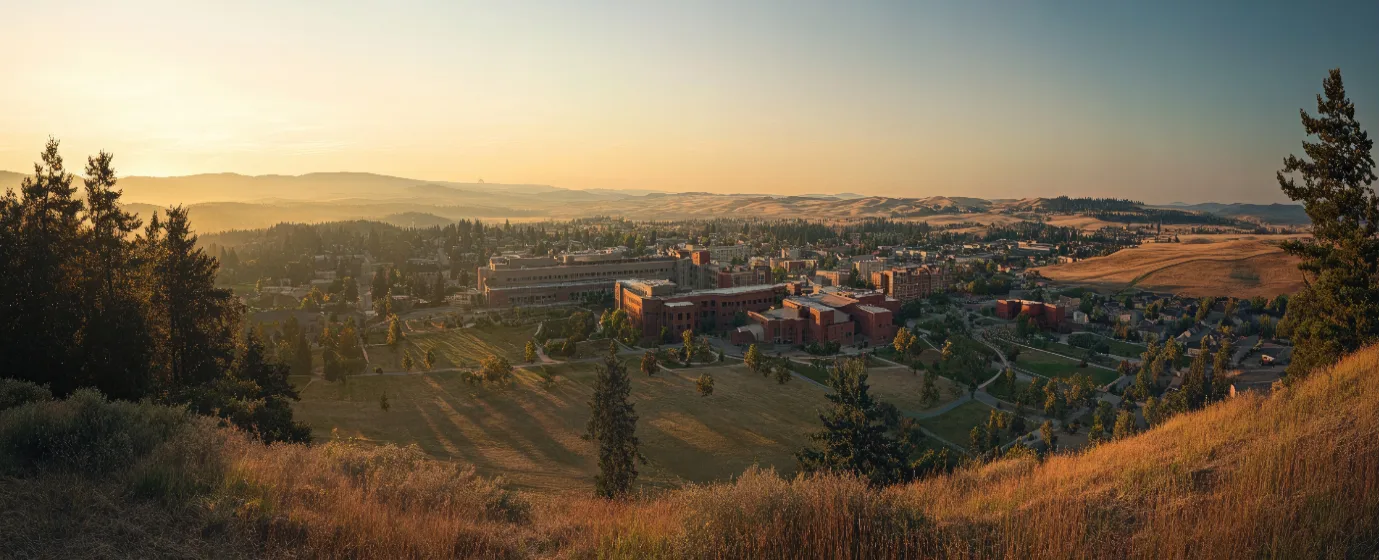
You probably didn't picture a college town when you started thinking about where to retire. But people who end up in Pullman tend to arrive for an unexpected reason — a child who went to Washington State University and never left, a job at Schweitzer Engineering Laboratories that turned into roots, or a deliberate search for a small city with genuine intellectual energy and prices well below the Puget Sound corridor. The Palouse hills roll in every direction, the downtown valley holds a walkable cluster of restaurants and coffee shops, and WSU's presence shapes the cultural calendar in ways that most towns a third this size simply can't replicate.
Pullman sits at the bottom of Whitman County in southeast Washington, about eight miles from the Idaho state line and roughly 90 minutes south of Spokane on US-195. Washington State University — with roughly 20,000 students and its own hospital system, arts venues, and athletics — is the dominant economic engine. Pullman Regional Hospital is the city's primary acute-care facility and the anchor of local healthcare. The combination of a research university and a growing engineering sector (Schweitzer Engineering Laboratories has been part of the city's economy for decades) gives Pullman a professional and intellectual depth unusual for a city of 33,000.
On cost, Pullman runs noticeably below Seattle or Bellevue, and meaningfully below Spokane's more desirable west-side neighborhoods. The Zillow Home Value Index pegged the typical home price at $429,145 in June 2026 — entry-level enough that retirees downsizing from higher-cost markets can often buy outright or carry a small mortgage. Washington's complete absence of a state income tax is a real financial advantage: Social Security, pension distributions, and retirement-account withdrawals all land in your pocket untouched at the state level. For a full breakdown of day-to-day costs, see the cost of living page.
Whether you're seriously considering a move or just running the numbers, the sections below walk through who Pullman genuinely suits in retirement, what healthcare access looks like today (and where the gaps are), the retiree tax picture, walkability and community life, downsizing options, and how Pullman stacks up against the most relevant nearby alternatives.

Why Retirees Are Choosing Pullman
The retirees who thrive in Pullman share a few traits: they want intellectual stimulation, they can handle winters with real snow, and they're not interested in paying Sun Belt prices to be somewhere warm. WSU's arts programming, free or low-cost lectures, Cougar athletics at Martin Stadium, and Ferdinand's Creamery on campus — where Cougar Gold cheddar aged in tins has been a local institution since the 1940s — create a texture of daily life that goes well beyond what the population size would suggest.
The typical home price of $429,145 (Zillow Home Value Index, June 2026) means a retiree arriving from a major West Coast market may be able to buy a quality home outright or with minimal financing. That financial breathing room matters enormously on a fixed income. Pullman also sits squarely in Washington state's no-income-tax advantage, which applies just as strongly here in the Palouse as it does in Bellevue or Olympia.
Who should look elsewhere? If you require frequent specialist care — oncology, cardiology, neurology — Pullman's single community hospital means you'll be traveling to Spokane for anything beyond routine and emergency treatment. That's a 90-minute drive, and in winter on US-195, it is not a trivial trip. Retirees who absolutely cannot or will not drive in snow, or who need very high walkability for all daily errands without a car, will find Pullman imperfect. And if your retirement vision centers on warm winters, the Palouse's January temperatures will disappoint you within the first season.
Healthcare & Medical Access in Pullman
Pullman Regional Hospital
Pullman Regional Hospital is the city's sole acute-care facility and, for most day-to-day medical needs, it punches well above what you'd expect in a city this size. It operates an emergency department, surgical suites, imaging, and a growing range of outpatient specialty clinics — in part because serving a university community and a rural county creates demand for breadth.
In November 2025, Pullman Regional broke ground on a $41 million, four-phase Patient Care Expansion Project covering 33,000 square feet of remodeled and new space. The scope is significant: an expanded emergency department, an additional operating room, an endoscopy room, new behavioral health rooms, and a new medical office building. Phase 1 — which added laboratory capacity, expanded surgical infrastructure, and completed critical systems upgrades including emergency power, medical gas, and fire suppression — received Washington State Department of Health approval in July 2026 and is cleared for patient use. The remaining phases are expected to continue over the following two years.
This expansion matters specifically for retirees. The added surgical and emergency capacity means fewer transfers out for procedures that previously required Spokane. That said, complex cancer care, advanced cardiac intervention, and specialized neurosurgery will still require the drive north. The practical reality: Pullman Regional handles your primary care, annual screenings, routine procedures, and genuine emergencies. For anything requiring a subspecialist with a narrow focus, plan on Spokane.
Primary Care and Specialists
WSU's presence indirectly strengthens local healthcare — the university draws researchers and clinicians who sometimes practice locally, and the student health infrastructure creates additional capacity in the broader ecosystem. Primary care access is generally solid for a city this size; residents consistently report shorter waits than in larger metro areas. Dental, optometry, and physical therapy are all represented locally.
The Distance Reality
Spokane is the regional referral hub — roughly 90 minutes north on US-195. That highway runs through open Palouse farmland with limited cell service and real winter hazards. If you or a partner has a condition likely to require frequent specialist visits, build that commute into your honest planning. Some retirees with serious chronic conditions ultimately decide to base themselves closer to Spokane rather than in Pullman itself, and that's a reasonable call to examine before you commit.

The Retiree Budget in Pullman
Washington's No-Income-Tax Advantage
Washington is one of nine U.S. states with no individual income tax — a group that also includes Florida, Nevada, and Texas — which means Pullman's retirement tax profile is genuinely competitive with major Sun Belt markets. Social Security benefits, pension distributions, 401(k) withdrawals, and IRA distributions are all untaxed at the state level. For a retiree drawing $60,000 a year from a mix of Social Security and retirement accounts, that's real money that stays in the household budget.
Washington does impose a capital gains tax on long-term gains above $278,000 per individual or couple (2025 threshold), but this tax explicitly does not apply to retirement-account withdrawals. The typical retiree living on Social Security and distributions will never encounter it. The exception worth noting: if you're selling a highly appreciated investment portfolio outside of retirement accounts, consult a CPA before the sale.
Property Taxes and Senior Programs
Pullman's effective property tax rate is approximately 1.45%. That figure is meaningfully higher than some neighboring states but is offset by Washington's zero income tax, so the combined burden for most retirees compares favorably to income-tax states with lower property rates.
Washington's senior property tax exemption program can reduce the assessed value subject to taxation for qualifying homeowners — income limits apply, and the thresholds are set at the county level. More useful for some retirees is Washington's property tax deferral option: qualifying seniors can essentially borrow from the state to cover annual tax bills, with repayment required only when the home is sold or ownership transfers. For a retiree who is house-rich but cash-limited, this deferral program is worth knowing about early — not after the first large tax bill lands.
Daily Cost of Living on a Fixed Income
Pullman does not have a Trader Joe's — the nearest is in Moscow, Idaho, a 10-minute drive across the state line. Grocery options run to a standard regional supermarket and a handful of independent stores; prices are roughly in line with small-city Washington, not inflated by resort or tourist economics. The downtown corridor along Main Street and Grand Avenue holds independent cafés, South Fork Public House on S Grand Ave, and Paradise Creek Brewery's restaurant on SE Paradise St — evening meals out at a mid-range price point are accessible without a special-occasion budget. For the full picture on groceries, utilities, and transportation costs, see the Pullman cost of living page.
Looking to buy in Pullman? Estimate your payment.
Enter your numbers to see an estimated monthly mortgage payment.
Estimate only. Excludes HOA fees and mortgage insurance. The interest rate above is a starting point, not a quoted rate — replace it with your own to see real numbers. Insurance is a flat placeholder, not a Pullman quote.
Walkability, Community & Staying Active in Pullman
The Walkability Reality
Pullman is hilly — genuinely, inconveniently hilly in the residential neighborhoods that ring the downtown valley. College Hill, Pioneer Hill, and Military Hill all involve elevation changes that are fine in your 50s and worth recalibrating in your 70s or 80s if knee health becomes a consideration. The downtown valley itself, centered on Main Street and Grand Avenue, is flat enough for comfortable on-foot access to dining, the post office, and basic errands.
The city's 2026 planning process includes a dedicated community survey on transit and walkability — a sign that the city takes pedestrian infrastructure seriously, even if the topography creates permanent limits. Pullman Transit runs fixed-route buses throughout the city and a Dial-A-Ride paratransit program offering door-to-door service. Riders 65 and older qualify for reduced-cost fares on the paratransit service without needing a doctor's verification, which is a meaningful practical benefit for retirees who are transitioning away from driving.
The University as a Community Resource
WSU's impact on retirement quality of life is hard to overstate. The university's performing arts venues, free and low-cost public lectures, museum on campus, and Division I athletics at Martin Stadium provide a cultural calendar most cities ten times Pullman's size would envy. Osher Lifelong Learning Institute (OLLI) programs — continuing education classes for adults 50 and older — are available through WSU, making it possible to keep learning without the tuition pressure of a degree program.
Where Retirees Actually Gather
The Pullman Farmers Market at Reaney Park draws consistent weekend crowds from spring through fall — it's a genuine social anchor, not a tourist attraction. Reaney Park itself, with its pool, open fields, and easy trail access, is where multi-generational Pullman gathers on warm afternoons. The Paradise Creek Brewery Trailside Taproom on SE Riverview St sits close to the trail system along the creek corridor, and the evening crowd at South Fork Public House on S Grand Ave skews older than the student-centered bars near campus.
Volunteer opportunities connect naturally to the university and the hospital system. Many retirees find that the combination of WSU events, the farmers market rhythm, and a few volunteer commitments creates a social structure that took them years to build in a larger city. What surprises people after six months: Pullman is smaller than it looks on paper, and everyone — retirees, faculty, students, longtime locals — ends up at the same dozen places. That's a feature for people who like a tight social web. It's a friction point for those who prefer anonymity.
Right-Sizing: Downsizing in Pullman
The Inventory Challenge
Pullman's housing stock skews toward multi-story homes and student-rental properties — not what most retirees are searching for. Single-level ranch homes exist but represent a smaller share of active inventory than in purpose-built retirement markets. If single-level living is a non-negotiable, expect to be patient or flexible on location.
The market at the $429,145 median (Zillow Home Value Index, June 2026) does offer some meaningful options. Older ranch-style homes in the Sunnyside area and parts of the Grand Avenue corridor occasionally come to market in the $350,000–$430,000 range and offer the flat-floor layout retirees want. Newer construction condos and townhomes exist in small pockets near the university and downtown but are primarily built for the student and faculty market, meaning unit sizes and layouts don't always translate well to full-time retirement living.
55+ and Active-Adult Options
Pullman does not have a large-scale 55+ gated community or a purpose-built active-adult campus of the kind you'd find in Spokane Valley or the Tri-Cities. What the city does have is a small but growing inventory of patio-style homes — attached and detached single-story units with minimal yard maintenance — that function as de facto downsizing options even without an age-restriction covenant.
For retirees who want a purpose-built senior living community with services, Moscow, Idaho — ten minutes east — offers a broader range, including independent living facilities and assisted living options that Pullman itself doesn't match in depth. Pullman's assisted living and memory care inventory is limited; if a partner's care needs are likely to intensify, factoring in Moscow's facilities as part of the same functional market is sensible planning.
The Washington Property Tax Deferral Program
For retirees who own a Pullman home outright or with low remaining debt, Washington's property tax deferral program is worth revisiting at the downsizing stage. Qualifying seniors can defer annual property tax bills — essentially a state-backed loan — with no repayment until the home is sold. If you're buying a smaller home with sale proceeds from a higher-cost market and sitting on equity, this program keeps monthly cash outflow low while the deferred balance accumulates as a lien. A real estate attorney or CPA familiar with Washington senior programs can walk you through the income and ownership thresholds in Whitman County.
Pullman vs Nearby Retirement Destinations
| City | Cost vs Pullman | Primary Hospital | Walkability | Senior Living Depth | Overall Retirement Fit |
|---|---|---|---|---|---|
| Pullman, WA | Anchor | Pullman Regional Hospital (expanding) | Moderate; flat downtown, hilly neighborhoods | Limited 55+ inventory; growing patio-home stock | Quiet Nature Good for active, self-sufficient retirees |
| Moscow, ID | About the same | Gritman Medical Center | Similar; slightly hillier downtown | Stronger assisted living and senior community options | Families Transit Strong alternative, especially if care needs are higher |
| Colfax, WA | Noticeably cheaper | Whitman Hospital (critical access) | Low; car-dependent for most errands | Very limited; largely single-family stock | Value Best for truly rural-minded retirees who drive regularly |
| Palouse, WA | Noticeably cheaper | No local hospital; nearest is Pullman or Colfax | Very low; small-town, walkable core but limited services | Minimal; no senior-specific facilities | Privacy For retirees wanting maximum quiet and minimal price |
| Spokane, WA | Noticeably pricier | Multiple major hospital systems with full specialty depth | High in walkable neighborhoods; varies widely | Extensive; large 55+ communities, CCRCs, memory care | Luxury Transit Better for complex medical needs or urban retirement lifestyle |
| Lewiston, ID | Slightly cheaper | St. Joseph Regional Medical Center (strong regional hospital) | Moderate; flat lower valley, walkable core | Good; broader senior housing inventory than Pullman | Value Views Warmer winters, stronger healthcare depth, worth comparing |
Moscow, Idaho beats Pullman on senior housing depth and offers a comparable intellectual atmosphere via the University of Idaho — if assisted living options matter to your planning, the two towns function as a single ten-mile market and Moscow's inventory tips the balance. Spokane wins decisively on healthcare depth and senior living variety, but at a noticeably higher price point and with the added complexity of a metro area. Lewiston is the sleeper pick: warmer, slightly cheaper than Pullman, with a meaningfully stronger hospital and a flatter geography that ages better than Pullman's hills. Colfax and Palouse suit retirees who want maximum quiet and minimal cost and are genuinely comfortable with limited local services — for anyone who anticipates increasing healthcare reliance, those small towns work better as a scenic backdrop than a retirement base.

Local Expert Takeaway: Pullman rewards retirees who show up curious. The WSU calendar — free lectures, Cougar athletics at Martin Stadium, OLLI continuing-education courses — fills an active social life without requiring a big entertainment budget. Washington's zero state income tax means your Social Security and retirement-account withdrawals land untouched, and the $429,145 typical home price (Zillow Home Value Index, June 2026) gives downsizing buyers from pricier markets real purchasing power. The honest catch: Pullman Regional Hospital's $41 million expansion is underway, but Spokane remains the referral destination for complex specialty care, and that 90-minute drive on US-195 in January is not to be romanticized. Retirees who've thrived here for a decade say the same thing — the town's small size, which looked like a limitation on paper, turned out to be exactly why they know the pharmacist, the farmers-market vendor, and half the people at any given evening event at the university's performing arts venues on campus.
Quick Takeaways & FAQs
✅ Washington's no-income-tax policy means Social Security, pension, and retirement-account income are all untaxed at the state level — a genuine financial advantage that holds in Pullman just as in Seattle.
⚠️ Pullman Regional Hospital is expanding, but complex specialty care still requires a 90-minute drive to Spokane on a rural highway that gets genuinely difficult in winter — plan accordingly before committing.
📍 WSU's Osher Lifelong Learning Institute (OLLI) and the campus cultural calendar give Pullman retirees access to lectures, concerts, and continuing education that most small cities simply can't offer.
Is Social Security taxed in Washington state for Pullman retirees?
What is the nearest major hospital to Pullman, WA?
What is the effective property tax rate in Pullman, WA?
Are there 55+ or active-adult communities in Pullman?
How does retiring in Pullman compare to retiring in Moscow, Idaho or Spokane?
Moving to Washington?
Tell us what you need help with and we'll connect you with local resources.
