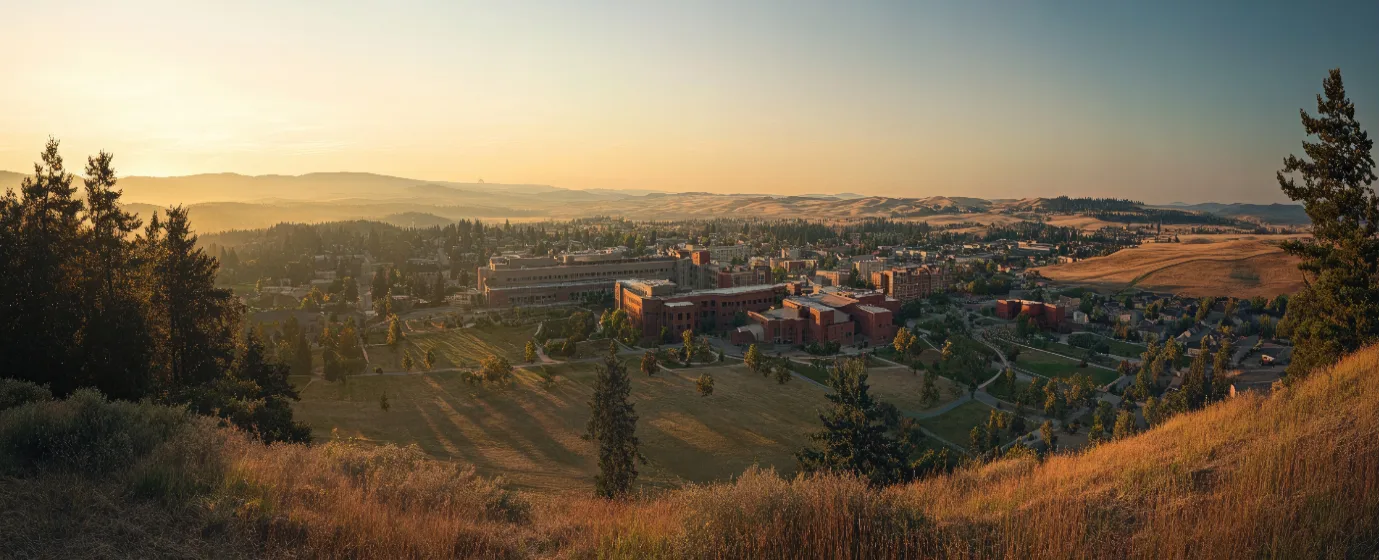
You've probably done the math on paper and it looked almost too good to be true. No state income tax. Home prices a fraction of what you left behind in the Bay Area or Los Angeles. A walkable college town with a major research university as its economic engine. What the spreadsheet doesn't tell you is that Pullman, Washington sits in the far southeastern corner of the state — rolling Palouse wheat fields in every direction, 90 minutes from Spokane, and nine miles from the Idaho border. The nearest large airport is Spokane International. The nearest Costco is also in Spokane. The trade-off for financial breathing room is genuine geographic isolation, and that reality shapes everything about daily life here.
Washington State University is not just the largest employer in town — it is the reason Pullman exists at the scale it does. The university brings researchers, engineers, and faculty from across the country, which is why you'll find a disproportionate number of transplants and a more nationally diverse community than the surrounding rural region would suggest. Schweitzer Engineering Laboratories, headquartered here on the edge of the WSU campus, draws power systems engineers from across North America. The Pullman School District holds an A rating, according to Niche, and serves a community that takes education seriously, partly because so many residents work in it. Who moves here? Mostly people who have a specific reason — a WSU position, an SEL offer, a deliberate lifestyle downshift — rather than people who simply ended up here.
Cost of living in Pullman runs roughly 7% below the national average and noticeably below most Washington cities, which is unusual for a state where Seattle sets the expectation. The typical Pullman home value was $429,145 as of the Zillow Home Value Index in June 2026 — a figure that will feel almost surreal if you're arriving from San Francisco or elsewhere in the Bay Area. Property taxes run higher per dollar of assessed value than California's, but the elimination of state income tax restructures the overall picture dramatically for most working households. For a fuller breakdown of how the numbers stack up day to day, the cost of living in Pullman page has the complete picture.
Whether you've accepted a position at WSU, followed a partner here, or deliberately chosen to leave California's cost structure behind, the sections below cover what Californians most need to understand before making the move: the tax math, the home-buying reality, the lifestyle adjustment, the seasonal surprises, and what daily life in Pullman actually looks and feels like once the boxes are unpacked.

The Tax Math: What Californians Actually Gain (and Give Up)
Washington's single biggest draw for Californians is the one that shows up in every paycheck: no state income tax. California's top marginal rate reaches 13.3%, and even a household earning $150,000 a year in a mid-range California bracket is paying a meaningful share to Sacramento. That goes to zero the moment you establish Washington residency.
Washington does levy a capital gains excise tax — 7% on long-term capital gains above a $278,000 standard deduction for 2025, rising to 9.9% on gains above $1,000,000. This is relevant if you're selling appreciated California stock or investment property. It does not apply to wages or ordinary income, and the sale of a primary residence is exempt. For most relocating employees, the income tax elimination is clean and immediate.
The Sales Tax Reality
Washington funds its budget partly through a higher sales tax, and Pullman's combined rate is 8% — 6.5% state base plus a 1.5% city add-on. That is higher than most California counties. The meaningful offset: Washington exempts unprepared groceries entirely from sales tax, so your weekly supermarket run is untaxed in a way it isn't in California.
Property Tax: The Number That Surprises Buyers
Pullman's effective property tax rate is approximately 1.45%. California's average effective rate runs around 0.71% — roughly half. On a home assessed at $429,145, that difference is real and annual. The key context is that you're applying that higher rate to a dramatically lower purchase price than you'd face in most California markets. The net annual tax bill on a Pullman home still typically runs well below what you'd owe on a comparable California property, even at twice the rate, because the base is so much smaller.
| Tax Category | California | Pullman, WA | Net Effect for Relocating CA Buyer |
|---|---|---|---|
| State income tax (wages) | Up to 13.3% marginal | 0% | Major annual savings for working households |
| Capital gains excise | Up to 13.3% (same rate) | 7% on long-term gains above $278,000 standard deduction (2025); 9.9% above $1,000,000 | Lower rate; primary home sale exempt |
| Effective property tax rate | ~0.71% avg | ~1.45% | Higher rate, but applied to a much lower price |
| Sales tax (general) | 7.25–10.75% depending on county | 8% | Similar or slightly lower than high-CA counties |
| Sales tax on groceries | Taxed (most food) | Exempt (unprepared food) | Meaningful everyday savings |
| Estate / inheritance tax | None | None at state level | Neutral |
For most California professionals relocating to Pullman, the income tax elimination more than offsets the higher property tax rate — often within the first year. See the full cost-of-living breakdown for how utilities, groceries, and transportation fit into the picture.
Home Prices: The California Comparison That Requires a Second Look
The typical Pullman home value was $429,145 (Zillow Home Value Index, June 2026). If you're arriving from the Bay Area — where median sold prices in many submarkets ran well above $1.2 million in the same period — that figure takes a moment to process as real.
Even Southern California buyers accustomed to $700,000–$900,000 entry points in the Inland Empire will find Pullman's price point noticeably lower. This is not a market where you're trading a California condo for a Washington condo at a slight discount. You're trading a California condo for a Washington house with a yard, often in a neighborhood within walking distance of the WSU campus or Reaney Park.
What the Pullman Market Is Actually Like
Pullman's ownership rate is low — roughly 31% of households own, with the majority renting, which reflects the dominant student population. That dynamic matters for buyers: the inventory of owner-occupied homes for sale is limited, competition from other non-student buyers is real, and properties near campus tend to carry a rental-premium pricing dynamic that pushes values above what purely residential demand would sustain.
Homes farther from the WSU core — along the Terre View corridor or in the Pioneer Hill area — tend to offer more space for the price. College Hill and the Grand Avenue corridor command a premium for walkability and proximity to campus, which is worth it if your daily life revolves around WSU, but less relevant if you're commuting elsewhere or working remotely. For the specifics on what different areas offer at different price points, the neighborhoods guide breaks it down in detail.
The California Equity Advantage
Many California buyers arrive with substantial equity from a sale. Putting a large down payment on a $429,145 home — rather than stretching for a $1.3 million Bay Area property — produces a monthly payment structure that can feel genuinely transformative. Some California transplants buy outright. That shift in financial breathing room is the single most commonly cited reason people say moving here was the right call.
One honest caution: Pullman is a small market. Appreciation is driven heavily by WSU enrollment trends and the health of Schweitzer Engineering Laboratories. It does not behave like a major metro market, and liquidity is lower — if you need to sell quickly, you may wait longer than you would in Sacramento or San Diego.

Daily Life Adjustment: What Changes When You Arrive
Most Californians who move to Pullman say the first six months are easier than expected in one way and harder than expected in another. The financial relief is immediate. The geographic adjustment takes longer.
The Distance Reality
Spokane is 90 minutes away. That's where Spokane International Airport (GEG) is — your hub for anything beyond regional travel. Big-box retail, a wider restaurant selection, specialty medical care, and the nearest major shopping mall all require that drive. Californians used to a Target within 10 minutes and a Whole Foods on the way home will recalibrate. Pullman has a grocery store and the basics; Spokane has everything else. Weekend Spokane runs become a routine part of life.
Moscow, Idaho — nine miles east via Highway 270 — functions almost as a second half of the Pullman metro. The Bill Chipman Palouse Trail, a paved path connecting the two cities, means you can bike to Moscow on a dry afternoon. University of Idaho is there, which means Moscow adds restaurants, a farmers market, and a few retail options to what Pullman offers directly.
Where People Actually Gather
The social fabric of Pullman is tighter than its size suggests, partly because WSU gives everyone a common point. On fall Saturdays, Martin Stadium draws crowds that temporarily double the city's footprint — Cougar game days are a genuine local event, not just a sports fact. The rest of the year, Grand Avenue is the axis: The Old European Restaurant on S Grand Ave handles the weekend brunch crowd, Cougar Country Drive In on N Grand Ave is the reliable local burger institution, and Paradise Creek Brewery in the historic downtown post office building on SE Paradise St is where you'll find the craft beer and sour-leaning tap list that residents point to when explaining why Pullman punches above its weight for a city of 33,000.
Health Insurance and Routine Care
One thing Californians reliably notice: health insurance premiums run noticeably below what you were paying in the Bay Area or Los Angeles, which adds to the monthly financial picture. The honest trade-off is that you will drive farther for specialist and advanced care than you were accustomed to — Pullman has solid routine coverage, but complex cases go to Spokane.
The Seasonal Surprise
Nobody warns California transplants adequately about the winters. Pullman gets real snow — not the occasional dusting that shuts down a Bay Area suburb — and the hills that make the Palouse beautiful in summer make navigating the city genuinely challenging from December through February. Rear-wheel-drive California cars are a liability. All-wheel drive or front-wheel drive with good winter tires is not optional; it's how you get to the grocery store.
Looking to buy in Pullman? Estimate your payment.
Enter your numbers to see an estimated monthly mortgage payment.
Estimate only. Excludes HOA fees and mortgage insurance. The interest rate above is a starting point, not a quoted rate — replace it with your own to see real numbers. Insurance is a flat placeholder, not a Pullman quote.
The Palouse Lifestyle: What You're Actually Moving To
Pullman is not a suburb of anywhere. That's the thing that surprises Californians who assume a small Washington city will feel like a satellite of Seattle. Pullman is its own self-contained place, shaped almost entirely by WSU, the surrounding agricultural landscape, and a community that chose to be here intentionally.
The Outdoor Baseline Is Different Here
California outdoor culture is built around the ocean, the Sierra Nevada, and year-round mild weather. The Palouse is rolling hills, wheat fields, dry summers, and snowy winters. Hiking and trail running exist — the parks and trails around Pullman are genuinely worth exploring — but you're not surfing in January or skiing in March on a 90-minute drive the way you could from parts of California. Palouse Falls, Washington's official state waterfall, is about 90 minutes west — a striking landscape unlike anything in the Pacific Northwest cliché, and a legitimate weekend destination.
The University Dividend
Living adjacent to a major research university delivers cultural amenities that a city of 33,000 would not otherwise support. WSU brings lectures, performances, athletic events, and a campus dining culture — including Ferdinand's Ice Cream Shoppe, where WSU food science students have been producing Cougar Gold sharp white cheddar since 1948. It has become one of Washington's most recognizable food exports and is genuinely good; buying a tin makes an easy explanation of where you live when you visit family back in California.
What the Community Feels Like Day to Day
Pullman skews young, educated, and transient — the student population turns over on a four-year cycle, faculty come and go with careers, and engineers at Schweitzer Engineering Laboratories rotate in from across the country. That means the community is unusually open to new arrivals, which helps. It also means long-term community roots are shallower than a comparably-sized non-university town. If you're looking for the kind of social infrastructure built over generations, Pullman is still growing that layer.
The living in Pullman guide covers what daily life, commuting, and the broader employer landscape look like across different buyer types.
Should You Actually Move Here? An Honest California-to-Pullman Assessment
Most people who move from California to Pullman had a specific pull — a job offer, a partner's position, a deliberate decision to exit the cost structure. Very few stumble into it. That specificity matters: Pullman rewards people who want what it offers and tends to frustrate people who arrived hoping it would be something different.
Who Thrives Here
If you're joining WSU or Schweitzer Engineering Laboratories, Pullman's infrastructure is built around you. The schools are a genuine draw for families with kids — the Pullman School District is consistently among the stronger districts in the state. The financial restructuring from California to Washington is real and immediate: no income tax, dramatically lower home prices, and a cost of living roughly 17% below the average Washington city means the same salary genuinely goes farther. For a detailed look at how schools perform, the schools page breaks down the specifics.
Who Struggles Here
Californians who move here primarily to cut costs, without a job anchoring them to the community, often leave within two to three years. The isolation that's easy to romanticize in photos of rolling Palouse hills is harder to live with when you need a specialist appointment or want a non-chain restaurant on a Tuesday night. Remote workers without a local community anchor report the adjustment being harder than expected once the initial financial relief settles in.
People who move here and never fully accept that Spokane is their city for airport runs, big retail, and a wider dining selection tend to feel stranded. People who fold the 90-minute Spokane run into a normal part of their rhythm — combined with Moscow day trips and occasional Palouse outdoor adventures — tend to feel like they've found something most people don't know about.
The Bottom Line for California Buyers
| Factor | California Baseline | Pullman Reality | Best For |
|---|---|---|---|
| State income tax | Up to 13.3% | 0% | Commuter Tech |
| Home price entry point | Far higher in most CA metros | $429,145 typical (ZHVI, June 2026) | First-Time Families |
| School quality | Varies widely by district | Consistently among the state's stronger districts | School Families |
| Walkability / daily errands | Varies by city | Manageable within Pullman; Spokane for big retail | Walkable |
| Outdoor access | Coast, Sierra Nevada, year-round mild | Palouse trails, Palouse Falls 90 min west | Nature |
| Cost of living overall | Above national average | ~7% below national average | Value |
| Isolation / metro access | Most CA cities have nearby metro | Spokane ~90 min; no closer large city | Quiet Privacy |
* ZHVI = Zillow Home Value Index.
If you're weighing safety as part of the relocation decision, Pullman's crime figures are covered on the safety page. If you're thinking about the buying process itself, the first-time homebuyer guide walks through what the purchase process looks like in Washington specifically.

Local Expert Takeaway: The Californians who make Pullman work long-term are the ones who treat Spokane as a regular part of their orbit rather than a failure of the local scene. Pullman itself covers the day-to-day — The Old European on S Grand for weekend breakfast, Cougar Country Drive In on N Grand for a no-ceremony burger, Paradise Creek Brewery downtown for a sour ale after a Palouse trail run — but Spokane handles the airport, the specialists, and the big-box runs. Build that rhythm into your mental model before you arrive, and the isolation stops feeling like a bug and starts feeling like the point.
Quick Takeaways & FAQs
✅ Washington's zero state income tax is an immediate, real savings for California professionals — the effective elimination of a rate that reaches 13.3% at the top California bracket shows up in every paycheck from day one.
⚠️ Pullman's geographic isolation is the cost of admission: Spokane International Airport, major retail, and advanced specialist care are all a 90-minute drive, and Californians accustomed to urban density nearby consistently underestimate this adjustment.
📍 Pullman's effective property tax rate (approximately 1.45%) is roughly double California's average rate — but applied to a typical home value of $429,145 (Zillow Home Value Index, June 2026), the annual bill still typically runs well below what you'd owe on a comparable California property.
Does Washington really have no state income tax, and does that apply to me as a California transplant?
How does Pullman's home price compare to what I'm used to in California?
Is Pullman's 8% sales tax a problem compared to California?
What do Californians most underestimate about living in Pullman?
Is Pullman a good place for families moving from California?
Moving to Washington?
Tell us what you need help with and we'll connect you with local resources.
