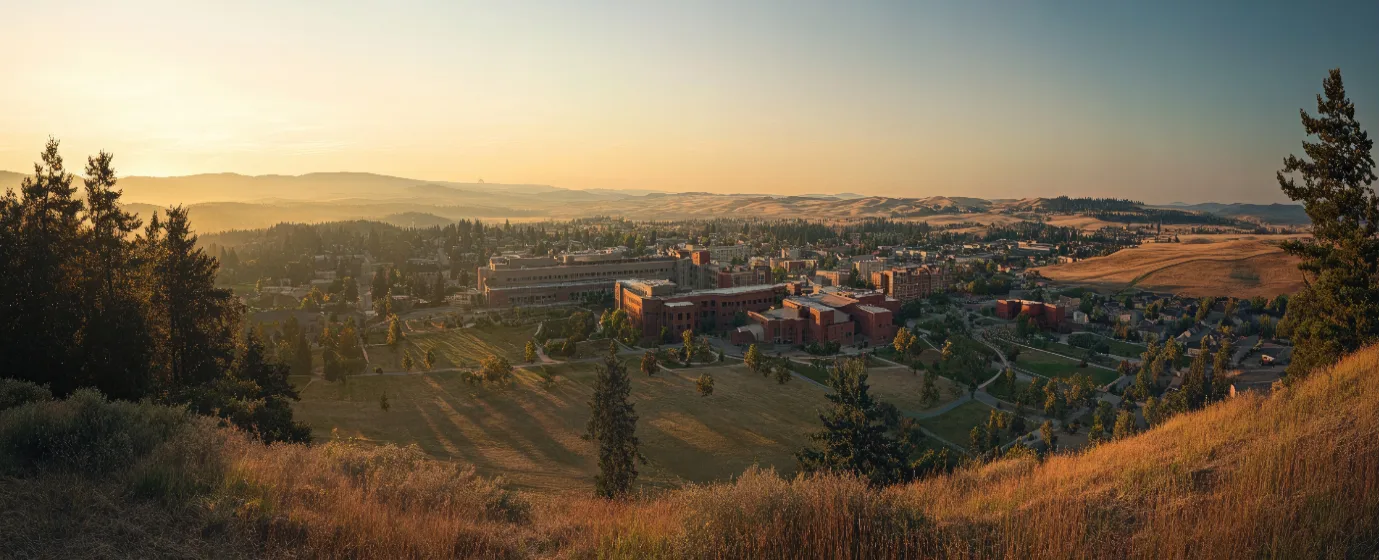
Pullman is a city built on four hills, and that geography is not a metaphor — it is the organizing fact of daily life here. College Hill, Military Hill, Pioneer Hill, and Sunnyside Hill divide the city into roughly equal quarters, with the Palouse River valley and Downtown sitting at the bottom where they converge. Which hill you land on shapes your commute to Washington State University, your walk to Main Street, your sense of quiet or energy, and your realistic price range. Buyers who ignore the topography and shop by square footage alone routinely end up on the wrong hill for their lifestyle.
WSU is the gravitational center of Pullman in a way that few university towns match at this scale — nearly every major employer, from Schweitzer Engineering Laboratories to Whitman County government, orbits the university's presence in some way. The Pullman School District holds an A rating, according to Niche, which matters to families evaluating the district alongside the university crowd. The result is a buyer pool that skews toward faculty, staff, engineers, and young professionals who arrived for the university and stayed for the lifestyle.
The city-wide typical home value sits at $429,145 (Zillow Home Value Index, June 2026), which is noticeably below comparable college towns in the Pacific Northwest — a meaningful advantage for buyers coming from Seattle, Spokane, or the Treasure Valley. Day-to-day life means Reaney Park along the creek corridor, the National Lentil Festival every August in Downtown, and a dining scene anchored along Main Street and Grand Avenue, including The Black Cypress on E Main Street and the Downtown Restaurant by Paradise Creek Brewery on SE Paradise Street, operating out of the old Post Office building. For a fuller look at cost of living in Pullman, the numbers tell a genuinely competitive story.
Whether you're relocating for a WSU position, buying your first home while renting out a room, or looking for a quieter Palouse-view street away from game-day crowds, the sections below break down Pullman's neighborhoods, price ranges, buyer types, common mistakes, and the best areas to rent.

The Pullman Reality
The single most important thing to understand before buying in Pullman is the hill divide — and specifically, which side of campus a neighborhood sits on. College Hill and Terre View press directly against the WSU campus from the southeast and northwest respectively, meaning foot or bike access to campus is genuinely easy. Military Hill and Pioneer Hill require crossing the valley floor, which adds time on foot but almost nothing by car. Sunnyside sits furthest from campus, south of Davis Way, and feels like a different city on a slow football-Saturday morning.
The second reality is that WSU game days transform parking and traffic in ways newcomers consistently underestimate. The College Hill Core Neighborhood Plan flagged a severe shortage of on-street parking within a quarter mile of campus, and Martin Stadium events make the surrounding blocks nearly unusable for residents without off-street parking. If you're buying within six blocks of the stadium, walk the neighborhood on a home-game Saturday before you make an offer — not a Tuesday afternoon.
School boundaries inside the Pullman School District are not the same as neighborhood boundaries, and a single block can mean different elementary assignments. This matters most in Sunnyside, where the newer subdivisions feed Sunnyside Elementary, while portions of adjacent areas route elsewhere. Verify your specific address's school assignment directly with the district before assuming the neighborhood label tells you everything.
Neighborhoods at a Glance
| Neighborhood | Best For | Price Range | Vibe |
|---|---|---|---|
| College Hill | Walkable to WSU Investors | $380,000–$520,000 | Historic, dense, lively on weekends |
| Downtown Pullman | Walkable First-Time | $320,000–$450,000 | Flat, central, dining and arts on the doorstep |
| Sunnyside | Families School | $430,000–$600,000 | New construction, quiet, suburban feel |
| Military Hill | Quiet Value | $300,000–$430,000 | Modest, established, low foot traffic |
| Pioneer Hill | Families First-Time | $340,000–$480,000 | Historic cottages, parks, civic anchor |
| Grand Avenue Area | Commuters Walkable | $360,000–$500,000 | Central spine, mixed residential and commercial |
| Terre View | Views Privacy | $390,000–$540,000 | Quiet, faculty-friendly, Palouse hill panoramas |
Price ranges reflect typical listed and sold homes in each area based on current market activity and should be read alongside the city-wide Zillow Home Value Index figure of $429,145 (June 2026). Entry-level and premium ends of each range vary significantly by lot size and renovation status.

Best Neighborhood by Buyer Type
| Buyer Type | Best Neighborhood | Why |
|---|---|---|
| First-Time Buyer | Military Hill | The lowest typical entry prices in the city give first-time buyers real negotiating room without sacrificing access to downtown or WSU. |
| Luxury Buyer | Sunnyside | New construction with larger floor plans, attached garages, and trail access represents Pullman's closest approximation to a premium suburban product. |
| Walkability Seeker | Downtown Pullman | The valley floor puts The Black Cypress, the Downtown Restaurant by Paradise Creek Brewery, and the Regional Theatre of the Palouse within a short walk in every direction. |
| Families with Kids | Pioneer Hill | Kruegel Park, Lawson Gardens, the Recreation Center, and City Hall anchor a neighborhood that feels genuinely oriented around daily family life. |
| Commuters | Grand Avenue Area | Grand Avenue runs directly through the city's spine, making it the most efficient corridor for reaching WSU, Schweitzer Engineering Laboratories, or the highway north. |
| Large-Lot Buyers | Terre View | Lots here tend to be more generous than College Hill's historic parcels, and the quieter streets attract faculty who want space alongside the Palouse views. |
| Renters | College Hill | The highest density of rental supply in the city keeps options plentiful, though competition from student demand peaks every August. |
Looking to buy in Pullman? Estimate your payment.
Enter your numbers to see an estimated monthly mortgage payment.
Estimate only. Excludes HOA fees and mortgage insurance. The interest rate above is a starting point, not a quoted rate — replace it with your own to see real numbers. Insurance is a flat placeholder, not a Pullman quote.
Most Popular Neighborhoods in Pullman
1. College Hill
College Hill is Pullman's most historically textured neighborhood — a 23.7-acre historic district listed on the National Register of Historic Places in 2006, with homes in Colonial Revival, Bungalow/Craftsman, and Tudor Revival styles dating from 1888 to 1946. It sits closest to the WSU campus of any neighborhood, which means the walk to class or the office is real, but so is the noise on football Saturdays and the chronic on-street parking shortage the neighborhood's own plan flagged as severe within a quarter mile of campus. Prices run $380,000–$520,000, with the premium end driven by renovated historics on larger corner lots.
Best for: WSU faculty and staff who want to walk to work, parents buying for a student, and investors comfortable managing university-driven rental turnover.2. Downtown Pullman
Downtown occupies the valley floor where all four hills converge, which makes it the geographic heart of the city and the place where the hills' residents come to eat and gather. The Black Cypress on E Main Street, the Downtown Restaurant by Paradise Creek Brewery on SE Paradise Street, and the Regional Theatre of the Palouse are all within blocks of each other — walkable in a way that almost nowhere else in Pullman matches. The downside is that the valley topography channels traffic and noise, and buyers should drive the area on a busy game-weekend evening before deciding on proximity to Main Street. Prices range $320,000–$450,000, making it among the more accessible areas for entry-level buyers who prioritize on-foot access over quiet.
Best for: Buyers who want to walk to dinner, first-time buyers on a tighter budget, and renters transitioning to ownership.3. Sunnyside
Sunnyside is the newest chapter in Pullman's residential story — south of Davis Way, with newly built subdivisions, paved trails, and Sunnyside Elementary School serving the area. The trade-off is real: you gain a garage, a floor plan that doesn't require negotiating around 80-year-old plumbing, and a quieter street, but you give up walkability to campus and downtown entirely, and Davis Way can feel like a one-way valve during peak hours. Prices run $430,000–$600,000, the highest typical range in the city, reflecting the new-construction premium. Families with school-age children who don't need to be on campus daily are the natural fit here.
Best for: Families with kids, buyers who want new construction, and anyone whose daily commute runs south toward Moscow or Pullman's airport rather than north to campus.4. Military Hill
Military Hill carries a name older than the neighborhood's current character — named for the Pullman Military College that opened in 1891 and burned just two years later — and today it is one of the city's quieter residential pockets, sitting north of the Palouse River and west of North Grand Avenue. Access to WSU and Pullman's light industrial areas is straightforward, but the neighborhood sees less foot traffic and fewer amenities on its own streets than College Hill or Pioneer Hill. Prices in the $300,000–$430,000 range make it the most accessible entry point in the city, which also means competition when well-priced homes appear.
Best for: First-time buyers, value-focused buyers who want low foot traffic, and buyers employed in Pullman's industrial corridor rather than on campus.5. Pioneer Hill
Pioneer Hill is Pullman's civic neighborhood in the most literal sense: City Hall and the Parks and Recreation Center both sit here, alongside Craftsman cottages and ranch-style homes that give the streetscape a grounded, established feel. Kruegel Park and Lawson Gardens provide genuine green space rather than the vestigial strips common in newer subdivisions. The honest catch is that the housing stock's age means buyers should budget for updates — older plumbing and electrical are common in homes that haven't been renovated, and inspection surprises are more frequent here than in Sunnyside. Prices run $340,000–$480,000, which is reasonable given the location and park access.
Best for: Families with kids, buyers who value park access and civic amenities within walking distance, and buyers who like older architectural character and can handle a renovation project.6. Grand Avenue Area
Grand Avenue is Pullman's primary north-south artery, running from the valley floor outward in both directions and anchoring a corridor of restaurants — Mexican and Thai dining among them — alongside everyday services. Living adjacent to the avenue means genuine convenience: most errands and many dining options are reachable without backtracking across a hill. The trade-off is the corridor's commercial character; homes directly on or near the avenue experience more traffic noise than the quieter residential streets on either side, and buyers should walk the specific block before assuming the neighborhood label captures what their street will actually feel like. Prices range $360,000–$500,000 depending on distance from the commercial strip and lot size.
Best for: Commuters who value corridor efficiency, buyers who want dining and services within easy reach, and renters evaluating owner-occupied options near their current apartments.7. Terre View
Terre View sits northwest of NE Stadium Way and pushes up toward the Palouse hills, giving it the kind of open-sky views that are easy to undervalue on a cloudy December showing and genuinely striking by May. The neighborhood draws a mix of WSU faculty, families, and students who want proximity to campus without the density and parking stress of College Hill proper. Streets here are quieter than the historic district but the WSU walk is still real — shorter than Pioneer Hill, longer than the College Hill core. Prices typically run $390,000–$540,000, with the premium end reserved for homes on the ridge where the Palouse views are widest.
Best for: WSU faculty and staff who want views and quiet over walkability scores, families who want proximity to campus without the game-day chaos, and buyers who find College Hill's density too high for their lifestyle.Common Mistakes Buyers Make in Pullman
Assuming Every Hill Feels the Same
Buyers from flat cities are sometimes surprised to find that a half-mile on a map can mean a 10-minute uphill walk or an actual change in neighborhood character. College Hill and Terre View both sit close to WSU, but the approach from College Hill is direct and walkable while Terre View requires navigating Stadium Way and the campus edge. Shop each hill in person, not just on satellite view.
Buying on College Hill Without Testing a Game Day
The College Hill Core Neighborhood Plan flagged a severe on-street parking shortage within a quarter mile of campus — and that shortage becomes critical on WSU home-game Saturdays when Martin Stadium fills. Buyers who close in January and move in during the quiet spring semester sometimes spend their first full fall in genuine frustration. Walk your specific block on a game day before going under contract.
Chasing Square Footage in Sunnyside Without Doing the Commute Math
Sunnyside's newer homes offer the largest floor plans in Pullman, which attracts buyers from larger metros who instinctively reach for space. But Sunnyside sits farthest from campus and downtown, and Davis Way narrows the options for reaching the north end of the city efficiently. For a faculty buyer whose calendar runs on office hours and department meetings, the daily commute friction adds up faster than the extra bedroom compensates.
Treating Downtown's Price Range as a Sign of Lower Quality
Downtown Pullman's $320,000–$450,000 range is partly a product of older, smaller homes — not a red flag about the area. Some of the best daily-life access in the city sits at the bottom of the price stack here. Buyers who dismiss Downtown because the homes aren't as large as Sunnyside sometimes realize a year later that the on-foot access to the National Lentil Festival, the theatre, and Main Street dining was exactly what they moved to Pullman for.
Best Areas to Rent in Pullman
| Area | Ideal For | Typical Rent Range | Trade-off |
|---|---|---|---|
| College Hill | Students, young professionals, WSU staff | $900–$1,600/mo (1–2BR) | Highest demand; availability dries up by July for fall — search early or compete hard |
| Downtown Pullman | Renters who want walkable streets and no car for daily errands | $850–$1,400/mo (studio–2BR) | Older building stock means variable unit quality; always inspect before signing |
| Pioneer Hill | Families, longer-term renters, anyone who wants park proximity | $950–$1,500/mo (2–3BR) | Fewer units than College Hill; single-family rentals turn over less frequently |
| Sunnyside | Families with kids, renters transitioning toward ownership | $1,300–$1,$900/mo (3BR+) | Limited rental inventory; most units here are owner-occupied new construction |
| Grand Avenue Corridor | Commuters, professionals who want convenience over quiet | $800–$1,350/mo (1–2BR) | Traffic noise on the avenue itself; step one block off Grand for a noticeably quieter unit |
Pullman's rental market runs on the university calendar — August is the most competitive month of the year by a wide margin, and anyone arriving in September to look for housing will find the best inventory already signed. If you're relocating to Pullman for a WSU position or a role at Schweitzer Engineering Laboratories starting in fall, locking in a rental by May or early June is the practical move, not a sign of overreaction.

Local Expert Takeaway: Pullman's four-hill layout means there is genuinely no single best neighborhood — the right answer depends entirely on whether you need to walk to the WSU campus, want new construction south of Davis Way in Sunnyside, or are drawn to the historic Craftsman character of Pioneer Hill near Kruegel Park. The buyers who get it right are the ones who drive each hill on a Tuesday morning and again on a game-day Saturday, then commit to the neighborhood that matches their actual daily routine rather than the one that photographs best or has the most square footage per dollar.
Quick Takeaways & FAQs
✅ Pullman's typical home value of $429,145 (Zillow Home Value Index, June 2026) is noticeably below comparable Pacific Northwest college towns, giving buyers genuine purchasing power in every neighborhood.
⚠️ College Hill's parking shortage is documented and real — the neighborhood's own plan flagged it, and Martin Stadium game days make it significantly worse; buy here only if you have dedicated off-street parking.
📍 The rental market resets every August with the academic year, and the best College Hill and Downtown units are typically signed by June — arriving in September to find housing is the single most common mistake new WSU employees make.
What is the most affordable neighborhood in Pullman, WA?
Which Pullman neighborhood is best for WSU faculty and staff?
Is Sunnyside a good neighborhood for families in Pullman?
When should I start looking for rentals in Pullman?
How much do homes cost in Pullman's most popular neighborhoods?
Moving to Washington?
Tell us what you need help with and we'll connect you with local resources.
