What Is Living in Spokane, Washington Like?
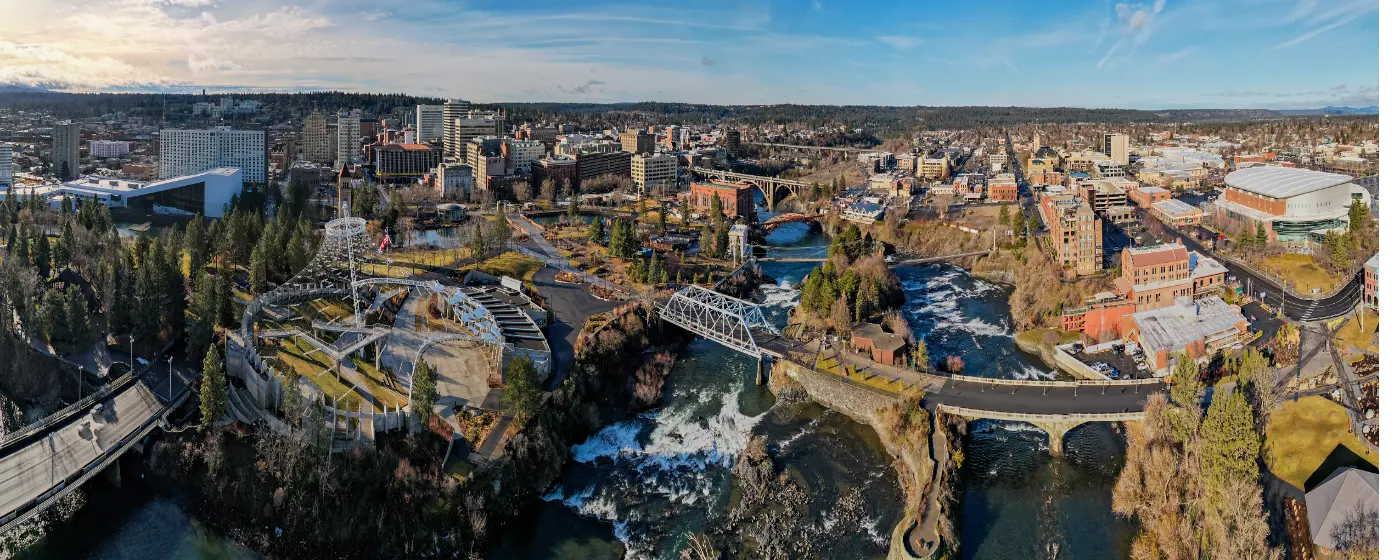
Maybe your company is relocating you here. Maybe you've been priced out of Seattle and someone mentioned Spokane. Either way, the first thing people notice — and nobody quite warns them about — is the scale. Spokane is Washington's second-largest city, with roughly 230,600 residents, yet it operates at a pace that has nothing in common with the I-5 corridor. Positioned 280 miles east of Seattle near the Idaho border, the city sits along the Spokane River in the shadow of the Selkirks and Cascade Range, with downtown built right around Spokane Falls. The Inland Northwest isn't a consolation prize for people who couldn't afford the coast — it's a genuinely different way of living, and understanding that distinction is the whole point of this guide.
The economic backbone here is more diversified than outsiders expect. Fairchild Air Force Base, roughly 10 miles west of downtown, anchors a significant military and defense presence. Gonzaga University draws students and faculty from across the country and fuels the Logan/Gonzaga District's energy year-round. A major regional health system and a second large health system together make healthcare the city's single largest employment sector — between clinical staff, administration, and support roles, they touch nearly every corner of the local economy. Amazon has established a logistics footprint here as well. Spokane Public Schools (District No. 81) holds a B rating, according to Niche, and serves the city's families across a wide geographic spread — the district's performance is uneven enough by school and neighborhood that boundary research matters before you buy.
Housing is the number that stops Seattle-area and California-area transplants mid-sentence. The Zillow Home Value Index put Spokane's typical home price at $403,557 as of June 2026 — a figure that would be unremarkable in a Tacoma suburb but represents genuine accessibility in a city with a riverfront park, a walkable downtown arts district, and 260 sunny days a year. The median household income of $70,064 runs somewhat below the national median, so wages are part of the calculation too. Day-to-day life here means four real seasons, a park system spanning nearly 4,000 acres, and weekend access to Mt. Spokane, Riverside State Park, and the 39-mile Centennial Trail without ever leaving the metro area.
Whether you're weighing a job offer, following a partner's transfer, or simply deciding whether Spokane belongs on your short list, the sections below break down the city's neighborhoods, housing market, commute patterns, top employers, and what daily life here is actually like once the moving truck leaves.
Spokane at a Glance
Looking to buy in Spokane? Estimate your payment.
Enter your numbers to see an estimated monthly mortgage payment.
Estimate only. Excludes HOA fees and mortgage insurance. The interest rate above is a starting point, not a quoted rate — replace it with your own to see real numbers. Insurance is a flat placeholder, not a Spokane quote.
Why Are People Moving to Spokane?
Spokane keeps attracting people for the same three reasons: price, pace, and proximity to the outdoors. What they don't always anticipate is how quickly those reasons stop feeling abstract once they're actually living here.
The Price Reality
A typical home that would push well past seven figures in Seattle or the Eastside sits in the low-to-mid $400,000s here — not in a declining market, but in one where inventory is genuinely tight and homes routinely go to pending within 15 days. That gap has been the dominant driver of in-migration for the past several years, and it hasn't closed.
Washington's lack of a state income tax means Spokane's affordability compounds over time in a way it wouldn't in Oregon or Idaho. The effective property tax rate of approximately 0.83% is one of the more manageable in the region. For the fuller cost picture, see the Spokane cost of living page.
The Employers Drawing People In
Fairchild Air Force Base is the city's most consequential single employer for relocation purposes — a permanent installation with thousands of active-duty personnel and civilian staff cycling through on orders. If you're military, Spokane knows how to receive you.
Gonzaga University isn't just a basketball program. It's a full research and employment ecosystem in the University District, drawing academics, administrators, and the kind of supporting economy — independent bookstores, coffee shops, a dense rental market — that follows a serious institution. The healthcare sector spans two major systems and extends into research, medical education, and outpatient care across the metro.
Amazon's logistics presence has added warehouse and distribution jobs at scale on the south end of the city. These aren't remote positions — they're roles that require showing up, and they've contributed to a broader working-class stability that balances Spokane's higher-ed and military anchors.
Who Actually Moves Here
| Buyer Type | What Draws Them | Best Fit |
|---|---|---|
| Commuter Military families | Fairchild AFB proximity; established PCS infrastructure | Airway Heights, North Indian Trail, West Plains |
| First-Time Young professionals | Attainable prices; downtown job access; walkable neighborhoods | Kendall Yards, Browne's Addition, Logan/Gonzaga |
| Families Relocating parents | Suburban feel with city amenities; outdoor access; school options | South Hill, North Indian Trail, Manito Park area |
| Tech Remote workers | Cost arbitrage vs. Seattle; real estate upside; lifestyle quality | Kendall Yards, Browne's Addition, South Hill |
| Value Western WA refugees | Same state, no income tax, fraction of the housing cost | South Hill, Spokane Valley, Liberty Lake |
| School Higher-ed faculty/staff | Gonzaga University; Washington State University Spokane campus | Logan/Gonzaga District, Manito Park area |
The one honest caveat: wages follow the local market, not the Seattle market. Remote workers bringing a Seattle or Bay Area salary to Spokane housing prices are in an enviable position. Local hires should model income carefully before assuming the lower cost of living entirely offsets the gap.
What People Don't Expect
Six months in, a lot of newcomers say the same thing: the community is more interconnected than they anticipated. Spokane has the footprint of a city and the social fabric of a large town — you run into people, neighborhoods have regulars, and a Friday evening at Riverfront Park or along the Centennial Trail feels genuinely communal rather than anonymous.
The winter is also more of a factor than the 260-sunny-days statistic implies. Snow falls, roads ice, and the south-facing slopes of South Hill drain faster than the flats. Buyers who don't account for that in their neighborhood choice occasionally regret it come January.
What Daily Life Feels Like in Spokane
Spokane doesn't ask you to choose between urban amenities and outdoor access — it just requires you to drive to both, because most of the city is built around the assumption that you have a car.
The Rhythm of a Week Here
Downtown is genuinely walkable within its core: the Riverfront Park loop, the Monroe Street Bridge, the downtown performing arts theater, and the regional arts and culture museum are all within easy reach of each other. That walkability doesn't extend far past downtown's edges, which is worth knowing if you're comparing Spokane to a city where on-foot access is the default.
The bus rapid transit route that opened in July 2023 changed the calculus slightly. Running 6 miles from Browne's Addition through downtown and the University District to Gonzaga University and on to Spokane Community College, it draws around 2,400 weekday riders and is genuinely useful if your life falls along that corridor. A second BRT line is planned along Division Street, with service expected between 2027 and 2029.
Seasons Shape Everything
Summer in Spokane is legitimately spectacular — warm and dry, with the Spokane River running high through June and the Centennial Trail busy from dawn to dusk. Lilac season in May is when the city feels most like itself: the annual lilac festival has run for decades, and Manito Park's blooms draw people from across the region.
Winter is the honest part of the bargain. The city averages meaningful snowfall, and the elevation difference between neighborhoods means South Hill and the ridgeline areas stay icy longer than downtown. Mt. Spokane Ski Area is less than an hour away, which reframes that reality for people who ski — the same snow that complicates your commute is what you're driving toward on weekends.
Food, Culture, and Where People Actually Go
The dining scene has grown faster than Spokane's national reputation has caught up with it. No-Li Brewhouse on E Trent Ave has become a genuine local gathering point — the outdoor beer garden draws crowds on warm evenings, and the brewery's reputation extends well beyond the city. Brick West Brewing on W 1st Ave anchors the downtown taproom scene, close enough to Riverfront Park to make a summer evening there easy to plan.
The downtown performing arts theater brings touring Broadway productions, the symphony, and major concerts to a beautifully restored 1931 venue at the center of downtown. The regional arts and culture museum holds the largest collection of Inland Northwest Native artifacts in the Pacific Northwest. These aren't footnotes; they're the cultural infrastructure that makes Spokane feel like a real city rather than a large suburb.
The Geographic Divide Worth Knowing
The Spokane River and the bluffs that frame it create a real psychological split between the north and south sides of the city. South Hill is quieter, more residential, and traditionally where families with school-age children have concentrated. North of downtown feels more urban, more transient near the university, and more industrial as you move toward Hillyard. Buying without understanding this distinction is one of the most common mistakes relocating buyers make. For a full breakdown, see the Spokane neighborhoods guide.
The Spokane Housing Market Right Now
Spokane's housing market in mid-2026 is best described as tight and competitive despite a slight price softening. The Zillow Home Value Index put the typical home price at $403,557 as of June 2026 — down just 0.3% from the prior year, a figure that suggests stability rather than any meaningful correction.
How Fast Things Move
Homes are going to pending in roughly 15 days. That pace reflects limited inventory rather than a frenzy of demand — new construction hasn't kept up with population growth, particularly at the entry-level and mid-range price points where most buyers are competing. If you're serious about a neighborhood, you'll need to be ready to move quickly.
Some areas of the city carry notably higher price points than others — the gap between Spokane's most desirable established neighborhoods and its more affordable corners is significant. For neighborhood-level detail, the best neighborhoods page covers that breakdown fully.
What the Market Means for Buyers
Compared to the west side of the state, Spokane's prices remain noticeably lower — enough that buyers relocating from the Seattle metro or Eastside often feel they have room to be selective. That room is real, but it's smaller than the raw price gap implies: wages here are lower too, and the combination matters when you're qualifying.
Rental inventory is similarly compressed. For city-wide rent figures and a full cost breakdown, the cost of living page has the current numbers. The effective property tax rate of approximately 0.83% is one of the lowest in Washington, which helps on the carrying-cost side of the ledger.
Who the Market Suits Right Now
Buyers with flexibility on timing and neighborhood have the clearest path — the 15-day pace rewards preparation rather than speed for its own sake. The market is more forgiving than Seattle's peak years, but it is not a buyer's market by any conventional measure.
Spokane Neighborhoods
Spokane has several distinct areas — each with its own character and appeal. Here’s a breakdown to help you narrow down where to focus your home search.
🏡 Browne's Addition
Spokane's oldest residential neighborhood sits just west of downtown with Victorian and Craftsman architecture lining streets within walking distance of the Centennial Trail and the neighborhood's central park. It suits buyers who want urban texture — independent restaurants, walkable blocks, and a neighborhood identity — without paying downtown condo prices.
🏠 South Hill
South Hill is the city's largest residential district, stretching south from downtown across a series of ridgelines with Manito Park at its center. Families with school-age children have traditionally concentrated here for the quieter streets, larger lots, and proximity to the park's rose garden, duck pond, and conservatory.
🌳 Kendall Yards
A planned mixed-use development on the north bank of the Spokane River, Kendall Yards sits on approximately 78 acres immediately adjacent to downtown with the Centennial Trail running along its southern edge. It draws buyers who want modern construction, riverfront access, and walkable proximity to downtown without the density of a traditional urban neighborhood.
🏘 Manito/Cannon Hill
The blocks surrounding Manito Park on the upper south side carry some of the city's most established residential character — mature trees, well-maintained older homes, and a neighborhood pace defined by proximity to some of Spokane's best green spaces. It tends to attract buyers who prioritize quiet, walkable streets and proximity to the park over urban nightlife.
🏔 West Central
West Central is an evolving neighborhood northwest of downtown along the Spokane River corridor, currently among the city's more affordable entry points for buyers willing to accept a neighborhood in transition. The Centennial Trail runs nearby, and incremental investment in the area has accelerated — but the pace of change remains uneven.
🌆 Hillyard
Hillyard sits on the northeast side of the city, a working-class neighborhood with roots in Spokane's early railroad economy and housing stock that reflects that history. Entry prices run among the lowest in the city proper, and it suits buyers prioritizing price per square foot over proximity to downtown amenities.
Pros & Cons of Living in Spokane
The Pros
- Housing and overall cost of living well below Puget Sound metros
- Four distinct seasons with abundant year-round outdoor recreation
- Growing healthcare
- education
- and logistics job base
- Strong small-city arts
The Cons
- Crime rate runs notably higher than the national average for a city its size
- Cold
- snowy winters with fewer sunny days than the U.S. average
- Median household income trails the Washington state average
Getting Around & Commuting in Spokane
Spokane is a driving city. Understanding that upfront saves a lot of frustration for people relocating from transit-oriented metros — and it also reveals where the real commute advantages are.
The Core Commute Reality
Downtown Spokane sits roughly 20 minutes from most residential neighborhoods under normal conditions. That's the baseline — and compared to Seattle or Portland, it's almost disorienting. A commute from South Hill to a downtown office that would be 45 minutes in traffic in a major coastal city is typically 15 to 20 minutes here, even during morning peak hours.
The primary east-west corridors are I-90 and the surface streets that parallel it. North-south movement runs along Division Street and Maple/Ash — the latter a one-way pair through the South Hill and downtown transition zone that newcomers need to learn quickly. Interstate 90 also connects Spokane to Spokane Valley and the Idaho border, where Coeur d'Alene sits about 30 miles east — a genuine cross-state commute that a meaningful number of residents make daily.
Fairchild Air Force Base Access
The base sits on the west side of the city, accessible via I-90 to US-2. For military personnel and civilian employees commuting from the north or east sides of the city, the drive can stretch toward 30 to 40 minutes during peak periods. Airway Heights and the West Plains neighborhoods exist largely because of that commute — they're the closest residential options to the flight line.
Transit: Better Than Its Reputation, Not Yet a Full Alternative
The Spokane Transit Authority operates 51 bus routes across a 248-square-mile service area, with 2025 ridership of approximately 10.94 million — a real system, not a token one. The bus rapid transit line that opened in July 2023 is the network's most useful route for anyone living or working between Browne's Addition and Gonzaga University. The $2.00 standard fare and free rides for anyone 18 and under (expanded after voters passed STA Proposition 1 in August 2026) make it accessible.
Outside that BRT corridor, STA bus service is functional but infrequent enough that most Spokane residents still structure their lives around car ownership. The planned Division BRT — a 9-mile north-south corridor along Division Street, with construction targeting a start in 2026 and service between 2027 and 2029 — will be the biggest expansion of true rapid transit the city has seen. It won't replace a car for most households, but it will make car-optional living genuinely feasible in a wider swath of the city.
Driving Patterns Worth Knowing
The Monroe Street corridor through the center of town is one of those streets that looks straightforward on a map and regularly isn't during school drop-off and afternoon pickup windows. Division Street, running north through the commercial spine of the north side, backs up predictably between 4:30 and 6 p.m. on weekdays.
Snow changes everything. The city has a snow-route system, and knowing which streets are priority-cleared versus which aren't is genuinely useful knowledge for anyone buying in a hillside neighborhood. South Hill's steeper cross streets can be impassable for a day after a significant storm even when the main arterials are clear.
Spokane International Airport
Spokane International Airport (GEG), about 5 miles west of downtown, serves direct flights to Seattle, Portland, Denver, Los Angeles, Phoenix, San Francisco, and Las Vegas among others. The airport is small enough to be stress-free on a normal travel day — park-and-fly without the anxiety of SeaTac. For international connections, Seattle-Tacoma International Airport is the usual routing, reachable by a roughly 4.5-hour drive or a quick hop on Alaska Airlines.
Schools in Spokane
Families relocating to Spokane have public, private, and higher-education options nearby. Here’s a quick overview.
🎓 School District
Spokane Public Schools (School District No. 81) serves K–12 students across Spokane and the surrounding area. Rated B (source: Niche.com).
🏆 Graduation Rate
The 4-year high-school graduation rate here is approximately 90.4%.
📚 Higher Education
Washington’s public universities — the University of Washington, Washington State University, and Western Washington University — offer four-year degrees statewide, with a network of 34 community and technical colleges (SBCTC) providing two-year and workforce programs.
🌐 Online Learning
University of Washington Continuum College and Washington State University Online offer fully accredited online degrees for remote learners across the state.
Safety in Spokane
A quick look at how Spokane compares on the numbers that matter most when weighing a neighborhood or a move.
🛡 Violent Crime
Approximately 6.75 per 1,000 residents.
🔒 Property Crime
Approximately 48.4 per 1,000 residents.
Compared to the FBI’s most recent national data (2024), Spokane’s violent crime is above the national average (about 3.6 per 1,000), and property crime is above the national average (about 17.6 per 1,000).
Against Washington as a whole, Spokane’s violent crime is about double the state average, and property crime is about double the state average (Bureau of Justice Statistics, Crime Known to Law Enforcement, 2024 (tables 2 and 3)).
Crime rates can vary a lot within a single city, so the citywide numbers above are only a starting point. Some neighborhoods in Spokane run well below these averages, while others run higher — the kind of block-by-block detail that matters most when you’re actually choosing where to live. The full guide below breaks it down neighborhood by neighborhood.
Working in Spokane
Spokane’s largest employers span several industries — here are some of the anchors of the local job market.
🏥 Providence Health & Services
Healthcare
🏛 Fairchild Air Force Base
Military/aviation
🎓 Gonzaga University
Higher education
🏥 MultiCare Health System
Healthcare
💼 Amazon
Logistics
Parks & Recreation in Spokane
Some of the outdoor spaces that shape everyday life in Spokane.
🌱 Riverfront Park
🌱 Spokane Falls
🌱 Manito Park
Spokane residents don’t have to go far for green space — spots like Riverfront Park and Spokane Falls are part of everyday life here, whether that’s a morning walk, a weekend hike, or just somewhere to unwind outside. The full guide below covers more of what Spokane has to offer for parks and outdoor recreation.
Retiring in Spokane
Spokane draws retirees for its balance of amenities, outdoor access, and cost. Here’s what to weigh.
🌤 Climate
Spokane delivers four distinct seasons with approximately 260 sunny days per year — the summers are warm and dry, the falls are vivid along the river bluffs, and winters bring real snow that averages in the 20-inch-per-year range. Retirees who grew up with seasons tend to feel at home; those expecting a mild Pacific Northwest climate are sometimes surprised by how genuinely cold January gets.
🍴 Lifestyle
The downtown performing arts theater hosts the Spokane Symphony and touring Broadway productions in a restored art deco venue. The regional arts and culture museum sits near the west end of downtown with rotating exhibitions and permanent Inland Northwest history collections. Manito Park, with its formal rose garden and duck pond, functions as the city's living room for the south side — the kind of place where retirees spend a weekday morning without any particular agenda.
🏚 55+ Communities
The Spokane metro has a range of active-adult and senior-living options, from independent communities clustered on the south side of the city to assisted-living facilities distributed across the metro. Liberty Lake and Spokane Valley both have newer construction active-adult developments that draw retirees seeking single-story homes with HOA maintenance. For details on healthcare access and specific senior living options, the retiring in Spokane page has the full breakdown.
✈ Getting Around
Most retirees in Spokane drive — the city's layout assumes it, and parking is generally manageable by urban standards. Spokane International Airport, about 5 miles west of downtown, offers direct service to major hubs without the stress of a large airport. Within the city, the bus rapid transit route is a practical car-free option for trips along the Browne's Addition-to-Gonzaga University corridor, and the Spokane Transit Authority offers reduced fares for eligible riders.
🏛 Washington Taxes for Retirees — What to Know
- No state income tax — Washington does not tax personal income, so Social Security, pensions, and 401(k)/IRA withdrawals are all untaxed at the state level. There is no state return to file and no retirement exclusion to claim — the rate is simply zero.
- Military and public pensions — Because there is no income tax, military retirement pay and public-employee pensions are untaxed at the state level along with everything else.
- Sales tax is the tradeoff — The state sales tax is 6.5%, and local add-ons bring the combined rate in Spokane to 9.1% (Washington State Department of Revenue, Q3 2026 local sales & use tax rate table, July 2026). Groceries and prescription drugs are exempt.
- Property taxes, with senior relief — The effective property tax rate is roughly 0.9%. Homeowners 61+ (or unable to work due to disability, or a qualifying disabled veteran) who own and occupy their home may qualify for a reduction. Income limits are set against each county’s median household income, so the threshold differs by county — check with your county assessor. A separate deferral program is available for those who don’t qualify for the exemption.
- Capital gains tax — but not on retirement income — Washington taxes 7% on long-term capital gains above a $278,000 standard deduction for 2025, rising to 9.9% on gains above $1,000,000. Retirement accounts and real estate sales are both exempt. It therefore does not reach ordinary retirement income or the sale of a home.
- Estate tax — the one to plan for — Unlike most no-income-tax states, Washington has its own estate tax. For deaths on or after July 1, 2026, the exemption is $3 million with graduated rates topping out at 20%. Retirement accounts count toward the taxable estate, so long-time homeowners with sizable balances can cross the line without expecting to.
- No inheritance tax — Washington has no inheritance tax, and no gift tax.
- WA Cares payroll premium — Working Washingtonians pay 0.58% of gross wages into the WA Cares Fund, the state long-term care program, with no income cap. It applies to W-2 wages, so retirees who have stopped working do not pay it — but anyone relocating while still employed will see it. The private-insurance opt-out closed at the end of 2022 and is not available to new applicants; the remaining exemptions are narrow (living outside Washington, military spouses, certain visa holders, and veterans with a 70%+ service-connected rating).
- The Oregon border effect — Oregon has no sales tax, so Washington residents near the river — Vancouver, Camas, Washougal, Longview — often cross over for large purchases. Washington use tax technically applies to goods brought back for use in-state, though it is rarely enforced on ordinary personal purchases.
Tax laws change frequently and individual situations vary. This is general information, not tax advice — always consult a qualified Washington tax professional or CPA for personalized retirement tax planning.
Weekends & Local Favorites in Spokane
The city's outdoor infrastructure is what longtime residents point to first when asked why they stay. Nearly 4,000 acres of parks and natural lands — across nearly 120 properties — means weekends here have a low floor and a high ceiling depending on how much effort you want to put in.
The Centennial Trail as a Way of Life
The 39-mile Spokane River Centennial Trail is not a weekend destination — it's infrastructure. Running from Nine Mile Falls in the west to the Idaho state line in the east, it passes through Riverside State Park, the Kendall Yards neighborhood, and Riverfront Park before continuing another 24 miles into Coeur d'Alene. Cyclists, runners, and families with strollers use it on weekday mornings. The stretch through Kendall Yards, where the trail runs along the river with downtown visible on the bluffs above, is the postcard image of Spokane that residents actually live inside.
Riverfront Park and Downtown on Foot
Riverfront Park, rebuilt significantly in recent years, sits at the center of downtown Spokane with direct views of the falls. The Looff Carrousel — a 1909 hand-carved carousel that has been running continuously for over a century — is still there, still operating, and is genuinely one of those things that surprises people who assumed they'd seen it all. The park's event calendar fills from May through September.
Browne's Addition, just west of downtown, is where the city's independent restaurant and bar scene concentrates most densely. It has the feel of a neighborhood that knows what it is — Victorian houses, tree-lined streets, and the kind of local establishments that have been there long enough to have regulars. No-Li Brewhouse on E Trent Ave and Brick West Brewing on W 1st Ave anchor the city's craft beer scene on opposite ends of the downtown core.
The Outdoors as a Weekend Anchor
Mt. Spokane Ski and Snowboard Park is less than an hour's drive from downtown — close enough that locals treat it as an after-work option in deep winter rather than a trip requiring planning. Riverside State Park, northwest of downtown, has 55 miles of trails and sits within the city's own footprint. Farther east, Coeur d'Alene and its lake are a 30-minute drive — a meaningful asset when summer temperatures rise and a mountain lake becomes the obvious answer.
Arts and Culture Year-Round
The downtown performing arts theater draws touring Broadway productions and hosts the Spokane Symphony in a space that is genuinely beautiful — a restored art deco venue that seats 2,000 and still feels like an event to walk into. The regional arts and culture museum on the west side of downtown holds the largest collection of Inland Northwest Native materials in the country, alongside regional history exhibitions that give Spokane's past a specificity most newcomers don't expect to find.
The annual lilac festival each May — culminating in a large illuminated night parade that draws crowds from across the region — is the event that makes Spokane feel most like a city with a genuine civic identity. If you're visiting before deciding whether to move, try to time it for lilac season. It will tell you something true about the place.
Top Things Locals Say About Spokane
The best intel about a city comes from the people who actually live there. Here’s what Spokane residents say when newcomers ask the questions everyone’s thinking.
“I expected to miss the energy of a bigger city, but what actually surprised me was how quickly I found a routine here — the same trail section on the Centennial, the same Saturday market crowd, the same faces at the neighborhood brewery. Six months in, Spokane felt more like a place I actually lived than anywhere I'd rented before.”
— Recent Spokane home buyer
“What's the most surprising thing about living in Spokane?”
How genuinely close everything is — not just by distance but by time. People who move here from Seattle or Portland spend the first few months waiting for the traffic that never arrives. The drive from South Hill to Riverfront Park at 5:30 on a Friday is 15 minutes. That stops feeling remarkable eventually, but it takes longer than you'd think.
“What do locals love most about Spokane?”
The Centennial Trail is the honest answer from most people who've been here a few years. Thirty-nine miles of paved trail along the river, accessible from Kendall Yards or Riverside State Park, and it connects all the way to Coeur d'Alene if you're ambitious. The downtown performing arts theater on a symphony night is another one — you dress up, you walk a few blocks, you're in a 1931 art deco room listening to a real orchestra. It's the kind of thing that sounds boosterish until you actually do it.
“What should newcomers to Spokane know?”
Learn the snow routes before November. South Hill looks beautiful until there's four inches on the ground and the cross streets turn into luge runs. The city prioritizes arterials, so if you're on a residential block off of a main street, you may be waiting a day. Also: Division Street north of downtown backs up predictably between 4:30 and 6 p.m. on weekdays — if you can shift your schedule by 30 minutes, it's worth it.
“Can you live in Spokane without a car?”
Along the bus rapid transit corridor — running from Browne's Addition through downtown to Gonzaga University — yes, practically. Elsewhere in the city, it's genuinely difficult. The Spokane Transit Authority's 51 routes cover a wide service area but run infrequently enough outside core corridors that car-free living requires building your life around the schedule. The Division BRT planned for 2027–2029 will expand car-optional options north-south, but for now, most Spokane residents own at least one vehicle.
Cities Near Spokane
Other communities near Spokane worth a look — each with its own character and price point.
| City | Distance | Best For | Vibe | Median Rent | Median Buy |
|---|---|---|---|---|---|
| Spokane Valley | 10 mi | families, value buyers, easy I-90 access | suburban, affordable, straightforward | $1,300 | $430,000 |
| Liberty Lake | 18 mi | new construction, lake lifestyle, families | planned, quiet, upscale suburban | $1,500 | $480,000 |
| Cheney | 16 mi | Eastern Washington University students, budget buyers | college town, rural-adjacent, affordable | $1,150 | $350,000 |
More Helpful Guides for Spokane
Going deeper on Spokane? Our blog series covers everything from first-time buying to retiring here — explore the guides below.
Local Expert Takeaway: Spokane's real advantage is the combination of scale and accessibility — a city large enough to have the Spokane Symphony, a bus rapid transit line, and two major university hospitals, small enough that you can drive from South Hill to Riverfront Park in 15 minutes on a Tuesday evening and actually find parking. The Centennial Trail trailhead at Kendall Yards and the downtown performing arts theater are a 10-minute walk from each other. That proximity is what makes Spokane livable rather than just affordable.
Quick Takeaways & FAQs
✅ Spokane's Zillow Home Value Index sits at $403,557 (June 2026) — a genuine entry point into Washington homeownership that remains noticeably below the state's west-side metros.
⚠️ Property crime rates here run higher than many buyers expect from a mid-sized city — the safety page has the full breakdown, and neighborhood selection matters more than the city-wide average suggests.
📍 The bus rapid transit route running from Browne's Addition through downtown to Gonzaga University is one of the only truly car-optional corridors in the city, and a meaningful factor if your life aligns with that route.
Is Spokane, WA a good place to live?
What is the typical home price in Spokane, WA?
What are the major employers in Spokane?
How bad is traffic in Spokane?
What neighborhoods should I consider when moving to Spokane?
Helpful Links for Moving to Spokane
Moving to Washington?
Tell us what you need help with and we'll connect you with local resources.
