
Maybe your financial planner ran the numbers and Spokane keeps landing near the top of the list. Maybe your kids are here, or a friend retired here two years ago and won't stop talking about it. What surprises most newcomers after six months isn't the winters — it's how complete the city feels at this price point. A Zillow Home Value Index of $403,557 (June 2026) puts you in a city with genuine cultural institutions, a riverfront park that anchors daily life, multiple hospital systems, and a downtown restaurant scene — none of which you'd expect for what amounts to a fraction of Seattle or Portland real estate.
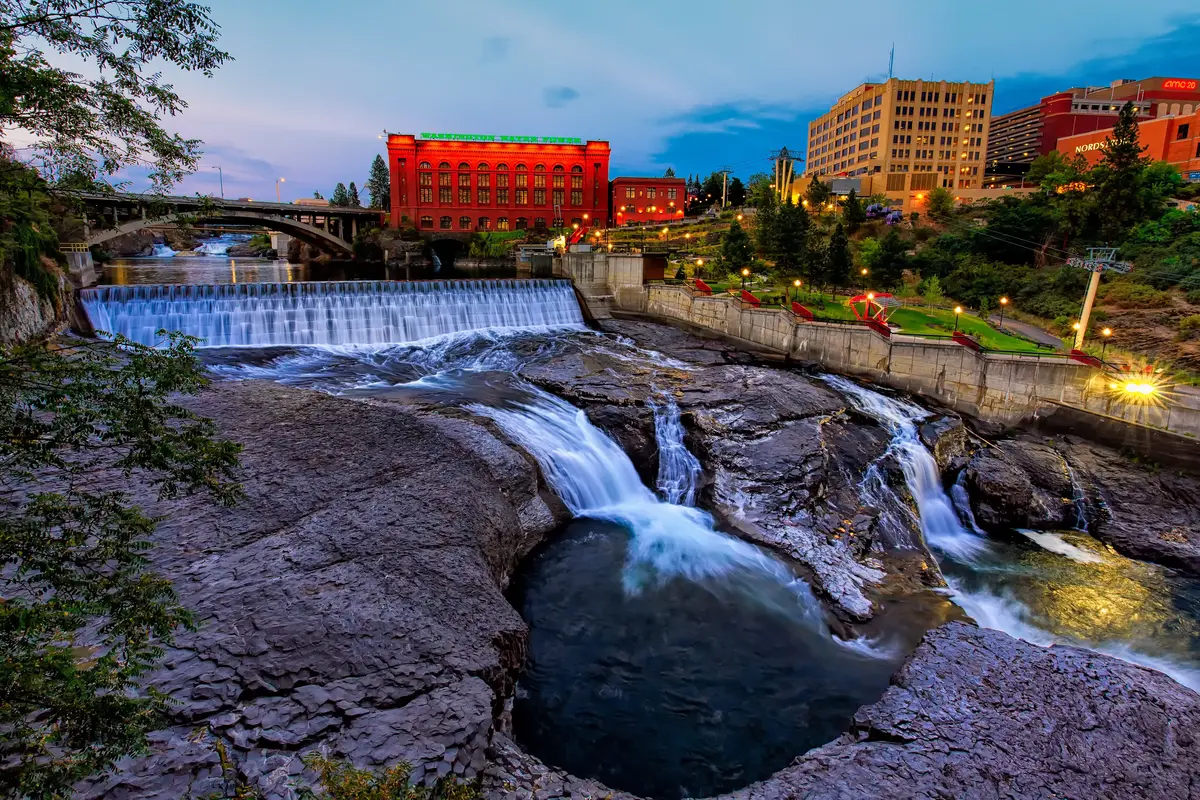
Spokane sits at the eastern edge of Washington state, roughly 280 miles from Seattle and 20 miles west of Coeur d'Alene, Idaho, straddling I-90 and US-395. The Spokane River runs through the middle of the city, and Riverfront Park — the 100-acre legacy of the 1974 World's Fair — gives retirees a genuine daily anchor for walking, the farmers market, and the historic Looff Carrousel. Providence Health & Services and MultiCare Health System together operate the city's major hospitals, giving Spokane a depth of medical infrastructure that would be unusual in a metro of this size. Gonzaga University and the WSU Health Sciences campus keep the city intellectually alive in ways that matter to retirees who want lectures, concerts at the Martin Woldson Theater at the Fox, and an engaged community rather than a sleepy suburb.
Washington's no-state-income-tax structure is the financial headline: Social Security, pension distributions, IRA withdrawals — zero state tax on any of it. Spokane's overall cost of living runs roughly 3% below the U.S. national average and noticeably below the Washington state average, so your retirement dollar actually stretches here. That said, Spokane is not a perfect fit for everyone. The city's Walk Score averages 49 overall, meaning a car is genuinely necessary unless you choose a specific downtown or South Hill address deliberately. Winters bring cold snaps and real snowfall — not enough to deter most retirees who grew up in the Midwest, but a genuine consideration for those arriving from Arizona or coastal California.
Whether you're weighing the move seriously or just doing early research, the sections below cover Spokane's healthcare infrastructure, the retirement tax picture, what daily costs look like on a fixed income, where active adults actually gather, how the downsizing market works here, and how Spokane stacks up against nearby retirement alternatives like Coeur d'Alene and Liberty Lake.

Why Retirees Are Choosing Spokane
The honest case for Spokane in retirement starts with two things that rarely coexist: genuine urban infrastructure and genuinely affordable housing. A Zillow Home Value Index of $403,557 (June 2026) gets you into a real city — not a retirement outpost — with multiple hospital systems, a performing arts scene anchored by the Martin Woldson Theater at the Fox, the Northwest Museum of Arts & Culture (MAC), and a downtown that has noticeably matured over the past decade. Retirees coming from larger coastal metros frequently report that Spokane delivers about 80 percent of what they had at 50 percent of the cost.
Spokane fits best for retirees who want a four-season city without four-season prices, who have a car and aren't counting on walking to every errand, and who want to be within striking distance of serious outdoor recreation — Riverside State Park, the Centennial Trail, and multiple ski areas within two hours. It also works well for grandparents whose adult children already live in the metro, since Spokane's size (roughly 230,000 people) means you don't feel isolated but you're not navigating a truly large city either.
Who should look elsewhere? Retirees who need mild winters should think hard — Spokane averages around 45 inches of snow annually and genuine cold snaps in January and February. Anyone who truly needs to walk everywhere, and isn't willing to choose a specific neighborhood deliberately, will find the city frustrating. And retirees accustomed to the specialist depth of a major academic medical center — Cleveland Clinic-level subspecialties — should understand that while Spokane's healthcare is strong for a city its size, the most complex cases still sometimes travel to Seattle or Portland. Those caveats aside, for the retiree who wants a real city with real cultural life at a price that doesn't require spending down principal, Spokane is a genuinely strong candidate.
Healthcare & Medical Access in Spokane
Spokane's medical infrastructure is the strongest argument for retiring here that most people don't know to make. The city functions as the regional referral hub for a wide swath of eastern Washington, northern Idaho, and western Montana — which means its hospitals are built to handle complexity, not just routine care.
The Hospital Landscape
Providence Sacred Heart Medical Center is the flagship. U.S. News & World Report ranks it the Spokane metro's Best Regional Hospital for 2025–26, with High Performing designations in Abdominal Aortic Aneurysm Repair and Spinal Fusion — two procedures that matter disproportionately as we age. MultiCare operates two facilities here: Deaconess Hospital, a Level III Trauma Center with certifications as a Chest Pain Center, a Total Joint Restoration Center, and an accredited Primary Stroke Center; and MultiCare Valley Hospital, which serves the eastern metro. Between them, retirees have eight hospitals within the metro, a high density of Medicare-registered physicians, and nearly 300 pharmacies.
The SeniorScore Reality
SeniorAdvice.com rates Spokane with a SeniorScore of 73 — one point above the national median and five points above the Washington state average — with its highest marks in Health & Safety and Recreation & Leisure. That composite reflects not just hospital count but doctor density and pharmacy access, which matter more than headline rankings for day-to-day retiree life.
The Honest Caveat
Spokane is strong for a city its size, but it is not a major academic medical center. Highly specialized oncology, complex cardiac surgery, and rare neurological subspecialties sometimes mean a referral to Seattle's University of Washington Medical Center, roughly a four-and-a-half-hour drive or a one-hour flight via Spokane International Airport. Most retirees will never hit that ceiling. But if you're managing a complex, actively monitored condition, have an honest conversation with your specialist about what's available locally before you commit.
The Retiree Budget in Spokane
Washington's tax structure is the first thing every out-of-state retiree should understand: the state levies no individual income tax. Your Social Security benefit, pension check, IRA distributions, and 401(k) withdrawals are entirely exempt from state taxation. That's not a small deal — it's one of the most retiree-friendly tax postures of any state west of the Mississippi.
Capital Gains: The Fine Print
Washington does have a 7% capital gains tax on long-term gains above approximately $278,000 (for 2025, indexed annually). The important detail for most retirees: transactions inside retirement accounts — 401(k)s, IRAs, Roth IRAs, defined-benefit plans — are fully exempt. So is the sale of a primary residence. The capital gains tax is effectively relevant only to retirees with significant taxable brokerage accounts making large, non-retirement-account trades in a single year. If that describes you, a Washington-licensed tax advisor is worth an hour of your time. If it doesn't, the no-income-tax benefit is yours, straightforwardly.
Property Taxes and Daily Costs
Spokane's effective property tax rate is approximately 0.83% — modest relative to much of the country and well below the rates retirees moving from Texas or Illinois will be used to. The engine's calculator below can model what that rate means for specific price points; the short version is that Spokane's property tax burden is not a deterrent for fixed-income budgeting.
For daily cost of living, Spokane runs approximately 3% below the U.S. national average overall, with housing costs roughly 13–14% below the national benchmark. Monthly rent for a two-bedroom averages around $1,138 — noticeably below comparable Pacific Northwest markets — which gives retirees who want to rent rather than own real flexibility. See the full cost-of-living breakdown for groceries, utilities, and transportation costs.
Looking to buy in Spokane? Estimate your payment.
Enter your numbers to see an estimated monthly mortgage payment.
Estimate only. Excludes HOA fees and mortgage insurance. The interest rate above is a starting point, not a quoted rate — replace it with your own to see real numbers. Insurance is a flat placeholder, not a Spokane quote.
Walkability, Community & Staying Active in Spokane
The city-average Walk Score of 49 means Spokane is car-dependent as a whole — but that figure flattens enormous variation. The downtown Riverside area scores 91, where retirees can walk to Frank's Diner on W 2nd Ave for breakfast, reach the Spokane Falls overlook in under ten minutes, and catch an evening performance at the Martin Woldson Theater at the Fox without touching a car key. Choose your neighborhood deliberately and Spokane can feel genuinely walkable.
Transit: Better Than It Looks
The Spokane Transit Authority's City Line bus rapid transit route, which opened in July 2023, runs 6 miles from Browne's Addition through downtown, the WSU Health Sciences campus, and Gonzaga University to Spokane Community College. Peak-hour buses arrive every 7.5 minutes and weekday ridership runs around 2,400 — real numbers for a mid-sized western city. Spokane has roughly 39 bus lines citywide, so retirees who plan ahead can cover medical appointments, errands, and social outings without always driving.
Senior Centers That Actually Do Something
The Corbin Senior Activity Center, run by the City of Spokane Parks and Recreation Department, is the genuine community hub most people don't discover until a neighbor tips them off. It offers foreign language classes, art, exercise, lapidary club, hiking groups, a dance club, monthly ethnic lunches, dinner theatres, AARP Tax Aid on-site, blood pressure checks, and foot care. It is emphatically not a waiting room with bingo — it's a full activity calendar. The Spokane Southside Community Center is a separate nonprofit that functions as a community anchor on the south side, running senior lunches, travel programs, volunteer coordination, and educational series. Both are worth a walk-through before you finalize any neighborhood decision.
Staying Active Outdoors
Manito Park on South Hill gives retirees formal gardens, a duck pond, and paved paths that are genuinely flat enough for daily walks well into one's 70s and 80s. Riverfront Park anchors the downtown end of the same equation. The parks and recreation page covers the full trail network, but the short version is that Spokane has 26 golf courses and 39 parks catalogued in its senior services database — outdoor options are not a weakness here.
Right-Sizing: Downsizing in Spokane
Downsizing in Spokane is a realistic move, not just a theoretical one. The median home price leaves meaningful room between what many retirees clear on a sale from a higher-cost metro and what they need to spend here — which is why cash buyers from Seattle and the Bay Area are a regular presence in the local market. The practical question is what form the right-sized home actually takes.
Single-Level and Patio Homes
South Hill has a solid inventory of ranch-style and single-level homes on larger lots — practical for aging in place and popular with buyers who want a yard without stairs. The trade-off is that South Hill is hilly (the name is honest), so walkability varies street by street. Kendall Yards, the master-planned development along the north bank of the Spokane River, offers newer construction townhomes and condos with river views and a short walk to the City Line BRT stop — a realistic no-car option for retirees who want urban proximity. Inventory in Kendall Yards skews newer and tighter in square footage, which suits downsizers but may require flexibility on price per square foot.
55+ and Active-Adult Communities
Spokane has a range of active-adult communities, though the market is not as deep as Phoenix or Palm Springs. Independent living campuses, continuing care retirement communities (CCRCs), and age-restricted patio home developments exist across the metro — concentrated in the South Hill corridor and in Spokane Valley to the east. The meaningful practical distinction is between independent living communities (social programming, optional meals, maintenance-free living) and CCRCs that include assisted living and skilled nursing on the same campus. If aging-in-place continuity matters to you, a CCRC gives you a single address through multiple care stages — worth understanding before you buy into a standalone patio home community that doesn't offer that path.
Renting as a Strategy
Average monthly rent running around $1,138 makes renting a genuinely viable first chapter in Spokane. Arriving as a renter for 12 months lets you discover which neighborhoods actually suit your daily life before committing to a purchase — a move that experienced local agents strongly endorse for out-of-state retirees who haven't spent a winter here yet.
Spokane vs Nearby Retirement Destinations
| City | Cost vs Spokane | Primary Hospital | Walkability | Senior Living Depth | Overall Retirement Fit |
|---|---|---|---|---|---|
| Spokane, WA | Anchor | Providence Sacred Heart + MultiCare Deaconess — regional referral hub | Car-dependent overall; downtown scores 91 | Good — CCRCs, independent living, patio home communities | Value Culture Strong all-around |
| Coeur d'Alene, ID | Noticeably pricier | Kootenai Health — solid regional hospital, one system | Moderate downtown core; car still needed | Growing — more limited than Spokane | Nature Views Beautiful but costs more and has shallower medical depth |
| Liberty Lake, WA | About the same to slightly pricier | Draws on Spokane systems — no independent hospital | Walkable town center; planned community feel | Modest — newer suburb, fewer established communities | Quiet Families Best for retirees who want suburban quiet and proximity to Spokane care |
| Spokane Valley, WA | About the same or slightly cheaper | MultiCare Valley Hospital on-site | Car-dependent; strip-mall suburban pattern | Good inventory — several established senior communities | Value Practical and affordable; lacks walkable culture |
| Cheney, WA | Noticeably cheaper | No major hospital — Eastern Washington University health clinic; relies on Spokane | Small-town, limited | Very limited — small college town | Quiet Budget-friendly but thin on services; best as a secondary property scenario |
| Airway Heights, WA | Cheaper | No independent hospital; draws on Spokane systems | Limited — auto-oriented | Limited — small, developing suburb | Entry-level price access to the Spokane metro; few retirement-specific amenities yet |
* Hospital and walkability characterizations are qualitative and based on 2025–26 available data; individual circumstances vary.
Coeur d'Alene is the most frequent comparison, and the honest read is this: it's a genuinely beautiful setting on Lake Coeur d'Alene, but you pay for it — it runs noticeably pricier than Spokane — and you accept shallower medical infrastructure. Retirees who prioritize waterfront scenery and can afford the premium tend to love it; those who want Spokane's hospital depth at that price point will find the math doesn't work. Liberty Lake is the right answer for retirees who want new construction, a quieter suburb, and easy access to Spokane's hospital systems without living in the city proper. Spokane Valley offers comparable value to Spokane itself with the MultiCare Valley Hospital as a genuine local asset, though the built environment is more suburban and less walkable. Cheney is genuinely inexpensive but thin on services — best as a rental base for someone who hasn't decided yet, not as a long-term retirement destination on its own.

Local Expert Takeaway: Spokane's retirement case rests on a combination that's harder to find than the brochures suggest: eight hospitals in the metro with Providence Sacred Heart ranked as the regional best, a Washington state tax structure that takes nothing from your Social Security or IRA, a Zillow Home Value Index of $403,557 that leaves real money on the table compared to coastal peers, and genuine daily anchors — Riverfront Park, Manito Park, the Corbin Senior Activity Center — that make retirement feel substantive rather than just affordable. The catch is that you need to choose your neighborhood deliberately (downtown Riverside or South Hill) rather than defaulting to wherever you find a deal, because Spokane's car-dependence is real in the wrong zip code. Pick the right block, and the lifestyle-to-cost ratio here is among the best in the Pacific Northwest.
Quick Takeaways & FAQs
✅ Washington levies zero state income tax on Social Security, pensions, and IRA withdrawals — a genuine financial advantage that compounds across a 20-year retirement.
⚠️ Spokane's city-average Walk Score of 49 means car-dependence is real; retirees who need walkable daily access must choose their neighborhood deliberately, or they will be frustrated.
📍 The Corbin Senior Activity Center on the north side and the Spokane Southside Community Center together form an active, free-to-low-cost social infrastructure that most newcomers don't discover until a neighbor shows them.
Is Spokane a good place to retire on Social Security and a modest pension?
How good is Spokane's healthcare for retirees?
Does Washington State tax retirement income?
What 55+ or active-adult communities are available in Spokane?
How does Spokane compare to Coeur d'Alene for retirement?
Moving to Washington?
Tell us what you need help with and we'll connect you with local resources.
