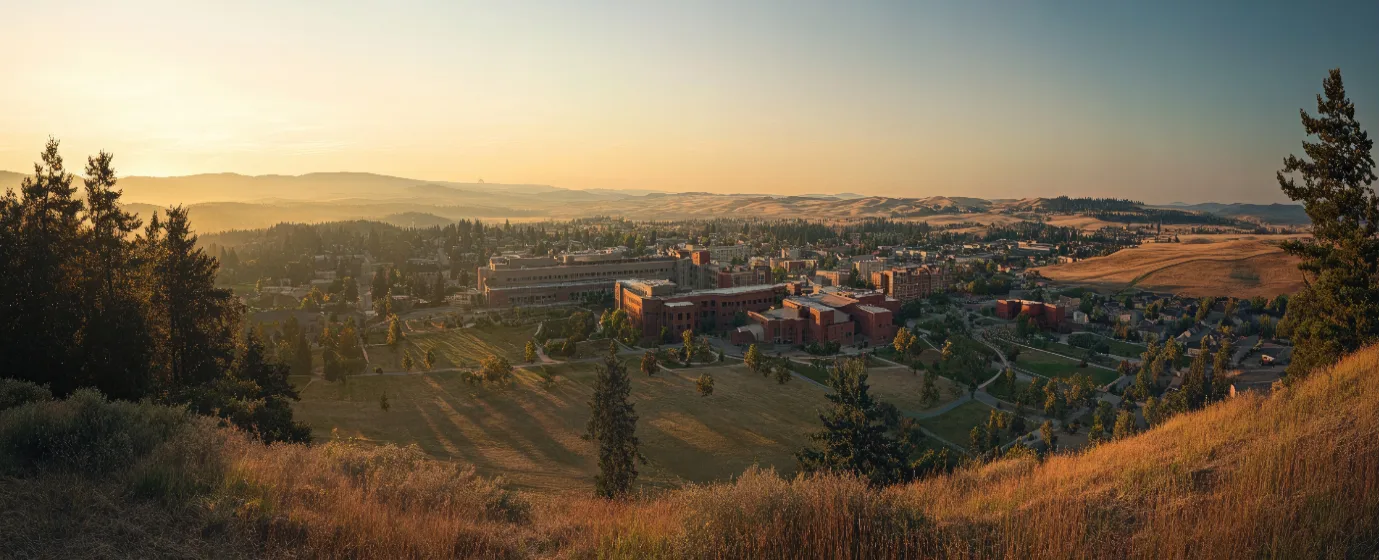
Most families moving to Pullman expect a college town. What surprises them — in a good way — is how much the Pullman School District punches above its weight for a city its size. With roughly 33,500 residents and a population dominated by Washington State University, you might assume the local K–12 system is an afterthought. Instead, you get a district that holds an A rating, according to Niche, a high school ranked among the top 30 in Washington State, and per-pupil spending of $16,231 — a figure more commonly associated with wealthy suburban districts than a Whitman County agricultural hub. The university's gravitational pull draws in faculty and staff families who expect strong academics, and the district has built its programs to match.
Pullman School District serves approximately 2,720 students across six schools: four elementary schools (Franklin, Jefferson, Kamiak, and Sunnyside), Lincoln Middle School, and Pullman High School. That's a compact system — which means principals and counselors actually know students by name, and a family new to town won't spend years trying to navigate a labyrinthine bureaucracy. The demographic mix reflects the university-town reality: 40% minority enrollment and 27.6% of students identified as economically disadvantaged, which means the district serves a genuinely wide range of households, from graduate student families to longtime Palouse farming families whose kids attend from the surrounding area.
Day-to-day family life here runs through Reaney Park, the Parks & Recreation youth leagues, and a high school that fields WIAA Class 2A teams in the Greater Spokane League. Families who want bigger-city amenities — select club leagues, regional tournaments — can access Spokane on a weekend without uprooting. The city's parks and trails add meaningful outdoor programming that rounds out the after-school calendar for kids of every age.
Whether you're relocating for a WSU position, a role at Schweitzer Engineering Laboratories, or simply drawn by the cost of living and the quieter pace of the Palouse, the sections below break down Pullman's school district rating and performance, the standout schools worth knowing, the youth sports landscape, and — honestly — who this district is and isn't the right fit for.

Pullman School District at a Glance
The district's strong performance isn't marketing spin — it reflects measurable outcomes across a small, well-managed system. The class of 2024 posted a 93.8% four-year cohort graduation rate, well above the Washington State average. SchoolDigger ranks the district 19th–20th out of 247 Washington districts, giving it a 5-star rating for the same period.
Spending per pupil at $16,231 (2025–2026) positions Pullman above most rural districts in the state. That money shows up in program depth: Gifted & Talented offerings at the elementary level, robust WIAA athletic participation at the high school, and a nationally recognized sustainability focus that the district has maintained for years.
| Metric | Pullman School District | Washington State Avg |
|---|---|---|
| District rating | A (Niche) | — |
| 4-year graduation rate (class of 2024) | 93.8% | ~83% (state avg) |
| Per-pupil expenditure | $16,231 | ~$14,500 (est.) |
| Total enrollment | ~2,720 students | — |
| Number of schools | 6 | — |
| Minority enrollment | 40% | ~49% |
| Economically disadvantaged | 27.6% | ~42% |
| PHS ELA proficiency (2024–25) | 81.76% | 53.1% |
| PHS Math proficiency (2024–25) | 53.53% | 42.63% |
| PHS Science proficiency (2024–25) | 77.96% | 49.38% |
The district's size is both its strength and its limit. Six schools means tight community cohesion — but also limited elective variety compared to a district of 10,000 students.
One practical note for parents arriving mid-year: elementary boundaries are drawn by neighborhood, so your address determines which of the four elementary schools your child attends. If you're considering homes in the Sunnyside or Grand Avenue area, confirm the boundary before you close.
Pullman High School: The Greyhounds in Numbers
Pullman High School sits on the north end of campus-adjacent Pullman, serving roughly 838–855 students in grades 9–12. The blue-and-gray Greyhounds compete in WIAA Class 2A, District Seven, in the Greater Spokane League — a classification that puts them against similarly sized schools in a competitive regional bracket, including cross-border rival Moscow High School just eight miles away in Idaho.
The 2024 U.S. News & World Report Best High Schools rankings placed Pullman High at No. 29 in Washington State and No. 1,623 nationally, evaluated across nearly 18,000 schools on college readiness, proficiency, and graduation rates. The school also earned a GreatSchools College Success Award for the 2024–25 school year — a recognition tied specifically to college enrollment and persistence rates, not just graduation.
The proficiency numbers tell the clearest story. In 2024–25, 81.76% of students scored proficient or above in ELA, compared to 53.1% statewide. Math proficiency came in at 53.53% against a statewide 42.63%. Science scored 77.96% versus the state's 49.38%. Every category lands meaningfully above the state benchmark.
What Drives the Numbers
The university-town effect is real. When a significant share of parents hold advanced degrees and work in research or engineering, that cultural expectation flows into how kids approach school. That's not a policy the district created — it's a demographic reality that the district has built programs around, including dual enrollment and AP course access for students who want to push ahead.
The catch, for families coming from large suburban districts, is range. A high school of 850 students in Class 2A will not have the elective catalog of a 2,500-student Class 4A school in Bellevue or Spokane Valley. Drama, music, and core sports are well-supported. Highly specialized electives — certain CTE pathways, specific world languages beyond Spanish — may be thinner.

Three Schools Worth Knowing
Franklin Elementary — The Academic Anchor
Franklin Elementary at 850 SE Klemgard Street enrolls roughly 274 students in grades K–5 and consistently performs at the top of the district and the state. SchoolDigger places it in the top 5.2% of Washington elementary schools. U.S. News ranks it No. 80 out of 1,110 Washington elementary schools — a figure that would be notable for any school, and striking for one in a city of 33,000.
Franklin also houses the district's Gifted & Talented program, making it the destination for families whose children have been identified for accelerated instruction. If your child qualified for a similar program in your previous district, check the identification process early — Pullman's GT pathway runs through Franklin regardless of which elementary your address boundary assigns.
Best for: Families with academically advanced kids or those prioritizing elementary-level program depth.
Lincoln Middle School — The Only Bridge
Lincoln Middle School at 315 SE Crestview is the district's sole middle school, serving all ~643 students in grades 6–8 before they transition to Pullman High. There's no choice here — every sixth grader in the district feeds into Lincoln, which creates a genuinely unified middle school community. The upside is that kids from all four elementary schools converge and build friendships early; the downside is that if Lincoln's culture or approach isn't working for your child, there's no within-district alternative.
Its direct feeder role to Pullman High means the curriculum alignment is intentional. Students aren't navigating a seam between two disconnected schools — the vertical alignment between Lincoln and PHS is one of the district's practical strengths.
Best for: All district families — this is the path, not a choice among paths.
Pullman High School — College-Track Culture
Beyond the rankings and proficiency scores already covered, the daily atmosphere at Pullman High reflects something harder to quantify: the proximity of WSU creates a baseline college-going expectation that most students absorb through proximity alone. Older siblings attend WSU. Neighbors teach there. The campus is walkable from neighborhoods like College Hill. That ambient academic pressure can be a genuine motivator for students who respond to it — and occasionally a source of stress for those who don't.
The GreatSchools College Success Award specifically recognizes schools where students don't just enroll in college but persist through the first year. That persistence metric is harder to fake than a test score, and it's the one families planning to raise college-bound kids should weigh most.
Best for: Students oriented toward four-year college pathways and families who value a small, cohesive high school culture over elective breadth.
Looking to buy in Pullman? Estimate your payment.
Enter your numbers to see an estimated monthly mortgage payment.
Estimate only. Excludes HOA fees and mortgage insurance. The interest rate above is a starting point, not a quoted rate — replace it with your own to see real numbers. Insurance is a flat placeholder, not a Pullman quote.
Youth Sports and Kids Activities in Pullman
Pullman Parks & Recreation runs one of the more complete youth athletic calendars you'd expect from a city this size, and families who show up in August are sometimes surprised by how much is already organized before school starts. The city's youth sports portal (sports.pullman-wa.gov) lists programming across every season of the year.
Year-Round Rec Leagues
Flag football and soccer run in the fall. Basketball fills the fall-winter window. Volleyball appears in both fall and spring. T-ball, baseball, and softball take the spring and summer. For the youngest kids — typically ages 3 to 5 — Pee Wee Sports gives them a first taste of structured play before they're old enough for the league formats. Seasonal sports camps supplement the league schedule throughout the year.
These leagues are genuinely beginner-friendly. Registration fees stay accessible, games are played locally, and the emphasis is on participation rather than travel. If your child is six and you're not ready to commit to a club-level schedule, Pullman's rec leagues are the right starting point.
WIAA Interscholastic Athletics at Pullman High
Pullman High School competes across a full slate of WIAA Class 2A sports in the Greater Spokane League. The Greyhounds program covers football, cross country, basketball, wrestling, soccer, baseball, softball, tennis, golf, swimming, and track and field — a full menu for a school its size. The Class 2A classification means PHS competes against schools with comparable enrollment, keeping postseason paths realistic for athletes who aren't Division I prospects but are genuinely competitive.
The Greater Spokane League rivalry with Moscow High School (eight miles across the state line) is one of the more geographically compressed high school rivalries in the Pacific Northwest. Greyhound-Bear games draw community-level attention that you don't always get in bigger districts where sports feel anonymous.
Club Sports and the WSU Effect
For families seeking club or select-level play, Pullman's small size creates a genuine tension. Fully developed club programs in sports like competitive soccer, club volleyball, or travel baseball typically require a critical mass of players and access to regional tournament infrastructure. Some club leagues run cross-border partnerships with Moscow, ID — the Palouse region gets treated as one market by many youth athletic organizations, which expands the pool in sports where a single-city model wouldn't be viable.
WSU's campus is an underappreciated resource for older kids. Youth enrichment programs, clinics run by university athletic programs, and summer camps hosted on campus give Pullman children access to collegiate facilities and coaching that most small cities can't replicate. It's not a formal pipeline — but a teenager who wants to develop in a sport or explore a new one has unusual access here.
Where Families Actually Gather
Reaney Park on the south end of town is the consistent answer when you ask Pullman parents where kids actually spend their weekends. The park anchors community events through the spring and summer, and the adjacent recreation infrastructure keeps it active year-round. On game days, the Greyhounds draw real community crowds — Martin Stadium on the WSU campus creates a football culture for the whole city, and that energy filters down to the high school level in ways that make Friday nights genuinely worth attending.
After a game or a Saturday soccer morning, Cougar Country Drive-In on N Grand Avenue has been the post-game stop for Pullman families for generations — and it's still running under new ownership as of spring 2025, keeping the tradition intact.
Who This District Is NOT the Right Fit For
A highly rated district with strong proficiency numbers doesn't mean it's the right match for every family. Honest relocation research includes knowing where the gaps are.
Families Who Need Elite Special Education Support
Pullman School District provides required special education services, but its small size limits the depth of specialized programming available on-site. Families whose children have complex IEPs — particularly those requiring intensive behavioral support, specialized communication programs, or medically complex accommodations — may find the district's resources stretched. The nearest larger districts with broader special education infrastructure are in Spokane. Have a direct conversation with the district's special education coordinator before assuming your child's current program can be replicated here.
Students Who Thrive on Elective Variety
If your teenager spent the last two years building a schedule around specialized courses — specific AP tracks, vocational CTE programs, multiple world languages, advanced music conservatory pathways — a school of 850 students in Class 2A has real constraints. Pullman High School covers the core breadth well. What it can't replicate is the elective depth of a 2,500-student school with 14 AP offerings and four different language tracks. Students who define their high school identity through elective exploration may find the catalog narrower than they're used to.
Families Prioritizing Private School Options
Pullman does not have a meaningful private school market. The nearest parochial or independent schools of any size are in Moscow, Idaho or Spokane. Families who have relied on private school as either a primary choice or a safety-valve option will be working with public school as the practical default — which is fine given the district's performance, but worth understanding before you arrive.
Highly Competitive Club-Level Athletes
A student-athlete with legitimate aspirations at the high club or AAU level in a sport like volleyball, basketball, or soccer will quickly run up against the Palouse's geographic reality. Select programs, showcase tournaments, and the exposure infrastructure that college recruiters watch require travel to Spokane or beyond on a regular basis. The talent and the coaching exist here; the ecosystem around elite youth sports development does not, at least not locally.
What Families Learn After Six Months Here
The most common surprise among families who move to Pullman for a WSU or Schweitzer Engineering role and have school-age kids: the district is genuinely better than they expected, and they wish someone had told them that clearly upfront instead of letting them discover it after months of cautious optimism.
The second surprise is the sports calendar compression. Pullman's rec leagues and high school programs run on a tight schedule, and fall in particular — when flag football, soccer, volleyball, and the WIAA football season all overlap — can be genuinely hectic for families with multiple kids in multiple activities. Newcomers who haven't pre-registered for rec leagues before arriving sometimes find sessions already full. The Parks & Recreation portal opens registration well before the season; check it the week you arrive, not the week the season starts.
The Boundary Quirk to Know Before You Buy
Elementary school boundaries in Pullman don't always follow the logic newcomers expect. Families who specifically want Franklin Elementary's Gifted & Talented program need to check whether their address falls within Franklin's boundary — and if it doesn't, understand the district's process for program-based transfers. This isn't an unusual situation, but it's the kind of detail that gets missed when families focus entirely on a home's features rather than district boundary maps during the search. The district office is straightforward to work with on boundary questions; just ask before you close.
The longer-term observation from families who've been here three or four years: the small-school cohesion compounds over time. By the time a kid reaches Pullman High as a Greyhound, they've often known their classmates since elementary school. For children who thrive on stable peer networks — which is most children — that continuity is worth more than any individual program ranking.

Local Expert Takeaway: Pullman School District holds an A rating, according to Niche, and consistently outperforms its size — a 93.8% graduation rate, a high school in Washington's top 30, and Franklin Elementary in the top 5% of the state. But the district's strength is academic culture driven by the university environment, not program breadth. Families who need deep elective variety, elite club-sport infrastructure, or complex special education support will run into real limits. For families who want a cohesive, academically serious small-town school system — where your kid's teachers will actually know their name and the Friday night football game is a real community event — Pullman delivers more than the enrollment numbers suggest. Register for Parks & Recreation youth leagues early; the fall season fills up fast, and Cougar Country Drive-In on Grand Avenue will become a post-game ritual whether you plan it that way or not.
Quick Takeaways & FAQs
✅ Pullman High School ranks No. 29 in Washington State and earned a GreatSchools College Success Award, with ELA and science proficiency rates roughly 25–30 points above the state average.
⚠️ The district's small size (six total schools, one middle school) limits elective depth and makes elite club-sport development a significant travel commitment for serious athletes.
📍 Elementary school boundaries in Pullman determine which of the four elementary schools your child attends — and Franklin Elementary's Gifted & Talented program is only accessible if your address falls within its boundary or you request a program-based transfer.
What rating does Pullman School District have?
How does Pullman High School rank in Washington State?
What youth sports leagues are available for kids in Pullman?
Does Pullman School District have a gifted and talented program?
What sports does Pullman High School compete in, and at what WIAA classification?
Moving to Washington?
Tell us what you need help with and we'll connect you with local resources.
