
What Is Living in Olympia, Washington Like?
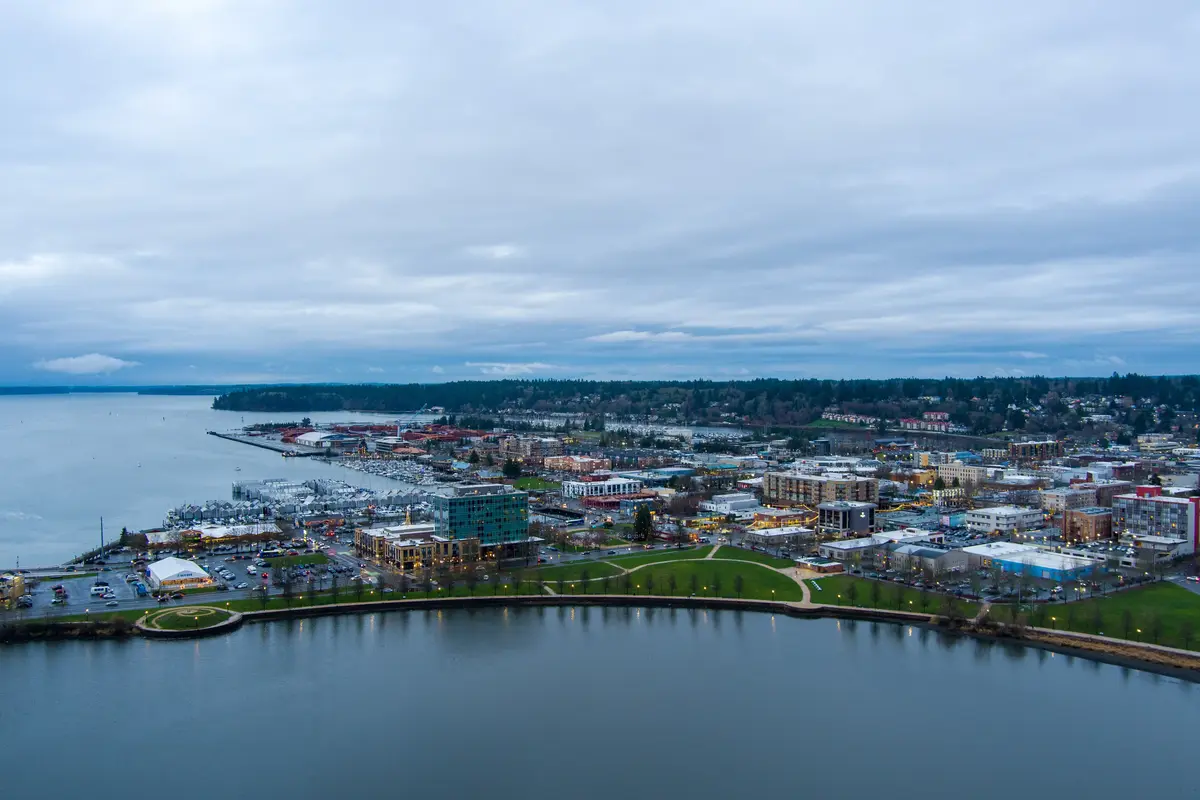
Maybe you've been priced out of Seattle and someone mentioned Olympia. Maybe your state agency job is transferring you here. Either way, the first thing you should know is that Olympia isn't trying to be a suburb of anywhere — it's Washington's state capital, sitting at the southernmost tip of Puget Sound where the Deschutes River meets tidewater, and it has a civic identity entirely its own. Interstate 5 runs straight through it, connecting you 30 miles north to Tacoma and 60 miles north to Seattle, while US-101 peels west toward the Olympic Peninsula. The geography shapes everything: water on one side, dense second-growth forest on another, and the gold-domed Capitol Campus rising above it all.
The economic backbone here is state government, full stop. A significant share of residents work in public administration at one of the dozens of state agencies concentrated around the Capitol Campus. Beyond government, The Evergreen State College — unique in American higher education for offering no grades and no traditional majors — anchors a creative and intellectual culture that makes Olympia feel different from every other mid-sized Washington city. South Puget Sound Community College adds another layer of education employment, and a major regional health system rounds out the top-employer list. The Olympia School District holds an A rating, according to Niche, which draws families with school-age children who want a strong public option without a private-school price tag.
Home prices here are noticeably below Seattle-area markets, giving buyers relocating from higher-cost Puget Sound metros a meaningful entry point they can't find closer to the city. Daily life in the core is genuinely walkable: Percival Landing's mile-long boardwalk connects the waterfront to the Olympia Farmers Market at 700 Capitol Way N, which runs year-round and hosts more than 120 vendors. Intercity Transit runs a completely fare-free bus network across the county, expanded in 2026 to 29 routes — an amenity that surprises nearly every newcomer. Rain is the honest trade-off: Olympia averages around 50 inches of precipitation annually, more than Seattle, and the gray stretches from October through April are real.
Whether you're seriously considering a move or just starting your research, the sections below break down Olympia's job market and who the city suits, what daily life feels like on the ground, current housing market conditions, commute realities, and the weekend spots and local rhythms that define life here.
Olympia at a Glance
Looking to buy in Olympia? Estimate your payment.
Enter your numbers to see an estimated monthly mortgage payment.
Estimate only. Excludes HOA fees and mortgage insurance. The interest rate above is a starting point, not a quoted rate — replace it with your own to see real numbers. Insurance is a flat placeholder, not a Olympia quote.
Why Are People Moving to Olympia?
The Government Economy — and What Grows Around It
State government is the engine. Dozens of Washington agencies are headquartered within walking distance of the Capitol Campus, which means a large share of Olympia's workforce is in public administration, policy, or support roles that aren't moving anywhere. That stability is a genuine draw for people tired of tech-sector volatility — a state budget crisis affects hiring, but agencies don't relocate to Austin.
The Evergreen State College brings a second, distinct population: faculty, staff, and the alumni who never quite left. Evergreen's interdisciplinary model attracts a specific kind of person — curious, politically engaged, comfortable with ambiguity — and that culture has seeped into the broader city in ways that show up in the local arts scene, the farmers market vendor mix, and the city's environmental commitments.
South Puget Sound Community College adds several thousand students and a meaningful number of education jobs. And while retail employment keeps the service economy functional, not everything here is government-dependent.
Remote Workers Discovering the Math
A newer and growing cohort is remote workers from Seattle-area companies who realized they could keep their salary and cut their housing costs substantially. Olympia's home prices are noticeably lower than what the same dollar buys in Bellevue or Kirkland, and the I-5 corridor keeps occasional office trips manageable.
That migration is real enough to show up in buyer demand data. Inventory sits at roughly 1.4 months of supply, homes are selling at approximately 99% of asking price, and the typical listing goes to pending in about 13 days. People aren't moving here accidentally.
Who Fits — and Who Tends to Leave
| Buyer Type | Why Olympia Works | The Honest Catch |
|---|---|---|
| Commuter State-sector worker | Agency jobs are walkable or a short drive from most neighborhoods | Government hiring cycles can be slow; lateral moves require patience |
| Families with school-age kids | Strong public school district; year-round outdoor access | Some districts' boundary lines are less intuitive than they look on a map |
| Transit car-free households | Fare-free Intercity Transit, 32 miles of bike lanes, walkable core | Outer neighborhoods and evening service gaps still require a car |
| Nature outdoor-focused buyers | Puget Sound access, forests, Olympic Peninsula day-trips via US-101 | Rain season runs six-plus months; gray skies are not seasonal — they're structural |
| First-time remote workers | Entry point noticeably below Seattle-area prices | Tight inventory means competitive offers even at this price point |
| Walkable downtown seekers | Percival Landing, the Capitol Campus, farmers market all on foot | Downtown's character shifts past dark — activity concentrated on specific blocks |
The people who tend to move out after a few years usually cite one of two things: the rain wore them down, or they wanted a bigger-city energy that Olympia's 55,000-person scale can't quite deliver.
What Daily Life Feels Like in Olympia
The Rhythm of a Capital City That Isn't a Big City
Olympia operates on a pace that surprises transplants from Seattle. The Capitol Campus empties by 5 PM on weekdays, and the downtown core quiets noticeably. That's not a flaw — it's structural. If your ideal Tuesday evening involves a 10-minute walk to the waterfront, a coffee from Olympia Coffee Roasting, and watching the tide come in at Percival Landing, this city delivers it effortlessly.
The Olympia Farmers Market is genuinely central to weekend life in a way that's hard to overstate. Open year-round at 700 Capitol Way N, it runs Thursdays through Sundays from April through October, tapering to Saturdays-only in winter. More than 120 vendors and eight on-site food operations make it a destination, not a farmers market in name only. On a dry Saturday morning in May, it's where you'll see state legislators, Evergreen professors, and newcomers all in the same line for local oysters.
The Rain Question — Answered Honestly
Everyone asks about the rain, and the honest answer is: yes, it matters. Olympia is wetter than Seattle, averaging around 50 inches of precipitation per year. The gray period runs from October into April, and it's not just drizzle — it's overcast skies that make noon feel like late afternoon for weeks at a stretch.
What locals will tell you is that you adapt or you leave. The people who stay long-term tend to develop an outdoor practice that works in the rain — trail running, kayaking, cycling — rather than waiting for it to stop. The 32 miles of city-maintained bike lanes and 10 miles of trails exist precisely because this is a city that decided to build for its actual weather.
Culture That Punches Above Its Weight
The Capitol Theater on Fifth Avenue hosts film, live music, and performing arts in a restored 1924 building. The Olympia Arts & Heritage Alliance Museum, which opened in June 2025 at 203 Columbia St. NW, added a dedicated history institution to a downtown that had long been missing one. Breweries like Three Magnets Brewing Co. and Well 80 Brewhouse anchor a local craft beer scene that draws people from Lacey and Tumwater on weekends.
April's Earth Day celebration — described as the largest in the Puget Sound area, drawing roughly 30,000 spectators — captures something real about Olympia's civic personality. This is a city where environmental politics aren't a talking point; they show up in transit funding referendums, building codes, and what people actually do on weekends.
Where Families Actually Gather
Parents with young children gravitate toward the Hands On Children's Museum, which sits just off the waterfront and gives kids a half-day destination on rainy Saturdays. Percival Landing's boardwalk is the default evening walk for most neighborhoods in the core. The farmers market functions as a town square — the kind of place where you run into your kid's teacher and your neighbor in the same visit.
The Olympia Housing Market Right Now
Where Prices Stand
The Zillow Home Value Index for Olympia was $536,583 as of July 2026 — essentially flat over the prior year, down just 0.2%. That plateau reflects a market where demand from remote workers and state-sector employees is keeping prices stable even as broader Pacific Northwest markets cool slightly.
For neighborhood-level breakdowns, the best neighborhoods page goes deeper on character and price range by area. For a full picture of how housing costs interact with taxes, utilities, and everyday expenses, see the cost of living page.
Market Pace: Faster Than It Looks
The headline price is only part of the story. Inventory sits at roughly 1.4 months of supply — well below what's considered a balanced market — and homes are selling at approximately 99% of asking price. The typical listing goes to pending in about 13 days, which means you rarely have the luxury of a second weekend to think it over.
That pace catches relocating buyers off guard, especially those coming from markets where a two-week decision window is normal. If you're moving from out of state and planning to make a trip to tour homes, building flexibility into your schedule matters — the right house won't wait for your return flight.
What's Driving Demand
Remote-work migration from the Seattle metro has been a documented factor in Olympia's sustained demand. Buyers who can keep a Seattle-area income and purchase at Olympia price points have real financial motivation to make the move, and that trend hasn't reversed.
State government jobs aren't going anywhere, which means the demand floor here is sturdier than in markets dependent on a single private employer. That stability has historically kept Olympia from the sharp downturns seen in more volatile markets — but it also means prices don't drop dramatically when the broader market softens.
Olympia Neighborhoods
Olympia has several distinct areas — each with its own character and appeal. Here’s a breakdown to help you narrow down where to focus your home search.
🏡 Downtown Olympia
The most walkable part of the city, anchored by the Olympia Farmers Market, Percival Landing, and Capitol Way's arts and dining corridor — suited to buyers who want urban texture at a Pacific Northwest scale. Housing ranges from historic Craftsman bungalows to newer infill condos, with the Capitol Theater and waterfront both reachable on foot.
🏠 South Capitol
One of Olympia's most architecturally distinguished neighborhoods, with tree-lined streets of well-preserved early-20th-century homes close to the Capitol Campus grounds. It suits buyers who want historic character, walkable state-agency access, and a neighborhood that feels settled rather than transitional.
🌳 Eastside
A mixed residential area east of Capitol Way with a range of housing ages and styles, offering relatively accessible price points compared to South Capitol while maintaining reasonable proximity to downtown. Families with school-age children and commuters who want a quick Capitol Campus connection tend to find it practical.
🏘 Northeast Olympia
A larger, more suburban-feeling section of the city with newer single-family construction and good I-5 access for north-bound commuters heading to Tacoma or beyond. It suits buyers who prioritize garage space, newer builds, and quieter residential streets over walkable urban access.
🏔 Southeast Olympia
A sprawling area that blends established neighborhoods with more recent development, generally at price points more accessible than the western core. Car dependence is higher here, but it's a practical choice for families wanting more square footage and yard space close to Lacey's commercial amenities.
🌆 South Westside
A hillier, more wooded section of the city with a quieter residential feel and longer sightlines than the flatter core neighborhoods. It suits buyers who want privacy and forest backdrop without committing to a fully rural address, though the grades make walking or cycling to downtown less convenient than it looks on a map.
Pros & Cons of Living in Olympia
The Pros
- Walkable
- historic downtown with a strong arts and food scene
- Stable government-driven job base as the state capital
- Easy access to Puget Sound waterfront
- the Olympics
- and Mount Rainier
The Cons
- Rainy
- gray winters with limited sunshine
- Property and overall crime rates run above national averages
- Home prices and cost of living well above the national norm
Getting Around & Commuting in Olympia
Interstate 5 — The Spine of the Commute
Most commuters in and out of Olympia travel I-5. Tacoma is roughly 35 minutes north in light traffic, which makes Olympia a legitimate option for people working in Pierce County who want a smaller-city base. Seattle runs about 60 miles and an hour in good conditions — a real commute, not a quick hop, which is why remote-work flexibility is often what makes that equation work.
The stretch of I-5 through Olympia itself — particularly around the Tumwater and Martin Way interchanges — backs up during the state-shift change around 4:30–5:00 PM. It's not Seattle-level gridlock, but new residents consistently underestimate it in the first few months.
Intercity Transit: A Genuine Asset
Intercity Transit runs completely fare-free across Olympia, Lacey, Tumwater, and Yelm — zero cost to board, no ticket to buy. The agency eliminated fares in 2020 after finding they generated less than 2% of net revenue, and voters backed an expansion plan that launched in 2026, growing the network from 20 routes to 29 and adding 18,000 annual service hours.
That's not a minor amenity. For downtown-based state workers who live within a mile of a bus stop, it's entirely possible to commute without a car on weekdays. The network's projected impact — a 25% reduction in vehicle miles traveled from 2021 levels by 2040 — reflects an actual shift in how people are getting around, not just optimistic planning language.
Biking and Walking in the Core
The city maintains 32 miles of bike lanes and 10 miles of dedicated trails. The downtown-to-Capitol Campus corridor is genuinely bikeable for most fitness levels, and the Percival Landing boardwalk connects the waterfront to the farmers market on foot in minutes. Further from the core — in Southeast Olympia or along the corridor toward Lacey — a car becomes more necessary, especially after dark when bus frequency drops.
| Destination | Drive Time (I-5, light traffic) | Notes |
|---|---|---|
| Tacoma | ~35 min | Reliable off-peak; add 15–25 min in peak hours |
| Seattle (downtown) | ~60 min | Real commute; remote flexibility recommended |
| Lacey | ~10 min | Neighboring city; Intercity Transit connects both |
| Tumwater | ~8 min | Adjacent; many state workers based here |
| SeaTac Airport | ~55 min | Via I-5 north; no rail link from Olympia currently |
| Shelton | ~30 min | Via US-101 west; smaller town, limited employment base |
There's no Amtrak station within Olympia proper — the nearest stop is Centralia, about 25 miles south — so air travel means driving to SeaTac or occasionally using the smaller Olympia Regional Airport for charter or prop service.
Schools in Olympia
Families relocating to Olympia have public, private, and higher-education options nearby. Here’s a quick overview.
🎓 School District
Olympia School District serves K–12 students across Olympia and the surrounding area. Rated A (source: Niche.com).
🏆 Graduation Rate
The 4-year high-school graduation rate here is approximately 90.6%.
📚 Higher Education
Washington’s public universities — the University of Washington, Washington State University, and Western Washington University — offer four-year degrees statewide, with a network of 34 community and technical colleges (SBCTC) providing two-year and workforce programs.
🌐 Online Learning
University of Washington Continuum College and Washington State University Online offer fully accredited online degrees for remote learners across the state.
Safety in Olympia
A quick look at how Olympia compares on the numbers that matter most when weighing a neighborhood or a move.
🛡 Violent Crime
Approximately 5.65 per 1,000 residents.
🔒 Property Crime
Approximately 34.35 per 1,000 residents.
Compared to the FBI’s most recent national data (2024), Olympia’s violent crime is above the national average (about 3.6 per 1,000), and property crime is above the national average (about 17.6 per 1,000).
Against Washington as a whole, Olympia’s violent crime is about one and a half times the state average, and property crime is somewhat above the state average (Bureau of Justice Statistics, Crime Known to Law Enforcement, 2024 (tables 2 and 3)).
Crime rates can vary a lot within a single city, so the citywide numbers above are only a starting point. Some neighborhoods in Olympia run well below these averages, while others run higher — the kind of block-by-block detail that matters most when you’re actually choosing where to live. The full guide below breaks it down neighborhood by neighborhood.
Working in Olympia
Olympia’s largest employers span several industries — here are some of the anchors of the local job market.
🏛 Washington State Government
Public administration
🏥 Providence St. Peter Hospital
Healthcare
🎓 The Evergreen State College
Higher education
🎓 South Puget Sound Community College
Education
🛒 Safeway/Walmart
Retail
Parks & Recreation in Olympia
Some of the outdoor spaces that shape everyday life in Olympia.
🌱 Capitol Lake
Olympia residents don’t have to go far for green space — spots like Capitol Lake are part of everyday life here, whether that’s a morning walk, a weekend hike, or just somewhere to unwind outside. The full guide below covers more of what Olympia has to offer for parks and outdoor recreation.
Retiring in Olympia
Olympia draws retirees for its balance of amenities, outdoor access, and cost. Here’s what to weigh.
🌤 Climate
Olympia's mild Pacific Northwest climate means temperatures rarely drop below freezing or climb above the mid-80s — a genuine draw for retirees leaving colder inland climates. The flip side is a long gray season from October through April with around 50 inches of annual rainfall. Summers are dry and genuinely pleasant, with long daylight hours from June through August.
🍴 Lifestyle
The year-round Olympia Farmers Market, Percival Landing's waterfront boardwalk, and the Capitol Theater's arts programming give retirees a built-in weekly rhythm that doesn't require a car. Olympia Coffee Roasting's multiple city locations and the downtown dining scene — anchored near Capitol Way — provide daily socialization options at a walkable pace.
🏚 55+ Communities
The greater Olympia area — including neighboring Lacey and Tumwater — has a range of active-adult and senior-living communities serving the South Puget Sound region. The area's concentration of healthcare services and proximity to the Olympic Peninsula's natural amenities makes it an increasingly popular landing spot for retirees relocating from higher-cost Pacific Northwest metros.
✈ Getting Around
Intercity Transit's fare-free, 29-route bus network is a practical asset for retirees who want to reduce car dependence without giving it up entirely. SeaTac Airport is roughly 55 minutes north on I-5 — driveable for most trips. The city's flat waterfront core is manageable on foot; hillier western neighborhoods are better suited to drivers or cyclists comfortable with grade.
🏛 Washington Taxes for Retirees — What to Know
- No state income tax — Washington does not tax personal income, so Social Security, pensions, and 401(k)/IRA withdrawals are all untaxed at the state level. There is no state return to file and no retirement exclusion to claim — the rate is simply zero.
- Military and public pensions — Because there is no income tax, military retirement pay and public-employee pensions are untaxed at the state level along with everything else.
- Sales tax is the tradeoff — The state sales tax is 6.5%, and local add-ons bring the combined rate in Olympia to 10.0% (Washington State Department of Revenue, Q3 2026 local sales & use tax rate table, July 2026). Groceries and prescription drugs are exempt.
- Property taxes, with senior relief — The effective property tax rate is roughly 0.9%. Homeowners 61+ (or unable to work due to disability, or a qualifying disabled veteran) who own and occupy their home may qualify for a reduction. Income limits are set against each county’s median household income, so the threshold differs by county — check with your county assessor. A separate deferral program is available for those who don’t qualify for the exemption.
- Capital gains tax — but not on retirement income — Washington taxes 7% on long-term capital gains above a $278,000 standard deduction for 2025, rising to 9.9% on gains above $1,000,000. Retirement accounts and real estate sales are both exempt. It therefore does not reach ordinary retirement income or the sale of a home.
- Estate tax — the one to plan for — Unlike most no-income-tax states, Washington has its own estate tax. For deaths on or after July 1, 2026, the exemption is $3 million with graduated rates topping out at 20%. Retirement accounts count toward the taxable estate, so long-time homeowners with sizable balances can cross the line without expecting to.
- No inheritance tax — Washington has no inheritance tax, and no gift tax.
- WA Cares payroll premium — Working Washingtonians pay 0.58% of gross wages into the WA Cares Fund, the state long-term care program, with no income cap. It applies to W-2 wages, so retirees who have stopped working do not pay it — but anyone relocating while still employed will see it. The private-insurance opt-out closed at the end of 2022 and is not available to new applicants; the remaining exemptions are narrow (living outside Washington, military spouses, certain visa holders, and veterans with a 70%+ service-connected rating).
- The Oregon border effect — Oregon has no sales tax, so Washington residents near the river — Vancouver, Camas, Washougal, Longview — often cross over for large purchases. Washington use tax technically applies to goods brought back for use in-state, though it is rarely enforced on ordinary personal purchases.
Tax laws change frequently and individual situations vary. This is general information, not tax advice — always consult a qualified Washington tax professional or CPA for personalized retirement tax planning.
Weekends & Local Favorites in Olympia
The Waterfront as Default Backdrop
Percival Landing's mile-long boardwalk is where Olympia residents end up on Friday evenings without a plan. It runs along the waterfront adjacent to the Olympia Farmers Market, and the combination of water views, public art installations, and foot traffic makes it feel more like a European harbor promenade than a typical mid-sized American waterfront. The annual Harbor Days festival — a free three-day event featuring vintage tugboat races, vendor booths, and tribal cultural demonstrations — draws the whole region each summer.
The farmers market at 700 Capitol Way N is the other anchor. Eight on-site food operations mean you can eat a full meal there without hitting a restaurant; the vendor mix skews toward local farms, artisan producers, and Pacific Northwest seafood. Longtime residents treat the Saturday market as a social obligation as much as a grocery run.
Craft Beer, Coffee, and the Arts
Olympia's brewing culture is older than the current craft-beer moment — the city has had a reputation for independent brewing since long before it was fashionable. Three Magnets Brewing Co. and Well 80 Brewhouse are the two anchors locals reliably point to. Olympia Coffee Roasting operates multiple locations across the city and has built a following among both residents and the coffee-curious visiting from Tacoma or Seattle.
The Capitol Theater on Fifth Avenue hosts everything from independent film screenings to live chamber music, and its calendar rewards checking regularly — programming leans eclectic in a way that reflects the Evergreen-inflected culture of the city. The Olympia Arts & Heritage Alliance Museum, which opened at 203 Columbia St. NW in June 2025, added a history and culture institution that downtown had been missing for years.
Getting Outside Without Driving Far
Capitol Lake sits at the edge of the downtown core and offers kayaking and flat-water paddling minutes from the Capitol Campus. The Black Hills to the west and the forest trails within a short drive give trail runners and mountain bikers options they don't have to plan a weekend around. US-101's western corridor connects Olympia to the Olympic Peninsula's national park trails in under two hours — which is a genuinely remarkable day-trip option that residents use more than you'd expect.
April's Earth Day celebration — roughly 30,000 spectators, 2,000–3,000 costumed marchers, and a multiblock footprint through downtown — has become the single biggest recurring event that signals what kind of city Olympia is to people attending for the first time. If you want to understand the city's culture in three hours, that Saturday is the day to be here.
What Newcomers Don't Expect
The thing that catches people off guard after six months: how much of social life here organizes itself around the farmers market, the waterfront, and a handful of neighborhood coffee shops rather than bars or late-night venues. Olympia quiets down early by urban standards. That's exactly what draws some buyers and exactly what frustrates others — knowing which camp you're in before you sign is worth the honest self-assessment.
Top Things Locals Say About Olympia
The best intel about a city comes from the people who actually live there. Here’s what Olympia residents say when newcomers ask the questions everyone’s thinking.
“I assumed the Capitol area would feel bureaucratic and sleepy, but our neighborhood actually has more foot traffic on a Tuesday morning than my old block in Bellevue ever did. The farmers market proximity alone changed how we shop, eat, and honestly just spend our weekends.”
— Recent Olympia home buyer
“What's the most surprising thing about living in Olympia?”
The fare-free buses. You hop on Intercity Transit and just... don't pay. It sounds like a small thing until you've used it for three months and realize you've barely touched your car for weekday errands. The 2026 route expansion made it genuinely useful for more of the city, not just the downtown-to-Capitol corridor.
“What do locals love most about Olympia?”
The scale of it. You can walk from Percival Landing to the Capitol Campus to the farmers market in an afternoon and feel like you've seen a real city — not a suburb pretending to have a downtown. The combination of water access, the arts scene at the Capitol Theater, and the craft brewery culture gives Olympia a texture that's hard to find at this price point on Puget Sound.
“What should newcomers to Olympia know?”
The I-5 interchange at Tumwater backs up worse than people expect — budget extra time between 4:30 and 6 PM if you're coming northbound into the city. Also: the farmers market isn't just for tourists. Go on a Thursday in summer when it's less crowded and you'll understand why longtime residents structure their whole week around it. And get rain gear before October, not after.
“Can you live in Olympia without a car?”
Comfortably, if you're in the core — downtown, South Capitol, or the Eastside neighborhoods near Capitol Way. Intercity Transit is fare-free and now runs 29 routes. Further out, toward Southeast Olympia or the Northeast corridor, you'll want a car for evenings and weekends. The bike lane network helps but has gaps, and the hills on the west side add effort to what looks like a short trip on a map.
Cities Near Olympia
Other communities near Olympia worth a look — each with its own character and price point.
| City | Distance | Best For | Vibe | Median Rent | Median Buy |
|---|---|---|---|---|---|
| Lacey | 7 mi | Families seeking new construction and retail access | Suburban, growing, amenity-rich | $1,650 | $480,000 |
| Tumwater | 5 mi | State workers wanting a quieter, lower-cost base | Compact, historic, unpretentious | $1,600 | $470,000 |
| Yelm | 20 mi | Buyers wanting acreage and rural pace | Rural edge, small-town, affordable | $1,500 | $420,000 |
More Helpful Guides for Olympia
Going deeper on Olympia? Our blog series covers everything from first-time buying to retiring here — explore the guides below.
Local Expert Takeaway: Olympia rewards people who moved here deliberately — not those who drifted south from Seattle and expected a smaller version of the same city. The fare-free Intercity Transit network, the year-round farmers market at Percival Landing, and the state-government employment base create a stability and texture that most mid-sized Pacific Northwest cities can't match. But the rain is real, the downtown goes quiet after 8 PM, and the housing market moves fast enough — 13 days to pending, 99% of asking — that showing up without a clear plan tends to end in frustration. Come with a specific reason to be here and you'll likely stay longer than you expected.
Quick Takeaways & FAQs
✅ Intercity Transit runs completely fare-free across Olympia, Lacey, Tumwater, and Yelm — one of the only zero-cost public transit networks of its scale in the Pacific Northwest.
⚠️ Olympia averages around 50 inches of rain annually — more than Seattle — and the overcast season runs from October into April, which genuinely affects quality of life for people who need sun.
📍 The Olympia Farmers Market at 700 Capitol Way N operates year-round and functions as the city's de facto town square, with eight on-site food operations and 120-plus vendors at peak season.
Is Olympia a good place to live if I work remotely for a Seattle company?
How are the public schools in Olympia?
What is the housing market like in Olympia right now?
Do I need a car to live in Olympia?
What should I know about the weather in Olympia before moving?
Helpful Links for Moving to Olympia
Moving to Washington?
Tell us what you need help with and we'll connect you with local resources.
