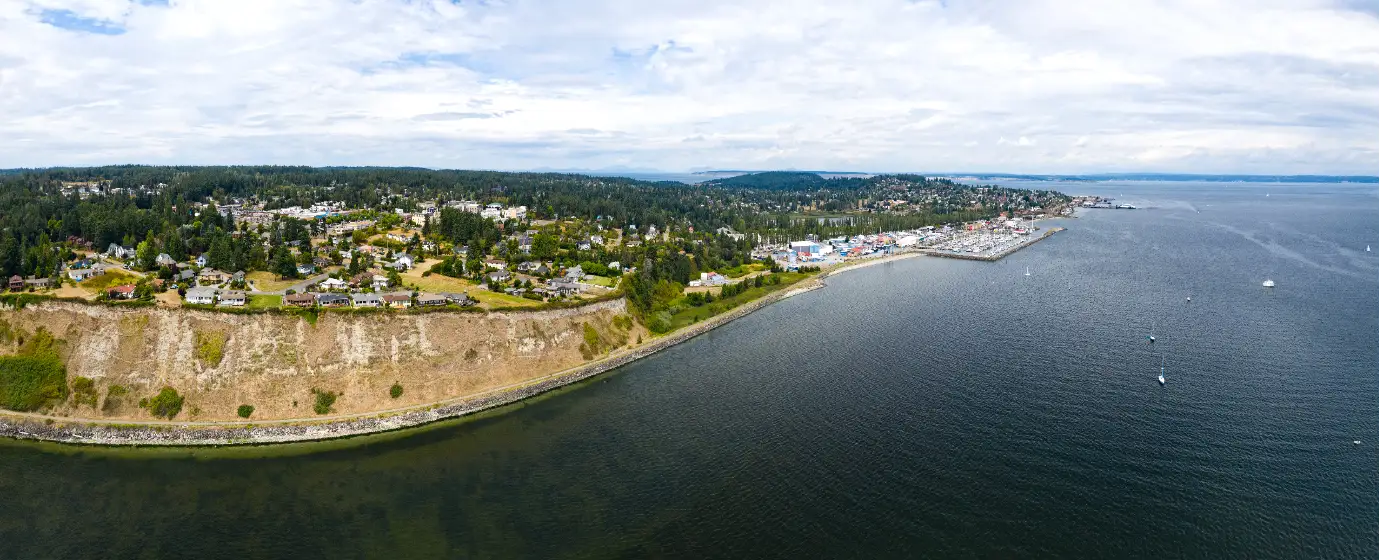
Maybe you've taken the ferry from Bainbridge or Kingston and stepped onto Water Street for the first time — Victorian storefronts, salt air, a lighthouse visible from the end of the block — and thought: this is what retirement is supposed to look like. Port Townsend earns that reaction. Tucked at the northeastern tip of the Olympic Peninsula, roughly 90 minutes from Seattle via ferry, it's a small city of about 10,500 people that draws a disproportionate share of artists, sailors, and quietly well-read retirees. The ferry crossing that keeps day-trippers at arm's length also keeps the town feeling like itself — unhurried, intentional, not a suburb of anywhere.
The population tells you something important before you read a single review: estimates suggest roughly 41% of Port Townsend residents are aged 65 or older. That's not a retirement community in the planned-development sense — it's a real city that has simply become, organically, a place where people want to age. The employers that anchor the local economy — Jefferson Healthcare, Port Townsend Paper Corporation, Jefferson County government — keep the town functioning year-round, not just in tourist season. That matters when you're here in February and the gift shops are dark but the hardware store, the pharmacy, and the hospital are all open and staffed.
Cost is the honest complication. The typical Port Townsend home price sits at $642,884 (Zillow Home Value Index, May 2026), which puts it well above most Olympic Peninsula towns and above what a median household income here can comfortably carry. Retirees moving in with equity from a California, Seattle-area, or East Coast sale often find the math works; those relying primarily on Social Security alone may find it tight, especially as rental inventory stays thin. Washington's lack of a state income tax softens the blow meaningfully — more on that in the budget section. For an honest look at full cost-of-living figures including rent ranges, that page goes deeper.
Whether you're seriously considering a move or still narrowing your list, the sections below walk through Port Townsend's healthcare access, retiree budget picture, daily walkability, downsizing options, and how it stacks up against nearby alternatives on the peninsula.
Why Retirees Are Choosing Port Townsend
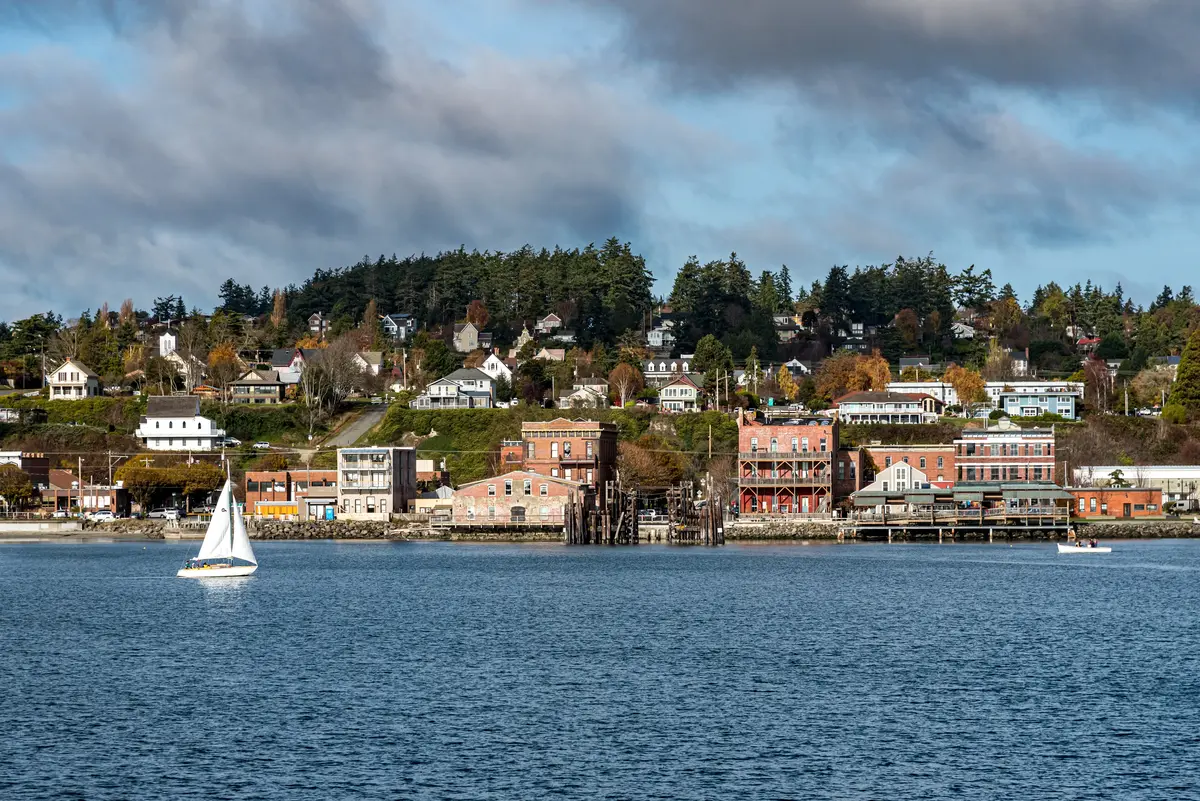
Port Townsend fits a specific kind of retiree well: someone who wants a real town, not a resort, and who values walking to dinner over driving to a chain. The Water Street Historic District, the arts scene anchored around Fort Worden State Park, the annual Wooden Boat Festival, the Rhododendron Festival — these aren't marketing bullet points; they're the actual texture of daily life here. If your idea of a good retirement week includes a gallery opening, a kayak rental, live music at a pub on Water Street, and a Saturday farmers market, Port Townsend delivers all of that without needing a car.
The typical home price of $642,884 (Zillow Home Value Index, May 2026) is the threshold question. Retirees arriving with equity — from the Bay Area, from Seattle, from a paid-off East Coast home — often find that buying here outright or with a small mortgage pencils out. Those without significant assets to deploy will find the rental market thin and the ownership market competitive. This is not a place where retirement income alone stretches easily without equity working in your favor.
Port Townsend tends to disappoint retirees who need frequent specialist care, prefer big-box convenience, or want a large peer network of people their own age in a structured active-adult campus setting. The town's insularity — that same ferry-crossing buffer that keeps it charming — means driving to Sequim, Port Angeles, or eventually the Bremerton or Seattle metro for certain medical visits. If you have a chronic condition requiring regular subspecialty management, that travel reality deserves serious weight. For everyone else, the combination of walkability, community depth, and Washington's tax posture makes a genuinely strong case.
Healthcare & Medical Access in Port Townsend
Jefferson Healthcare: The Anchor
Jefferson Healthcare, at 834 Sheridan Street, is the city's sole hospital — a 25-bed critical access facility with a 24-hour emergency department, hospitalist coverage, acute and intensive care units, diagnostic imaging, a laboratory, and a full suite of rehabilitation therapies including physical, occupational, speech, and respiratory. For primary care, routine procedures, imaging, and emergency stabilization, it handles the full range of what most retirees need most of the time.
The patient experience ratings are notably strong for a rural critical access hospital. Healthgrades has recognized Jefferson Healthcare with its Outstanding Patient Experience Award, and U.S. News & World Report data shows 93% of patients saying they would recommend it — a figure that reflects genuine community trust, not marketing copy.
The Expansion That Changes the Specialty Equation
The more significant development for retirees is Jefferson Healthcare's $85 million campus expansion and modernization project, which added new capacity for pulmonology, neurology, ENT, dermatology, expanded OB/GYN, hand and plastics, and a new MRI suite. These were specialties that previously required Jefferson County residents to travel off-peninsula. The project was on track for mid-2025 completion — confirm current status directly with Jefferson Healthcare before making a decision that hinges on any specific specialty being available locally.
Jefferson Healthcare also operates primary care clinics in Port Ludlow and Quilcene, which matters if you end up in one of the surrounding communities rather than Port Townsend proper.
The Honest Distance Reality
For complex cardiac care, oncology, neurosurgery, and Level I trauma, you will travel. Regional medical centers in Bremerton and the full University of Washington Medical Center system in Seattle are the realistic options for high-acuity care — and either means a ferry crossing or a long drive around the water. In an emergency, Jefferson Healthcare stabilizes and transfers; that's the system working as designed. But if you're managing a serious chronic condition that requires frequent subspecialty visits, factor in that a routine appointment can easily become a half-day or full-day trip.
The Retiree Budget in Port Townsend
Washington's Tax Advantage for Retirees
Washington levies no personal income tax — full stop. Social Security benefits, pension distributions, IRA withdrawals, and 401(k) income are all untaxed at the state level. For retirees drawing from multiple income streams, this is a meaningful structural advantage over states like Oregon (which taxes all retirement income) or California.
Washington does have a 7% capital-gains tax, but it applies only to long-term gains above approximately $278,000 per year (the 2025 threshold, indexed to inflation — confirm the current figure before filing). Critically, it explicitly exempts retirement account transactions — 401(k)s, IRAs, Roth IRAs, defined-benefit pensions — and the sale of a primary residence. Most retirees will never trigger it.
Property Taxes and the Senior Exemption
The effective property tax rate in Port Townsend runs approximately 0.90% — below the national average and well below what most Western metros charge. Washington also offers a senior property tax exemption for homeowners aged 61 or older whose annual income falls within the qualifying range (roughly $45,000–$70,000 for 2025, depending on county). Eligible Jefferson County residents can reduce their tax bill by an estimated $500–$1,500 per year. If you're on a fixed income in that range, it's worth filing for — the county assessor's office handles the application.
Day-to-Day Costs on a Fixed Income
Port Townsend is not inexpensive on a daily basis. Groceries, dining out, and services all carry a small-town-on-a-peninsula premium — supply chains here are longer than in a metro, and the local labor market is tight. A dinner for two at a downtown restaurant on Washington Street or an evening at a pub on Water Street runs at the higher end of what you'd pay in a mid-size Pacific Northwest city. For a full picture of rents and daily expenses in Port Townsend, the cost-of-living page has the specifics.
The honest fixed-income reality: retirees with a paid-off home, a pension or solid investment income, and low healthcare-cost exposure are comfortable here. Those budgeting tightly around Social Security alone will feel the squeeze — particularly if assisted living ever becomes necessary, where costs average approximately $6,785 per month locally, above state norms.
Looking to buy in Port Townsend? Estimate your payment.
Enter your numbers to see an estimated monthly mortgage payment.
Estimate only. Excludes HOA fees and mortgage insurance. The interest rate above is a starting point, not a quoted rate — replace it with your own to see real numbers. Insurance is a flat placeholder, not a Port Townsend quote.
Walkability, Community & Staying Active in Port Townsend
The Walking Reality
Port Townsend's Walk Score of 81 out of 100 — rated "Very Walkable" — isn't inflated. The downtown core genuinely allows most daily errands on foot: the pharmacy, the grocery, the post office, the library, the farmers market, and a wide range of restaurants and cafés are all reachable without a car from central neighborhoods. That puts it in a completely different category from most Olympic Peninsula towns, and from most small cities in Washington state, where the average Walk Score sits around 33.
The terrain caveat matters: Port Townsend is hilly. The Uptown neighborhood sits on a bluff above the downtown waterfront, and the climb between them is real. If mobility is a concern — now or planning ahead — that elevation change between Uptown and Water Street deserves a test walk before you commit to a specific neighborhood. Flat, continuous walking is easier along the waterfront and within the downtown core than it is between districts.
Community Depth
With roughly 41% of the population aged 65 or older, you're not retiring into a place where seniors are a minority. The Jefferson County Senior Services office coordinates programs, transportation assistance, and social activities. Fort Worden State Park — a former military installation converted into a cultural campus — hosts workshops, concerts, and residency programs year-round, drawing an engaged, intellectually active crowd. The Northwest Maritime Center on the waterfront runs year-round programming, including sailing and boatbuilding classes that attract serious retirees, not just tourists.
The annual Wooden Boat Festival brings the town alive every September, and the Rhododendron Festival in May marks the turn to summer. These aren't novelties — they're fixtures that give the community calendar a rhythm, and they create natural entry points for newcomers trying to find their people.
For parks and outdoor recreation details including trails at Fort Worden, that page covers the full range of options.
What Locals Know After Six Months
People who move here in spring or summer sometimes underestimate how social the town is — and then underestimate how quiet it goes in November. The arts scene and the event calendar thin out in winter, the tourist restaurants close or cut hours, and the ferry feels farther away when the weather is rough. Retirees who build their social life around the community's year-round infrastructure — the senior center, the maritime center, the library's programming — adapt well. Those who counted on the summer energy to carry them can find the off-season isolating.
Right-Sizing: Downsizing in Port Townsend
The Inventory Reality
Port Townsend's housing stock is dominated by Victorian-era single-family homes — two and three stories, with staircases and character in equal measure. Finding genuinely single-level, low-maintenance housing in the historic core is harder than in a newer city, and the inventory that does exist turns over slowly in a market this small. If aging-in-place accessibility is a priority from the start, you'll likely be competing for a shorter list of options or planning a renovation budget alongside your purchase.
Condo and Low-Maintenance Options
The condo and townhome supply in Port Townsend is limited but real. Kala Point, a gated community along the water northeast of the downtown, includes townhome-style units with HOA maintenance coverage that appeals to retirees who want to minimize exterior upkeep. It's a quieter, more suburban feel than the downtown core — some people find that a relief; others feel cut off from the town's walkable energy. Know which camp you're in before you tour it.
The surrounding communities expand the realistic search area. Port Ludlow, roughly 20 miles south along the canal shoreline, has been a deliberate retirement-oriented development for decades — golf, a marina, HOA-maintained homes, and Jefferson Healthcare's satellite clinic nearby. Port Hadlock and Chimacum offer more affordable price points with reasonable proximity to Port Townsend's amenities, though without its walkability.
Senior Living Communities
For independent or assisted living within Port Townsend proper, Port Townsend Senior Living by Cogir offers both independent and assisted living options, including income-qualified affordable units — a rarity in a market this expensive. Discovery View is a 62+ income-restricted apartment community for those who qualify. At least four senior living communities were operating in Port Townsend as of 2026, though the assisted living cost of approximately $6,785 per month is above average and reflects both the peninsula's supply constraints and the high local demand created by an older-than-average population.
A 55+ or active-adult campus in the planned national-developer sense doesn't exist in Port Townsend. If that's what you're looking for — a purpose-built community with a clubhouse, pickleball courts, and 500 neighbors your own age — Sequim or the greater Bremerton area will have closer matches. Port Townsend's version of active-adult living is more organic: it's the community you build through the maritime center, the arts programs, and the neighbor you meet at the farmers market.
Port Townsend vs Nearby Retirement Destinations
| City | Cost vs Port Townsend | Primary Hospital | Walkability | Senior Living Depth | Overall Retirement Fit |
|---|---|---|---|---|---|
| Port Townsend | Anchor | Jefferson Healthcare (local, critical access, expanding specialties) | Very Walkable (Walk Score 81) | Moderate — organic senior culture, limited campus-style options | Walkable Views Strong for arts/culture retirees |
| Sequim | Noticeably cheaper | Olympic Medical Center (Port Angeles, ~20 min) | Car-dependent outside downtown core | Strong — multiple 55+ communities and active-adult campuses | Active Adults Value Best for planned-community seekers |
| Port Angeles | Noticeably cheaper | Olympic Medical Center (on-site, full-service regional hospital) | Moderate — some walkable blocks, largely car-dependent | Moderate — more options than Port Townsend, less than Sequim | Value Best if healthcare access is the top priority |
| Port Ludlow | About the same | Jefferson Healthcare satellite clinic; hospital access via Port Townsend | Low — car required for most errands | Moderate — retirement-oriented HOA community with marina | Quiet Nature Best for marina/golf lifestyle |
| Port Hadlock | Noticeably cheaper | Jefferson Healthcare (Port Townsend, ~10 min drive) | Low — almost entirely car-dependent | Limited — mostly single-family residential | Value Best for budget-conscious buyers near Port Townsend amenities |
| Chimacum | Noticeably cheaper | Jefferson Healthcare (Port Townsend, ~15 min drive) | Very low — rural, no walkable core | Very limited | Privacy Nature Best for rural acreage buyers |
Sequim is the most direct alternative for retirees who want a lower price point, more purpose-built senior living options, and comparable outdoor access — its lavender fields and "blue hole" sunshine reputation aren't exaggerated, and Olympic Medical Center in Port Angeles gives the Sequim corridor better on-the-ground hospital infrastructure than Port Townsend currently has.
Port Angeles wins on healthcare depth outright: Olympic Medical Center is a full-service regional hospital with a broader specialist base, and the city is meaningfully less expensive. What it doesn't have is Port Townsend's walkability or architectural character. Port Ludlow suits retirees who want a marina-oriented, HOA-maintained lifestyle without Port Townsend's Victorian eccentricity or price tag — though you trade the walkable downtown for a car-dependent enclave. Port Hadlock and Chimacum are realistic budget anchors if you want to stay in Jefferson County at a lower cost, with Port Townsend's amenities a short drive away. For the retiree who genuinely values walkability, cultural engagement, and a real town over a planned retirement product, Port Townsend remains the standout on the peninsula — as long as the math works.

Local Expert Takeaway: Port Townsend rewards retirees who arrive with equity, curiosity, and a willingness to make their social life rather than buy into one. The walkable downtown, Jefferson Healthcare's expanding specialty services, Washington's zero income tax on retirement income, and a community where 41% of residents are already over 65 create a genuine retirement environment — not a theme-park version of one. The catch is inventory: single-level homes are scarce, assisted living is expensive, and the ferry crossing that makes the town feel magical in October can feel like a logistical burden when you need a subspecialist in Bremerton. If you're torn between Port Townsend and Sequim, Sequim wins on cost and planned senior infrastructure; Port Townsend wins on walkability and character. Most people who leave Port Townsend in retirement do so because of healthcare complexity or because the off-season isolation hit harder than expected — not because they stopped loving the town itself.
Quick Takeaways & FAQs
✅ Washington's zero state income tax means Social Security, pension, and IRA withdrawals are all untaxed at the state level — a meaningful advantage for retirees drawing from multiple income streams.
⚠️ Advanced specialist care still requires ferry travel to Bremerton or Seattle for high-acuity needs, and the off-season social scene is quieter than the summer energy suggests — both realities catch newcomers off guard.
📍 With roughly 41% of residents aged 65 or older and a Walk Score of 81, Port Townsend has one of the most genuinely walkable and organically senior-friendly downtowns on the entire Olympic Peninsula.
Is Port Townsend a good place to retire on a fixed income?
What hospital serves Port Townsend, and is it enough for retirement healthcare needs?
Does Washington State tax Social Security or pension income?
Are there 55+ or active-adult communities in Port Townsend?
How does Port Townsend compare to Sequim for retirement?
Moving to Washington?
Tell us what you need help with and we'll connect you with local resources.
