
What Is Living in Mill Creek, Washington Like?
Maybe you've been priced out of Kirkland or Redmond and someone mentioned Mill Creek. Maybe your company is relocating you to the Everett corridor and you're trying to figure out which suburb actually has a pulse. Here's the thing most people don't realize until they drive through: Mill Creek doesn't look like a suburb. It looks like a place someone actually planned. That's because someone did — the city grew from a 1970s golf-course development built around the Mill Creek Country Club, incorporated in 1983, and spent decades as a quiet residential enclave before a Town Center gave it a proper main street. It sits in Snohomish County, about 24 miles north of Seattle along the Interstate 5 corridor, with State Route 527 — the Bothell–Everett Highway — running through its commercial core and I-5 just a mile from most front doors.
The economic profile here skews toward dual-income households commuting to Seattle, Everett, and the Eastside. The median household income of $124,364 is well above both state and national figures, and that income base shows in the schools: Mill Creek feeds into the Mukilteo School District, which holds a B+ rating, according to Niche, and draws parents who treat school boundaries as part of the home search. The major employers within or directly adjacent to the city include The Everett Clinic (now part of Optum), Albertsons, Central Market, Lowe's, and QFC — a mix of healthcare, retail, and grocery that provides local jobs but doesn't define the city's economy the way Boeing defines Everett's. Most residents commute out, and the infrastructure increasingly accommodates that.
Housing runs close to $967,807 (Zillow Home Value Index, May 2026) — noticeably below Bellevue or Kirkland, but well above Everett or Lynnwood. What you get for that price is space: newer construction, wooded lots, and a city that has genuinely invested in its parks system. More than 23 miles of nature trails thread through 11 city parks, the North Creek Trail connects Mill Creek to Bothell and Everett on a paved, shaded path, and the Town Center on Main Street gives residents a walkable commercial core with 88 shops and restaurants — rare for a city this size in Snohomish County. The city's own infrastructure assessments have flagged aging sidewalks and stormwater systems as deferred maintenance priorities, but that's the kind of challenge a financially stable city can solve.
Whether you're seriously considering a move or just mapping the Snohomish County landscape, the sections below break down Mill Creek's daily life, housing market, commute patterns, local employers, and what weekends actually look like here.
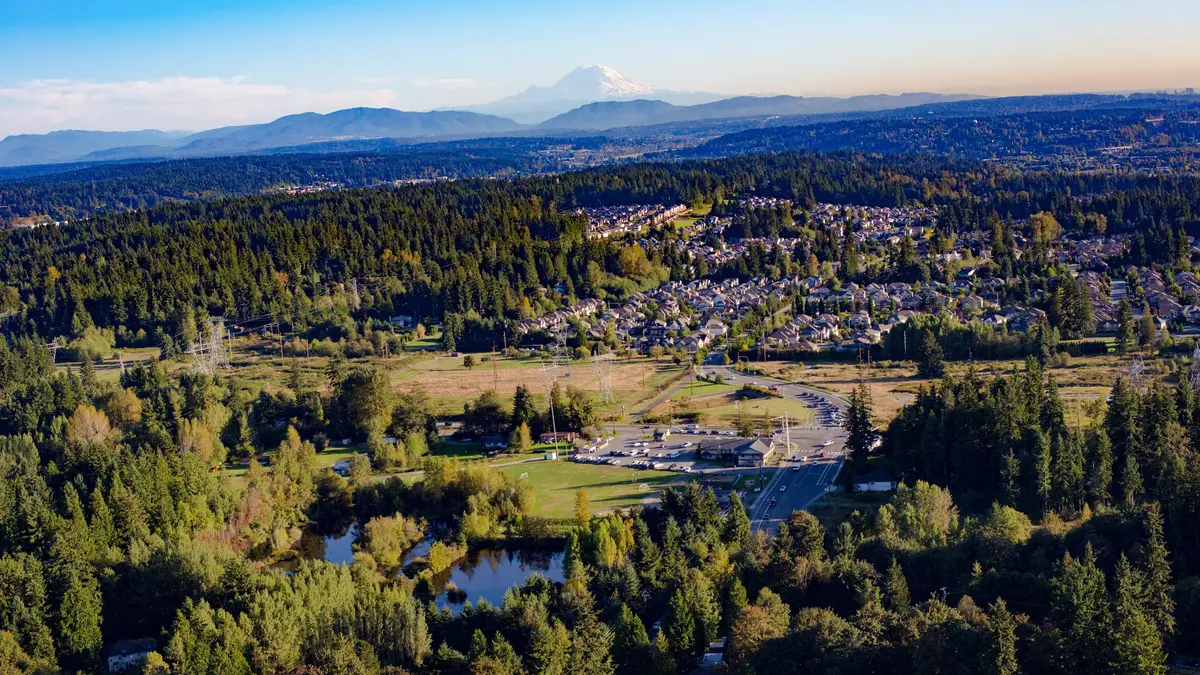
Mill Creek at a Glance
Looking to buy in Mill Creek? Estimate your payment.
Enter your numbers to see an estimated monthly mortgage payment.
Estimate only. Excludes HOA fees and mortgage insurance. The interest rate above is a starting point, not a quoted rate — replace it with your own to see real numbers. Insurance is a flat placeholder, not a Mill Creek quote.
Why Are People Moving to Mill Creek?
The short version: people move here because they want Seattle proximity without Seattle density — and they want schools that don't require a private-school backup plan.
The Planned-Community Difference
Mill Creek's origins as a planned golf-course development aren't just trivia. They explain why the street layout is more coherent than most suburbs its age, why mature trees line so many residential roads, and why the Mill Creek Country Club sits at the city's geographic heart rather than on its fringe. The city covers just 4.66 square miles, which means it's genuinely compact — most residents are within a few minutes of the Town Center.
That compactness matters when you're choosing between here and sprawling alternatives in Snohomish County. You give up acreage. You gain a city that feels finished rather than perpetually under construction.
Schools Drive the Decision
The Mukilteo School District consistently ranks among the stronger districts in Snohomish County, and that reputation is the reason many families with school-age children specifically target Mill Creek over nearby Everett or Lynnwood. Boundary assignments here can feel consequential, and longtime residents will tell you which elementary schools draw the most competitive interest. See the full breakdown on the Mill Creek schools page.
The Income Floor Effect
A median household income of $124,364 creates a self-reinforcing community character. Retail follows income, which is part of why the Town Center at 15310 Main St has stayed relevant and well-maintained since it opened in 2004 rather than declining the way some suburban commercial centers do. The city is actively planning a South Town Center Subarea redevelopment — a mixed-use project designed to concentrate new housing, retail, and amenities in one district without fragmenting the existing residential character.
That planning ambition is one of the clearest signals that Mill Creek intends to grow more carefully than the suburbs around it.
Who Actually Moves Here
| Buyer Type | What They're After | Best Fit? |
|---|---|---|
| Families | Mukilteo SD schools, trails, parks, safe streets | Strong yes |
| Commuters | I-5 access, Swift BRT to Link light rail, ~35-min Seattle drive | Yes, with caveats on peak-hour I-5 |
| Tech workers | Eastside access via I-405, remote-work suburb feel | Yes, especially with hybrid schedules |
| Quiet-seekers | Low crime, wooded neighborhoods, no urban density | Strong yes |
| Walkable-lifestyle buyers | Town Center on foot, North Creek Trail from the door | Depends on which neighborhood |
| First-time buyers | Entry-level price point relative to closer-in Seattle suburbs | Challenging at current prices; possible |
The one buyer who tends to be disappointed: anyone who moves here expecting urban energy. Mill Creek is genuinely quiet on weeknights, and that's a feature for most residents here — not a bug they're hoping to fix.
What Daily Life Feels Like in Mill Creek
Six months in, most newcomers report the same adjustment: they stop driving to Bothell or Everett for everything and realize the Town Center handles more of their weekly routine than they expected.
The Town Center as Social Infrastructure
Mill Creek Town Center isn't a mall — it's an outdoor lifestyle center with a park-like layout along the Bothell–Everett Highway. The 88 shops and services there include grocers, restaurants, and independent businesses arranged around open plazas rather than a food-court anchor. On summer evenings, the Concert series fills those plazas with residents who didn't have to drive anywhere to get there. Art Walks and Kids Fest draw the same crowd on weekends in a way that makes the Town Center feel less like retail and more like a shared backyard.
Tablas Woodstone Taverna on Main St is one of the standout independent options — a tapas and Spanish restaurant that regulars treat as a neighborhood spot rather than a special-occasion destination.
The Trails Are Not a Marketing Claim
More than 23 miles of nature trails woven through 11 city parks is an unusual amenity for a city of 21,000 people covering under five square miles. The North Creek Trail — paved, shaded, and connecting Mill Creek to both Bothell and McCollum Park in Everett — is the one residents use most. Parents with kids run it on weekend mornings. Commuters use segments of it to reach transit stops. It passes multiple ponds and enough tree cover that you can forget you're inside a suburb. See Mill Creek parks and trails for the full breakdown.
What Surprises People After Six Months
The quiet is the most common adjustment — and for most people, it turns out to be exactly what they moved here for. What catches people off guard is how self-contained the city actually is once they stop defaulting to Everett or Lynnwood for errands. Central Market on the north end of town is the grocery store that converts skeptics: it's more Whole Foods in quality, more community-market in feel, and it becomes a weekly ritual for a lot of households that expected to do most shopping elsewhere.
The honest downside that surfaces around month four: if you moved here from a city with nightlife, you will need to leave Mill Creek to find it. The Town Center quiets early, and the city has no bar district to speak of.
Community Character
The city is safe — among the lower crime environments in the broader Seattle metro — and that safety translates into a particular kind of community confidence. Full safety and crime data is on the safety page. Kids ride bikes on the trail network. The Mill Creek Country Club golf course shapes the western edge of the city in a way that keeps one corridor genuinely green and quiet. It's a place where people know their neighbors, show up to Town Center events, and are largely happy with the trade they made.
The Mill Creek Housing Market Right Now
The Zillow Home Value Index for Mill Creek stood at $967,807 in May 2026 — essentially flat year-over-year, which is a materially different signal than the rapid appreciation the city saw in prior years.
What Flat Means in Practice
Flat doesn't mean easy. Homes here are still selling at approximately 98.4% of list price (NWMLS data, June 2026), with a median of 11 days on market and roughly 3.1 months of active inventory. That's a market in balance — not the frenzied multiple-offer environment of 2021 or 2022, but not a buyer's market either. Correctly priced homes still move quickly.
Some parts of the city carry higher price points than others, reflecting lot size, proximity to the trail network, and the age of construction. The Mill Creek neighborhoods page covers those distinctions in detail.
The Honest Context
At just under $1 million for a typical home, Mill Creek is priced well below the closest comparable suburbs on the Eastside — but it is not an entry-level market for most buyers. The effective property tax rate is approximately 0.78%, which sits noticeably below the Snohomish County average and is one of the cost-of-living advantages that doesn't always make the headline comparison. Full cost-of-living data, including rent ranges and tax figures, is on the cost-of-living page.
What's Coming
The South Town Center Subarea redevelopment project is the most significant near-term factor in the local market. The city is planning a concentrated mixed-use district — new housing, retail, and public amenities — in a defined area adjacent to the existing Town Center. For buyers thinking about long-term value, that kind of deliberate densification near a commercial core has historically been positive for surrounding property values in comparable Seattle-area suburbs.
The deferred infrastructure work identified in recent city planning assessments — aging sidewalks and stormwater pipes — is a real line item, not a crisis. The city carried a balanced budget into 2025–26 and a fully staffed police department, which is a better starting position than many Snohomish County cities of similar size.
Mill Creek Neighborhoods
Mill Creek has several distinct areas — each with its own character and appeal. Here’s a breakdown to help you narrow down where to focus your home search.
🏡 Seattle Hill-Silver Firs
A sprawling, family-oriented area on Mill Creek's eastern edge with larger lots and newer subdivision construction; it draws parents targeting specific Mukilteo School District assignments and residents who want more square footage for the price point.
🏠 Murphys Corner
A quieter residential pocket near the city's northern boundary that suits buyers looking for established neighborhoods with mature trees and easy I-5 access without paying a Town Center premium.
🌳 Silver Lake
Centered around Silver Lake itself, this area offers a more nature-immersed feel with lakeside access and trail connectivity; it tends to draw outdoor-oriented buyers who want the North Creek Trail practically outside their door.
🏘 Wintermutes Corner
An established residential area known for its mature landscaping and quieter street character; it sits close enough to the Bothell–Everett Highway corridor to make Town Center errands easy without being in the commercial zone's noise footprint.
🏔 Mays Pond
One of Mill Creek's more serene residential pockets, built around the natural wetland and pond environment that gives the city its trail-threaded character; families here value the greenspace buffer and the neighborhood's relative calm.
🌆 Thrasher's Corner
A transitional area on Mill Creek's southern edge near the Bothell border, with a mix of housing ages and easy access to SR-527; it attracts buyers who want Mill Creek schools and community without the full price premium of the Town Center-adjacent blocks.
Pros & Cons of Living in Mill Creek
The Pros
- Top-rated
- newer housing stock in a master-planned setting
- extensive trail and park network (23+ miles of trails)
- low violent crime and strong sense of suburban safety
- convenient Swift BRT and freeway access to I-5/I-405
The Cons
- Among the priciest housing markets in Snohomish County
- car-dependent layout with a low Walk Score
- peak-hour commutes to Seattle or the Eastside can stretch well beyond 45 minutes
Getting Around & Commuting in Mill Creek
The geographic reality of Mill Creek commuting is simple: Interstate 5 is about one mile from most of the city, and that proximity defines how residents move through the region.
The I-5 Corridor
State Route 527 — the Bothell–Everett Highway — is the city's main street and the road that connects Mill Creek to I-5 in both directions. The I-5/I-405 interchange puts both Seattle (roughly 35 minutes, 24 miles in normal traffic) and the Eastside within reach. In practice, southbound I-5 toward Seattle during the morning peak is the commute most residents are managing — and it is genuinely congested between about 7:00 and 9:00 a.m. Residents who have flexibility to leave before 6:45 a.m. or after 9:15 a.m. report a meaningfully different experience than those locked into the peak window.
Transit: Better Than You'd Expect
Community Transit operates two Swift Bus Rapid Transit lines through Mill Creek that are legitimately useful — not just a fallback for people without cars. The Swift Green Line runs from Mukilteo to Bothell. The Swift Orange Line, which opened March 30, 2024, runs from McCollum Park to Edmonds College and connects riders to Lynnwood City Center Station, where Link light rail provides a one-seat ride into the Seattle metro without touching I-5. For hybrid workers who commute two or three days a week, this is a genuinely viable option that makes car ownership feel optional on those days.
Eastside Access
The I-405 connection that comes with I-5 access matters more than it might seem. Residents working in Bellevue, Redmond, or Bothell can run south on I-5 and east on I-405 — a route that's often more predictable than the reverse-commute patterns closer to the Eastside. Mill Creek is positioned well for employers that have spread across both corridors.
Local Employers Worth Knowing
| Employer | Sector | Significance |
|---|---|---|
| The Everett Clinic / Optum | Healthcare | Major regional healthcare employer with Mill Creek presence |
| Albertsons | Retail / Grocery | Significant local employer and anchor retail tenant |
| Central Market | Grocery | Independent grocer; community institution |
| Lowe's | Retail | Home improvement anchor along SR-527 corridor |
| QFC | Grocery | Additional retail employment anchor |
Most residents commute out of Mill Creek rather than working within it — the city's job base skews retail and healthcare, while the income profile reflects tech, professional, and healthcare salaries earned in Everett, Seattle, or the Eastside.
The Commuter's Honest Trade-Off
What you give up by choosing Mill Creek over a closer-in suburb is I-5 buffer time on bad days. When there's an incident on southbound I-5 near Lynnwood or Mountlake Terrace, a 35-minute commute becomes 70 minutes with no good parallel route. Residents who commute daily to downtown Seattle build that variance into their expectations — and most still say the square footage and the school district made the math work.
Schools in Mill Creek
Families relocating to Mill Creek have public, private, and higher-education options nearby. Here’s a quick overview.
🎓 School District
Mukilteo School District serves K–12 students across Mill Creek and the surrounding area. Rated B+ (source: Niche.com).
🏆 Graduation Rate
The 4-year high-school graduation rate here is approximately 81.8%.
📚 Higher Education
Washington’s public universities — the University of Washington, Washington State University, and Western Washington University — offer four-year degrees statewide, with a network of 34 community and technical colleges (SBCTC) providing two-year and workforce programs.
🌐 Online Learning
University of Washington Continuum College and Washington State University Online offer fully accredited online degrees for remote learners across the state.
Safety in Mill Creek
A quick look at how Mill Creek compares on the numbers that matter most when weighing a neighborhood or a move.
🛡 Violent Crime
Approximately 2 per 1,000 residents.
🔒 Property Crime
Approximately 20 per 1,000 residents.
Compared to the FBI’s most recent national data (2024), Mill Creek’s violent crime is below the national average (about 3.6 per 1,000), and property crime is above the national average (about 17.6 per 1,000).
Against Washington as a whole, Mill Creek’s violent crime is roughly two-thirds of the state average, and property crime is somewhat below the state average (Bureau of Justice Statistics, Crime Known to Law Enforcement, 2024 (tables 2 and 3)).
Crime rates can vary a lot within a single city, so the citywide numbers above are only a starting point. Some neighborhoods in Mill Creek run well below these averages, while others run higher — the kind of block-by-block detail that matters most when you’re actually choosing where to live. The full guide below breaks it down neighborhood by neighborhood.
Working in Mill Creek
Mill Creek’s largest employers span several industries — here are some of the anchors of the local job market.
🏥 The Everett Clinic/Optum
Healthcare
🛒 Albertsons
Retail/grocery
🛒 Central Market
Grocery
🛒 Lowe's
Retail
🛒 QFC
Grocery
Parks & Recreation in Mill Creek
Some of the outdoor spaces that shape everyday life in Mill Creek.
🌱 Mill Creek Town Center
🌱 Mill Creek Country Club & Golf Course
Mill Creek residents don’t have to go far for green space — spots like Mill Creek Town Center and Mill Creek Country Club & Golf Course are part of everyday life here, whether that’s a morning walk, a weekend hike, or just somewhere to unwind outside. The full guide below covers more of what Mill Creek has to offer for parks and outdoor recreation.

Retiring in Mill Creek
Mill Creek draws retirees for its balance of amenities, outdoor access, and cost. Here’s what to weigh.
🌤 Climate
Mill Creek sits in the Pacific Northwest's maritime zone — mild, cloudy winters with temperatures rarely dropping below freezing, and dry, warm summers that peak in July and August. The gray stretch from November through March is real and long; retirees who need sun tend to plan winter trips south. The reward is a lush, green landscape year-round and summers that many describe as the best in the country.
🍴 Lifestyle
The Town Center on Main St provides a walkable cluster of restaurants, shops, and services that functions as a genuine daily amenity rather than a destination drive. The trail network — over 23 miles woven through 11 parks — supports active daily routines well into retirement. The Mill Creek Country Club golf course anchors the western side of the city for members who make golf a regular part of their week.
🏚 55+ Communities
Mill Creek proper has limited dedicated 55+ or active-adult community development given its small footprint, but the broader Snohomish County corridor — particularly toward Everett and Lynnwood — has more options at various price points. The South Town Center Subarea redevelopment may introduce additional housing types over the next several years as the city adds density near its commercial core.
✈ Getting Around
Most daily driving in Mill Creek is easy — the city is compact (4.66 square miles) and I-5 is about a mile from most residential areas. The Swift Bus Rapid Transit network provides transit access to Lynnwood, Mukilteo, Bothell, and the Link light rail system. Seattle-Tacoma International Airport is roughly 40 minutes south via I-5, and Paine Field in Everett offers direct flights on select routes for shorter regional trips.
🏛 Washington Taxes for Retirees — What to Know
- No state income tax — Washington does not tax personal income, so Social Security, pensions, and 401(k)/IRA withdrawals are all untaxed at the state level. There is no state return to file and no retirement exclusion to claim — the rate is simply zero.
- Military and public pensions — Because there is no income tax, military retirement pay and public-employee pensions are untaxed at the state level along with everything else.
- Sales tax is the tradeoff — The state sales tax is 6.5%, and local add-ons bring the combined rate in Mill Creek to 10.6% (Washington State Department of Revenue, Q3 2026 local sales & use tax rate table, July 2026). Groceries and prescription drugs are exempt.
- Property taxes, with senior relief — The effective property tax rate is roughly 0.9%. Homeowners 61+ (or unable to work due to disability, or a qualifying disabled veteran) who own and occupy their home may qualify for a reduction. Income limits are set against each county’s median household income, so the threshold differs by county — check with your county assessor. A separate deferral program is available for those who don’t qualify for the exemption.
- Capital gains tax — but not on retirement income — Washington taxes 7% on long-term capital gains above a $278,000 standard deduction for 2025, rising to 9.9% on gains above $1,000,000. Retirement accounts and real estate sales are both exempt. It therefore does not reach ordinary retirement income or the sale of a home.
- Estate tax — the one to plan for — Unlike most no-income-tax states, Washington has its own estate tax. For deaths on or after July 1, 2026, the exemption is $3 million with graduated rates topping out at 20%. Retirement accounts count toward the taxable estate, so long-time homeowners with sizable balances can cross the line without expecting to.
- No inheritance tax — Washington has no inheritance tax, and no gift tax.
- WA Cares payroll premium — Working Washingtonians pay 0.58% of gross wages into the WA Cares Fund, the state long-term care program, with no income cap. It applies to W-2 wages, so retirees who have stopped working do not pay it — but anyone relocating while still employed will see it. The private-insurance opt-out closed at the end of 2022 and is not available to new applicants; the remaining exemptions are narrow (living outside Washington, military spouses, certain visa holders, and veterans with a 70%+ service-connected rating).
- The Oregon border effect — Oregon has no sales tax, so Washington residents near the river — Vancouver, Camas, Washougal, Longview — often cross over for large purchases. Washington use tax technically applies to goods brought back for use in-state, though it is rarely enforced on ordinary personal purchases.
Tax laws change frequently and individual situations vary. This is general information, not tax advice — always consult a qualified Washington tax professional or CPA for personalized retirement tax planning.
Weekends & Local Favorites in Mill Creek
The weekend rhythm in Mill Creek is less about what's inside the city and more about what the city puts you within reach of.
The Town Center as the Default Gathering Spot
On a Saturday morning, the Town Center at 15310 Main St is where Mill Creek residents go first. Coffee shops, a farmers market presence during summer months, and the outdoor plaza layout make it a place you drift into rather than drive to specifically. The Summer Concert series runs on weekend evenings and draws a consistently large turnout — it's the kind of event that becomes a summer ritual within the first year for most new residents.
Tablas Woodstone Taverna on Main St anchors the evening dining scene for residents who want something beyond the national chains — the tapas format makes it a natural spot for groups and a Friday-night regular for people in the surrounding neighborhoods.
The Trail Network as Weekend Infrastructure
The North Creek Trail is the spine of Mill Creek's outdoor life. It runs from McCollum Park in Everett through the city center, passing ponds and tree cover that make the 23-mile trail network feel less like a suburban amenity and more like a genuine nature corridor. Cyclists, trail runners, and families with strollers use it throughout the year — and year-round use is the relevant detail here, because the Pacific Northwest's mild winters keep the paved trail accessible even when the weather is gray.
Beyond the City Limits
Residents don't stay in Mill Creek for everything, and the surrounding region rewards the short drives. Mukilteo's waterfront is 15 minutes west — a ferry terminal, a beach, and a small cluster of waterfront dining that functions as Mill Creek's informal evening escape. Snohomish, about 20 minutes east, offers an antiques district and weekend browsing along its historic First Street that regulars treat as a slow-Saturday tradition. The Cascades are close enough for day hikes that don't require leaving at dawn.
What Locals Know
The seasonal quirk that catches newcomers off guard: the Town Center events calendar goes quiet between October and late spring, and the city's social life contracts significantly. Unlike Seattle or Bothell, there's no indoor entertainment district to absorb the rainy-season shift. Residents who thrive here long-term tend to be people who find their rhythm on the trail system regardless of weather — or who were looking for an excuse to stay home anyway.
The Mill Creek Country Club is members-only, but the golf course shapes the western edge of the city in a way that benefits everyone — greenspace, quiet roads, and a view corridor that won't be built on.
Top Things Locals Say About Mill Creek
The best intel about a city comes from the people who actually live there. Here’s what Mill Creek residents say when newcomers ask the questions everyone’s thinking.
“I knew the commute would be longer than living in Bothell, but I didn't expect how quickly the Town Center would become my default Saturday morning — coffee, a loop on the North Creek Trail, done before noon. The quiet took some getting used to at first, but six months in I stopped noticing it.”
— Recent Mill Creek home buyer
“What's the most surprising thing about living in Mill Creek?”
How complete the trail system actually is. You read '23 miles of trails' in a listing description and assume it's marketing language — then you move in and realize the North Creek Trail genuinely runs from your neighborhood all the way to McCollum Park in Everett, paved and shaded the whole way. It changes how you use your weekends.
“What do locals love most about Mill Creek?”
The combination of the Town Center and the trails is hard to replicate in other Snohomish County suburbs. Having a walkable main street with real restaurants and a Summer Concert series, and then a trail network you can access from most neighborhoods, means the city has a social life that doesn't require driving to Everett or Bothell for everything. The community events at the Town Center — Art Walks, Kids Fest — bring out a genuinely engaged crowd.
“What should newcomers to Mill Creek know?”
Plan your I-5 commute around the clock, not around the distance. Southbound in the morning between 7 and 9 a.m. is real congestion, and there's no clean parallel route when it backs up. If you have any flexibility in your start time, use it. Also: Central Market on the north end of town becomes most people's primary grocery store within a few months of moving here — budget accordingly, because it is not a discount option.
“Can you live in Mill Creek without a car?”
Not comfortably, unless you're close to the Town Center and your job is transit-accessible. The Swift Orange Line, which opened in 2024, now connects Mill Creek riders to Lynnwood City Center Station and from there to Link light rail into Seattle — which is a meaningful improvement. But daily errands, getting kids to activities, and reaching most local employers still require a car for the vast majority of residents.
Cities Near Mill Creek
Other communities near Mill Creek worth a look — each with its own character and price point.
| City | Distance | Best For | Vibe | Median Rent | Median Buy |
|---|---|---|---|---|---|
| Everett | 7 mi | Value-seekers, Boeing employees, renters | Urban, industrial, more affordable | $1,900 | $585,000 |
| Bothell | 8 mi | Tech commuters, walkable downtown lovers | Polished, growing, Eastside-adjacent | $2,300 | $1,050,000 |
| Lynnwood | 6 mi | Transit commuters, renters, first-time buyers | Dense, transit-connected, changing fast | $2,000 | $650,000 |
More Helpful Guides for Mill Creek
Going deeper on Mill Creek? Our blog series covers everything from first-time buying to retiring here — explore the guides below.
Local Expert Takeaway: Mill Creek is a city that rewards buyers who do their homework on two specific things: which neighborhood puts them on the North Creek Trail or within walking distance of the Town Center on Main St, and how their commute pattern interacts with southbound I-5 between 7 and 9 a.m. Get both of those right and Mill Creek is a genuinely excellent suburb — good schools, real trails, a walkable commercial core, and a community that has its finances in order. Get either one wrong and the price tag stings more than it should.
Quick Takeaways & FAQs
✅ Mill Creek's Mukilteo School District holds a B+ rating, according to Niche, and is one of the strongest draws in Snohomish County for families with school-age children.
⚠️ Southbound I-5 during peak morning hours is the city's most consistent frustration — residents without commute flexibility should plan for 60+ minutes to downtown Seattle on bad days.
📍 The Town Center at 15310 Main St hosts a Summer Concert series, Art Walks, and Kids Fest that function as the city's de facto community calendar — get on the email list in your first week.
Is Mill Creek, WA a good place to raise a family?
How far is Mill Creek from Seattle and what is the commute like?
What is the typical home price in Mill Creek, WA?
What are the best neighborhoods in Mill Creek?
Does Mill Creek have good walkability?
Helpful Links for Moving to Mill Creek
Moving to Washington?
Tell us what you need help with and we'll connect you with local resources.
