
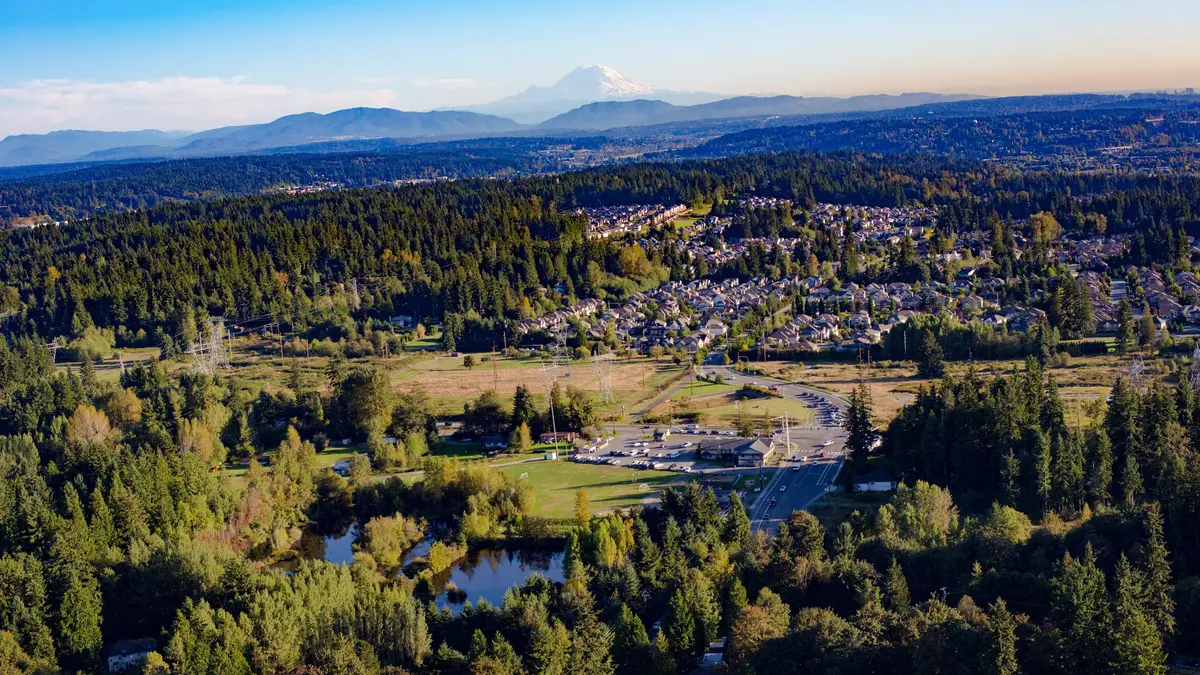
Maybe you've spent 30 years in a Seattle-area home and you're not ready to leave the Pacific Northwest — you're just ready to leave the commute. Mill Creek sits in that productive middle ground: close enough to Seattle's medical centers and cultural life, quiet enough that your neighborhood actually goes to sleep at night. The city of roughly 21,000 sits in southern Snohomish County, a few miles east of I-5 and north of Bothell, with SR-527 as its main arterial spine. What draws retirees isn't a single landmark — it's a cluster of conveniences that take years to notice: a healthcare system with deep local roots, a compact town center for errands, and trails that thread through the neighborhoods rather than requiring a drive to access them.
Washington's tax structure is the quiet financial engine behind a lot of retirement decisions in this state, and Mill Creek benefits directly from it. There's no state income tax at all, which means Social Security checks, pension distributions, and retirement-account withdrawals arrive in your account untouched by Olympia. Services like grocery anchors and everyday retail keep the daytime population steady and errands manageable — and that matters more than it sounds when you're thinking about what a Tuesday afternoon actually feels like in a place.
Cost of living is the honest friction point. The typical home value in Mill Creek was $967,807 as of May 2026 (Zillow Home Value Index), and while that's noticeably below Seattle's core prices, it's still a premium market by any national measure. Retirees with paid-off homes get the most leverage here: the effective property tax rate is low by Washington standards and well below the national median, and state-level tax exemptions can soften the picture further. For full details on daily living costs, see the cost of living in Mill Creek page.
Whether you're weighing a downsize from a larger family home nearby, relocating from out of state, or comparing Mill Creek against Bothell, Mukilteo, or Snohomish, the sections below cover the healthcare landscape, retiree tax posture, senior services, active-adult housing options, and how Mill Creek stacks up against the alternatives.

Why Retirees Are Choosing Mill Creek
The retirees who thrive here share a profile: they want a quiet, well-maintained suburb with real access to healthcare, they own their home outright or carry minimal debt, and they're not expecting a walkable urban retirement. Mill Creek delivers safety, greenery, and proximity to Everett's and Lynnwood's expanding medical corridors without the density or cost of Seattle proper. For couples downsizing from larger Snohomish County homes, it often represents a lateral move in geography and a step up in livability.
Who should look elsewhere? If your retirement plan centers on walking to coffee shops, using public transit as a primary mode, or living in a city with a robust downtown cultural scene, Mill Creek will feel limiting within six months. Most errands require a car. The Mill Creek Town Center is functional and pleasant, but it's a suburban retail hub — not a walkable village center. Retirees who need or want dense social programming, frequent live events, or proximity to a major university's continuing-education offerings will find Bothell or Lynnwood more naturally suited.
The typical home value of $967,807 (Zillow Home Value Index, May 2026) makes Mill Creek a realistic retirement destination primarily for those who already own equity in the region — not for buyers entering the market fresh on a fixed income. If you're bringing proceeds from a larger home sale, the math works well. If you're renting into retirement or financing from scratch, the monthly obligation will consume a significant share of most fixed incomes.
Healthcare & Medical Access in Mill Creek
The Local Healthcare Anchor
The Everett Clinic, now operating under Optum, is the dominant healthcare presence serving Mill Creek residents and is one of the largest multi-specialty group practices in the Pacific Northwest. Multiple Everett Clinic locations sit within a short drive of Mill Creek, offering primary care, cardiology, orthopedics, dermatology, and a wide range of specialty services that most retirees rely on regularly. For a suburb of Mill Creek's size, having this depth of outpatient specialty care within ten to fifteen minutes is a genuine advantage.
Hospital Access
Providence Regional Medical Center Everett is the closest full-service hospital, roughly eight to twelve miles north depending on your neighborhood. It operates a comprehensive Level II Trauma Center and is among the largest hospitals in Snohomish County. Major medical center campuses in Seattle are accessible in 35–45 minutes, which matters for oncology, neurology, and complex surgical cases — the appointments where advanced subspecialty depth is non-negotiable.
The Honest Distance Reality
For routine and urgent care, Mill Creek residents are well positioned. For the highest tier of tertiary and quaternary care — specialized cancer programs, complex cardiac surgery, transplant centers — the drive to Seattle is unavoidable. In a medical emergency, that distance is managed by Snohomish County's EMS system and the trauma center in Everett, which handles the volume. But retirees managing serious chronic conditions should factor the Seattle-access reality into their decision: it's manageable, and it requires planning.
Cogir of Mill Creek, located within the city, provides independent living, assisted living, and respite care and has earned Best of Senior Living recognition from A Place for Mom five consecutive years (2022–2026). Brookdale Mill Creek, at 14905 Bothell-Everett Highway, adds assisted living options with studio and one-bedroom apartments serving the 98012 zip code. Both are relevant for retirees planning ahead or considering a care continuum within Mill Creek itself.

The Retiree Budget in Mill Creek
Washington's Tax Gift to Retirees
Washington State has no personal income tax — full stop. Social Security benefits, pension income, and retirement-account withdrawals are entirely untaxed at the state level. For retirees moving from California, Oregon, or any other state with an income tax, the difference can be several hundred to several thousand dollars per year depending on income level.
Washington does have a 7% capital gains tax, but it's narrower than it sounds for most retirees. The tax applies only to gains above a $278,000 annual deduction (2025 threshold, adjusted annually for inflation), and it explicitly exempts retirement-account transactions — 401(k)s, IRAs, and defined-benefit plans are all excluded. Real estate sales are also exempt. A typical retiree drawing on Social Security, a pension, and retirement-account distributions owes no Washington capital gains tax at all.
Property Tax: The Rate Matters Here
Mill Creek's effective property tax rate is approximately 0.78% — meaningfully below the national median of roughly 1.0%–1.1%. That lower rate provides real budget stability on a fixed income, and the state goes further: qualifying senior homeowners can defer property taxes entirely until the home is sold or ownership transfers, with income and age thresholds determining eligibility. The Snohomish County Assessor's office administers the program locally.
Daily Cost of Living on a Fixed Income
Groceries are priced at Seattle-metro levels — expect to pay above national averages. Mill Creek's concentration of grocery options keeps competition reasonable, but the Pacific Northwest cost base is elevated. Snohomish County PUD offers senior and low-income discount programs on electric bills, and the county's Energy Assistance Program covers heating costs for qualifying households — both worth a phone call if your income drops post-retirement. For the full cost picture including rent and utilities, see the cost of living in Mill Creek page.
Looking to buy in Mill Creek? Estimate your payment.
Enter your numbers to see an estimated monthly mortgage payment.
Estimate only. Excludes HOA fees and mortgage insurance. The interest rate above is a starting point, not a quoted rate — replace it with your own to see real numbers. Insurance is a flat placeholder, not a Mill Creek quote.
Walkability, Community & Staying Active in Mill Creek
The Walkability Reality
Mill Creek is car-dependent by design. Most daily errands require a vehicle, and the city's walk scores reflect its suburban layout rather than any marketing copy. That said, the trail network that winds through Mill Creek's neighborhoods — particularly the off-road paths connecting residential areas to the Town Center — is genuinely usable for daily exercise and low-stakes errands on foot or by bike. It's not the same as walkable; it's better than most suburbs its size.
Community Transit serves Mill Creek with local buses and Swift bus rapid transit, running every 10–20 minutes. The Swift Orange Line connects to Lynnwood City Center Station, where riders can transfer to Link light rail heading into Seattle. The Swift Green Line runs between Mukilteo and Bothell with stops in Mill Creek. For retirees who've handed over the car keys — or are planning to — this network is functional but will require flexibility in scheduling. It's not a replacement for a car; it's a supplement to one.
Senior Services and Community Infrastructure
The Mill Creek Senior Center, operated by Northshore Senior Center, runs Monday through Friday, 9 a.m. to 3 p.m., offering health, educational, and social programming. It also distributes Snohomish County Farmer's Market Program vouchers — a practical perk that stretches a grocery budget while connecting seniors to the local food community.
Homage Senior Services, based in Lynnwood, extends free health consultations, transportation assistance, minor home repair, nutrition services, and advocacy to older adults throughout Snohomish County — Mill Creek included. Homage Meals on Wheels provides meal delivery to homebound residents. Snohomish County Human Services layers on additional programs: Senior Peer Counseling (one-on-one, in-home), Volunteer Chore Services covering housekeeping, yard work, and shopping, Volunteer Transportation, a Daybreak Respite Program, and Geriatric Depression Screening. The county-level safety net here is meaningfully deeper than what most suburbs of Mill Creek's size maintain on their own.
Staying Active Beyond the Senior Center
The Mill Creek Country Club and Golf Course gives golfers a dedicated local option without driving to Everett or Bothell. The trail corridors throughout the city support walking groups and casual cyclists year-round — Northwest winters are mild enough for an afternoon walk far more often than newcomers expect. The social life that forms here tends to be neighborhood-scale: the trail, the Town Center coffee stops, and the senior center programming rather than a buzzing downtown social scene.
Right-Sizing: Downsizing in Mill Creek
The Downsizing Decision
Most retirees downsizing in Mill Creek are moving within Snohomish County — from a four-bedroom family home in nearby Silver Lake, Mays Pond, or Martha Lake into something smaller, lower-maintenance, and single-level. The inventory of single-story homes and patio-style properties exists in Mill Creek, but it's not abundant. The city developed primarily in the 1980s and 1990s as a family suburb, meaning two-story layouts dominate. Single-level homes or homes with primary-bedroom-on-main configurations tend to sell quickly and carry a premium over comparable square footage in two-story designs.
Senior Living Communities
Cogir of Mill Creek is the city's flagship senior living option, offering independent living, assisted living, and respite care under one roof. Its five-year streak of Best of Senior Living recognition from A Place for Mom signals consistent resident satisfaction — not just marketing. For retirees who want to age in place with a care continuum available on-site, it's the most complete local option.
Brookdale Mill Creek on the Bothell-Everett Highway offers assisted living with studio and one-bedroom apartments for those who need a higher level of support. Between these two communities and the county's in-home services through Homage and Snohomish County Human Services, Mill Creek can support a full range of aging-in-place scenarios — from fully independent homeownership to memory care transitions in nearby communities.
Condos and Lower-Maintenance Options
The Mill Creek Town Center area has the city's most relevant concentration of attached and lower-maintenance housing. Condos and townhomes near the Town Center trade some square footage for walkable access to retail and dining and eliminate the yard maintenance that becomes a real burden after 70. Inventory turns over slowly in this segment — when a well-located single-level unit comes up, it tends to move. Buyers targeting this profile should plan to move quickly and work with someone who knows the Town Center submarket specifically.
Purpose-built 55+ or active-adult communities in Mill Creek proper are limited. Retirees who specifically want an age-restricted community with organized amenities — a clubhouse, a pool, planned social activities — will find more purpose-built options in Bothell, Lynnwood, or further out in Snohomish. That's a real gap in the local inventory, and worth weighing honestly before committing to Mill Creek over a nearby alternative.
Mill Creek vs Nearby Retirement Destinations
| City | Cost vs Mill Creek | Primary Hospital | Walkability | Senior Living Depth | Overall Retirement Fit |
|---|---|---|---|---|---|
| Mill Creek | Anchor | Providence Regional Medical Center Everett (~10 mi) | Car-dependent; good trail network | Cogir + Brookdale on-site; strong county services | Quiet Nature Strong for equity-rich downsizers |
| Bothell | About the same | EvergreenHealth (~8 mi, Kirkland) | Slightly more walkable near Canyon Park and downtown | Multiple senior communities; growing inventory | Walkable Transit Better for those wanting more on-foot options |
| Lynnwood | Noticeably cheaper | Providence Regional Medical Center Everett (~6 mi) | Good near Alderwood; car-dependent elsewhere | Deep — Homage HQ is here; multiple senior facilities | Value Best for fixed-income retirees; less residential quiet |
| Mukilteo | About the same | Providence Regional Medical Center Everett (~10 mi) | Limited — ferry town layout | Thinner locally; relies on Everett and Lynnwood options | Views Quiet Strong lifestyle fit; smaller senior-service footprint |
| Everett | Noticeably cheaper | Providence Regional Medical Center Everett (on-site) | Best of any option listed; downtown walkable core | Broad — largest senior-service concentration in county | Transit Value Best for budget-conscious retirees needing medical proximity |
| Snohomish | Noticeably cheaper | Providence Regional Medical Center Everett (~15 mi) | Walkable historic downtown; limited elsewhere | Thin — small town with limited on-site options | Quiet Privacy Best for rural-feel retirees comfortable with less infrastructure |
Everett is the clearest winner on cost, hospital proximity, and transit access — retirees who prioritize being close to their healthcare rather than paying for a quieter suburb should compare Everett seriously before choosing Mill Creek. Lynnwood competes on price and senior-service depth, and its proximity to Homage Senior Services headquarters means more programs accessible without driving far.
Bothell is Mill Creek's closest functional equivalent: similar prices, similar suburban character, slightly better on-foot access near its downtown core. The meaningful edge Mill Creek holds is its trail-threaded residential character and the quieter pace that comes with being a purpose-built residential suburb rather than a commercial corridor city. Mukilteo appeals to retirees who want water views and a small-town feel but requires accepting thinner local senior infrastructure. Snohomish suits retirees who want a genuine small town with a walkable historic district — at the cost of driving farther for almost every medical or senior-service need.
Local Expert Takeaway: Mill Creek earns its retirement credibility primarily through Washington's tax structure, a below-national-average property tax rate, meaningful county-level senior services through Homage and Snohomish County Human Services, and the Mill Creek Senior Center's weekday programming. The honest catch: it's a car-dependent suburb without purpose-built 55+ communities in meaningful supply, and the entry price requires existing regional equity to make the budget work. Retirees who arrive here with a paid-off home or a strong equity position from a larger property, and who want quiet streets, trail access, and proximity to Everett's healthcare corridor without Seattle's density, consistently find it delivers exactly what it promises.
Quick Takeaways & FAQs
✅ Washington State has no income tax, so Social Security, pension income, and retirement-account withdrawals are entirely untaxed at the state level — a genuine financial advantage Mill Creek retirees benefit from on day one.
⚠️ Mill Creek is car-dependent, lacks purpose-built 55+ communities in meaningful supply, and carries a near-$1 million typical home price — making it a realistic retirement destination primarily for those already holding significant regional equity.
📍 The Mill Creek Senior Center (operated by Northshore Senior Center, open weekdays 9 a.m.–3 p.m.) and Cogir of Mill Creek's independent-to-assisted living continuum are the two most important local infrastructure points any prospective retiree should visit in person before deciding.
Is Mill Creek, WA a good place to retire?
Does Washington State tax Social Security or retirement income?
What is the closest major hospital to Mill Creek, WA?
Are there 55+ or active-adult communities in Mill Creek?
What senior services are available in Mill Creek?
Moving to Washington?
Tell us what you need help with and we'll connect you with local resources.
