
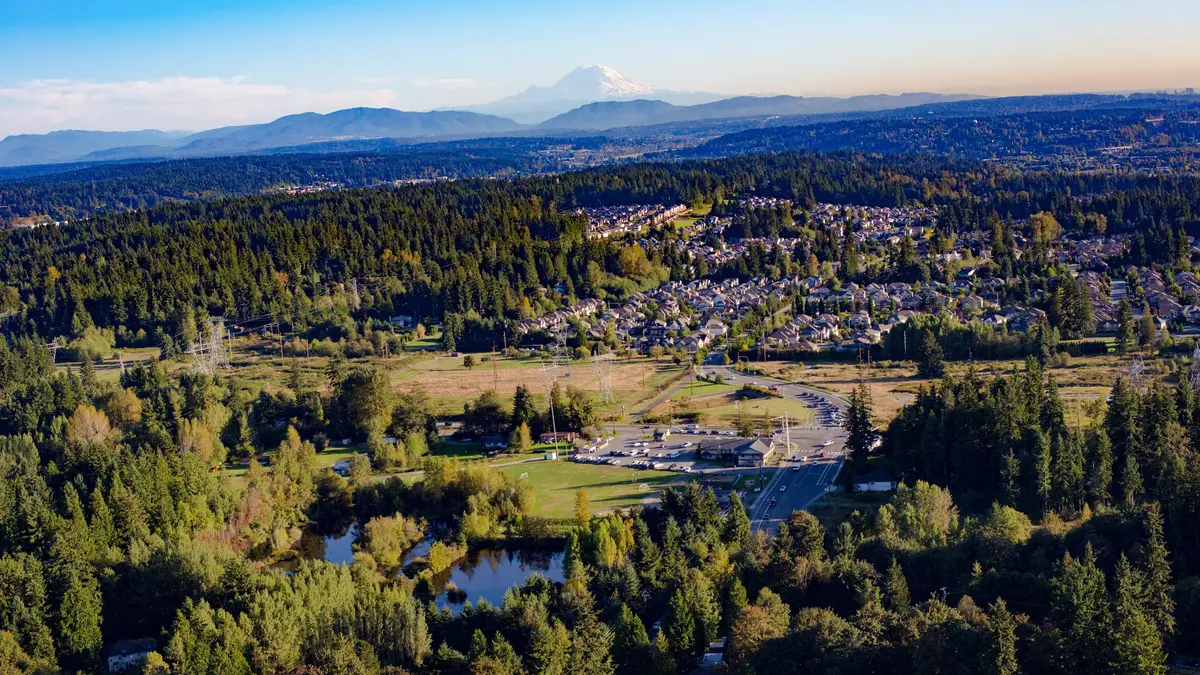
Maybe your company announced a move to the Seattle metro and someone on the relocation team mentioned Mill Creek. Maybe you've watched Bay Area or Los Angeles prices climb past what any reasonable salary can absorb and started running the numbers on the Pacific Northwest. Either way, Mill Creek tends to surprise Californians who look it up: it's not the rainy, gray, vaguely Seattleish suburb they imagined. It's 20 miles north of downtown Seattle in Snohomish County, tucked between I-5 and SR-527, and it has the kind of order and greenery that makes transplants say, quietly, that it feels like the California they thought they were leaving behind — minus the traffic, the fire risk, and the tax bill.
What actually sustains Mill Creek is a professional demographic base with a median household income of $124,364. The Mukilteo School District, rated B+ by Niche, consistently draws families with school-age children who have been priced out of Bellevue or Kirkland but refuse to compromise on public school quality. Major employers anchoring the local economy include a regional healthcare network alongside large retail and grocery employers. The Seattle tech corridor — Bothell, Redmond, Bellevue — is accessible via I-405, and Sound Transit's express bus network plus the Lynnwood Link light rail extension make car-optional commuting genuinely possible for the first time in the city's history.
On price, Mill Creek is not cheap — the typical home value sits at $967,807 (Zillow Home Value Index, May 2026) — but that number looks different depending on where you're moving from. For most Bay Area buyers, it represents a meaningful step down in entry cost. For Southern California buyers in coastal markets, the gap is narrower but the tax story more than compensates. Washington has no personal state income tax, and Mill Creek's effective property tax rate runs approximately 0.78% of assessed value, noticeably below the rate a California buyer faces on a newly purchased home under Prop 13's reset rules. The full cost-of-living breakdown covers utilities, groceries, and day-to-day spending in more detail. The North Creek Trail, Mill Creek Town Center on Main Street, and the Mill Creek Country Club and Golf Course give daily life a suburban texture that Californians recognize — walkable errands, restaurant rows, weekend green space — without the density of Seattle proper.
Whether you're relocating for work, for schools, or simply for financial breathing room, the sections below walk through the California-to-Mill Creek comparison on taxes and home prices, what the lifestyle adjustment actually looks like, where the real trade-offs are, and what California transplants typically say after their first year here.

The Tax Shift: What Leaving California Actually Means for Your Paycheck
The single biggest financial change when you move from California to Mill Creek is one you feel on the first paycheck: Washington has no personal state income tax. Zero. It is written into Washington's state constitution, and no bill or legislative session is about to change it. California's top marginal rate is 13.3%, the highest of any state in the country.
That gap is not theoretical. For a household earning $200,000 — roughly in line with what many dual-income professional couples in Mill Creek report — the effective California state income tax burden can run well into five figures annually. In Washington, that line on the tax return simply does not exist. For remote workers who kept a California employer after the pandemic and now want to formalize their move, the calculation is usually straightforward: establish residency in Washington, update your withholding, and stop paying California state income tax.
California residency rules are worth understanding before you celebrate, though. California's state tax authority is notably aggressive about auditing people who claim to have left. If you're still working for a California employer, spending significant weeks in the state, or maintaining a California home, the state may argue you're still a California resident. Talk to a CPA before you file your first Washington return — this is one of the most common friction points for people who relocate from California to a no-income-tax state and assume the savings are automatic.
| Category | California | Mill Creek, WA |
|---|---|---|
| State income tax (top marginal) | 13.3% | 0% |
| State income tax (middle income, ~$100K) | ~6–9% | 0% |
| Effective property tax rate (new purchase) | ~1.1–1.25% (Prop 13 reset) | ~0.78% |
| Combined sales tax rate | ~7.25–10.75% (varies by county) | 10.6% |
| Grocery sales tax | Exempt (most items) | Exempt |
| Capital gains tax | Up to 13.3% (taxed as income) | 0% state (federal applies) |
| Estate / inheritance tax | None | Washington estate tax applies above $2.193M threshold |
The one line where California sometimes wins: sales tax. Mill Creek's combined rate is 10.6% — competitive with Los Angeles County's 10.25% or San Francisco's 8.625%, but higher than many inland California counties. Groceries are exempt under Washington law, which softens the headline rate for everyday household spending.
The Property Tax Reset
California's Proposition 13 caps annual property tax increases at 2% for existing owners — which sounds like a protection until you buy a new home and the assessment resets to purchase price. A buyer paying Bay Area prices who relocates to Mill Creek will likely see a lower effective tax rate on their new purchase at 0.78%, applied to an assessed value that is probably well below what they sold.
Washington does not have a Prop 13 equivalent, so assessments can rise with the market. But the effective rate of 0.78% is meaningfully below the national average of roughly 1.1%, and significantly below what a newly purchased California home in a high-cost county typically produces after a Prop 13 reset. For a detailed breakdown of what Washington taxes look like year to year, the cost-of-living page covers the full picture.
Home Prices: The California Comparison That Actually Matters
The typical Mill Creek home value is $967,807 (Zillow Home Value Index, May 2026). That is a real number — Mill Creek is not inexpensive, and anyone moving from California's Central Valley or Inland Empire may not feel immediate sticker relief. But for buyers coming from the Bay Area's established tech corridors or coastal Southern California, the contrast is significant.
The Bay Area's median home prices have hovered well above $1.3 million in recent years for single-family homes in established suburban cities. San Francisco proper routinely exceeds $1.5 million for comparable single-family inventory. Mill Creek's sub-$1 million typical value — for a city with strong schools, low crime, and 35-minute freeway access to downtown Seattle — is a fundamentally different risk profile for a buyer who has been watching Bay Area prices for years.
Southern California is a more nuanced comparison. Buyers from inland San Diego, parts of Orange County, or the Conejo Valley may find the raw price gap smaller. What shifts the math is the income tax elimination and the property tax rate: a household that was paying California state income tax on a six-figure income and resetting a Prop 13 assessment on a high-value home can come out ahead in Mill Creek even if the purchase price is close.
What the Mill Creek Market Actually Feels Like
Mill Creek is not a distressed or declining market — homes move. Buyers coming from California's hyper-competitive markets often find the pace here slightly less frenetic, but multiple-offer situations on well-priced homes in the Town Center area and along the greenbelt corridors are routine, not exceptional.
Entry-level inventory — older construction, smaller lots — generally starts noticeably below the city-wide typical value. The upper end of the market, larger homes near the Mill Creek Country Club and Golf Course or backing onto the North Creek greenbelt, can run considerably above it. For a full look at how specific areas of the city compare in character and price positioning, the neighborhoods guide covers the distinctions that matter most to buyers coming from out of state.
| California Market | Approx. Median (Single-Family, 2025–2026) | Mill Creek Typical Value | Directional Gap |
|---|---|---|---|
| San Francisco | ~$1.5M+ | $967,807 | Noticeably below |
| Silicon Valley / South Bay | ~$1.5M+ | $967,807 | Noticeably below |
| East Bay (established suburbs) | ~$1.2–1.4M | $967,807 | Meaningfully below |
| Los Angeles (metro) | ~$1.0–1.4M | $967,807 | Comparable to below |
| San Diego (coastal) | ~$1.1–1.3M | $967,807 | Somewhat below |
| Sacramento metro | ~$550–700K | $967,807 | Mill Creek is higher |
| Inland Empire | ~$550–650K | $967,807 | Mill Creek is higher |
The table makes the point plainly: if you're coming from Sacramento, the Inland Empire, or California's Central Valley, Mill Creek's home prices will feel elevated — and the income tax savings do not change that reality. If you're coming from the Bay Area or coastal Southern California, the math typically runs the other direction.

Daily Life Adjustment: What California Transplants Actually Notice
The lifestyle shift from California to Mill Creek is more specific than most relocation guides acknowledge. It is not just "less traffic" or "more green." It is a particular kind of suburb: tight, well-maintained, 20,993 people, oriented around the Town Center at 15310 Main St with its shops and restaurants, and surrounded by forested greenbelt trails rather than strip-mall sprawl.
Californians who move here in summer often say month three is when the weather reality arrives: the Pacific Northwest's gray, drizzly fall and winter set in around October and does not fully lift until May. People who moved from San Diego or Los Angeles are rarely prepared for how long the overcast lasts. This is not a minor detail — it is the most common reason California transplants reconsider Mill Creek after the first year. If you've spent decades in a climate with 280+ days of sun, budget time and intention to manage the seasonal adjustment.
Where People Actually Gather
The Town Center on Main Street is the social spine of Mill Creek. Weekend mornings pull residents to the coffee shops and a seasonal farmers market rotation around SR-527. The local taphouses and neighborhood gathering spots draw the after-work crowd — a reliable Friday scene for the tech and healthcare professionals who commute to Seattle or Everett during the week.
The North Creek Trail is the other gathering place — over 23 miles of wooded paths connecting Mill Creek to Bothell and Everett alongside North Creek. Californians used to weekend hikes in the Sierra Nevada foothills or coastal ranges will find the trail system more urban-adjacent but genuinely beautiful in the Douglas fir canopy sections. The parks and recreation page covers the specifics of what's accessible and from where.
The Slower Pace Is Real — And Then It Isn't
Mill Creek has no nightlife to speak of. It has no downtown arts district, no dense transit-oriented corridor, no late-night food scene. Californians used to Los Angeles or a large metro often find the pace genuinely relaxing for the first six months, and genuinely limiting by month nine.
The answer most transplants land on: Seattle is 35 to 55 minutes away depending on traffic, and the Lynnwood Transit Center now connects to the Lynnwood Link light rail extension into the city's light rail network. Mill Creek is a base, not a destination — and that framing fits some California households perfectly, and chafes others. The living in Mill Creek guide covers who tends to thrive here versus who eventually moves on.
Healthcare cost is one area where the move typically works in your favor: insurance premiums run noticeably below what most California residents were paying, though you will drive farther when specialist care is needed. Routine care access is solid for a city this size.
Looking to buy in Mill Creek? Estimate your payment.
Enter your numbers to see an estimated monthly mortgage payment.
Estimate only. Excludes HOA fees and mortgage insurance. The interest rate above is a starting point, not a quoted rate — replace it with your own to see real numbers. Insurance is a flat placeholder, not a Mill Creek quote.
Schools, Safety, and the Practical Checklist for California Families
For California families moving because of schools — and a significant share of Mill Creek's California transplants give this as a primary reason — the Mukilteo School District's B+ rating is the relevant data point. It consistently ranks among the stronger districts in Snohomish County and draws comparison, favorably, to many California unified districts that serve comparable suburban demographics. The full picture on specific schools, boundary quirks, and what the rating actually reflects is on the schools page.
Safety is among the more concrete adjustments Californians notice. Mill Creek's violent crime rate runs at 2 per 1,000 residents — among the lower figures in the Seattle metro. Property crime at 20 per 1,000 is similarly below state and national averages. Parents with school-age children who moved from parts of the Bay Area or Los Angeles with elevated property crime often mention the difference in the first year, sometimes in the context of leaving garage doors open or letting kids walk to school independently.
The Practical Relocation Checklist
- Driver's license and vehicle registration: Washington gives new residents 30 days to get a WA license and 60 days to register vehicles. Washington does not have a smog check requirement — a welcome change for anyone with an older vehicle that was marginal in California.
- Voter registration: Washington is a fully vote-by-mail state. Register online through the state's voter registration portal; ballots arrive automatically.
- Washington does not have a state income tax withholding form — update your federal W-4 and notify your employer's payroll of your new state of residence immediately.
- Establish Washington residency clearly: Get a WA license, register to vote, and update your primary address on all financial accounts before filing your final California return. California's residency audit standards are specific, and documentation of a clean break matters.
- Home buying process: Washington is an escrow state with a standard 30-day close. Buyers from California will find the process broadly familiar. For first-time buyers or anyone navigating Washington-specific programs, the first-time homebuyer guide covers the mechanics.
- Pet licensing: Snohomish County requires annual pet licensing. Budget for this — it is enforced.
The vehicle registration note is worth expanding: Washington's registration fees are based on vehicle value and age, and can be higher than California for newer vehicles in the first year. Do not assume registration will be cheaper just because the state has no income tax.
Honest Trade-offs: What You Gain and What You Give Up
The case for moving from California to Mill Creek is structurally sound for most mid-to-high-income professional households. The income tax elimination is real and recurring. The home price, for Bay Area and coastal Southern California buyers, is generally more accessible. The schools perform. The crime rates are low. The commute to Seattle — 35 to 55 minutes on I-5 south, with transit backup via Sound Transit Express and the Lynnwood Link — is manageable for most professional schedules.
The honest case against it is shorter but worth reading before you make an offer.
What You Give Up
California's Proposition 13 was protecting long-term homeowners from runaway tax bills on appreciated property. Washington's property tax system has no equivalent cap on annual assessment growth, which means if Mill Creek's values continue climbing, your tax bill climbs with them. The current effective rate of 0.78% is favorable — but it is not frozen the way a long-held California property's effective rate can be.
Washington's 10.6% combined sales tax is among the higher rates in the country. For high-spending households — new cars, large appliances, significant retail — this matters. California residents from low-sales-tax counties may feel it acutely in the first year. Groceries are exempt, which helps on daily spending, but the headline rate on everything else is real.
California has a more developed specialist and research care ecosystem than most of the Pacific Northwest. Routine care access in Mill Creek is solid, but for complex or rare conditions, the nearest major academic research centers require a trip to Seattle or, in some cases, farther. That trade-off is manageable for most families and significant for some.
What You Gain That Isn't on the Spreadsheet
Mill Creek's greenbelt system — the North Creek Trail running through wooded corridors alongside the creek — gives the city a physical calm that is hard to replicate in California's suburban markets at this price point. The Town Center at 15310 Main St gives daily errands a walkable, human-scale quality that most California suburbs of comparable size don't have. And 20,993 people in a single city means the community is small enough to feel coherent — the kind of place where the neighbors at the end of the block know your name by spring.
The surprise most California transplants report after 12 months: they miss the sun more than they expected, and they miss the cost of California less than they feared. The income tax line on a Washington pay stub — blank, every month — has a way of making the adjustment feel worthwhile. For a full read on what buyers typically experience when they arrive and what pushes some to eventually leave, the living in Mill Creek guide covers the arc honestly.
| Factor | California (typical) | Mill Creek, WA | Verdict for Most CA Transplants |
|---|---|---|---|
| State income tax | Up to 13.3% | 0% | Strong gain |
| Home price (Bay Area / coastal SoCal) | Noticeably higher | $967,807 typical | Gain for most |
| Property tax rate (new purchase) | ~1.1–1.25% | ~0.78% | Gain |
| Sales tax | Varies; often lower | 10.6% | Watch spending |
| Climate / sunshine | High | Overcast Oct–May | Major adjustment |
| School district quality | Highly variable | B+ (Mukilteo) | Solid gain |
| Walkable commercial hub | Rare at this density | Town Center, Main St | Gain |
| Outdoor / trail access | Year-round; drier | Year-round; wetter | Comparable, different |
The table is a starting framework, not a verdict. The weight you put on each row depends on your household's income level, your kids' ages, your employer's location, and how much the Pacific Northwest's winter gray will affect your mood. Run your own numbers — but run them with Washington's zero on that income tax line.
Local Expert Takeaway: The financial case for moving to Mill Creek from California is strongest for households earning above $150,000 who are buying from a Bay Area or coastal Southern California market. The income tax elimination is not a rounding error — it is a structural, recurring gain that compounds every year you live here. The Town Center on Main Street and the North Creek Trail give daily life a quality that most California suburbs at this price point don't have. The honest catch: the overcast season is long, the sales tax is high, and Washington's property tax system has no Prop 13 equivalent to protect you if values keep climbing. Go in with clear eyes on the weather and the sales tax, and the math usually works.
Quick Takeaways & FAQs
✅ Washington's zero state income tax is permanent and constitutional — for most California households earning six figures, it is the single largest financial benefit of moving to Mill Creek.
⚠️ Mill Creek's 10.6% combined sales tax is among the higher rates in the country and will surprise Californians from lower-rate counties — especially on large purchases like vehicles and appliances.
📍 The North Creek Trail's 23-mile wooded corridor through Mill Creek's greenbelt is one of the few genuinely local amenities in the city that has no California equivalent at this price point.
Do I still owe California income tax after moving to Mill Creek, WA?
How do Mill Creek home prices compare to where I'm moving from in California?
What is Washington's sales tax, and is it higher than California?
How do I establish Washington residency quickly after moving from California?
Is Mill Creek a good fit for California families who prioritize school quality?
Moving to Washington?
Tell us what you need help with and we'll connect you with local resources.
