
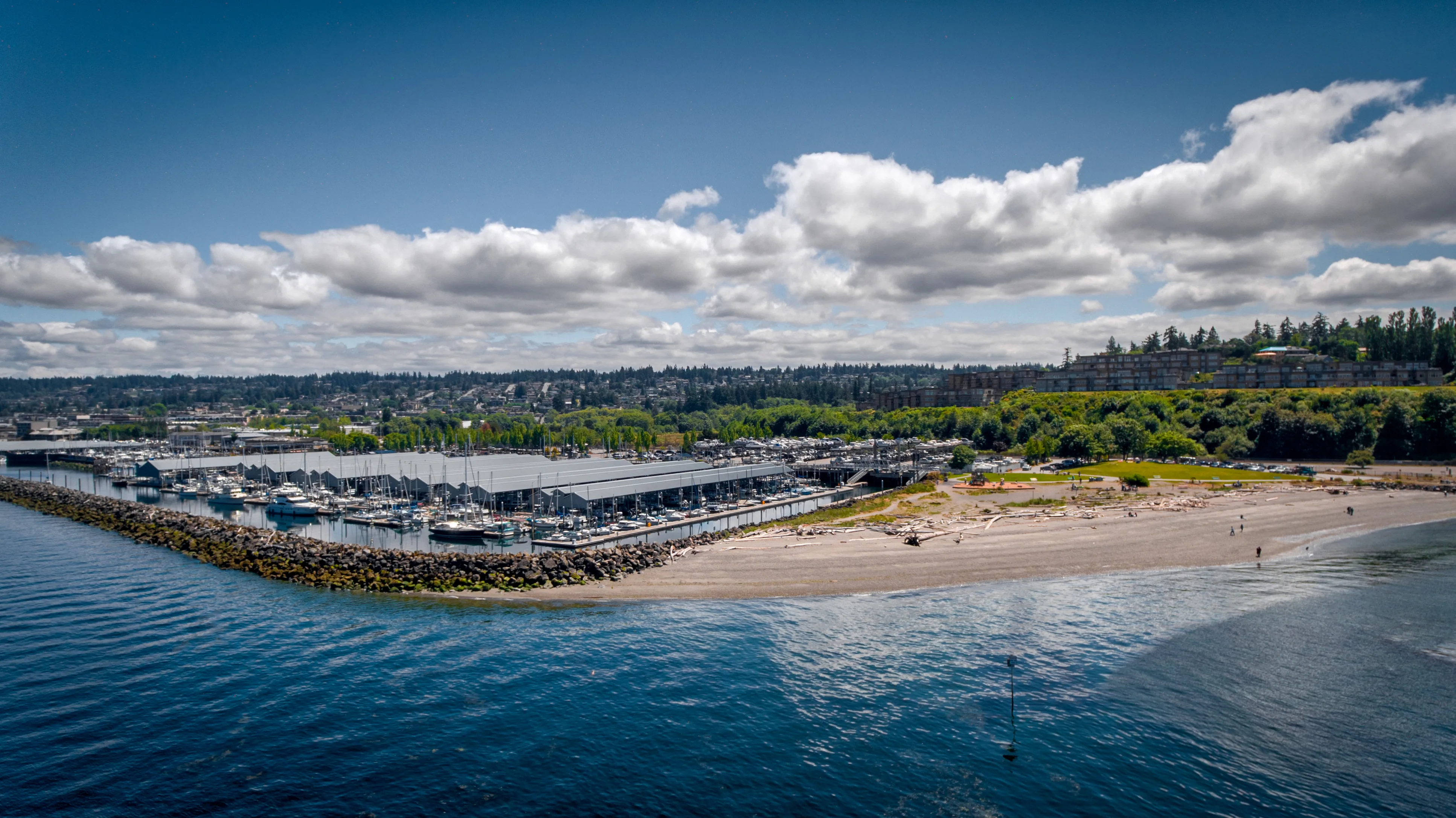
Here is what catches most people off guard: Edmonds sits just 15 miles north of Seattle, shares the same Puget Sound shoreline, and consistently prices itself closer to Bellevue than to Lynnwood. The Zillow Home Value Index puts the typical home at $855,381 as of mid-2026 — a number that stops buyers cold when they first pull it up, especially if they drove through and assumed a small waterfront town would be a relative bargain compared to the city. It is not. What drives the number is a combination of genuinely limited inventory, the ferry terminal at the foot of Main Street, the walkable downtown around the Edmonds Waterfront and Marina, and a consistent demand from Seattle-area professionals who want a town that feels distinct from the suburbs sprawling east along I-405.
The economic backbone here is anchored by the Port of Edmonds, Sound Transit's Sounder N Line commuter rail, and Community Transit, which connect residents to Seattle without requiring a car — a meaningful cost offset for households willing to work around a peak-hour schedule. Downtown small businesses fill the blocks around the waterfront and give the area a density of independent retail and dining that most Snohomish County cities lack.
Overall, Edmonds runs noticeably above the Washington state average and well above the national baseline. BestPlaces estimates total living costs at 36.2% above the U.S. average, driven primarily by housing. The saving graces on the expense side are real: Washington levies no personal income tax, electricity here runs roughly 42% below the national average thanks to Pacific Northwest hydropower, and the Sounder rail commute to Seattle runs $3–$6 one-way — which means households that can structure their lives around transit find the day-to-day less punishing than the housing sticker suggests.
Whether you are comparing Edmonds to Shoreline to the south, Mukilteo to the north, or your current city across the country, the sections below break down Edmonds's housing costs, rent versus buy math, everyday expenses, nearby-city comparisons, and the full tax picture so you can build a realistic budget before you decide.
What It Really Costs to Live in Edmonds
Edmonds is a premium market inside an already-expensive metro. The typical home value is $855,381 (Zillow Home Value Index, mid-2026), which places it noticeably above the broader Snohomish County average and in the same conversation as the pricier pockets of Seattle's north end rather than its more affordable suburbs.
Three things push the number this high. First, geography: the city is wedged between Puget Sound to the west and rising terrain to the east, so developable land is genuinely constrained. Second, access: the Edmonds-Kingston Ferry Terminal and the Sounder N Line rail station make this one of the few places in Snohomish County where you can realistically commute to downtown Seattle without a car. Third, character: the walkable downtown, the Edmonds Fishing Pier, and the Edmonds Underwater Park create an amenity stack that buyers pay a consistent premium to be near.
Compared to the state average, Edmonds is substantially more expensive. Compared to Kirkland or Bellevue across the lake, it is closer to competitive. For buyers moving from Lynnwood or Mountlake Terrace — both within a few miles — the gap is real enough to matter in a budget conversation. Groceries run approximately 11–12% above the national average, transportation costs are estimated at 34% above average (car ownership in a sprawling metro is expensive even when transit is available), and city utility rates have climbed steeply in recent years. The income picture is strong — median household income sits at $122,449 — but that number still gets stretched by what Edmonds asks of homeowners.
Housing: Rent vs Buy in Edmonds
Buying in Edmonds means entering a market where entry-level homes — older construction, smaller lots, farther from the waterfront — start around $650,000 to $700,000 on the low end, with the typical home value at $855,381 (Zillow Home Value Index, mid-2026). Entry-level inventory tends to cluster in parts of the city away from the downtown core; for neighborhood-level context, the Best Neighborhoods guide breaks that down specifically. Do not attach a price expectation to a specific area based on what you read elsewhere — pricing shifts block by block here, and the waterfront premium is steep.
The effective property tax rate in Edmonds is approximately 0.70% — one of the lower rates in Washington state, and a genuine bright spot in an otherwise high-cost market. That rate applies to assessed value, so the actual annual bill scales with the purchase price; the interactive calculator below will give you a personalized mortgage and tax estimate once you plug in your numbers. Do not use any figure you see quoted elsewhere as a monthly payment — the calculator owns that math.
Renting makes clear financial sense for anyone planning to stay fewer than three to four years, or for households that have not yet saved a down payment scaled to these prices. A typical two-bedroom rental in Edmonds runs roughly $2,200–$2,800 per month depending on location and condition, with waterfront-adjacent units pushing above that range. The rent-versus-buy crossover point is longer here than in most markets, simply because the purchase prices are high enough that the monthly cost of ownership — even before maintenance — typically exceeds renting equivalent square footage.
One friction point that surprises renters: available inventory is thin. Edmonds is a city where a high percentage of residents own, and the rental market is dominated by single-family homes and small condo complexes rather than large apartment buildings. When a well-priced two-bedroom comes available, it moves fast — sometimes in under a week.

Everyday Costs Beyond Housing in Edmonds
Utilities in Edmonds carry a silver lining and a sting. Electricity rates run approximately 12¢ per kWh as of July 2026 — well below the national average, driven by the region's hydropower grid — which meaningfully lowers summer bills for households that rely primarily on electric appliances. The sting is water, sewer, and stormwater: the City of Edmonds implemented a council-mandated rate schedule for 2026 that raised water rates 9%, sewer 10%, and stormwater 8.5%, with an additional temporary 10% surcharge added across all three categories in December 2025. Households that moved here before these increases hit are now carrying meaningfully higher utility bills than they budgeted for. Natural gas, the primary winter heating fuel here, tracked at a statewide average of $20.41 per thousand cubic feet as of May 2026 per the U.S. Energy Information Administration — a figure that varies with winter severity.
Groceries run about 11–12% above the national average, consistent with the broader Seattle metro region. You will not find dramatic relief by driving to Lynnwood or Mountlake Terrace — the regional pricing floor is high. The Sounder N Line commute to Seattle runs $3–$6 one-way, which is a genuine bargain for a 30-minute train ride; for car-dependent households, the combination of fuel, insurance, and parking adds up to transportation costs running an estimated 34% above the national average.
| Category | Typical Monthly Cost | Notes |
|---|---|---|
| Housing (2BR rent) | $2,200–$2,800 | Renters' baseline; homeowners: use the mortgage calculator below for an ownership estimate |
| Electricity | $80–$130 | Approx. 12¢/kWh (July 2026) — well below national average |
| Water, Sewer & Stormwater | $120–$180 | Rates rose significantly in 2026 with council-approved increases plus a temporary surcharge |
| Natural Gas (heating) | $60–$140 | Seasonal; higher Nov–Feb; statewide avg $20.41/Mcf (EIA, May 2026) |
| Groceries | $550–$750 | Approx. 11–12% above U.S. average; estimate for 2-person household |
| Transportation & Gas | $250–$500 | Lower end with Sounder rail pass; higher end for car-dependent households driving to Seattle |
| Phone & Internet | $120–$200 | Typical bundled or separate plans; fiber service available in most neighborhoods |
| Misc / Discretionary | $300–$600 | Dining along Main Street, ferry day trips, arts events at Edmonds Center for the Arts |
These are estimates for a two-person renting household; individual spending varies significantly. A single person on a tight budget can come in below the ranges above; a family of four will almost certainly exceed them.
Looking to buy in Edmonds? Estimate your payment.
Enter your numbers to see an estimated monthly mortgage payment.
Estimate only. Excludes HOA fees and mortgage insurance. The interest rate above is a starting point, not a quoted rate — replace it with your own to see real numbers. Insurance is a flat placeholder, not a Edmonds quote.
Edmonds vs Nearby Cities: Cost Comparison
| City | Median Home Price | Typical 2BR Rent | Cost vs Edmonds |
|---|---|---|---|
| Edmonds | $855,381 (ZHVI, mid-2026) | $2,200–$2,800/mo | — baseline — |
| Lynnwood | Approx. $620,000–$660,000 | $1,900–$2,400/mo | Noticeably cheaper |
| Mountlake Terrace | Approx. $630,000–$680,000 | $1,900–$2,400/mo | Noticeably cheaper |
| Shoreline | Approx. $760,000–$820,000 | $2,100–$2,600/mo | Moderately cheaper |
| Mukilteo | Approx. $760,000–$830,000 | $2,000–$2,500/mo | Moderately cheaper |
| Woodway | $1,300,000+ | Very limited rental stock | Substantially higher |
* ZHVI = Zillow Home Value Index. Non-Edmonds figures are estimated ranges from available market data and should be verified before relying on them for a purchase decision.
The clearest pattern: Edmonds prices a meaningful step above Lynnwood and Mountlake Terrace — two cities that share its commuter access to Seattle — and sits closer to Mukilteo and Shoreline, which offer comparable ferry or light-rail access. Woodway, the small incorporated city bordering Edmonds to the north, is in an entirely different price tier and has almost no rental market to speak of.
Taxes & the Bottom Line for Edmonds
Washington's most important tax feature for incoming residents: there is no personal state income tax. For a household earning $122,449 — the Edmonds median — that is a meaningful advantage compared with moving from California, Oregon, or any state with a significant income tax rate. Washington funds state government primarily through sales tax and a gross-receipts Business & Occupation tax on businesses, not on workers' paychecks.
The trade-off is a high sales tax. Edmonds carries a combined rate of 10.7% in 2026 — the highest tier in Snohomish County — built from Washington's 6.5% state base plus 4.2% in local add-ons. That rate applies to most retail purchases, restaurant meals, and many services. A meal at one of the independent restaurants along Main Street, a new appliance, a car purchase: all taxed at 10.7%. For households that spend heavily on taxable goods, this offsets the income-tax advantage faster than most people initially calculate.
The effective property tax rate of approximately 0.70% is genuinely low by Washington standards — and very low by national standards for a city at this price point. It does not cushion the total cost of ownership at the price levels described above, but it does mean the annual property tax burden is more modest than the sticker price might suggest. Use the mortgage calculator after the housing section to model total ownership cost with that rate built in.
The honest bottom line: Edmonds fits households with incomes comfortably above the median — dual-income professional couples, remote workers with Seattle-level salaries who no longer need the commute every day, and established owners who bought before the current price levels took hold. Buyers stretching to make the numbers work at current prices often find that the 10.7% sales tax, the rising utility bills, and groceries priced at a metro premium compound in ways the housing number alone doesn't reveal. Renters on a single moderate income will find it tight. The city rewards financial flexibility; it punishes thin margins.
Local Expert Takeaway: Edmonds is not a value play within the Seattle metro — it is a premium you pay for a specific combination of walkable waterfront access, Sounder rail to King Street Station, and a downtown where you can walk from an independent oyster bar on Main Street to the ferry terminal in under ten minutes. The electricity bill will be lower than you expect; the water and sewer bill will be higher than you budgeted; and the 10.7% sales tax on everything from a restaurant tab to a new refrigerator adds up faster than people from income-tax states anticipate. If your household income clears $130,000–$150,000 and you can put 20% down, the math is workable. If you are stretching below that threshold, Lynnwood or Mountlake Terrace offer meaningfully lower entry points with nearly identical transit access.
Quick Takeaways & FAQs
✅ Washington's zero personal income tax is real and applies fully in Edmonds — a genuine advantage for high earners relocating from California, Oregon, or other high-income-tax states.
⚠️ Edmonds carries a 10.7% combined sales tax rate — the highest tier in Snohomish County — which offsets the income-tax benefit for households with heavy retail and dining spending.
📍 City utility rates (water, sewer, stormwater) jumped sharply in January 2026 with council-approved increases plus a temporary surcharge, so budget higher than pre-2026 estimates suggest.
What is the typical home price in Edmonds, WA in 2026?
How much does it cost to rent a two-bedroom apartment in Edmonds?
Does Washington State have an income tax, and how does that affect Edmonds residents?
What is the property tax rate in Edmonds, WA?
How do utility costs in Edmonds compare to the national average?
Moving to Washington?
Tell us what you need help with and we'll connect you with local resources.
