
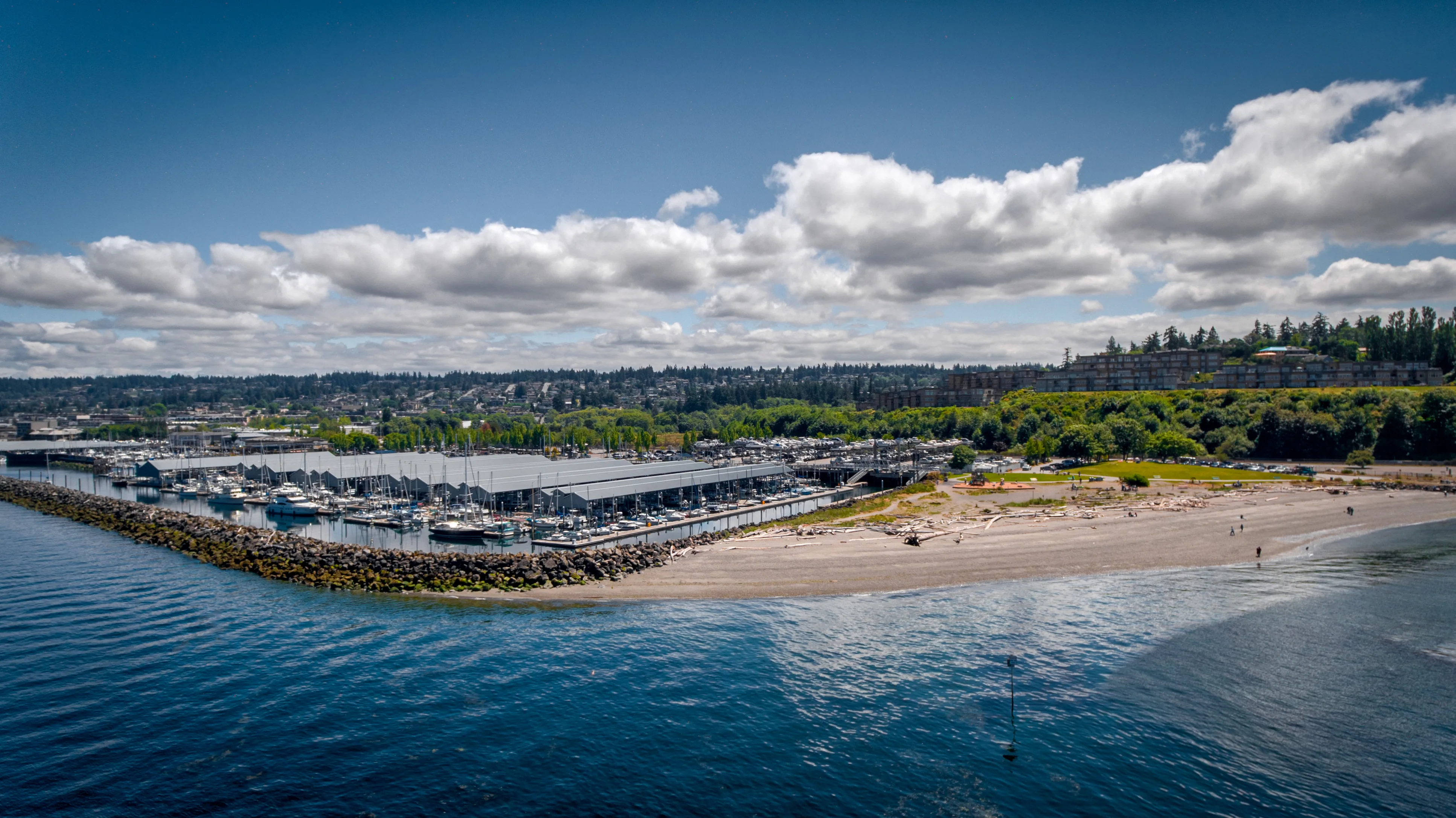
Most Californians who move to Edmonds say the same thing around month three: they didn't realize how green it actually is — not just the landscape, but the quality of life per dollar. Edmonds sits on a bluff above Puget Sound, about 15 miles north of Seattle, close enough to I-5 to feel connected to a major metro and far enough from downtown to feel genuinely like a small city with its own identity. The Edmonds-Kingston Ferry Terminal sits at the foot of Main Street. The Edmonds Fishing Pier and Brackett's Landing are where people actually spend Saturday mornings, not just a backdrop for real-estate photography.
The economic case is real. Washington State collects no personal income tax on wages — California's top marginal rate sits at 13.3%, and even middle-income Californians are paying 6–9%. That single line item changes the math on a $122,449 median household income more than most people model before the move. Edmonds School District holds a B+ rating, according to Niche, and Washington's Running Start program lets high school juniors and seniors earn tuition-free community college credit simultaneously — something California's system doesn't offer in the same form. The city's major employers span education, the Port of Edmonds, transit, and a healthcare anchor, giving the local economy a broad base that doesn't swing with a single industry.
On housing, the comparison depends entirely on where in California you're coming from. If you're leaving the Bay Area or coastal Los Angeles, Edmonds will feel comparable or slightly cheaper — Edmonds's citywide median sits at $855,381 (Zillow Home Value Index, mid-2026), detailed further on the cost-of-living page. If you're leaving Sacramento's inland suburbs or the Inland Empire, prepare for sticker shock. What you get either way is a 0.70% effective property tax rate — well below what California coastal counties charge on a reset assessed value.
Whether you're weighing a job offer in Seattle, following family north, or simply done with California's cost structure, the sections below cover what actually shifts when you make this move: the tax picture in full, the housing market realities, the climate adjustment nobody talks about enough, what daily life looks like compared to California, and the honest downsides worth knowing before you sign anything.
The Tax Shift: What Leaving California Actually Does to Your Paycheck
The headline is true: Washington has no personal income tax on wages, salaries, or ordinary business income. If you've been paying California's rates — which reach 13.3% at the top bracket and hit 9.3% on income above roughly $68,000 for a single filer — the difference lands immediately on your first Washington pay stub.
For a household earning $150,000 in California, the state income tax bill often runs $10,000–$13,000 per year depending on filing status and deductions. In Washington, that number drops to zero on ordinary income. That's not a rounding error; it's a meaningful lifestyle upgrade that shows up in monthly cash flow.
The Washington Tax Trade-Offs
Washington raises revenue differently, and you should understand what replaces the income tax before you celebrate too loudly. The state sales tax base is high, and Edmonds's combined rate is 10.7% as of April 2026 — tied with Lynnwood for the highest in the state. A 0.1% public-safety increase took effect April 1, 2026. Groceries are exempt, which softens the daily impact, but big-ticket purchases — appliances, vehicles, furniture for a new home — hit harder than in California.
| Tax Type | California | Washington / Edmonds |
|---|---|---|
| State income tax (wages) | 1%–13.3% marginal | None |
| Sales tax (combined local) | ~7.25%–10.75% | 10.7% (Edmonds, April 2026) |
| Groceries taxed? | No | No |
| Effective property tax rate | Varies; resets on purchase | 0.70% (Edmonds) |
| Capital gains tax | Up to 13.3% (taxed as income) | 7% on gains above $278K; 9.9% above $1M; real estate exempt |
| Estate / inheritance tax | None (state level) | Washington estate tax applies above $2.193M threshold |
The property tax comparison is where Edmonds genuinely wins for buyers arriving from coastal California. When you buy a California home, Proposition 13 resets your assessed value to the purchase price — and at California coastal effective rates, the annual bill on an $855,000 home can run considerably higher than Edmonds's 0.70% rate.
The Capital Gains Question for Home-Sale Proceeds
Washington does levy a capital gains excise tax, and Californians arriving with significant investment portfolios need to understand it. The tax applies to long-term gains above $278,000 (the 2025 standard deduction, adjusted annually) at 7% on the first $1 million of taxable gains and 9.9% above that. Here is the critical detail: real estate sales are fully exempt. If your California home sale generated a large gain, that gain is not subject to Washington's capital gains tax — you bring those proceeds to Edmonds clean.
Investment accounts are a different story. If you're planning to realize large gains from a stock portfolio after establishing Washington residency, the math works in your favor compared to California — which taxes capital gains as ordinary income at up to 13.3%. But the exemption is not blanket, and the tax exists where California transplants sometimes assume it doesn't.
A Note for High Earners
Washington currently has no income tax on wages at any level. However, a proposed measure (SB 6346 / HB 2724) introduced in early 2026 would impose a 9.9% income tax on earnings above $1 million annually, with a proposed effective date of January 1, 2028. This had not passed as of mid-2026. Tech executives, founders, and investors relocating from the Bay Area or Silicon Valley should monitor this legislation — it is not enacted law, but it is a live political conversation.
Home Prices in Edmonds: The California Buyer's Reality Check
Edmonds is not a bargain market. The citywide median sits at $855,381 (Zillow Home Value Index, mid-2026), which places it firmly in premium Pacific Northwest territory. What it offers a California buyer is context: this is a walkable waterfront city 15 miles from a major tech employment hub, with a ferry terminal at the end of Main Street and a school district that consistently ranks among the stronger in the region. In coastal California, that combination would push prices noticeably higher.
Where Californians Land in the Market
Bay Area buyers often find Edmonds comparable or modestly less expensive on the purchase price alone. The sharper advantage shows up in the carrying costs: a 0.70% effective property tax rate versus California coastal rates that frequently run higher on a reset assessment. For a home at the Edmonds median, the annual property tax bill works out to approximately $5,988 — a figure that surprises buyers used to California's post-purchase tax bills.
Buyers arriving from inland California metros — Sacramento's eastern suburbs, the Inland Empire, the Central Valley — will feel this market as genuinely expensive. Edmonds does not have a deep inventory of homes under $600,000, and entry-level options skew toward smaller or older construction. For a detailed breakdown of what each Edmonds neighborhood offers buyers, the best neighborhoods page covers the specific character and price ranges across areas like Downtown Edmonds, Seaview, Meadowdale, and Lake Ballinger.
What the Purchase Process Looks Like Here
Washington is a deed-of-trust state with no mandatory attorney review period — the process moves faster than California's, and timelines from accepted offer to close can run as short as 21 days on a clean transaction. Edmonds attracts competitive offers on well-priced homes, and waived inspection contingencies — common in California's recent boom years — have appeared here as well during low-inventory periods.
Washington State charges a Real Estate Excise Tax (REET) on the seller at graduated rates: 1.1% on the portion of the sale price up to $525,000, 1.28% from $525,001 to $1.525 million, and higher rates above that. As a buyer, REET is the seller's cost — but it factors into seller net calculations and therefore into how motivated sellers price and negotiate. For a walkthrough of the buying mechanics, see the first-time homebuyer page.
The Prop 13 Reset Effect
California buyers sometimes underestimate this: when you sell your California home, you lose your Prop 13 assessed value. If you've owned for 10–20 years, your California tax bill may be based on an assessed value well below current market. In Edmonds, your property tax is based on assessed value that tracks market value more closely — but the rate itself is low enough that the net result is often comparable or lower than what California buyers were paying on an equivalent-value home after a purchase-triggered reset.

The Climate Adjustment: What Californians Underestimate Every Time
No section of this guide will save you more frustration than this one. The Pacific Northwest climate is genuinely different from anything in California, and the adjustment is real enough that it drives a meaningful share of people who move here back out within two or three years.
What the Numbers Actually Mean
Edmonds averages approximately 160 sunny days per year — the U.S. average is 205. From roughly November through March, the sky is almost continuously overcast. January brings as few as 8.9 hours of daylight. The city averages 37–39 inches of rainfall annually, spread across approximately 158 precipitation days — which means it isn't a city where it pours and then clears; it's a city where it drizzles steadily and stays grey for weeks at a time.
Snow is rare. The city averages about 4 inches per year, and it rarely sticks more than a day or two. If you're imagining a snowy Pacific Northwest winter, that's more eastern Washington. Edmonds winters are wet, mild, and dark — consistently in the 40s°F, not cold enough for dramatic weather, relentless enough to wear on people who grew up in California sun.
The Summer That Makes It Worth It
July and August in Edmonds are genuinely exceptional. Highs run around 75°F with low humidity, rarely a cloud, and Puget Sound visible from half the city. The Edmonds waterfront on a July evening — ferry traffic moving across the Sound, the marina lit up, the Fishing Pier crowded with families — is the version of the city that people post to social media and that Californians see before they decide to move. It is real. It is also about eight to ten weeks of the year.
The Six-Month Reality
The first winter after moving from California is the one that tests people. October arrives and the grey begins. Unlike a rainy season in Sacramento or a coastal fog burn-off in San Francisco, it doesn't lift on a daily schedule — it just stays. Many California transplants invest in quality rain gear, full-spectrum lighting, and a deliberate social calendar to manage the seasonal shift. The ones who thrive here treat outdoor activity as year-round rather than waiting for sun — the parks and recreation page covers what that actually looks like on the trails and waterfront. The ones who struggle are the ones who expected the grey to feel temporary and discovered it doesn't.
Looking to buy in Edmonds? Estimate your payment.
Enter your numbers to see an estimated monthly mortgage payment.
Estimate only. Excludes HOA fees and mortgage insurance. The interest rate above is a starting point, not a quoted rate — replace it with your own to see real numbers. Insurance is a flat placeholder, not a Edmonds quote.
Daily Life Compared: What Changes and What Doesn't
Edmonds is a small city of about 42,700 people. If you're arriving from the Bay Area, Los Angeles, or San Diego, that scale is an immediate adjustment — and for most people, a welcome one. The downtown core around Fifth Avenue and Dayton Street has independent coffee shops, a farmers market, the Edmonds Center for the Arts, and Salish Sea Brewing Company on Dayton Street. It's walkable in a way that most California suburbs of comparable size are not.
Groceries and Everyday Costs
Groceries and everyday goods are exempt from Washington's sales tax, which softens the 10.7% combined rate at the register. Utility costs — electricity and natural gas — tend to run noticeably lower than California rates, which have climbed sharply in recent years. For a full breakdown of how Edmonds stacks up on utilities, groceries, and transportation costs, the cost-of-living page has the detail. On healthcare costs, insurance premiums here generally run below California levels, though you'll drive farther for specialist care than you would in a large California metro — the trade-off is fewer specialists within short range, not lower quality at the facilities that exist.
Getting Around
Edmonds is not a car-optional city for most residents, but transit exists and is used. Sound Transit and Community Transit connect toward Seattle and toward Lynnwood's Link light rail station, which extended north during recent years. The Edmonds-Kingston Ferry Terminal provides a connection to the Kitsap Peninsula — useful if you're working on that side of the Sound. Off-peak, the drive to Seattle runs about 30 minutes. Peak-hour commutes on I-5 are a different conversation, and residents learn quickly which routes and departure times to avoid. For commute specifics, see the living in Edmonds page.
Where People Actually Gather
The Friday night spot in Edmonds tends to be the waterfront — specifically Brackett's Landing and the area around the Fishing Pier — or downtown's small cluster of restaurants and the Edmonds Center for the Arts when something's running. The farmers market draws a crowd on Saturdays from late spring through fall. This is not a city with a late-night scene; it closes early by California standards and that shift surprises people who expected a Seattle suburb to feel more urban after dark.
Schools: One Genuine Advantage
The Edmonds School District is consistently among the stronger performers in the region, and Washington's Running Start program allows high school juniors and seniors to take community college courses tuition-free, earning simultaneous high school and college credit. California has dual enrollment programs, but the scope and accessibility of Running Start is wider. For boundary specifics and school-by-school detail, see the schools page.
Honest Downsides: What Pushes Californians Back
The Edmonds relocation story is genuinely positive for many California transplants. But the people who move back — and some do — tend to cite the same few things. Worth knowing before you sign a purchase agreement.
The Grey Wins Eventually for Some People
Seasonal affective disorder is not a punchline here; it's a real clinical phenomenon that affects a higher share of Pacific Northwest residents than any California population center. The combination of short winter days and persistent cloud cover from November through March is the single most common reason California transplants give for leaving. People who grew up in the Pacific Northwest are often surprised this is a dealbreaker — for them, it's ambient. For someone who spent 30 years in San Diego or the Central Valley, it can be genuinely destabilizing. Go in with eyes open and a plan, not an assumption that you'll adapt automatically.
The Housing Entry Point Is High
If you're arriving without significant California home-sale equity — or if your California home didn't appreciate much — Edmonds is a hard market to enter. The entry-level segment is thin, and the gap between what's available and what people expect from a mid-sized Pacific Northwest suburb catches buyers off guard. Inland California transplants in particular often discover that the tax savings don't fully close the housing gap in their first year.
What You Won't Find Here
Edmonds does not have a Trader Joe's within the city limits; the nearest is in a neighboring city. The restaurant density of a large California coastal metro doesn't exist here — the downtown dining scene is real but small, and driving to Lynnwood, Mountlake Terrace, or Shoreline for broader options is normal. If you're accustomed to the diversity of a large California metro's food scene, the adjustment is noticeable.
High Earners: Watch the Legislative Calendar
The proposed 9.9% income tax on wages above $1 million (SB 6346 / HB 2724) had not passed as of mid-2026, but it reflects a broader political direction in Olympia worth monitoring. Washington's no-income-tax status has historically been one of the primary financial reasons high-earning California tech workers relocate here. If that changes — even partially — the calculus shifts. This is not a reason to avoid the move; it is a reason to structure finances with awareness of the legislative environment rather than assuming the current rules are permanent.
For a full picture of what safety looks like across different parts of the city, the safety page has current figures and context. And if you're close to retirement age and thinking about how Edmonds fits a longer-term life plan, the retiring in Edmonds page covers the specific considerations that shift at that stage.
Local Expert Takeaway: The income tax elimination is real and significant — a California household earning $150,000 is looking at $10,000-plus in annual state tax savings the moment Washington residency is established. But the move works best for people who are prepared for what Edmonds actually trades for that savings: a grey, wet winter that runs five months; a housing market where the median sits at $855,381 and entry-level inventory is thin; a sales tax rate of 10.7% that stings on big purchases; and a small-city scale that rewards people who wanted out of California's metro pace but punishes those who expected a West Coast city and got a waterfront town. Walk the stretch from the Edmonds-Kingston Ferry Terminal up Fifth Avenue to the Edmonds Center for the Arts on a July evening before you make any decisions. That is the city at its best. Then come back in February.
Quick Takeaways & FAQs
✅ Washington's zero personal income tax on wages is a genuine financial advantage — California's top marginal rate reaches 13.3%, and even median earners pay 6–9%.
⚠️ Edmonds's 10.7% combined sales tax rate is tied for the highest in Washington State, and the grey, overcast winters from November through March drive a real share of California transplants back south within a few years.
📍 Washington's capital gains tax fully exempts real estate sales — Californians arriving with home-sale proceeds won't owe state capital gains tax on that equity, but investment-account gains above $278,000 are taxed at 7%.
Do I really pay zero income tax if I move from California to Edmonds?
How do Edmonds home prices compare to coastal California?
What is the sales tax rate in Edmonds, and how does it compare to California?
Is the Pacific Northwest climate really that hard to adjust to for Californians?
If I sell my California home, will I owe Washington capital gains tax on the proceeds?
Moving to Washington?
Tell us what you need help with and we'll connect you with local resources.
