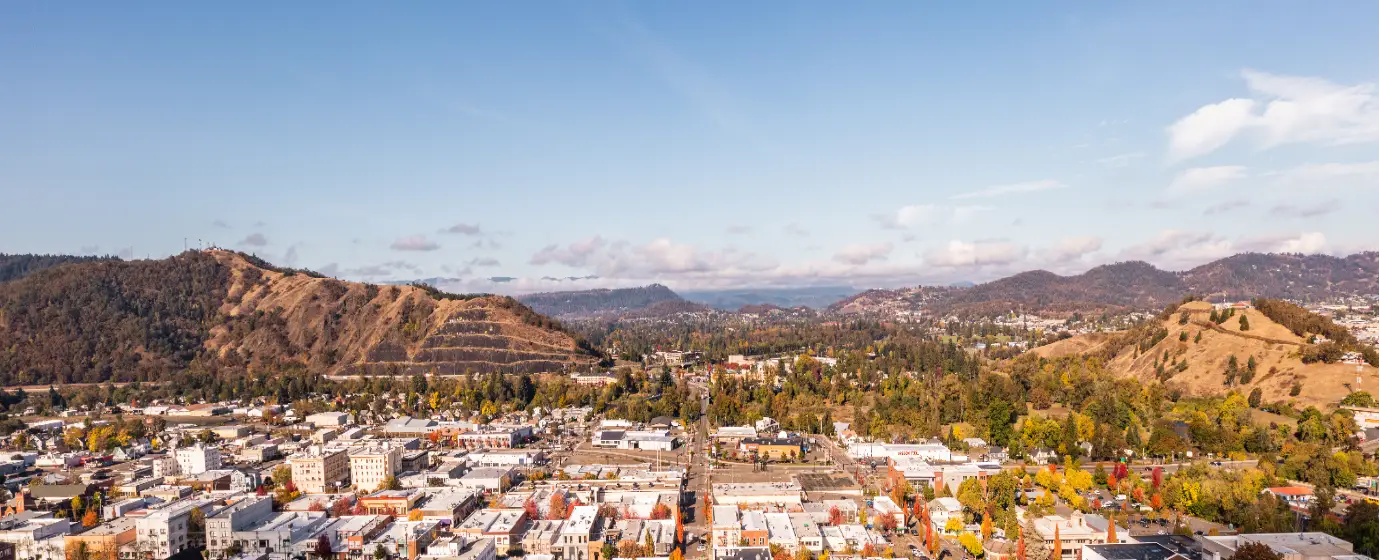
Most people who retire to Roseburg were not planning to retire to Roseburg. They came through on I-5, or a friend mentioned it, or they were priced out of Bend and Ashland and started looking at what else Southern Oregon had to offer. What stops them is the combination: a real hospital inside city limits, home prices that leave room in a retirement budget, and the North Umpqua and South Umpqua rivers meeting just outside town. That convergence is not accidental — Roseburg is the Douglas County seat, which gives it an institutional weight that smaller Southern Oregon towns simply do not have.
The city has a population of 23,795 and sits along I-5 in the Umpqua Valley, roughly midway between Eugene and Medford. It is not a resort town and it does not try to be. The economy runs on healthcare, government, education, and a growing wine region — the Umpqua Valley has earned a reputation as one of Oregon's most underrated wine corridors, with HillCrest Vineyard among its most historically significant producers. Mercy Medical Center is the region's dominant employer and its most important retirement-relevant asset. Umpqua Community College brings a continuing-education and cultural dimension that keeps the city from feeling purely functional.
For retirees comparing costs, Roseburg's typical home price of $368,343 (Zillow Home Value Index, July 2026) sits noticeably below what buyers are paying in Ashland or Eugene. Oregon's income tax structure has real implications — Social Security goes untaxed at the state level, which matters on a fixed income — and the effective property tax rate of approximately 0.65% is among the lower rates in the Pacific Northwest. The Umpqua Valley's 182 sunny days a year also tends to surprise people who assume all of Oregon is grey nine months out of twelve. For more on day-to-day living costs, see the full cost-of-living breakdown.
Whether you are comparing Roseburg against Ashland, Sutherlin, or somewhere in Northern California, the sections below cover what actually matters in retirement: healthcare access and depth, the retiree tax picture, walkability and social life, downsizing options, and an honest comparison against the nearby alternatives.

Why Retirees Are Choosing Roseburg
Roseburg fits a particular kind of retiree: someone who wants a real town — with a real hospital, a downtown, a farmers market, and a university — without paying the premium that Ashland or the Oregon coast charge for essentially the same lifestyle. The typical home price of $368,343 (July 2026) leaves considerably more room in a retirement budget than most Western Oregon cities at this level of services. That math is the starting point for most conversations about retiring here.
The retiree who does well here values self-sufficiency and outdoor access over urban amenity. Fly fishing the Umpqua, day trips to Crater Lake National Park or the Oregon Caves, and a low-key tasting-room circuit through the wine country — these are the activities that fill a Roseburg retirement. Veteran retirees have a specific and compelling reason to look here: the Roseburg VA Health Care System provides inpatient and outpatient services, multiple regional outpatient clinics, and integrated mental health services, making Roseburg one of the more complete VA-served communities in rural Oregon.
Who should look elsewhere? If walkable urban density, proximity to a major airport, or a rich arts scene are non-negotiable, Roseburg will disappoint. The Eugene Airport is about 75 miles away. The downtown is genuinely walkable by small-city standards, but most errands still require a car. Retirees who need regular access to subspecialty care — major cardiac surgery, comprehensive cancer treatment centers, transplant programs — should factor in that Roseburg's hospital, while solid, is a community-level facility. The drive to Eugene or Medford for advanced subspecialty care is real, and worth planning around before you commit.
Healthcare & Medical Access in Roseburg
Mercy Medical Center sits inside Roseburg's city limits and is the anchor of healthcare for this entire region. It is a non-profit community hospital with a Level III trauma center emergency department, a heliport, and Joint Commission accreditation. Its specialist bench is broad for a city of Roseburg's size — covering orthopedics, cardiac monitoring, surgical procedures, and rehabilitation — and gives most retirees genuine day-to-day medical coverage without leaving town.
CHI Mercy Health, which operates the hospital, has earned a consecutive series of top patient-safety grades from the Leapfrog Group, a national nonprofit hospital watchdog. For routine and moderately complex care, Mercy handles the full range. The hospital also includes intensive care and a helipad for air transport when a higher level of trauma response is needed.
The honest limitation is subspecialty depth. Roseburg does not have a comprehensive cancer center, a transplant program, or the full range of interventional cardiac and neurosurgical services that a larger regional medical center provides. For those needs, Eugene and Medford are the realistic options. That is a drive that retirees with complex chronic conditions should think through carefully — not as a dealbreaker, but as a practical reality of living in a smaller Southern Oregon city rather than a metro.
Veteran retirees get an additional layer. The Roseburg VA Health Care System operates a full medical center with both inpatient and outpatient capability, multiple community outpatient clinics across the Douglas County region, a Virtual Health Resource Center, and integrated mental health services. For retirees who qualify for VA care, this effectively doubles the primary care and mental health infrastructure available without leaving the area. It is one of the more meaningful differentiators between Roseburg and comparably sized Southern Oregon towns.

The Retiree Budget in Roseburg
Oregon's treatment of Social Security income is the first thing retirees from most other states notice: the state does not tax Social Security benefits or Railroad Retirement Board benefits. Both are fully subtracted from Oregon taxable income. For retirees whose income is primarily Social Security, that is a meaningful structural advantage over states that tax it.
The picture is more complicated for retirees drawing pension income, 401(k) distributions, or IRA withdrawals. Oregon taxes those at the state's regular graduated rates, which run from 4.75% up to 9.9%. Retirees with significant investment income or pension distributions need to plan for that — Oregon's top rate is not lenient. A tax advisor familiar with Oregon's rules is genuinely useful here, not just a formality.
Oregon has no state sales tax. On a fixed income, that adds up across groceries, household goods, and everyday purchases in a way that feels tangible month to month. It is one of the few structural advantages Oregon offers that benefits retirees at every income level equally.
The effective property tax rate in Roseburg is approximately 0.65% — low by most Pacific Northwest standards and low compared to many states retirees are leaving. Oregon also offers a property tax deferral program for homeowners age 62 or older whose household income does not exceed $60,000: the state pays the county property taxes directly, records a lien at 6% simple interest, and collects when the home is sold. For retirees on tight fixed incomes who own their home outright or nearly so, this program can meaningfully smooth cash flow in the early retirement years.
Daily living costs in Roseburg run below what most West Coast cities charge. Groceries and services reflect a small-city pricing structure rather than a Portland or Bay Area one. The interactive calculator below this section can help you model what a purchase at Roseburg's current price level actually costs month to month at prevailing rates.
Looking to buy in Roseburg? Estimate your payment.
Enter your numbers to see an estimated monthly mortgage payment.
Estimate only. Excludes HOA fees and mortgage insurance. The interest rate above is a starting point, not a quoted rate — replace it with your own to see real numbers. Insurance is a flat placeholder, not a Roseburg quote.
Walkability, Community & Staying Active in Roseburg
Roseburg is a car-dependent city by any honest measure — but with one genuine exception. The Downtown Roseburg Mill-Pine Historic District has the highest on-foot access of any neighborhood in the city. The Douglas County Museum of Natural and Cultural History, the South Umpqua River waterfront path at Riverfront Park, the Umpqua Valley Farmers' Market, and a walkable block of independent coffee shops and restaurants sit within easy walking distance of each other. For retirees who want to choose a neighborhood where they can leave the car parked for daily errands and morning walks, downtown is the one area where that is realistic.
Outside the downtown core, most of Roseburg requires driving. Garden Valley and Edenbower are pleasant and suburban, with good single-level housing stock — but flat walking access to services is limited. The terrain in the Highlands and parts of Hucrest is hillier, which matters more than it might seem once knee and hip health become a practical consideration.
Community Life and Social Anchors
Umpqua Community College runs continuing education programming and cultural events that give retirees a consistent reason to engage with the city. The Music on the Halfshell outdoor concert series and Movies in the Park bring people together through the warmer months. The Umpqua Valley Farmers' Market and the Roseburg Saturday Market are weekly gathering points that regulars describe as much a social occasion as a shopping trip.
The Umpqua Valley wine region gives Roseburg a leisure culture that most comparably sized towns lack. HillCrest Vineyard and a growing roster of tasting rooms and winery events draw retirees who prefer that circuit to a bar scene. It is low-key and genuinely local, without the tour-bus energy of wine country closer to Portland.
Outdoor recreation is the other social layer. Stewart Park and Riverfront Park anchor the river corridor. The South Umpqua River waterfront draws walkers, anglers, and paddlers. For those willing to drive a short distance, the North Umpqua Scenic Byway accesses Susan Creek Falls and Watson Falls. The Wildlife Safari in nearby Winston — a drive-through animal park — is the kind of place that becomes a regular outing rather than a once-a-year trip once you live here.
One thing that surprises retirees after a few months: the social scene is more self-organized than programmed. Roseburg does not have the structured retiree-activity infrastructure of a purpose-built retirement community. People who build a rich social life here tend to do it through the wine circuit, the outdoor community, UCC events, and the farmers market regulars — not through a city-run calendar. That suits some retirees perfectly and frustrates others.
Right-Sizing: Downsizing in Roseburg
Single-level living is achievable in Roseburg without a long search, particularly in Garden Valley and Edenbower, where ranch-style homes and newer construction on flat lots make up a significant portion of the housing stock. These neighborhoods draw downsizers specifically because the combination of single-level floor plans, attached garages, and manageable yard sizes maps well onto what retirees are actually looking for when they leave a larger family home.
Patio homes and smaller detached homes with low-maintenance exteriors exist in the market, though the inventory of true lock-and-leave condos is thinner than you would find in a larger Oregon city. Retirees who want the convenience of a condo lifestyle — no yard work, HOA-maintained exteriors — will find fewer options here than in Eugene or Medford, and should expect to be patient or flexible about location.
55+ Communities
Rose Village is the established 55+ community within Roseburg. It offers age-restricted living in a community setting with the social dimension that comes from living among neighbors in a similar life stage. For retirees who want the built-in community structure that a general neighborhood does not provide, Rose Village is the primary option within city limits.
Beyond Rose Village, many Roseburg retirees downsize into standard single-family homes on the resale market rather than into a dedicated senior community — partly because the supply of purpose-built 55+ product is limited, and partly because the city's general housing stock at its price level includes plenty of manageable, single-level homes that suit retirement living without the age-restriction overlay. For a full picture of which neighborhoods carry the most relevant inventory, the neighborhood guide breaks down the character and housing stock across Hucrest, Garden Valley, Edenbower, and the rest.
Roseburg vs Nearby Retirement Destinations
| City | Cost vs Roseburg | Primary Hospital | Walkability | Senior Living Depth | Overall Retirement Fit |
|---|---|---|---|---|---|
| Roseburg | Anchor | Mercy Medical Center — full-service community hospital, Level III trauma center, broad specialist bench; VA medical center also present | Walkable downtown core; car needed elsewhere | Rose Village 55+ community; solid resale single-level stock | Strong for active retirees valuing healthcare access and outdoor life |
| Sutherlin | Somewhat lower | No hospital in city; relies on Mercy Medical Center in Roseburg | Limited; small-town commercial strip | Minimal dedicated senior housing | Good fit for retirees who prefer a quieter small town and don't mind the drive to Roseburg for medical care |
| Winston | Noticeably lower | No hospital in city; relies on Mercy Medical Center in Roseburg | Very limited on-foot access | Minimal dedicated senior housing | Best for retirees who prioritize low cost and rural quiet over services |
| Myrtle Creek | Noticeably lower | No hospital in city; longer drive to regional care | Small walkable core; limited services | Very limited | Appeals to retirees on tightest budgets; healthcare access requires planning |
| Ashland | Pricier | A regional community hospital nearby | Genuinely walkable downtown; Oregon Shakespeare Festival anchors cultural life | More diverse senior housing options | Stronger cultural and walkability fit; meaningfully higher cost of entry |
| Grants Pass | About the same | A larger regional medical center serving the Rogue Valley | Walkable downtown; car needed for most errands | More 55+ and senior community options than Roseburg | Comparable overall; stronger for retirees who want more senior housing variety and a slightly larger hospital system |
The cost comparison here is straightforward for the smaller towns: Winston and Myrtle Creek both come in noticeably below Roseburg on home prices, but neither has a hospital, and the drive to Mercy Medical Center adds a practical burden that grows more significant as healthcare needs increase. Sutherlin is the most natural alternative for budget-conscious retirees who still want Roseburg's hospital within a reasonable distance — the towns are close enough that the drive is manageable for most appointments.
Ashland offers a cultural richness and walkability that Roseburg does not match, but at a cost that prices out most retirees on a fixed income who are looking at Southern Oregon specifically because it is more affordable. Grants Pass is the closest true comparison — similar price level, a slightly larger and more comprehensive hospital system, and a broader inventory of dedicated senior housing. Retirees who land in Grants Pass instead of Roseburg usually did so because they found more 55+ community options or preferred the Rogue Valley setting.
For veteran retirees, Roseburg's edge is the VA medical center, which none of the nearby alternatives match at the same scale. That single factor makes Roseburg the clear first choice for retirees who rely on VA care and want to stay in Southern Oregon.
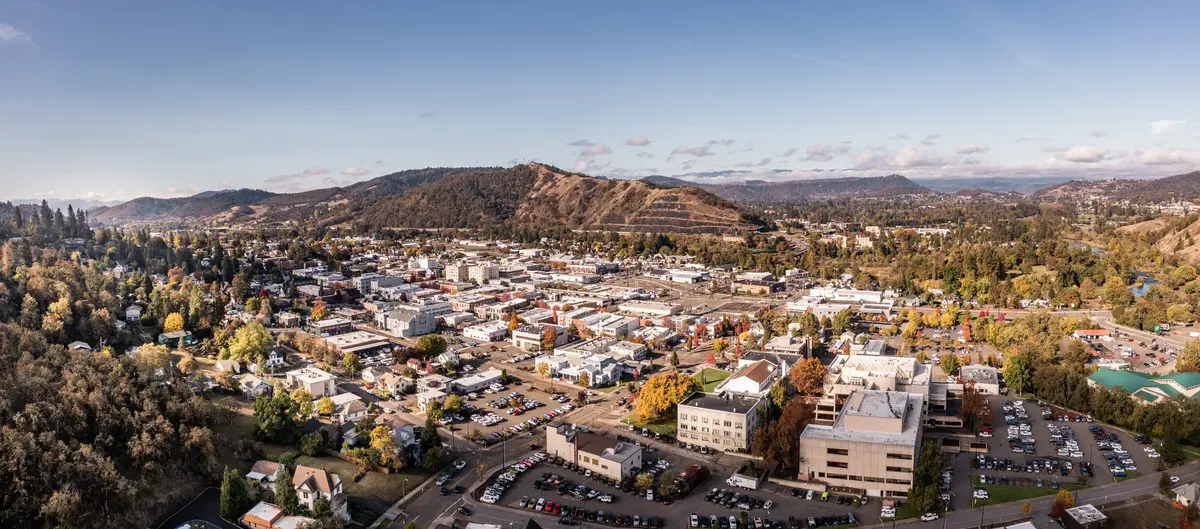
Local Expert Takeaway: Roseburg earns its retirement case honestly. Mercy Medical Center inside city limits — a full-service community hospital with a Level III trauma center and a broad specialist bench for a city this size — is the real differentiator from every smaller Southern Oregon town. Layer on Oregon's Social Security exemption, a property tax rate of approximately 0.65%, and a typical home price that leaves room in a retirement budget, and the numbers work in a way they simply do not in Ashland or on the coast. The catch is that Roseburg asks you to build your social life rather than join one — through the Umpqua Valley wine circuit, the weekly farmers markets, Stewart Park and the river trail, and UCC's community programming. Retirees who arrive expecting programmed activity tend to underestimate how much they will need to initiate. Those who arrive ready to explore a genuine small city at their own pace tend to stay.
Quick Takeaways & FAQs
✅ Mercy Medical Center — inside city limits, with a full-service emergency department, a Level III trauma center, and a VA medical center also in town — gives Roseburg healthcare depth that no comparably priced Southern Oregon city can match.
⚠️ Oregon taxes pension and IRA distributions at rates up to 9.9%, so retirees drawing heavily from those sources need a tax plan before they move, not after.
📍 The property tax deferral program for homeowners 62 and older (income limit $60,000) can significantly ease cash-flow pressure in the early retirement years — worth asking a local real estate attorney about before closing.
Does Oregon tax Social Security retirement benefits?
What is the closest hospital to Roseburg, and how comprehensive is it?
Are there 55+ communities in Roseburg?
What is the property tax rate in Roseburg, and are there breaks for seniors?
How does Roseburg compare to Ashland or Grants Pass for retirement?
Moving to Oregon?
Tell us what you need help with and we'll connect you with local resources.
