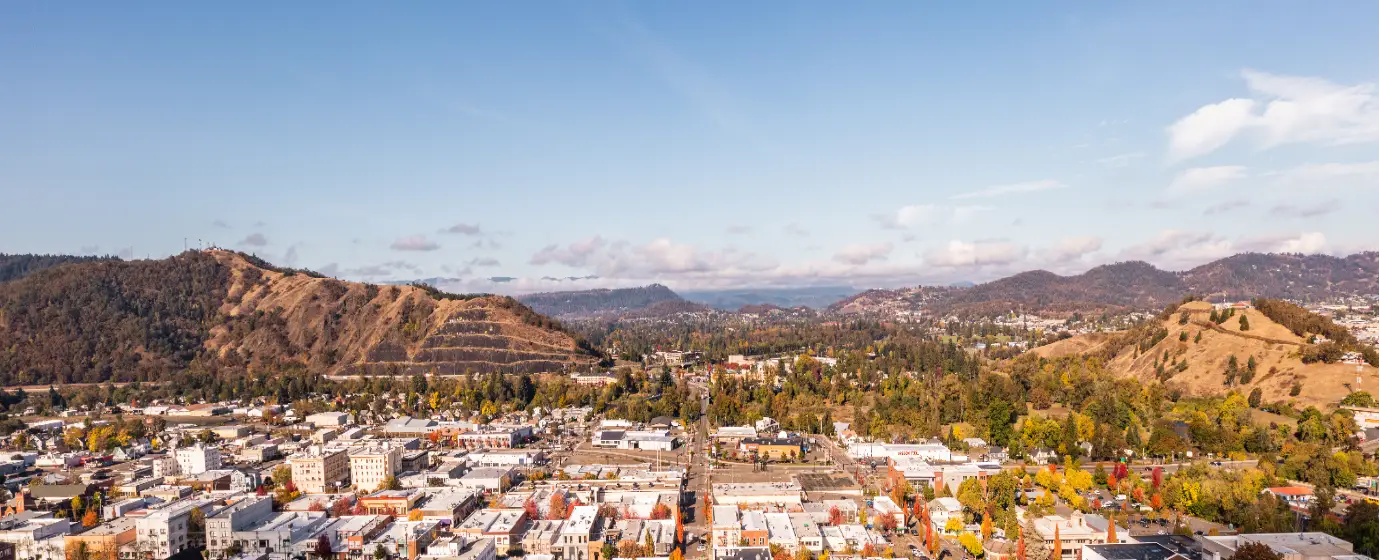
Most people researching Roseburg expect a small timber town that peaked decades ago. What they find instead is a city of 23,795 sitting at the confluence of the North and South Umpqua rivers, where I-5 bisects the valley and the question of which side of the freeway you land on shapes daily life more than any other single decision. The mountains close in on both sides, OR-138 pushes east toward the Cascades, and OR-99 threads through the older commercial spine — which means the freeway isn't background noise here, it's a genuine organizing force that divides neighborhoods, school assignments, and commute patterns.
The economy is anchored by Mercy Medical Center, Douglas County government, Roseburg Public Schools, and Umpqua Community College. Medical professionals, county workers, educators, and a growing number of remote workers are the dominant buyer profiles. The city is also home to Douglas County, which carries the highest veteran population in Oregon, so military and VA-eligible buyers make up a meaningful slice of the market.
The typical home price in Roseburg sits at $368,343 (Zillow Home Value Index, July 2026) — noticeably below what buyers are paying in the Eugene or Medford metro areas — making it one of the more accessible markets left in western Oregon. The catch is that the median household income of $53,918 still falls short of what's needed to comfortably carry that price, which means buyers are stretching, and the gap between want and budget shapes neighborhood choices here as much as preference does. For more on the full cost of living in Roseburg, that page has the complete breakdown.
Whether you're relocating for a job at the hospital, cashing out of a pricier market, or just following a slower pace of life toward Southern Oregon, the sections below break down Roseburg's neighborhoods, who each one suits, the mistakes buyers commonly make here, and where renters have the most options.
The Roseburg Reality
I-5 doesn't just carry freight through Roseburg — it divides the city into two genuinely different housing markets. The west side, where Hucrest, Garden Valley, and Edenbower cluster together, is where newer construction concentrates, school access tends to be more consistent, and the buyers competing for homes skew toward medical professionals and families with school-age children. The east side and the areas flanking the river corridors offer older craftsman stock, lower entry points, and more character — at the cost of longer drives to the city's retail and medical core.
School boundaries compound that divide. Roseburg Public Schools assigns elementary students largely by geography, and the boundaries don't always follow neighborhood lines neatly. A buyer who crosses the wrong boundary by two blocks can land in a different feeder pattern entirely. This matters most for families prioritizing specific elementary schools — and it's the one detail that trips up relocating buyers who assume one side of town is interchangeable with the other.
The other reality to understand before touring is that Roseburg rewards buyers who think about commute direction. The drive to Eugene is about 70 minutes via I-5, which means anyone commuting north needs to be west of the freeway or close to an on-ramp to avoid adding meaningful time. Buyers who work locally — at the hospital, the county, or the college — have more flexibility, and that's exactly why the west side runs at a premium relative to the rest of the city.
Neighborhoods at a Glance
| Neighborhood | Best For | Vibe |
|---|---|---|
| Hucrest | Families Walkable | Tight-knit, west-side suburban with wide sidewalks and immediate park access |
| Garden Valley | Families Nature | Lush, residential-commercial mix; greener and more spread-out than Hucrest |
| West Harvard | First-Time Quiet | Mid-century ranch homes, bike paths, and a settled neighborhood feel |
| Edenbower | Quiet Value | Retiree-friendly, low vacancy, diverse housing stock west of the freeway |
| Downtown Roseburg (Mill-Pine Historic District) | Walkable Renter | National Register craftsman district; urban energy and genuine historic character |
| Melrose | Privacy Nature | Rural-edge feel, mix of homes and small farms, room to breathe |
| Winchester | Nature Quiet | River-adjacent, north of the city, quieter but I-5 noise affects some sections |
| Highlands | Views Families | Elevated position with ridge views and a residential neighborhood feel |
Roseburg typical home price: $368,343 (Zillow ZHVI, July 2026). Typical rent: $1,542/mo (Zillow ZORI, July 2026). Neighborhood tiers on this page are relative to these figures.
Best Neighborhood by Buyer Type
| Buyer Type | Best Neighborhood | Why |
|---|---|---|
| First-Time Buyer | West Harvard | Mid-century ranch homes sit at accessible price points and the neighborhood's established feel reduces guesswork for buyers new to the market. |
| Luxury Buyer | Garden Valley | The corridor's larger lots, proximity to vineyards, and newer builds attract the city's highest-end buyers looking for space and surroundings. |
| Walkability Seeker | Hucrest | Wide sidewalks, direct access to the 236-acre Stewart Park, and proximity to downtown make this the city's most genuinely on-foot-accessible neighborhood. |
| Families with Kids | Hucrest | The west-side school feeder pattern, tight-knit community, and immediate park access combine to make this the most family-sought address in Roseburg. |
| Commuter | Edenbower | West of I-5 and with quick on-ramp access, Edenbower is the most practical base for anyone commuting north toward Eugene. |
| Large-Lot Buyer | Melrose | The rural-edge character and mix of homes and small farm parcels give buyers space that no in-city neighborhood can match. |
| Renter | Downtown Roseburg (Mill-Pine Historic District) | The highest concentration of rental inventory in the city sits in and around the historic district, with the most on-foot access to services. |
Looking to buy in Roseburg? Estimate your payment.
Enter your numbers to see an estimated monthly mortgage payment.
Estimate only. Excludes HOA fees and mortgage insurance. The interest rate above is a starting point, not a quoted rate — replace it with your own to see real numbers. Insurance is a flat placeholder, not a Roseburg quote.
Most Popular Neighborhoods
Hucrest
Developed in the late 1950s, Hucrest is the west side's most sought-after address for a simple reason: Stewart Park — 236 acres with a golf course, a concrete skate park, baseball fields, a butterfly garden, and a summer concert series called Music on the Halfshell — sits directly on its edge. The neighborhood's wide sidewalks and ranch-style homes give it a walkable, family-forward feel that's rare in a city this size. The trade-off is that demand keeps prices above the city median, and inventory moves quickly when it appears.
Best for: Families with school-age children, buyers who want to walk to a major park, and anyone prioritizing the west-side school feeder pattern.
Garden Valley
Garden Valley runs along the northwest side of the city as a mixed residential and commercial corridor — lush, green, and noticeably more spread-out than Hucrest. Residents describe it as peaceful and practical: local shops and schools are close, and the surrounding area edges toward wine country, with vineyards accessible just beyond the corridor. The compromise is that the mixed-use character means commercial traffic is part of daily life, and lots can vary widely in what's next door.
Best for: Buyers seeking newer or larger homes, medical professionals working nearby, and households that want a quieter suburban feel without going fully rural.
West Harvard
About two miles from downtown, West Harvard is the city's most reliable first-entry neighborhood — mid-century ranch homes, established lots, wide sidewalks, and bike paths give it a settled, honest character. Douglas County carries the highest veteran population in Oregon, and West Harvard reflects that: this is a neighborhood with long-tenure residents and a community that doesn't turn over quickly. The honest caveat is that the older housing stock means buyers should budget for updates, and some homes have had deferred maintenance.
Best for: First-time buyers, veterans using VA financing, and households that want a real neighborhood feel at an accessible price point.
Edenbower
Edenbower sits west of I-5 and has built a strong reputation as the city's most retiree-friendly neighborhood — quiet surroundings, low turnover, and a housing stock that skews toward well-maintained homes from the 1970s through the 1990s. The vacancy rate is extremely tight at 2.1%, which tells you something about how rarely residents choose to leave. Homes here run above the city-wide typical home price, and that premium is unlikely to erode given how little inventory turns over.
Best for: Retirees, buyers seeking quiet surroundings with quick freeway access, and anyone prioritizing a well-established, low-turnover setting.
Downtown Roseburg (Mill-Pine Historic District)
The Mill-Pine Historic District — listed on the National Register of Historic Places since 1985 — is one of Southern Oregon's genuinely intact historic neighborhoods, with homes built between 1878 and 1927 in Rural Gothic, Italianate, Queen Anne, and Bungalow styles originally constructed for railroad workers. Living here puts you within walking distance of the Riverfront Park and the South Umpqua River waterfront, and close to the Umpqua Valley Farmers' Market and Roseburg Saturday Market. The honest trade-off: older homes require real maintenance budgets, and the downtown adjacency means more foot traffic, street parking competition, and urban noise than the west-side neighborhoods.
Best for: Buyers who value architectural character, urban walkability, and proximity to the river; also the city's strongest rental zone for investors.
Melrose
Melrose occupies the rural edge of Roseburg's west side — a mix of single-family homes and small farm parcels that creates more breathing room than any other neighborhood on this list. If you want space between you and your neighbors without leaving the Roseburg area entirely, this is where to look. The compromise is real: services, retail, and schools all require a drive, and the rural character means the commute calculus changes significantly compared to Hucrest or Edenbower.
Best for: Large-lot buyers, hobby farmers, and households that prioritize privacy over walkability or proximity to services.
Winchester
Winchester sits just north of Roseburg along the North Umpqua River — technically a community closely associated with the city rather than a formal city neighborhood, but consistently grouped with Roseburg's residential areas and within about 10 minutes of the city's main retail corridors. The river-adjacent setting and quieter residential character appeal strongly to outdoor-oriented buyers. The real catch: Winchester straddles the I-5 corridor, and portions of the community deal with meaningful highway noise — which section you land in matters more here than in almost any other area on this list.
Best for: Buyers who want river access and a quieter feel, and who are willing to vet specific parcels carefully for noise exposure.
Highlands
Highlands is Roseburg's elevated residential neighborhood, offering ridge views over the valley that none of the flat west-side neighborhoods can match. It's an established Douglas County neighborhood designation with a residential character that appeals to buyers prioritizing scenery and separation from the commercial corridors below. Detailed profile data is limited compared to the more documented west-side neighborhoods, so buyers should plan to tour carefully and lean on local agent knowledge to fill the gaps.
Best for: View-seekers, buyers who want an elevated, quieter setting, and households less dependent on walking distance to services.
Common Mistakes Buyers Make in Roseburg
Treating I-5 as a Detail, Not a Dividing Line
The single most common mistake relocating buyers make is assuming that a home on the east side of I-5 is interchangeable with one on the west. It isn't. The west-side corridor — Hucrest, Garden Valley, Edenbower — concentrates newer construction, tighter school feeder patterns, and lower commute friction for anyone heading north on the freeway. Buying east of I-5 without understanding that distinction is how buyers end up frustrated six months later, especially families who assumed school access would be comparable.
Ignoring Winchester's Noise Split
Winchester's river setting photographs beautifully, and buyers from outside the area often assume the whole community shares that quiet. It doesn't. The portions that sit close to the I-5 corridor carry consistent highway noise that makes a meaningful quality-of-life difference — and the difference between a peaceful lot and a noisy one can come down to a few hundred yards. Touring during a weekday morning, when freeway traffic is at its peak, is not optional here — it's the only way to know what you're actually buying.
Chasing Square Footage Over School Boundaries
Roseburg's market rewards patience, but it punishes one specific shortcut: choosing a larger home in a less familiar part of the city without verifying the elementary school assignment. The Roseburg Public Schools boundary map doesn't follow neighborhood names cleanly, and a buyer who crosses a boundary line by a block or two can land in a completely different feeder school. For families with school-age children, confirming the specific address against the district's current boundary map before making an offer is not a step to defer.
Underestimating What Melrose's Rural Feel Actually Means
Buyers drawn to Melrose's larger lots and farm-adjacent character sometimes don't fully price in the service gap. This isn't a neighborhood where a forgotten grocery item is a five-minute errand — it's a drive. The same goes for school runs, after-school activities, and anything involving the hospital on the west side of the city. Melrose is genuinely appealing for the right buyer, but it asks for a lifestyle adjustment that households used to suburban walkability consistently underestimate in their first months.
Best Areas to Rent in Roseburg
| Area | Ideal For | Trade-off |
|---|---|---|
| Downtown / Mill-Pine District | Walkable Renters | Most on-foot access to services and the river, but older building stock and parking can be tight |
| Hucrest | Families School | Best park proximity and west-side school access, but rental inventory is limited and competition is real |
| Garden Valley Corridor | Commuters Families | Mixed residential and commercial strip with more apartment options, but traffic along the corridor is noticeable |
| West Harvard | First-Time Quiet | Stable, established rental base of single-family homes, but the mid-century stock varies significantly in condition |
| Winchester / North Umpqua | Nature Quiet | River-adjacent feel at typically accessible rents, but highway noise affects some sections and services require a drive |
Vacancy across most of Roseburg's neighborhoods is tight — Winchester and Edenbower both carry vacancy rates around 2.1%, which means renters who find a unit they like should move on it rather than waiting. The Downtown and Garden Valley corridor areas hold the most rental supply, which translates to slightly more negotiating room and more options for renters who aren't yet sure which part of the city suits them best.
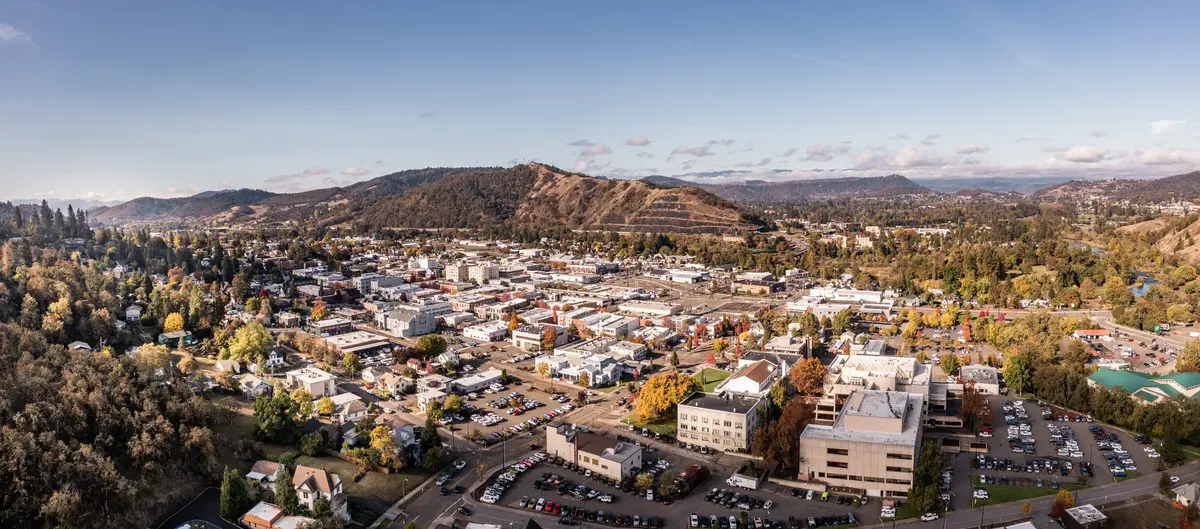
Local Expert Takeaway: The decision that matters most in Roseburg is simpler than it looks: west of I-5 or not. Hucrest and Edenbower give you Stewart Park, the west-side school feeder pattern, and fast freeway access — at prices that run above the city-wide typical. West Harvard is the honest entry point into that same corridor. If you can live without those specifics, the Mill-Pine Historic District gives you genuine architectural character and walkability to the Umpqua Valley Farmers' Market and the South Umpqua River waterfront at lower price points. And if space matters more than proximity to anything, Melrose is where Roseburg's rural edge begins. Verify school boundaries by address before you make an offer — the map doesn't follow neighborhood names, and the boundary is the thing that actually matters.
Quick Takeaways & FAQs
✅ Roseburg's typical home price of $368,343 (July 2026) puts it well below comparable Southern Oregon cities, with real single-family inventory still available on the west side.
⚠️ The I-5 corridor is a genuine quality-of-life divide — west-side neighborhoods like Hucrest and Edenbower command a consistent premium over east-side and downtown-adjacent areas.
📍 Winchester's river-adjacent setting is real, but highway noise affects specific parcels significantly — tour on a weekday morning before committing.
What is the best neighborhood in Roseburg for families?
Is Roseburg's west side really that different from the east side?
What is the Mill-Pine Historic District in Roseburg?
Is Winchester considered part of Roseburg?
Which Roseburg neighborhood is best for renters?
Moving to Oregon?
Tell us what you need help with and we'll connect you with local resources.
