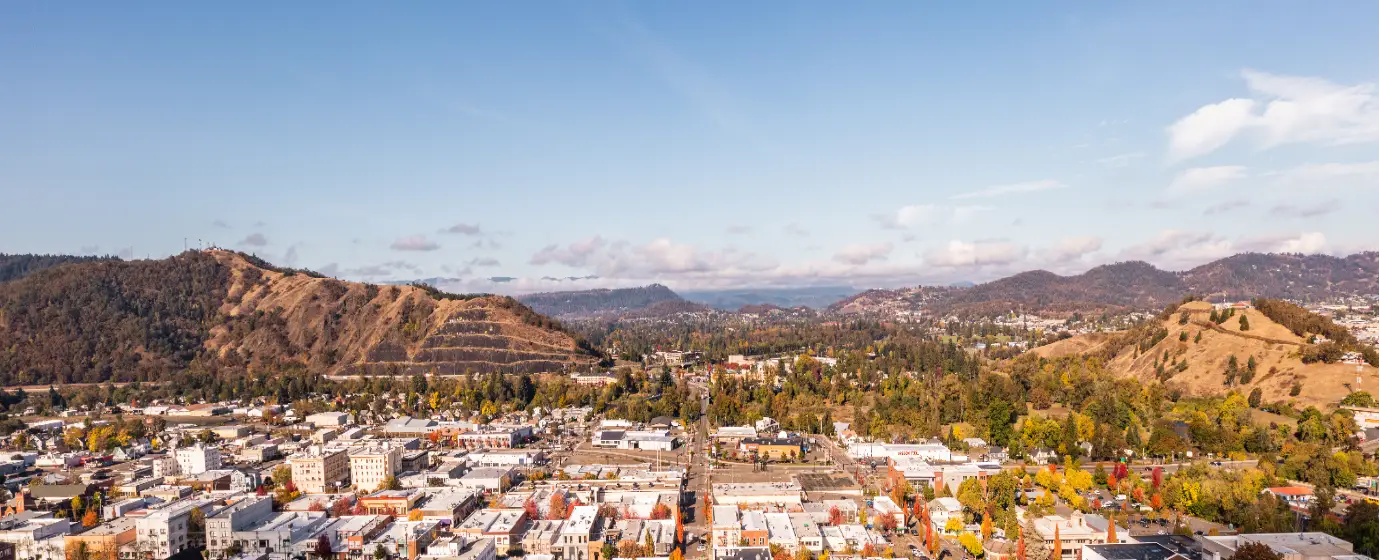
You've done the math, or someone did it for you. California's statewide typical home value of $773,735 against Roseburg's typical home price of $368,343 (July 2026) lands like a punch to the gut — in a good way. Half the price for a city of 23,795 in the Umpqua Valley, tucked between the Coast Range and the Cascades, where I-5 runs through the middle of town and the South Umpqua River bends around its western edge. The gap is real. But the move is not simply about a lower price tag, and the Californians who land here six months later happy are the ones who understood what they were actually trading.
Roseburg is the seat of Douglas County — Oregon's leading timber-producing county — and that heritage still shapes the economy and the culture. The major employers are a regional healthcare network, Douglas County government, Roseburg Public Schools, Umpqua Community College, and the City of Roseburg itself. This is not a bedroom suburb of Portland. The jobs here are in healthcare, education, timber-related industries, and public service, and the people who fill them tend to be lifers or deliberate arrivals, not commuters passing through. California accounted for 22% of all inbound moves to Oregon in the United Van Lines 2025 National Movers Study, and a meaningful share of those families end up in mid-sized Southern Oregon cities exactly like this one.
The cost picture extends well beyond the purchase price. Oregon carries no statewide sales tax — none — while California's statewide base sales tax rate of 7.25% is the floor before local additions. That difference alone saves the average household an estimated $2,000 to $4,000 annually on everyday purchases. Roseburg's total cost of living runs roughly 20% below California's on a broad basket of goods and services, and about 10.5% below the U.S. average overall. Health insurance premiums run noticeably below what most Californians were paying, though the trade-off is that specialist care and advanced treatment require a drive — this is a smaller city, and the depth of the specialist network reflects that. The outdoor life — the Umpqua River, Stewart Park and Riverfront Park, Wildlife Safari in nearby Winston — costs very little once you're here.
Whether you're comparing listings, working through the tax math, or just trying to picture what a Tuesday morning looks like in a city of under 24,000, the sections below break down the home price comparison, the tax picture, daily life logistics, what Californians typically get wrong, and what the local social fabric actually looks like.

The Home Price Reality: What Your California Equity Actually Buys Here
The price gap between California and Roseburg is not a rounding difference — it restructures what homeownership means. California's statewide typical home value of $773,735 buys a median-priced home in Roseburg more than twice over, with cash left on the closing table. For buyers arriving with Bay Area or Southern California equity, that surplus frequently means purchasing outright or putting down enough to keep a monthly payment dramatically lower than their California rent.
Roseburg's typical home price of $368,343 (July 2026) covers a range of housing stock that would astonish most California buyers. Mid-century ranch homes with yards in Hucrest and Garden Valley, craftsman-era houses near the Mill-Pine Historic District in Downtown Roseburg, newer construction in Edenbower — all sit within or below that figure depending on condition and location. The neighborhood breakdown covers character and geography in detail; what matters here is that entry-level options exist well below that typical price, and that the upper end of the market is relatively modest by any California standard.
The property tax comparison is equally striking. Roseburg's effective property tax rate sits at 0.65%. California's effective property tax rate of 0.71% is actually close — but California's Proposition 13 means longtime California homeowners often pay taxes on assessed values frozen decades ago. When you sell a California home and buy in Oregon, you reset to current market value here. Oregon's Measure 50 caps annual assessed-value increases, so the longer you own in Roseburg, the more your assessed value may drift below your purchase price — a benefit that compounds over time. For homeowners 62 and older with household income of $60,000 or less, Oregon also offers a property tax deferral program: the state covers the annual bill and records a lien, repaid when the home sells.
One number worth sitting with: Roseburg's median household income of $53,918 runs below what's needed to comfortably carry the typical home at current rates. That affordability gap matters for buyers relying entirely on local income. California equity buyers, remote workers, and retirees with fixed income or pension distributions are often better positioned to absorb Roseburg's price point than local first-generation buyers — which explains both why Californians keep arriving and why longtime residents have complicated feelings about it.
| Category | California | Roseburg, OR |
|---|---|---|
| Typical home value | $773,735 (Zillow ZHVI) | $368,343 (July 2026, Zillow ZHVI) |
| Effective property tax rate | 0.71% | 0.65% |
| Statewide sales tax | 7.25% base (plus local additions) | 0% — no sales tax |
| Top state income tax rate | 13.3% | 9.9% (kicks in around $125K for single filers) |
| Estate tax | None | 10%–16% above $1M exemption threshold |
| Oregon kicker refund | No equivalent | Yes — periodic credit returned to taxpayers when the state budget surplus exceeds its forecast |
* ZHVI = Zillow Home Value Index. California figures are from Zillow ZHVI (home value), Tax Foundation (property tax rate), California Franchise Tax Board (income tax), and California Dept. of Tax and Fee Administration (sales tax).
The Tax Picture: Better in Some Ways, More Complicated in Others
Oregon's tax story is genuinely good for most California transplants — but it is not a clean sweep, and going in with the wrong expectations is how people get surprised at their first Oregon filing.
The Clear Wins
Oregon has no sales tax. Full stop. Every grocery run, hardware store visit, and online purchase shipped to your Oregon address arrives untaxed at the state level. California's top state income tax rate of 13.3% applies only to the highest earners, but the broader California income tax structure is aggressive across a wide range of incomes. Oregon's top rate of 9.9% is meaningfully lower at the extreme end.
Oregon does not tax Social Security or Railroad Retirement benefits at the state level, regardless of income. For retirees drawing on either source, that is a real and durable advantage. Oregon also has a built-in mechanism that periodically returns excess budget surplus to taxpayers as a credit — California has nothing equivalent. Most other retirement income, including pension distributions, 401(k) withdrawals, and IRA draws, is taxed at Oregon's regular graduated rates.
The Part That Surprises People
Oregon's income tax brackets compress faster than California's. The 9.9% top rate kicks in around $125,000 for single filers. California reserves its highest rates for incomes above $1 million. That means a remote worker earning $150,000 may actually owe more in Oregon income tax than they did in California — even though California's top rate is higher. The zero sales tax is the primary offset, and for most households it more than compensates. But run the full calculation before assuming a blanket tax cut.
For California retirees arriving with substantial home equity, there is one more wrinkle worth knowing. Oregon levies an estate tax with a $1 million exemption threshold — not indexed for inflation and unchanged since 2012 — with graduated rates from 10% to 16% on the taxable amount above that level. California has no state estate tax. A Bay Area homeowner who sold a high-value house and also holds retirement accounts may find their total estate crosses that Oregon threshold faster than expected. The Retiring in Roseburg page addresses the retiree-specific picture in more depth.
The net result for most Californians: a real and meaningful cost reduction, most visible in the absence of sales tax and the lower housing carrying costs. The income tax story is more case-specific than the headlines suggest, and a brief conversation with a tax professional familiar with both states will save more confusion than any comparison article can.

Daily Life Logistics: What Shifts When You Get Here
Roseburg is a city that does not perform for visitors. It is built for the people who live here, and most of what shapes daily life is practical rather than promotional.
Groceries, Errands, and the Shopping Reality
Roseburg handles routine grocery runs and most everyday errands without any drama. A serious shopping trip beyond the ordinary — specialty retail, certain electronics, higher-end furniture — means a drive out of town. The nearest major airport with regular commercial service is Eugene Airport (EUG) at approximately 75 miles, or Medford (MFR) at approximately 98 miles. I-5 connects Roseburg to both directions cleanly; OR-99 parallels the freeway for local travel; OR-138 runs east toward Crater Lake country. Most Californians discover within the first month that they order more online here than they did at home, and that it bothers them less than expected because the housing savings absorb the inconvenience easily.
The Commute Question
Roseburg has no meaningful rush-hour traffic by California standards. If you need to reach Eugene for work or services, the drive is about 70 minutes to Eugene on I-5. Remote work has changed the calculus for many arrivals — healthcare, construction, and retail are the primary in-person hiring sectors locally, while knowledge workers and tech-adjacent roles are more often handled from home. That pattern is visible in the neighborhoods: Edenbower and Garden Valley skew toward households that have chosen Roseburg deliberately, often arriving with California equity and a laptop-dependent income.
Schools
Roseburg Public Schools holds a B- rating, according to Niche, serving a student body in the thousands across the district. On 2024-25 state assessments, 29.7% of students reached math proficiency and 45.4% reached reading proficiency — figures that reflect a district dealing with the same poverty-correlated challenges as most mid-sized Oregon cities. Strong athletics programs draw real community investment; the high school's teams and the Friday-night football culture are a genuine part of how this city gathers. Families researching individual schools and boundary details will find more on the schools page.
Weather: The Adjustment Californians Don't Always Anticipate
Roseburg sits in a rain shadow that gives it a more moderate profile than coastal Oregon — 182 sunny days a year, which compares well against Portland's significantly lower count. But Southern Oregon winters are grey and wet from November through March in a way that catches transplants from San Diego or the Central Valley off guard. The adjustment is real. Most people who've been here three years call it a reasonable trade; people who leave often cite the winter grey more than any other single factor.
Looking to buy in Roseburg? Estimate your payment.
Enter your numbers to see an estimated monthly mortgage payment.
Estimate only. Excludes HOA fees and mortgage insurance. The interest rate above is a starting point, not a quoted rate — replace it with your own to see real numbers. Insurance is a flat placeholder, not a Roseburg quote.
What Californians Get Wrong — and Why It Matters Before You Buy
The Californians who struggle in Roseburg tend to share a few predictable misreadings. None of them are fatal, but a few are expensive.
Treating It Like a Suburb
Roseburg is not a satellite of Portland or Eugene. It is a standalone city of 23,795 that functions as the commercial and civic hub for a large swath of Southern Oregon. There is no metro-area job market to tap if the local one doesn't fit. There is no adjacent urban core to borrow cultural amenities from on a weeknight. People who move here expecting to slip into a larger metropolitan rhythm tend to find Roseburg smaller than they bargained for. People who move here expecting exactly what it is — a small, self-contained city with real outdoor access and a low cost base — find it surprisingly complete.
Underestimating the Income Tax Nuance
As covered in the tax section, Oregon's income tax brackets compress quickly. A remote worker in the $130,000–$200,000 range may pay more in Oregon income tax than they did in California on the same gross income. The zero sales tax typically compensates, but not always fully. Run the actual numbers with someone who knows both states' structures before basing a budget on the assumption that every line item drops.
The Equity Windfall and the Local Income Gap
Roseburg's median household income is noticeably below the income level needed to carry the typical home here at current financing costs. If you arrive with California equity and use it to buy outright or nearly so, that gap is invisible to your budget. If you plan to work locally and carry a mortgage, the local salary ranges — particularly outside healthcare and education — may not pencil the way you expect. Check the employer and income landscape honestly before committing to a purchase price that requires a California-level income to service.
The Estate Tax Blind Spot
Oregon's $1 million estate tax exemption threshold has not moved since 2012 and is not indexed for inflation. A California homeowner who sold a high-value house, holds a retirement account, and has other assets can cross that threshold faster than they realize. California has no state estate tax. This is not a reason not to move — but it is a reason to talk to an estate planning attorney before you complete the transaction, especially if you're arriving with a meaningful equity event behind you.
The people who move here and stay tend to have one thing in common: they researched the real Roseburg, not a projected version of it. The neighborhood geography, the safety picture, and the full cost-of-living breakdown are worth reading before you make an offer.
Weekends and Local Favorites: What Life Actually Looks Like Here
Roseburg on a weekend is not Napa or Santa Barbara. It is something quieter and more self-sufficient, and once you stop comparing it to where you came from, most transplants find it has more texture than the drive-through impression suggests.
Where People Gather
The South Umpqua River waterfront and Riverfront Park are the city's living room in warm weather — people fish, run the path, let kids loose, and generally decompress in ways that don't require a reservation or a cover charge. Stewart Park, on the north end, serves the same function with more grass and more dogs. The Umpqua Valley Farmers' Market and the Roseburg Saturday Market draw a reliable weekend crowd through the growing season — local produce, prepared food, the kind of small-city social ritual that Californians from farmers-market cultures tend to find genuinely satisfying.
Food and Coffee
The dining scene is small but not thin. Brix Grill anchors the more polished end of the local restaurant landscape. Rodeo Steakhouse & Grill and Jersey Lilly represent the kind of straightforward, meat-forward dining that Douglas County does without apology. True Kitchen + Bar and Old Soul Pizza fill out the range for evenings when you want something between a drive-through and a special occasion. On the coffee side, My Coffee, Gathering Grounds Coffee House, Cascades Coffee House, Java Run Stephens, and Java Run Green give the city more independent café options than you might expect at this size.
The Outdoors as Infrastructure
This is not a city where outdoor access is a weekend amenity. It is the primary social infrastructure. The OR-138 corridor heading east from town opens into the North Umpqua River canyon, where hiking trails and swimming holes are within easy reach of town. Wildlife Safari in nearby Winston is a regional draw that locals use far more often than tourism marketing suggests. The river, the trails, and the access to Crater Lake country to the east mean that the outdoor calendar here stays full in a way that costs almost nothing once you have the gear.
After about six months, most California transplants report the same adjustment curve: the first two months are disorienting, the third and fourth feel surprisingly manageable, and by month six they've stopped looking for what Roseburg isn't and started working with what it is. The ones who leave tend to do so by month eight — usually citing the winter, the distance from specialist care, or a career need that requires proximity to a larger market. The ones who stay tend to stay for a long time.
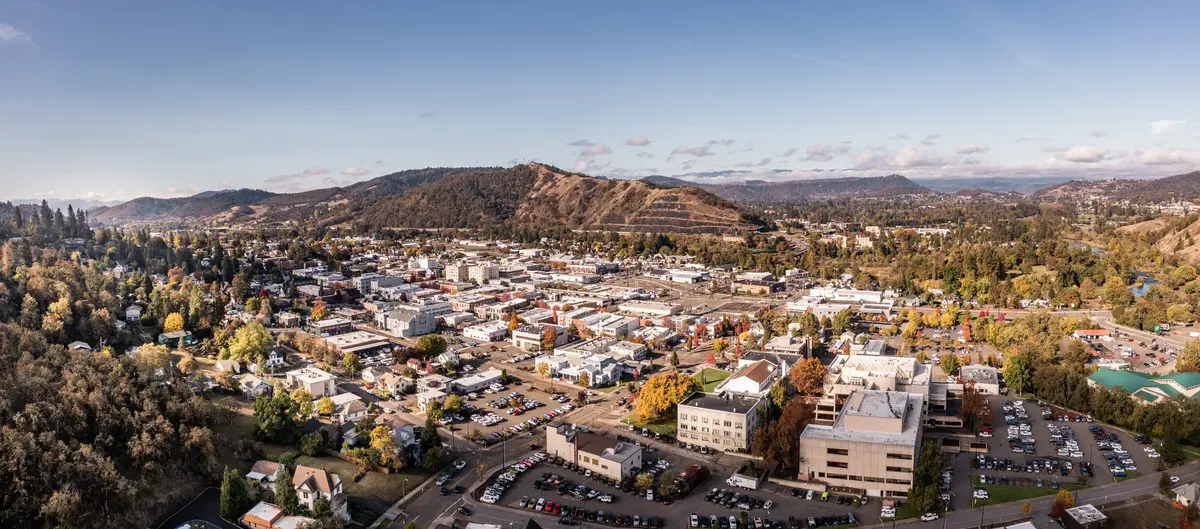
Local Expert Takeaway: Roseburg is the right move for Californians who want to cash out equity and genuinely reduce their cost of living — the home price gap is real, the sales tax savings are immediate, and the outdoor access is built into daily life rather than scheduled around it. The catch is specificity: this is a small, self-contained Southern Oregon city with a modest local job market, winter grey that surprises transplants from sunny California climates, and an Oregon income tax structure that can bite harder than expected at middle-to-upper incomes. Run the actual tax math, price out what you need locally versus what you'll order online or drive for, and be honest about whether 23,795 people is the city size you want — not the one you're settling for.
Quick Takeaways & FAQs
✅ Roseburg's typical home price of $368,343 (July 2026) sits dramatically below California's statewide typical home value, and Oregon's complete absence of sales tax adds real ongoing savings on everyday spending.
⚠️ Oregon's income tax brackets compress faster than California's, meaning remote workers earning above $125,000 may owe more in Oregon income tax than they did at home — the zero sales tax usually offsets this, but not always fully.
📍 Oregon's $1 million estate tax exemption threshold hasn't moved since 2012 and isn't indexed for inflation — California retirees arriving with home-sale equity and retirement accounts should run the numbers with an estate planning attorney before closing.
Is Roseburg actually cheaper than California when you account for all taxes?
How does the home price comparison between California and Roseburg actually work out?
What do Californians most commonly regret about moving to Roseburg?
Does Oregon's estate tax affect California transplants moving to Roseburg?
What is the local job market like for Californians moving to Roseburg?
Moving to Oregon?
Tell us what you need help with and we'll connect you with local resources.
