What Is Living in North Bend, Oregon Like?
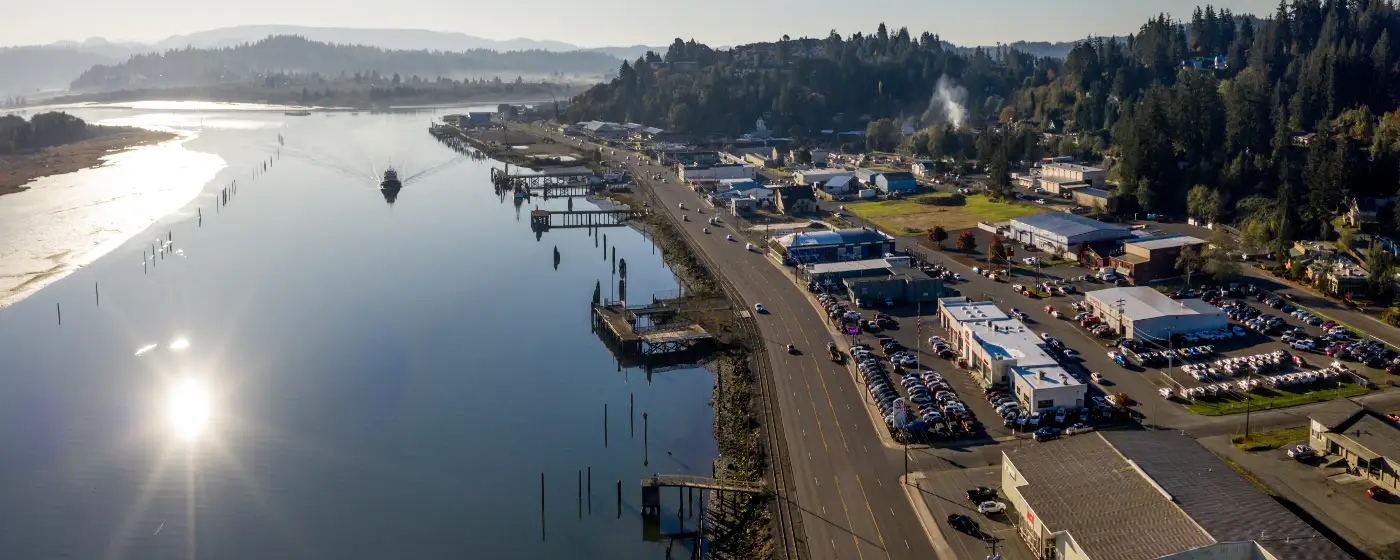
Most people discover North Bend one of two ways: they drove US-101 across the Conde B. McCullough Memorial Bridge and felt something shift — that 5,305-foot Art Deco span arcing over Coos Bay is genuinely one of the most dramatic highway crossings on the West Coast — or they were priced out of everywhere else on the Oregon coast and a friend said, "Have you looked at the Bay Area?" Both paths lead to the same place: a working-class port city of 10,049 people that happens to sit inside one of the most spectacular natural settings in the Pacific Northwest, where the Coos River meets the bay and the Oregon Dunes begin right at the edge of town. North Bend is surrounded on three sides by water, shares a continuous urban fabric with the city of Coos Bay to the south, and together the two form the largest community on the Oregon coast. The geography shapes everything about how the city works.
The economy here runs on a combination of sectors that have defined this stretch of coast for generations: commercial fishing, timber and wood products, port logistics, and a healthcare anchor in the regional health system across the bay. North Bend School District 13 holds a B rating, according to Niche, and with 2,698 students enrolled in 2025-26 it is small enough that most families know the staff by name. Southwest Oregon Regional Airport, less than a mile from downtown, provides scheduled commercial service to Portland — a genuine asset that most small Oregon coastal towns lack. The homeownership rate sits at approximately 65%, and the median age of 43.4 years tells you this is a community of established households rather than a transient one.
The typical home price of $362,945 (July 2026) puts North Bend well below coastal markets in Lincoln City, Newport, or Cannon Beach, making it one of the more affordable places you can actually live on the Oregon coast year-round rather than just visit. Day-to-day costs benefit from Oregon's lack of a sales tax, and the effective property tax rate of approximately 0.71% is modest. The honest caveat: the median household income of $83,484 runs below the income threshold to buy at that typical price, so first-time buyers here do their math carefully. What you get for your money, though, is immediate access to the Oregon Dunes National Recreation Area — the largest coastal dune system in North America — plus the North Bend Boardwalk, Simpson Park, and Horsfall Beach. The coast is not a weekend destination from here; it is Tuesday afternoon.
Whether you are seriously considering a move or just starting to research what the southern Oregon coast looks like as a place to actually live, the sections below cover North Bend's neighborhoods, housing market, daily commute, schools, local economy, and what residents find — good and surprising — after they settle in.
North Bend at a Glance
Looking to buy in North Bend? Estimate your payment.
Enter your numbers to see an estimated monthly mortgage payment.
Estimate only. Excludes HOA fees and mortgage insurance. The interest rate above is a starting point, not a quoted rate — replace it with your own to see real numbers. Insurance is a flat placeholder, not a North Bend quote.
Why Are People Moving to North Bend?
The honest answer is affordability — not in the way that phrase gets applied to suburbs of big cities, but in the rarer sense that you can buy a real house, on the Oregon coast, for a price that still makes sense to a schoolteacher or a port worker. That combination is genuinely scarce.
The Geographic Pull
North Bend's position is unusual. The city is surrounded on three sides by the Coos Bay estuary, with the Oregon Dunes beginning at its northern edge and the bay's working waterfront running along its eastern face. You are not near the coast — you are in it. The McCullough Bridge, completed in 1936 and listed on the National Register of Historic Places in 2005, was the structure that ended this region's relative isolation from land travel; before it opened, the coast here depended on sea transportation. That history still shapes the city's identity as a place that is self-sufficient by necessity.
Who Actually Moves Here
Remote workers from Portland and the Willamette Valley make up a meaningful share of recent arrivals — people who can live anywhere US-101 and a stable internet connection will reach, and who want the Oregon coast without the tourist pricing of the north coast. Retirees looking to downsize from the Willamette Valley find that North Bend offers the outdoor lifestyle without the inland heat. And a consistent stream of buyers comes from within the region itself — people already working at the port, in fishing, or for Coos County who are ready to own rather than rent.
The Economy Behind the Move
The local job base spans healthcare (a major regional health system operates across the bay in Coos Bay), government through Coos County and the City of North Bend, education through North Bend School District 13, and port logistics through the Oregon International Port of Coos Bay. Tourism tied to the Oregon Dunes National Recreation Area — 31,500 acres, the largest coastal dune system in North America — supports a hospitality and services sector. Southwest Oregon Regional Airport adds aviation and logistics employment. For buyers moving here without a local job lined up, remote work is a genuine and common arrangement; the city's average commute of 14.6 minutes reflects a workforce that mostly stays close to home.
For a full look at North Bend's schools, district test scores, and what families say about the district, the schools page has the detail.
What Daily Life Feels Like in North Bend
Six months after moving here, almost everyone says the same thing: the scale of the outdoors catches them off guard. Not in a dramatic, once-a-summer way — in the sense that the Oregon Dunes and Horsfall Beach are a short drive from a grocery run, and Simpson Park is where you end up on a Tuesday evening without planning it.
The Rhythm of a Small Port City
North Bend has the feel of a city that is comfortable with what it is. Pony Village Mall anchors the commercial core, and the mix of independent shops and service businesses along the main corridors serves a regional trade area that extends well beyond the city limits. There is no pretense of being a boutique destination, which is either a relief or a drawback depending on what you are looking for.
What Surprises People
The weather is the most common adjustment. The Oregon coast's reputation for rain is not wrong, but winters here also bring persistent low cloud and wind off the bay that earns your respect. Newcomers who move here expecting mild Pacific weather are generally prepared for rain; they are less prepared for how the fog can sit for days at a stretch in November and February.
Where People Actually Gather
The North Bend Boardwalk along the bay is the civic living room — a place where you see the same faces regularly, where the working port remains visible in the background. Simpson Park draws families with kids throughout the warmer months. The community here tends to organize around the water, the dunes, and a handful of genuinely good local spots — small enough that regulars know each other. The median age of 43.4 years means this is not a city built around young nightlife, but it is also not sleepy in the way that some small coastal towns can feel.
For the full picture on North Bend's parks, trails, and outdoor recreation — including details on the Oregon Dunes and what the North Spit offers — the parks page covers it.
The North Bend Housing Market Right Now
The typical home price of $362,945 (July 2026) makes North Bend one of the most attainable coastal markets in Oregon. That figure reflects a mix of older craftsman and mid-century stock, some newer construction in areas like Pony Creek Estates, and a genuine range of conditions and sizes.
What the Numbers Actually Mean
The effective property tax rate of approximately 0.71% keeps carrying costs manageable relative to the purchase price. The affordability picture is honest but not alarming: the median household income here runs somewhat below the income needed to purchase at the typical price, which means buyers who plan to stretch to ownership need to run the numbers carefully and may benefit from reviewing North Bend's first-time buyer options. Typical two-bedroom rents run $1,410–$1,720 per month, giving renters reasonable time to save.
How North Bend Compares Nearby
Compared with neighboring communities, North Bend's pricing sits somewhat above Coos Bay and somewhat below Charleston. Coquille, further inland, also comes in somewhat lower. For buyers who want the coastal location without the Charleston premium, North Bend is consistently the middle-ground choice.
What to Know Before You Look
The housing stock here rewards buyers who are willing to take on a renovation project — there is real character in the older neighborhoods, and the best-maintained properties in places like Simpson Heights and Hillcrest are legitimately well-priced for what they offer on the Oregon coast. Well-priced homes in better condition and locations rarely sit. For a full breakdown of pricing, taxes, and cost comparisons, the cost of living page has the detail.
North Bend Neighborhoods
North Bend has several distinct areas — each with its own character and appeal. Here’s a breakdown to help you narrow down where to focus your home search.
🏡 Glasgow
Glasgow is one of North Bend's older residential areas, with modest single-family homes on established lots that suit buyers looking for a straightforward, no-frills entry into the city. The neighborhood has a working-class character and is close to the commercial corridors that serve everyday needs.
🏠 Simpson Heights
Simpson Heights sits above the bay with some of the better-maintained older housing stock in North Bend, and its proximity to Simpson Park makes it a natural draw for families with school-age children and for buyers who want walkable access to green space.
🌳 Hillcrest
Hillcrest occupies elevated ground in the city's interior and offers a mix of mid-century and more recent construction; residents here trade some walkability for the quieter feel of a neighborhood set back from the main commercial corridors.
🏘 Airport Heights
Airport Heights is named for its proximity to Southwest Oregon Regional Airport and suits buyers who prioritize convenience to the terminal and to US-101 — a practical choice for households that travel regularly or work in aviation and logistics.
🏔 Mariner Heights
Mariner Heights has a residential feel oriented toward the bay side of the city, with housing that tends toward the mid-range of the local market and a neighborhood character that appeals to buyers who want to stay close to the water without the density of the commercial core.
🌆 Pony Creek Estates
Pony Creek Estates is one of the newer residential pockets in North Bend, with more recent construction than much of the city's older stock; the proposed Pony Creek Greenway trail would connect this area to Simpson Park and the junior high, making it a neighborhood to watch for families.
Pros & Cons of Living in North Bend
The Pros
- Direct access to Oregon Dunes National Recreation Area and Horsfall Beach for outdoor recreation
- Lower cost of living and home prices than much of the Oregon Coast
- Home to the coast's only commercial airport with scheduled flights
- Historic small-town character with a walkable Main Street and waterfront
The Cons
- Limited local job market outside healthcare, government, and retail
- Higher-than-average property crime rates reported by several crime-data sites
- Frequent overcast, rainy weather much of the year with mild but cool summers
Getting Around & Commuting in North Bend
North Bend is a driving city. Two cars per household is the norm, and the average commute is 14.6 minutes — one of the shorter averages you will find in any Oregon city, which reflects both the compact geography and the fact that most major employers are within the immediate Bay Area.
The Local Geography of Getting Around
US-101 is the spine of the city — running north-south through North Bend, across the McCullough Bridge, and continuing south into Coos Bay. OR-540, the Cape Arago Highway, branches west toward Charleston and the coast. Most daily errands and job trips run along these two corridors. The connection to Coos Bay is the most common daily movement: it is about 10 minutes to Coos Bay, where the regional health system, county government, the port, and additional retail are concentrated. That short crossing means residents functionally share an employment market with the larger neighbor city without the penalty of a long commute.
What Remote Workers Should Know
Internet infrastructure on the southern Oregon coast has improved, but it is worth verifying specific service levels before committing to a neighborhood. Many remote workers here manage well; a handful find that connectivity in the more outlying areas requires some backup planning. The practical question is whether your work can tolerate the occasional disruption that comes with coastal weather events — winter storms occasionally affect service.
The Airport Advantage
Southwest Oregon Regional Airport (OTH), about 1 mile from the city center, provides scheduled commercial service to Portland. For buyers who travel regularly for work, this is a genuine selling point that distinguishes North Bend from most comparably sized Oregon coast towns. The drive to a major hub airport is real, but the Portland connection makes it workable for moderate travel schedules.
Trail Infrastructure in Progress
The city applied for a $2.5 million ODOT and Federal Highway Administration grant to build a Pony Creek Greenway multi-use trail linking Simpson Park to North Bend Junior High. A separate effort by the Wild Coast Trails Association has proposed a broader trail network in the Pony Creek Watershed. Both efforts were active as of late 2025, reflecting a clear investment direction toward more connected non-motorized access across the city.
Schools in North Bend
Families relocating to North Bend have public, private, and higher-education options nearby. Here’s a quick overview.
🎓 School District
North Bend School District 13 serves K–12 students across North Bend and the surrounding area. Rated B (source: Niche.com).
🏆 Graduation Rate
The 4-year high-school graduation rate here is approximately 70%.
📚 Higher Education
Oregon’s public universities — the University of Oregon, Oregon State University, and Portland State University — offer four-year degrees statewide, with a network of 17 community colleges providing two-year and workforce programs.
🌐 Online Learning
Oregon State University Ecampus and Portland State University Online offer fully accredited online degrees for remote learners across the state.
Safety in North Bend
A quick look at how North Bend compares on the numbers that matter most when weighing a neighborhood or a move.
🛡 Violent Crime
Approximately 1.7 per 1,000 residents.
🔒 Property Crime
Approximately 32 per 1,000 residents.
Compared to the most recent national figures from the Bureau of Justice Statistics (2024), North Bend’s violent crime is below the national average (about 3.7 per 1,000), and property crime is above the national average (about 18.4 per 1,000).
Against Oregon as a whole, North Bend’s violent crime is roughly half the state average, and property crime is somewhat above the state average (Bureau of Justice Statistics, Crime Known to Law Enforcement, 2024 (tables 2 and 3)).
Crime rates can vary a lot within a single city, so the citywide numbers above are only a starting point. Some neighborhoods in North Bend run well below these averages, while others run higher — the kind of block-by-block detail that matters most when you’re actually choosing where to live. The full guide below breaks it down neighborhood by neighborhood.
Working in North Bend
North Bend’s largest employers span several industries — here are some of the anchors of the local job market.
🏥 Bay Area Hospital
Healthcare, located in Coos Bay
🏛 Coos County
Municipal government
🏛 City of North Bend
Municipal government
💼 Oregon International Port of Coos Bay
Logistics, located in Coos Bay
🎓 North Bend School District 13
Education
Parks & Recreation in North Bend
Some of the outdoor spaces that shape everyday life in North Bend.
🌱 Simpson Park
North Bend residents don’t have to go far for green space — spots like Simpson Park are part of everyday life here, whether that’s a morning walk, a weekend hike, or just somewhere to unwind outside. The full guide below covers more of what North Bend has to offer for parks and outdoor recreation.
Retiring in North Bend
North Bend draws retirees for its balance of amenities, outdoor access, and cost. Here’s what to weigh.
🌤 Climate
North Bend sits on the Oregon coast, where winters bring persistent low cloud, rain, and bay wind that can be relentless through February and March. Summers are mild and rarely hot, with temperatures that stay comfortable well into September. The trade-off for retirees is that arthritis and damp-weather sensitivity are worth factoring into the decision.
🍴 Lifestyle
Daily life centers on the bay, the boardwalk, Simpson Park, and the Oregon Dunes — passive and active recreation are woven into the routine rather than being a drive away. The dining scene is smaller than a Willamette Valley city of comparable size but has genuine local anchors. A serious shopping or medical specialist trip will typically mean the Coos Bay side, about 10 minutes away.
🏚 55+ Communities
No 55+ communities were found in North Bend. Retirees here typically buy single-family homes in established neighborhoods or look at the rental market, where two-bedroom units typically run $1,410 to $1,720 per month. The full picture on healthcare access and retirement considerations is on the retiring page.
✈ Getting Around
A car is essential for day-to-day life in North Bend. Most destinations within the Bay Area are reachable in under 15 minutes, and the Southwest Oregon Regional Airport (OTH) is about 1 mile from downtown, providing scheduled service to Portland for residents who travel regularly. The compact geography keeps most daily driving manageable.
🏛 Oregon Taxes for Retirees — What to Know
- Social Security is not taxed — Oregon does not tax Social Security or Railroad Retirement benefits. Any amount included in your federal adjusted gross income is subtracted back out on the Oregon return.
- But other retirement income IS taxed — This is the trade-off that surprises people moving from Washington or Texas. Pension distributions and 401(k)/IRA withdrawals are taxed as ordinary income at Oregon’s regular rates — there is no blanket retirement-income exclusion.
- Graduated income tax — Oregon has four brackets — 4.75%, 6.75%, 8.75% and 9.9%. The 4.75% rate covers the first $10,000 of taxable income for a single filer ($20,000 filing jointly); the 8.75% rate starts at $125,000 ($250,000 jointly); and the top 9.9% rate applies above $250,000 ($500,000 jointly).
- No sales tax — Oregon levies no general sales tax.
- Property taxes, with senior deferral — Oregon’s Senior and Disabled Property Tax Deferral lets qualifying homeowners have the state pay their county property taxes, with a lien recorded against the home. The 2026 household income limit is $70,000, and deferred balances accrue 6% simple interest — it defers the bill rather than forgiving it.
- Estate tax — the one to plan for — Oregon has its own estate tax with a $1 million filing threshold — far below the federal exemption, and NOT indexed for inflation, so it reaches more estates every year in real terms. Retirement accounts and a long-held home count toward the taxable estate, so estates that feel modest can cross the line without the owner expecting it.
- No inheritance tax — Oregon has no separate inheritance tax and no gift tax.
Tax laws change frequently and individual situations vary. This is general information, not tax advice — always consult a qualified Oregon tax professional or CPA for personalized retirement tax planning.
Weekends & Local Favorites in North Bend
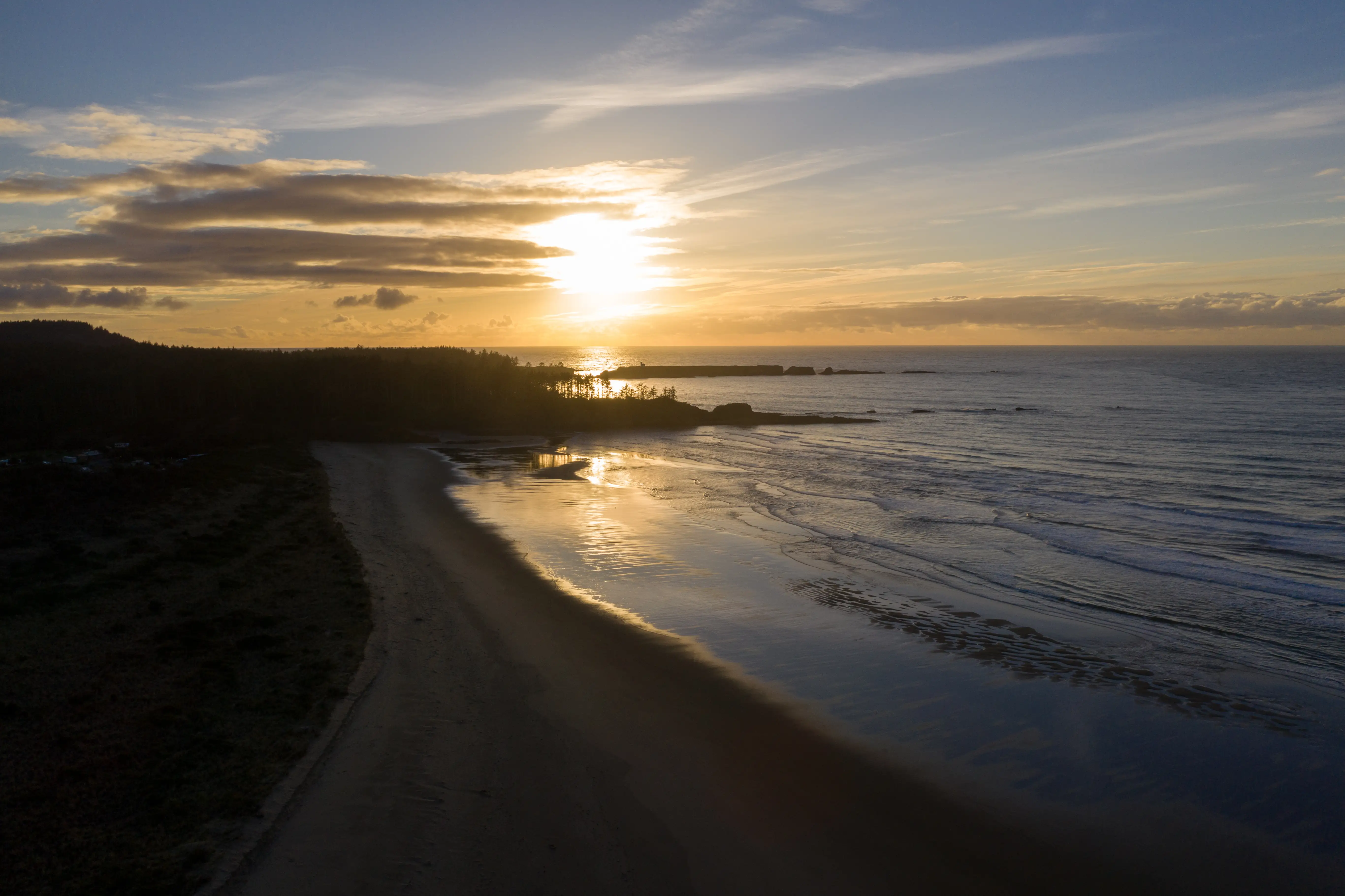
Outdoor recreation is not a weekend amenity here — it is the default. The Oregon Dunes National Recreation Area begins at North Bend's northern edge, and on any given day you will find OHV riders, hikers, photographers, and anglers across its 31,500 acres. Dunes tower up to 500 feet above sea level; the scale of it surprises people who have only seen it on a map.
The Dunes and the Beach
Horsfall Beach, within the Oregon Dunes NRA near North Bend, offers miles of open sand and access to the deflation plain wetlands and inland dune systems that make this stretch of coast unlike anything else in the lower 48. The North Spit runs along the bay's western edge and is a reliable spot for shore fishing, birding, and watching container ships navigate the channel. The McCullough Bridge waterfront trail gives walkers and cyclists a vantage on the bay that most people who cross the bridge by car never see.
Food and Coffee
The local dining and coffee scene is smaller than what you would find in a city of comparable size in the Willamette Valley, but it has its own reliable anchors. For burgers and sandwiches, Vinny's Smokin' Good Burgers & Sandwiches has a loyal following. Captain's Choice Fish House does what you would expect from a working port town — straightforward, fresh seafood. A counter-service spot for Mexican food, La Herradura, rounds out the casual end of the lineup. Hilltop House Restaurant & Lounge offers a sit-down option with bay views that residents tend to keep to themselves.
For coffee, Coast Cruiser Coffee and Black Anchor Coffee House are the daily-driver stops. Ezekiel's Tin Rooster Bakery Coffee Shop Bookstore & Roastery is a combination that sounds like a curiosity and turns into a regular destination — books, roasted coffee, and baked goods in one space. 350 Degrees Corporation and Coastal Coffee round out the options for anyone who prefers to walk rather than drive for their morning cup.
The Civic Calendar
Simpson Park is where the community gathers for outdoor events — it anchors the residential middle of the city and is the logical starting point for any new resident learning the social geography of North Bend. The Pony Village Mall area remains the practical retail hub for the region. A serious shopping run for anything outside everyday staples will mean driving, and most residents make peace with that early.
Local favorites in North Bend
Restaurants
- Vinny's Smokin' Good Burgers & Sandwiches
- Captain's Choice Fish House
- Yeong's Place Sandwiches • Exotic Burgers
- La Herradura
- Hilltop House Restaurant & Lounge
Outdoors
- Oregon Dunes National Recreation Area
- Horsfall Beach
- North Spit
- Simpson Park
- McCullough Bridge waterfront trail
Coffee
- Coast Cruiser Coffee
- Black Anchor Coffee House
- Ezekiel's Tin Rooster Bakery Coffee Shop Bookstore & Roastery
- 350 Degrees Corporation
- Coastal Coffee
Top Things Locals Say About North Bend
The best intel about a city comes from the people who actually live there. Here’s what North Bend residents say when newcomers ask the questions everyone’s thinking.
“I expected to feel isolated out here, but the airport changed everything — I can be in Portland in an hour when I need to, and the rest of the time I'm looking at the bay from my back deck. What I didn't expect was how long it takes to get used to the fog in February. Nobody warned me about February.”
— Recent North Bend home buyer
“What's the most surprising thing about living in North Bend?”
How close the dunes actually are. You see them on the map and think they're a destination — then you live here and realize Horsfall Beach is just where you go on a random afternoon. Simpson Park is the other one; it becomes your default park within the first month, whether you have kids or not.
“What do locals love most about North Bend?”
The scale of what's outside. You're not driving to the Oregon coast on weekends — you're already on it. The McCullough Bridge is something you cross twice a day and never quite stop noticing. And Coos Bay is close enough that you get a real city's worth of services without actually living in the middle of it.
“What should newcomers to North Bend know?”
Don't underestimate the wind off the bay — it's not just rain, it's sustained wind that makes you buy a better jacket in month two. US-101 through town moves fine most of the time, but the McCullough Bridge can back up when there's an event or a summer weekend and everyone is coming down the coast. Build that into your mental map of where you live.
“How much do you need a car in North Bend?”
You need a car for almost everything. The average household has two, which tells you what the locals have figured out. Most errands mean driving, and anything beyond everyday groceries or a hardware run means heading toward Coos Bay or planning ahead. The tradeoff is that most of those drives are short — the 14.6-minute average commute is real, and the Bay Area is compact enough that you rarely feel like you're grinding through traffic.
Cities Near North Bend
Other communities near North Bend worth a look — each with its own character and price point.
| City | Distance | Best For | Vibe | Median Rent | Median Buy |
|---|---|---|---|---|---|
| Coos Bay | 3 mi | Regional services & established neighborhoods | Working port city, slightly more urban | $1,603 | $330,015 |
| Charleston | 8 mi | Fishing community & waterfront access | Quiet, maritime, close-knit | $1,500 | $400,000 |
| Coquille | 18 mi | Budget buyers & rural pace | Inland, small-town, slower tempo | $1,300 | $329,773 |
More Helpful Guides for North Bend
Going deeper on North Bend? Our blog series covers everything from first-time buying to retiring here — explore the guides below.
Local Expert Takeaway: North Bend is the Oregon coast town where the gap between price and quality of life is still real — a $362,945 typical home price buys you immediate access to the largest coastal dune system in North America, a 14.6-minute average commute, and a small-city feel without the manufactured-quaintness of the tourist coast. The honest trade is that the economy is thin, the fog is persistent in winter, and a serious shopping trip means driving. But for remote workers, retirees, and buyers who want to own rather than rent on the coast, the math still works in a way it rarely does anywhere west of the Cascades.
Quick Takeaways & FAQs
✅ North Bend's typical home price of $362,945 (July 2026) is among the lowest of any community with direct Oregon coast access.
⚠️ The median household income runs below the income needed to purchase at the typical home price, so buyers who are stretching to ownership should plan carefully before making an offer.
📍 Southwest Oregon Regional Airport is about 1 mile from downtown and connects to Portland via scheduled commercial service — a genuine infrastructure advantage for a town of 10,049.
Is North Bend, Oregon a good place to live?
What is the cost of living in North Bend, Oregon?
How are the schools in North Bend, Oregon?
What is the job market like in North Bend?
What is the crime rate in North Bend, Oregon?
Helpful Links for Moving to North Bend
Moving to Oregon?
Tell us what you need help with and we'll connect you with local resources.
