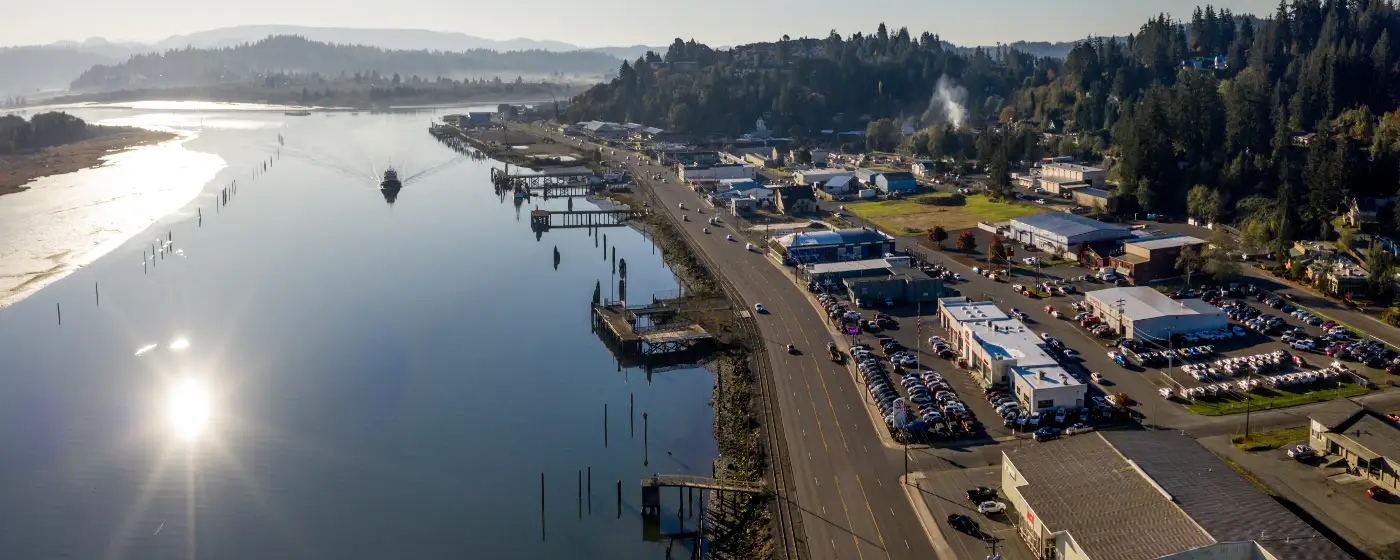
Maybe your company didn't relocate you here — you found it yourself on a slow drive down US-101, watching the Conde B. McCullough Memorial Bridge arc over the bay, and something clicked. North Bend is a working Oregon Coast town of 10,049 people, not a resort community, and that distinction shapes everything a retiree needs to weigh. It sits on a compact peninsula surrounded on three sides by the Coos Bay estuary, which keeps the geography tight, the population manageable, and the pace deliberately unhurried.
The draw for retirees is specific: a genuine small-city infrastructure — a regional hospital minutes away, an established senior center, a transit connection — at a price point well below what most coastal Oregon towns charge. The typical home here was $362,945 as of July 2026, which is a number that stops people mid-scroll when they've been watching prices in Lincoln City or Cannon Beach. Southwest Oregon Regional Airport handles direct regional flights, and Coos Bay sits about 10 minutes to Coos Bay, so the metro-level services are close without the metro-level noise.
The honest caveat is the Oregon Coast's perennial one: the sun. North Bend sees 186 sunny days a year, which is short of what the Pacific Northwest's marketing suggests and shorter still than what many retirees from California or the Southwest are prepared for emotionally. The grey seasons are long and damp, and the town's remote position on the southern coast means advanced specialty care beyond Bay Area Hospital requires a serious drive. Anyone who needs frequent access to a large academic medical center should weigh that distance carefully before committing.
Whether you're comparing North Bend against Coos Bay, Bandon, or towns further up the coast, the sections below break down the full retirement picture: healthcare access, the retiree tax situation, what daily life on a fixed income actually costs, walkability and community, downsizing options, and how the town stacks up against the most relevant nearby alternatives.

Why Retirees Are Choosing North Bend
The case for North Bend in retirement is built on three things that rarely appear together on the Oregon Coast: a real hospital nearby, an entry-level home price that doesn't require liquidating a portfolio, and a town small enough that you stop being a stranger within a season.
Retirees who thrive here tend to arrive from one of two directions. The first group is trading equity from a higher-cost market — often California or the Willamette Valley — and finds that the typical home price of $362,945 (July 2026) leaves meaningful capital left over for a comfortable retirement cushion. The second group has ties to the South Coast already, or has simply done the research and decided that proximity to the ocean, a functioning senior center, and a slower tempo outweigh the trade-offs. Both groups tend to be people who find identity in a place, not in a scene.
North Bend is a poor fit for retirees who need walkable retail density, frequent access to specialist medicine beyond what a regional hospital provides, or more than 186 sunny days a year. The town's commercial corridor along US-101 requires a car for most errands, advanced oncology and cardiac procedures exist locally but tertiary referral cases still travel, and the southern Oregon Coast winter is real. Retirees who need a full urban amenity set — major-league cultural venues, a walkable downtown restaurant row, a large airport — will find the remoteness frustrating rather than peaceful.
Healthcare & Medical Access in North Bend
The Regional Anchor
Bay Area Hospital in Coos Bay is the closest hospital to North Bend — about 3 miles away — and it carries considerably more weight than its distance suggests. It is a 172-bed acute care facility, the largest hospital on the Oregon Coast, and it holds Level III trauma center certification from the State of Oregon, meaning a multidisciplinary trauma resuscitation team is immediately available in the emergency department rather than on call.
For retirees, the specialist depth matters more than the bed count. The hospital houses the Prefontaine Cardiovascular Center for cardiac and vascular diagnosis and treatment, the Bay Area Cancer Center — described as the largest oncology treatment center on the Oregon Coast, offering advanced cancer therapies and clinical trials — and the Joint and Spine Care Center for orthopedic needs. Patient housing at the Bay Area Cancer Center was remodeled in February 2026 with support from the Bandon Dunes Charitable Foundation, specifically to reduce the travel burden for patients who need extended treatment stays.
The Honest Distance Reality
A Level III trauma center is meaningfully different from a Level I or II. For routine emergencies and most surgical needs, Bay Area Hospital handles the full picture well. For complex multi-system trauma, highly specialized neurosurgery, or advanced cardiac intervention beyond what the Prefontaine Center provides, patients are typically transferred to a higher-level facility — in this region, that means traveling to Eugene or Portland, a significant drive from the southern coast.
For most retirees, this distinction rarely surfaces in daily life. Routine care, cardiology, orthopedics, and cancer treatment are all available locally. But retirees with complex, pre-existing conditions that already require quarterly visits to a major academic medical center should build that drive time into their relocation calculation honestly. A medical situation that is manageable in Eugene becomes logistically demanding if you're routing it through North Bend.
Coos Health & Wellness also operates an Aging & People with Disabilities office in North Bend, providing local access to state-coordinated senior support services — useful for navigating home care, disability accommodations, and county-level assistance programs without driving to Coquille.

The Retiree Budget in North Bend
Oregon's Tax Posture for Retirees
Oregon's treatment of retirement income is genuinely mixed, and understanding the split matters before you make the move. Social Security benefits are fully exempt from Oregon state income tax, regardless of your total income level — a meaningful advantage compared with many states. Railroad Retirement benefits receive the same exemption.
The other side of the ledger is less favorable. Distributions from 401(k) accounts, IRAs, and most pensions are taxed at Oregon's regular graduated state income tax rates, which climb to 9.9% at the top bracket. Retirees drawing heavily from tax-deferred accounts should model that exposure carefully with a tax advisor before assuming Oregon will be light on their retirement income overall.
Oregon levies no state sales tax, which produces real savings on everyday purchases for anyone living on a fixed budget. The effective property tax rate in North Bend is approximately 0.71% — well below the national average — which softens the carrying cost of homeownership considerably. Oregon also offers a Property Tax Deferral program for homeowners 62 or older with household income up to $60,000 (2025 threshold): the state pays county property taxes directly on the homeowner's behalf, recording a lien at 6% simple interest to be settled when the home eventually sells. For retirees who are income-constrained but equity-rich, this program can meaningfully reduce monthly cash demands.
One planning note worth taking seriously: Oregon levies its own estate tax with a $1 million exemption that is not indexed to inflation. Estates that fall well below the federal exemption threshold can still trigger Oregon's estate tax. Retirees with significant assets should discuss this with an estate-planning attorney before relocating.
Day-to-Day Costs
Groceries, utilities, and local services on the southern Oregon Coast run close to — or modestly above — state averages, driven partly by the region's distance from major distribution hubs. A serious shopping trip often means driving out of town for anything the local stores don't carry. For a detailed look at cost of living in North Bend, including rent ranges and utility benchmarks, that page breaks it down in full.
Looking to buy in North Bend? Estimate your payment.
Enter your numbers to see an estimated monthly mortgage payment.
Estimate only. Excludes HOA fees and mortgage insurance. The interest rate above is a starting point, not a quoted rate — replace it with your own to see real numbers. Insurance is a flat placeholder, not a North Bend quote.
Walkability, Community & Staying Active in North Bend
Getting Around Without a Car
North Bend is compact — roughly 3.93 square miles of land area on a peninsula — but compact does not automatically mean walkable for errands. The primary commercial corridor along US-101 is car-oriented, and most grocery and retail runs require driving. The waterfront areas and the North Bend Boardwalk are genuinely pleasant on foot, and the McCullough Bridge waterfront trail gives walkers and cyclists a memorable stretch along the estuary. For outdoor access, the Oregon Dunes National Recreation Area and Horsfall Beach are close, but reaching either typically means driving.
Coos County Area Transit (CCAT) runs bus service in the area, and the North Bend Senior Recreation and Activity Center is on the CCAT route — meaning it is reachable without a car, which matters to retirees who are planning ahead for the years when driving becomes less reliable.
The Senior Center and Community Life
The North Bend Senior Recreation and Activity Center, founded in 1963, is the social anchor for active retirees in the city. It runs over a dozen activity programs, weekly hot lunches, and special events throughout the year. Lunch is free for members 60 and older. This is not a drop-in bulletin board — it is a genuine gathering place with consistent programming and a membership that turns up regularly.
The Coos County RSVP program connects adults 55 and older with structured volunteer opportunities across local nonprofits, which is a meaningful option for retirees who find purpose through community contribution rather than recreation alone. For those who prefer being outdoors, Simpson Park sits within the city, and the surrounding estuary, dunes, and beach access give North Bend an outdoor lifestyle infrastructure that few towns of 10,000 can match.
Six months in, most retirees who choose North Bend say the same thing: they underestimated how quickly a small community closes ranks around newcomers. The flip side is that the social scene is intimate enough to feel claustrophobic to people who need more anonymity. There is no middle ground between being known and being isolated here — newcomers tend to fall into one camp or the other within the first year.
Right-Sizing: Downsizing in North Bend
What the Inventory Looks Like
North Bend's housing stock skews older, which creates a specific challenge for retirees seeking single-level living. Ranchers and smaller mid-century homes exist throughout neighborhoods like Glasgow and Airport Heights, and they represent the most realistic path to step-free living in the city. The inventory of newer, purpose-built single-level homes is limited, and retirees who need or strongly prefer that configuration should expect to be patient or flexible on condition.
Patio homes and attached housing — the low-maintenance configurations that make the most sense for downsizers — are not abundant. The city is small enough that purpose-built low-maintenance communities of any kind are sparse. Buyers coming from markets where 55+ developments are common will find the selection thin by comparison.
The 55+ Community Question
No 55+ communities were found in North Bend. This is not a gap the market is currently filling at scale. Retirees who want a dedicated age-restricted community with shared amenities, an HOA managing exterior maintenance, and built-in peer community will need to look at nearby cities — Coos Bay has some additional senior housing options, and Bandon draws retirees specifically for its retirement lifestyle infrastructure.
What North Bend does offer is affordability at the city-wide level, which means a buyer can often afford a slightly larger or better-situated home than they expected. For retirees primarily focused on managing cost rather than maximizing amenity, the math can work in their favor even without dedicated senior inventory. For a deeper look at specific neighborhoods and what the housing stock looks like across the city, the North Bend neighborhoods page covers the character and trade-offs of each area in detail.
North Bend vs Nearby Retirement Destinations
| City | Cost vs North Bend | Primary Hospital | Walkability | Senior Living Depth | Overall Retirement Fit |
|---|---|---|---|---|---|
| North Bend | Anchor | Bay Area Hospital (3 mi, Level III trauma) | Car needed for most errands; boardwalk and estuary trails on foot | Senior center, CCAT bus, APD office; no 55+ communities | Value Nature Solid for active, budget-conscious retirees |
| Coos Bay | Somewhat lower | Bay Area Hospital (on-site or very close) | Slightly more walkable commercial core than North Bend | More senior housing options; similar services | Walkable Good alternative with marginally more retail access |
| Charleston | Somewhat higher | Bay Area Hospital (~8–10 mi) | Very limited; rural fishing village feel | Minimal dedicated senior infrastructure | Quiet Privacy Best for true solitude seekers; less support network |
| Coquille | Somewhat lower | Myrtle Point Medical Center (closer inland option); Bay Area Hospital farther | Small downtown walkable core; rural surroundings | Inland senior services; quieter pace | Value Lower cost, inland setting; farther from ocean and hospital |
| Lakeside | About the same | Bay Area Hospital (farther drive) | Minimal; very small community | Very limited; few organized senior services | Nature Appeals to retirees prioritizing lake access over services |
| Bandon | Pricier | Southern Coos Hospital & Health Center (local); Bay Area Hospital for higher acuity | Compact historic downtown is genuinely walkable | More developed retirement community profile; active arts scene | Luxury Walkable Better lifestyle polish; higher price to pay for it |
Coos Bay beats North Bend on walkable retail access and puts you even closer to Bay Area Hospital — for retirees who want the same healthcare anchor with slightly more on-foot convenience, it is the natural alternative, and its typical home price runs somewhat lower. Bandon is the coastal retirement destination for people who want a more developed lifestyle infrastructure: a walkable historic downtown, a stronger arts community, and a local hospital at Southern Coos Hospital & Health Center for routine needs. The price premium is real, and retirees on a tighter fixed income often find it untenable.
Coquille offers the lowest cost of the group and a quiet inland pace, but retirees give up both ocean proximity and immediate access to Bay Area Hospital's specialist services. Charleston is for people who want to disappear into a fishing village — the trade-off is minimal senior services and a longer drive to substantive medical care. Lakeside sits in between geographically but not in terms of services; it suits retirees for whom the draw is purely the natural setting.
North Bend's strongest case is the combination of affordability, a real hospital three miles away, an established senior center with transit access, and enough small-city infrastructure to make daily life manageable without a second car. For retirees who can accept the grey winters and the remoteness, it is one of the more practical retirement landings on the Oregon Coast.

Local Expert Takeaway: The North Bend Senior Recreation and Activity Center is the social infrastructure that makes this town actually work for retirees — it has been running programs since 1963, it is on the CCAT bus line, and it is the fastest way a newcomer goes from stranger to regular. Pair that with Bay Area Hospital three miles away, a property tax rate of approximately 0.71%, Oregon's full Social Security exemption, and a typical home price that leaves room to breathe financially, and the value case for retiring here is real. The catch is honest: no 55+ communities exist in the city, the grey season is long, and anyone needing tertiary specialty care beyond what a Level III hospital provides is looking at a meaningful drive. Go in with clear eyes on those three things and North Bend delivers a retirement that a lot of more-marketed coastal towns cannot actually match on fundamentals.
Quick Takeaways & FAQs
✅ Bay Area Hospital, a 172-bed Level III trauma center with dedicated cardiovascular and cancer specialty services, is just 3 miles from North Bend — unusually strong healthcare infrastructure for a coastal town this size.
⚠️ No 55+ communities exist in North Bend, and the housing stock of single-level homes is limited and skews older, which means downsizers often need to trade condition for step-free living.
📍 The North Bend Senior Recreation and Activity Center has offered free lunches and over a dozen activity programs to members 60 and older since 1963, and sits on the Coos County Area Transit bus route.
Is North Bend, Oregon a good place to retire?
Does Oregon tax Social Security benefits for retirees?
What hospital serves retirees in North Bend?
Are there 55+ communities in North Bend, Oregon?
Can I get around North Bend without a car as a retiree?
Moving to Oregon?
Tell us what you need help with and we'll connect you with local resources.
