
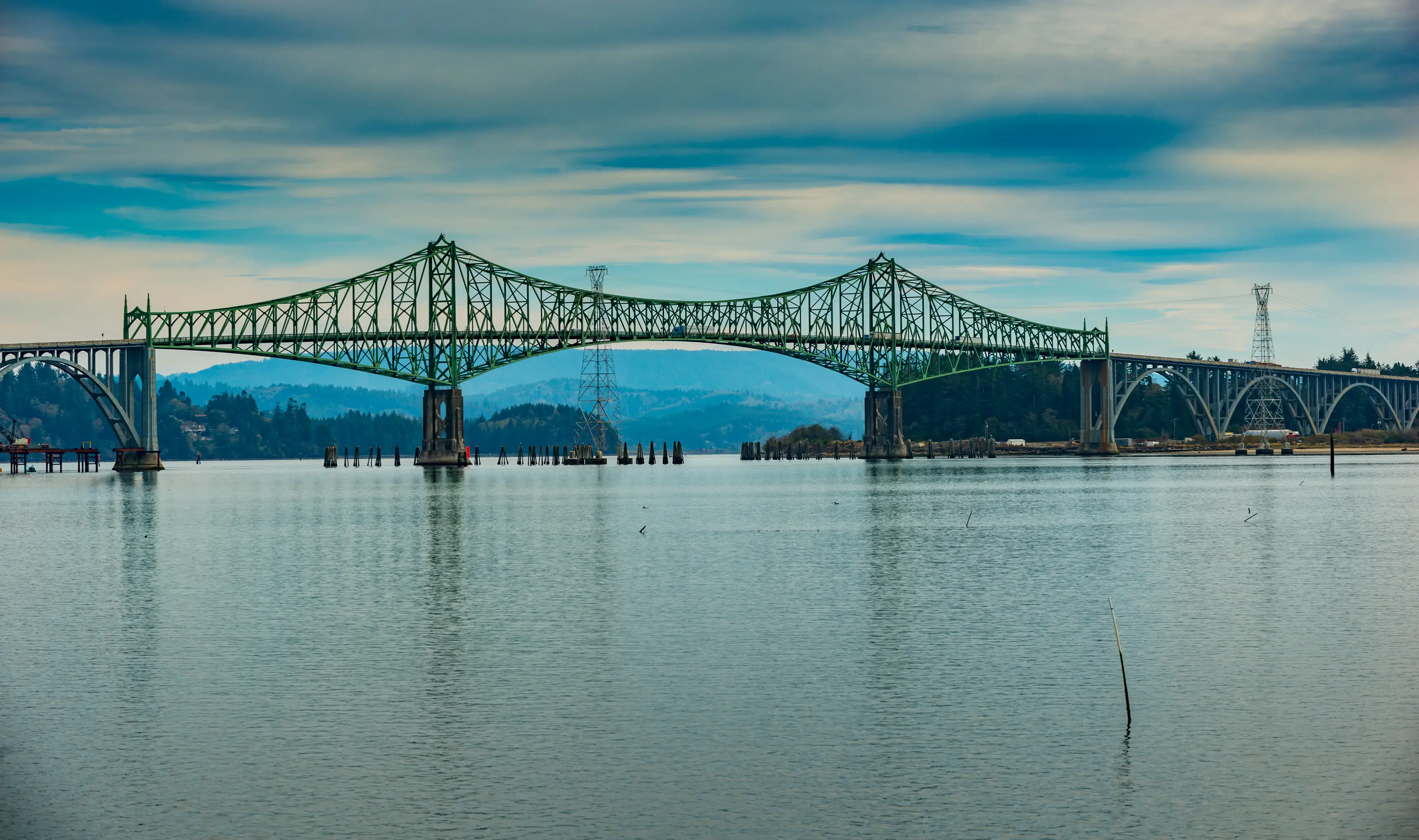
You've done the spreadsheet. North Bend checks boxes that California stopped checking years ago — home prices a fraction of what you left behind, no traffic, and a coastline most people only see on a long weekend. But the Oregon coast has a personality of its own, and a city of 10,049 on the edge of the continent operates on rhythms that take some adjusting to. The Conde B. McCullough Memorial Bridge arcing over Coos Bay is the first thing most people photograph when they arrive. The fog that rolls in off the Pacific for stretches in spring and summer is the thing nobody told them about.
North Bend sits on the southern Oregon coast in Coos County, connected to its sister city Coos Bay and served by US-101 running the length of the coast. Southwest Oregon Regional Airport is roughly a mile from downtown, one of the rare coastal towns where you do not need a long drive to catch a flight. The economic backbone spans government, education, logistics through the Oregon International Port of Coos Bay, and the North Bend School District 13. The city's identity has shifted over decades from one of the largest lumber ports on the west coast into a base for outdoor recreation, with Coos Bay now hosting regional healthcare and commercial anchors that North Bend residents rely on daily.
The headline number for Californians is the typical home value: $362,945 as of July 2026. That figure sits well below California's statewide typical home value of $773,735 (Zillow Home Value Index), and it represents real, detached homes — not condos marketed as starter units. Two-bedroom rents run $1,410–$1,720 per month. Oregon's zero sales tax erases one of the line items that quietly drains California household budgets every month. The trade-off on income tax is real and worth reading carefully before you move — this guide walks through it in full. Health insurance premiums run noticeably below California levels, though you will drive farther for specialist care, which is the honest reality of a small coastal city.
Whether you are escaping Bay Area prices, retiring early on coast equity, or simply drawn to dunes and fishing over freeways, the sections below break down North Bend's home price picture, taxes, lifestyle, schools, and the specific surprises that catch California transplants off guard.
The Home Price Reality: What Your California Equity Buys Here
The single most disorienting thing California buyers experience in North Bend is how far a dollar goes. A budget that bought a two-bedroom condo in a decent Sacramento suburb buys a three-bedroom house with a yard and a garage on the Oregon coast — and in some cases, something with water views.
North Bend's typical home value stands at $362,945 as of July 2026. Set that beside California's statewide typical home value of $773,735 (Zillow Home Value Index) and the gap is not a rounding error — it is the difference between stretching and choosing. For a California seller arriving with substantial equity, that spread means purchasing outright or carrying a modest mortgage for the first time in years.
Glasgow and Airport Heights offer older single-family construction that gives buyers multiple options at the city's more accessible price points. Hillcrest and Mariner Heights carry more established housing stock with bay-adjacent geography. For a deeper look at how those neighborhoods compare in character and housing stock, the best neighborhoods page covers each in detail.
What the Numbers Mean in Practice
A California buyer selling at or near California's statewide typical home value and purchasing in North Bend at the city's typical home value has the potential to eliminate a mortgage entirely or invest the remainder. That calculation has driven a meaningful share of the relocations here in recent years — retirees, remote workers, and anyone who no longer needs to be within commuting distance of a California metro.
The affordability picture has a realistic caveat. North Bend's median household income of $83,484 sits below the income needed to buy the typical home here — by roughly $14,000. That gap matters most to buyers who are purchasing on local wages alone rather than arriving with California equity. If you are in the latter group, you are in a fundamentally different position than the average local buyer, and the market will feel accordingly manageable.
Nearby, Coos Bay runs somewhat lower than North Bend's typical home value, while Charleston runs somewhat higher, and Coquille comes in somewhat lower — useful context if the first search results pull you toward a neighboring community.
What Californians Tend to Underestimate
The pace here is not California's pace. Well-priced homes in North Bend do not sit indefinitely, but neither does this market move with the frenzy of a California coastal city. You have room to do your due diligence — inspection, review, negotiation — without waiving contingencies to stay competitive. That alone is a material quality-of-life improvement for buyers who have lost offers before.
Taxes: The Full Picture, Not Just the Headline
Oregon's zero sales tax is the first thing California transplants celebrate. It deserves the attention — but the income tax story is more complicated, and the people who move here without reading it carefully tend to feel the surprise acutely in April.
Sales Tax: A Real, Permanent Win
California's statewide base sales tax rate of 7.25% — the highest in the country before local additions — means that California residents are paying tax on groceries, clothing, electronics, furniture, and most consumer goods every day. Oregon has none. No state sales tax, no local sales tax, no exceptions at the register. For a household spending meaningfully on taxable goods each year, this is a genuine and recurring advantage that compounds over time.
Income Tax: Read This Before You Celebrate
Oregon's top income tax rate is 9.9%, which sounds dramatically better than California's top state income tax rate of 13.3% (Tax Foundation). The catch is that Oregon's brackets are steep and compress quickly — Oregon is collecting near its maximum rate from anyone earning six figures, while California reserves its highest rates for earners well into the millions. California's top state income tax rate of 13.3% applies only to the highest earners, meaning most California middle-income filers are paying rates meaningfully below that ceiling.
At $100,000 of income, Oregon's tax burden runs noticeably above California's. That is the number that surprises people. The no-sales-tax advantage can offset this for households with significant consumer spending, but the offset is not automatic and depends on your specific spending patterns.
There is one meaningful relief valve specific to Oregon: the state allows residents to subtract a portion of their federal income taxes paid from Oregon taxable income. This deduction benefits moderate-income earners the most; for joint filers with federal adjusted gross income of $290,000 or more, the subtraction phases out entirely. If you fall in the middle-income range, this is worth understanding before you assume your Oregon tax bill will be higher than your California one.
Property Tax: The Proposition 13 Reset
California's effective property tax rate of 0.71% — held artificially low by Proposition 13 for long-term homeowners — resets to full market value the moment a home sells. New California buyers in today's market are frequently paying an effective rate of 1.2% to 1.5% once local bonds and assessments layer on. North Bend's effective property tax rate is 0.71%. For a California buyer who has already lost their Proposition 13 basis — or who never had one — moving to North Bend is essentially a wash or a modest improvement, not the shock of suddenly paying Oregon rates on a California-priced home.
For the full breakdown of Oregon vs. California tax figures including income brackets, the cost of living page covers the detail.
The Year-of-the-Move Tax Complication
The year you actually move is the messy one. As a partial-year resident of both states, you will file returns in both, navigate different deadlines, and need to avoid double taxation on income earned before and after the move. This situation genuinely benefits from a CPA who specializes in state-to-state relocations — not a general tax preparer, and not software alone.

What Daily Life in North Bend Actually Looks Like
North Bend is a working coastal town, not a resort. That distinction matters for Californians who have spent weekends in Cannon Beach or Carmel and are projecting that experience onto a permanent move. The energy here is lower-key, the population is 10,049, and most errands require a short drive rather than a walkable block.
The Weather Californians Don't Expect
North Bend sees 186 sunny days a year. That figure is the reality check. The Oregon coast is not seasonally sunny in the way that California coastal cities are, and the marine fog layer that sits over the bay in spring and early summer — locals call it "June-uary" — catches transplants genuinely off guard. By contrast, the summers that do arrive are spectacular: mild temperatures, open dunes, and the kind of afternoon light that makes the bay look like a painting.
If you are moving from a part of California where 270+ sunny days is standard, recalibrating your weather expectations before you commit is important. Seasonal affective disorder is a real consideration on the southern Oregon coast, and long-term residents who moved from sunnier climates will tell you it took a full year to adjust.
Getting Around
US-101 is the main artery — it runs along the coast and carries most of the traffic in and out of the area. OR-540, the Cape Arago Highway, connects North Bend to Charleston to the west. Most residents drive; the city is not built for transit dependence. Southwest Oregon Regional Airport sits roughly a mile from downtown, which is genuinely unusual for a city this size and a practical advantage for anyone who travels frequently for work or family.
Where People Spend Their Time
The Oregon Dunes National Recreation Area — the largest expanse of coastal sand dunes in North America, stretching 40 miles along the coast — defines a large part of outdoor life here. Horsfall Beach draws residents for long walks, fishing, and beachcombing. The North Bend Boardwalk along the bay is a low-key spot for an evening walk. Simpson Park is where families with school-age children tend to gather on weekends.
The UTV Takeover event draws crowds from across the region to the dunes each year, and for a city of North Bend's size, it is a significant annual moment — one that new residents either love or learn to plan around.
A serious shopping trip means driving out of the immediate area; you will be ordering online for anything the local shops and Pony Village Mall do not carry. That is not unique to North Bend on the Oregon coast, but it is the honest reality if you are accustomed to major retail within a few miles.
Looking to buy in North Bend? Estimate your payment.
Enter your numbers to see an estimated monthly mortgage payment.
Estimate only. Excludes HOA fees and mortgage insurance. The interest rate above is a starting point, not a quoted rate — replace it with your own to see real numbers. Insurance is a flat placeholder, not a North Bend quote.
Schools, Community, and the Weekends & Local Favorites
Schools
North Bend School District 13 holds a B rating, according to Niche, and 2,698 students enrolled in 2025-26. On 2024-25 state assessments, 36.3% of students reached math proficiency and 45.9% reached reading proficiency — figures that sit below Oregon state averages and worth understanding clearly if academics are a primary factor in your move. The district supports active OSAA athletics programs, and the Bulldogs mascot draws a community following that makes Friday night football a genuine local gathering.
For families with school-age children who are accustomed to highly-rated California suburban districts, setting expectations carefully before the move tends to prevent the most common post-arrival disappointment. A fuller look at the district's individual schools and programs lives on the schools page.
Weekends and Local Favorites
The food and coffee scene in North Bend is small but specific. Vinny's Smokin' Good Burgers & Sandwiches has a loyal following for a reason — the menu is straightforward and the portions are not California-sized in the polite direction. Captain's Choice Fish House is the answer to the question every visitor asks about where to get fresh seafood. An eclectic burger and sandwich spot that locals swear by rounds out the casual dining picture with the kind of personality that takes a few visits to fully appreciate. La Herradura rounds out a Mexican food option that locals return to regularly. Hilltop House Restaurant & Lounge carries more of a sit-down dinner energy and is where people go for a proper evening out without driving to Coos Bay.
On the coffee side, Black Anchor Coffee House and Coast Cruiser Coffee are the everyday stops. Ezekiel's Tin Rooster Bakery Coffee Shop Bookstore & Roastery is the kind of place that earns a long name because it genuinely does all of those things. 350 Degrees Corporation and Coastal Coffee round out a scene that, while modest by California standards, covers the bases without requiring a chain.
McCullough Bridge waterfront trail and the North Spit offer the most accessible outdoor escapes right within the city's reach. The Oregon Dunes and Horsfall Beach are the longer days — and the ones that make residents glad they moved here.
What California Transplants Should Know Before They Commit
Six months in, the most common observation from California transplants is not about the weather or the taxes — it is about pace and access. North Bend is genuinely quieter than any California city most people are leaving, and that quietness is the whole point. But the things you did not notice you were using — a specialist clinic nearby, a major airport hub, a full-service grocery, a range of evening dining — become visible quickly.
The Honest Trade-Offs
Remote workers and retirees arriving with California equity tend to settle in most comfortably, because the cost structure rewards income that does not depend on the local job market. People who move here expecting to replicate a California career trajectory often find the local employment base — city government, the school district, and regional logistics — is narrow. Many residents commute to Coos Bay for work or have deliberately structured remote roles. If your livelihood requires you to be in this city specifically, that is a conversation worth having before you close.
Why people move out is also worth saying plainly: professional isolation, the weather's effect on mood over multiple winters, and the distance from extended family. None of these are hypothetical — they are the reasons residents who gave North Bend a genuine attempt ultimately left. They are also not universal, and plenty of transplants are now long-term locals who would not trade the dunes and the bay for anything California offered them.
What You Should Not Skip
Do not buy without spending a full winter here first, if you can manage it. A week in August does not tell you what February looks and feels like. The fog, the rain, and the condensed daylight of a coastal Oregon winter are a meaningful part of what you are agreeing to, and the people who move here having experienced that season — and still wanted to stay — tend to be the ones who actually stay.
For the safety picture, North Bend carries a violent crime rate of 1.7 per 1,000 residents and a property crime rate of 32 per 1,000 residents. The violent crime rate sits below both the Oregon state rate and the national figure; property crime runs above both, which is worth factoring in when evaluating specific neighborhoods. The safety page has the full breakdown by area.
The parks and outdoor recreation available here — the dunes, Horsfall Beach, Simpson Park, the boardwalk, the North Spit — are the kind of amenity that California charges a premium for proximity to and North Bend simply offers as part of daily life. For anyone who genuinely uses those things, it is one of the strongest arguments for the move. The full outdoor picture is on the parks and recreation page.

Local Expert Takeaway: North Bend is the best financial case for a California coastal transplant who has already decided they can live without a major metro. The home price gap is real, Oregon's zero sales tax stays real every day, and the property tax picture at 0.71% is not the shock Californians expect. What catches people off guard is income tax — Oregon collects more than California does from middle-income earners, and the no-sales-tax offset only partially compensates depending on your spending. The life you are buying is one of dunes, fishing, quiet bays, and a pace that rewards people who wanted to stop accelerating. If you have been to Horsfall Beach on a clear morning and still wanted to move here, trust that feeling. If you have only seen the August version, spend a February weekend first.
Quick Takeaways & FAQs
✅ North Bend's typical home value of $362,945 (July 2026) sits well below California's statewide typical home value, giving California equity buyers significant financial runway on arrival.
⚠️ Oregon's income tax brackets compress quickly — middle-income earners often pay more state income tax than they did in California, and the savings on sales tax only partially offset this depending on household spending.
📍 The Oregon Dunes National Recreation Area — the largest coastal dune system in North America — begins just north of the city, making world-class outdoor recreation a genuinely ordinary part of life here rather than a destination trip.
Is North Bend, Oregon cheaper than living in California?
How does Oregon's income tax compare to California's for someone earning $100,000?
What is the property tax rate in North Bend, Oregon?
What surprises California transplants most about living in North Bend?
Is North Bend a good fit for California remote workers?
Moving to Oregon?
Tell us what you need help with and we'll connect you with local resources.
