
What Is Living in Newport, Oregon Like?
Most people who move to Newport expect a quiet coastal town and spend their first few months genuinely surprised by how much is actually here. Newport is the county seat of Lincoln County and the largest city on Oregon's central coast — a real, full-service community of 10,833 residents, not a resort town that empties after Labor Day. US-101 runs the length of it, and US-20, the Corvallis-Newport Highway, connects it inland to the Willamette Valley. What drives daily life here is the collision of three worlds that rarely share a zip code: a working commercial fishing port, a nationally significant marine science research cluster, and a tourism economy built around one of the most recognized landmarks on the West Coast.
The economic backbone is more layered than the beach town reputation suggests. A major regional health system is one of the largest employers. The Lincoln County School District runs the local schools. NOAA's Marine Operations Center — the agency's only ocean-port research facility on the West Coast — anchors a research corridor alongside OSU's Hatfield Marine Science Center and the Oregon Department of Fish and Wildlife. Oregon Coast Community College's 2025-26 capital bond, approved by Lincoln County voters with 64.6% in favor, funded the Oregon Coast Advanced Technology and Trades Center on its Newport campus; the project was under construction as of late 2025, with certificates and degrees planned in maritime technology, welding, construction, and HVAC. People move here for research positions, for fishing-industry jobs, for government work — and increasingly, for remote work with an ocean view.
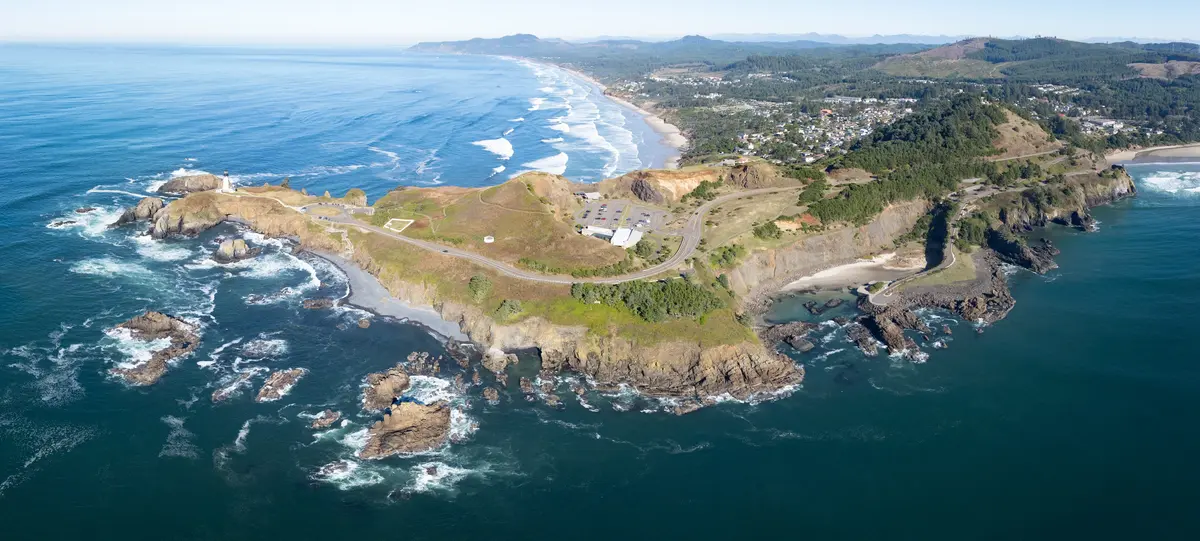
The typical home price in Newport stands at $454,809 (Zillow Home Value Index, July 2026), which runs noticeably below coastal markets in California and well below Oregon's metro areas. That figure matters because the median household income here is also below what's needed to carry that price comfortably — the cost-of-living page breaks that gap down in full. Day-to-day life without a state sales tax softens the edges a bit. The outdoors are immediate and free: Yaquina Head Outstanding Natural Area, Agate Beach, Nye Beach, and South Beach State Park are all within city limits or just beyond them. Most errands are drivable within Newport itself, though anything specialized — a major shopping run, a specialist appointment — means committing to the drive inland.
Whether you're weighing a move or just researching seriously, the sections below cover Newport's neighborhoods, housing market, daily life, commute realities, and where locals actually spend their time.
Newport at a Glance
Looking to buy in Newport? Estimate your payment.
Enter your numbers to see an estimated monthly mortgage payment.
Estimate only. Excludes HOA fees and mortgage insurance. The interest rate above is a starting point, not a quoted rate — replace it with your own to see real numbers. Insurance is a flat placeholder, not a Newport quote.
Why Are People Moving to Newport?
The people who move to Newport on purpose — as opposed to those who end up here by chance — usually fit one of a few clear profiles. Research scientists and federal agency staff come for NOAA and Hatfield. Healthcare workers come for the regional hospital. Fishing-industry workers and processors have been here for generations. And a newer wave of remote workers has discovered that Newport's internet infrastructure is serviceable and the trade-off — trading a commute for an ocean walk — is hard to argue with.
The marine science identity is real and worth understanding. NOAA's Newport Research Station is the agency's only ocean-port research facility on the West Coast, and it sits alongside the OSU Ship Operations Homeport. The Hatfield Marine Science Center has been a collaborative research hub since 1965, serving six state and federal agencies. In fall 2025, Hatfield opened a new on-site housing complex with 72 studio apartments and five two-bedroom units — built explicitly in response to Newport's housing shortage — which tells you something about both the demand for research positions here and the housing pressure that comes with it.
The fishing economy runs deeper than most newcomers expect. Newport operates one of Oregon's busiest commercial fishing ports, with crab, salmon, albacore, and shrimp fleets working out of Yaquina Bay year-round. Seafood processing is a real employment sector. The Historic Bayfront — sea lions at the docks, charter boats, working fishing vessels alongside tourist activity — is one of the few remaining authentic working waterfronts on the West Coast, and it functions as a genuine community hub, not just a set piece.
The Lincoln County School District, with 4,660 students enrolled in 2025-26, holds a C+ rating, according to Niche. Families with school-age children typically weigh that honestly against the lifestyle gains. The district fields competitive high school athletics programs that draw consistent community turnout on Friday nights. The district's performance picture is worth reading in full before making a decision.
Who Newport Actually Suits
| Buyer Type | Why Newport Works | The Catch |
|---|---|---|
| Nature Views Outdoor-first buyers | Immediate access to beaches, tidepools, coastal trails, and Yaquina Head Outstanding Natural Area | 156 sunny days a year — the rest is overcast, foggy, or rainy |
| Tech Remote workers | Real town infrastructure, no commute needed, ocean lifestyle | Spotty connectivity in some neighborhoods; no urban amenities nearby |
| Commuter Willamette Valley workers | Lower coastal prices, genuine community feel | about 60 minutes to Corvallis one-way, every day |
| Families Research/government employees | Stable federal and institutional employment base | School district ratings lag state averages; limited youth programming options |
| Value California refugees | Prices noticeably below California coastal markets | Income gap between local wages and local home prices is real |
| Quiet Retirees and downsizers | Walkable cores in Bayfront and Nye Beach, strong sense of place | No 55+ communities found in Newport; specialized healthcare means driving inland |
Newport draws people who want the coast to be a lifestyle, not a weekend visit — and who are prepared for the trade-offs that come with that.
What Daily Life Feels Like in Newport
The first thing longtime residents tell newcomers: learn which part of Newport you actually live in. The Bayfront and Nye Beach are genuinely walkable — connected by a beachside path, dense with independent coffee shops, galleries, and seafood restaurants, with the Newport Performing Arts Center anchoring the cultural calendar. South Beach, across Yaquina Bay, feels like a different city: residential, spread-out, newer construction, and very car-dependent. Newport Heights sits further inland and quieter still. Where you land shapes everything about your daily routine.
Summers transform the city. US-101 through the tourist core backs up reliably from late June through early September, and parking near the Bayfront can test your patience. Year-round residents learn to run their Bayfront errands before 10 a.m. or after dinner, and they learn to love the shoulder seasons — May and October are when Newport is genuinely theirs again. The winter quiet is real: restaurants that were standing-room-only in August have open tables, and the beaches are wide and empty.
The Weather Reality
Newport averages 156 sunny days a year. That number surprises almost everyone who moves here from a sunnier state — it sits well below what the Oregon Coast is often marketed as. The trade-off is mild temperatures year-round; the coast rarely freezes and rarely bakes. But the marine layer is persistent, the fog comes in fast, and a gray December week can feel long if you are not wired for it.
Daily Errands and Services
For a city of 10,833, Newport punches above its weight on daily services. Grocery stores, a regional hospital inside city limits, a community college, and a reasonable range of retail are all accessible without leaving town. The gap shows up for specialized needs: a serious shopping trip, a specialist medical appointment, or anything that requires a big-box store means committing to a drive. Oregon's lack of a state sales tax makes those trips marginally more bearable.
After six months here, most newcomers say the same thing about the fog: they stopped minding it. The Yaquina Bay Bridge framed in morning mist becomes its own kind of reward. What takes longer to adjust to is the distance — the psychological reality that the Willamette Valley is always about an hour away, and that distance is the price of the view.
The Newport Housing Market Right Now
The typical home price in Newport sits at $454,809 (Zillow Home Value Index, July 2026). For an Oregon coastal city with this much institutional employment and this level of tourism infrastructure, that figure is more accessible than many buyers expect — though the median household income here runs below what's needed to carry that price without a significant down payment or a dual income. The cost-of-living page has the full income-to-price breakdown.
The rental market reflects the same pressure. Typical two-bedroom rents run $1,910–$2,330 per month, with a city-wide typical rent of $2,078 per month (Zillow, July 2026). The housing crunch is real enough that OSU's Hatfield Marine Science Center built 77 on-site units in fall 2025 specifically to house research staff — an unusual step for an academic institution and a signal of how tight the market has been for working professionals.
What the Market Looks Like by Area
South Beach runs above the city-wide median — newer construction, larger lots, and proximity to the aquarium and Hatfield pull prices up. The older bungalow stock in Nye Beach and the Bayfront area tends to be smaller and more variable in condition, which creates entry opportunities but also means inspection due diligence matters more. The neighborhoods page has the full character breakdown by area.
Well-priced homes in the walkable cores move without much hesitation. Properties further from the water or in need of meaningful work tend to sit longer, giving buyers more negotiating room. The market rewards buyers who know the difference between a neighborhood's livability and its price tier — and those two things do not always align the way outsiders expect.
Newport's effective property tax rate runs approximately 0.78%, which is low by Oregon coastal standards and meaningfully lower than comparable California coastal markets.
Newport Neighborhoods
Newport has several distinct areas — each with its own character and appeal. Here’s a breakdown to help you narrow down where to focus your home search.
🏡 Nye Beach
Nye Beach is Newport's most character-rich neighborhood — a historic district of beach cottages, independent cafés, and galleries within easy walking distance of the sand and the Newport Visual Arts Center. It draws buyers who want a genuine walkable neighborhood over square footage, and the housing stock reflects that trade-off.
🏠 Agate Beach
Agate Beach sits at Newport's northern edge, anchored by miles of broad, flat sand that draws kite flyers, surfers, and beachcombers hunting polished stones. The neighborhood mixes year-round residents with vacation properties and suits buyers who want beach access without the density of the Bayfront or Nye Beach cores.
🌳 South Beach
South Beach occupies the south side of Yaquina Bay, offering newer subdivisions, spacious lots, and proximity to the Oregon Coast Aquarium and Hatfield Marine Science Center — making it the logical choice for research and institutional employees. It runs above the city-wide typical home price and trades walkability for space.
🏘 Newport Heights
Newport Heights is a quieter, more inland residential area that draws buyers who want lower density and more breathing room than the waterfront neighborhoods provide. It functions as a practical, car-dependent part of Newport with a predominantly local, year-round feel.
🏔 Bayfront
The Historic Bayfront is Newport's most distinctive neighborhood — working fishing fleets, sea lions at the docks, charter boats, and a street-level energy that blends tourist activity with genuine commerce. It suits buyers who want to be in the middle of Newport's identity rather than adjacent to it.
🌆 Southshore
Southshore occupies the quieter residential stretches along the southern bay, offering proximity to the water without the foot traffic of the Bayfront proper. It appeals to buyers looking for a lower-key coastal setting with easy access to both South Beach amenities and the city core.
Pros & Cons of Living in Newport
The Pros
- Genuine four-season coastal economy anchored by fishing, tourism, healthcare and marine science, not just a summer-vacation town
- Dramatic scenery with beaches, headlands and the working bayfront all inside city limits
- Below-average cost of living for a coastal market
- Strong sense of community with an active arts and culinary scene
The Cons
- Higher-than-average property crime rate and a below-state-average median household income
- Persistent coastal fog, wind and rain limit sunny days and summer warmth
- Limited local job market outside healthcare, tourism, fishing and government work
Getting Around & Commuting in Newport
Newport's two main arteries are US-101, which runs north-south through the entire city, and US-20, the Corvallis-Newport Highway, which is the primary inland connection. These two routes are the commuting reality for virtually every Newport resident — there are no alternatives, and understanding how they behave is essential before choosing where to live or work.
The Corvallis Commute
The drive to the Willamette Valley anchor city is about 60 minutes to Corvallis under normal conditions. US-20 climbs through the Coast Range, which means winter driving requires genuine attention — snow or ice on the pass can slow or close the route. This is not a commute that tolerates complacency in December or January. Residents who make it daily build their schedules around it and treat it as a given; buyers who assume it will feel manageable and then discover it does not are among the most common source of Newport departures.
Within Newport
Most errands in Newport require a car. The walkable exceptions — the Bayfront core and the Nye Beach district — are genuinely pleasant on foot once you are in them, connected by a beachside path that locals use daily. Everything else: South Beach, Newport Heights, the commercial strips along US-101 — is a drive. Daily life outside the two walkable cores is suburban in pace and car-dependent in practice.
For most residents, daily life here means driving. Buyers who currently rely on frequent transit service should plan for a car-first lifestyle from day one.
Remote Work and the Commute Math
A significant share of Newport residents work remotely, which is part of why the city has drawn buyers priced out of Willamette Valley markets. For remote workers, the commute question becomes about occasional rather than daily trips — and the calculus changes entirely. The occasional 60-minute drive to Corvallis for a meeting or a shopping run is a different proposition than doing it every morning. For hybrid workers who go in two or three days a week, Newport sits at the edge of what most people find sustainable; beyond that, it becomes a genuine lifestyle commitment rather than a convenience.
| Destination | Route | Typical Drive Time | Notes |
|---|---|---|---|
| Corvallis | US-20 East | about 60 minutes to Corvallis | Coast Range pass; monitor in winter |
| Lincoln City | US-101 North | ~35–40 minutes | Scenic but slow through resort areas |
| Waldport / Seal Rock | US-101 South | ~15–20 minutes | Quick coastal commute south |
| Toledo | US-20 East | ~10 minutes | Closest inland town; some residents work there |
| Eugene Airport (EUG) | US-20 to I-5 | ~80 miles | Nearest major airport; plan ~90 min to be safe |
| Salem | US-20 to OR-99W or I-5 | ~90 minutes | For specialized services not available in Newport |
The nearest major airport is Eugene Airport (EUG), approximately 80 miles inland — a manageable trip for occasional travel, but plan for the Coast Range portion of the drive regardless of season.
Schools in Newport
Families relocating to Newport have public, private, and higher-education options nearby. Here’s a quick overview.
🎓 School District
Lincoln County School District serves K–12 students across Newport and the surrounding area. Rated C+ (source: Niche.com).
🏆 Graduation Rate
The 4-year high-school graduation rate here is approximately 88.1%.
📚 Higher Education
Oregon’s public universities — the University of Oregon, Oregon State University, and Portland State University — offer four-year degrees statewide, with a network of 17 community colleges providing two-year and workforce programs.
🌐 Online Learning
Oregon State University Ecampus and Portland State University Online offer fully accredited online degrees for remote learners across the state.
Safety in Newport
A quick look at how Newport compares on the numbers that matter most when weighing a neighborhood or a move.
🛡 Violent Crime
Approximately 2 per 1,000 residents.
🔒 Property Crime
Approximately 26.3 per 1,000 residents.
Compared to the most recent national figures from the Bureau of Justice Statistics (2024), Newport’s violent crime is below the national average (about 3.7 per 1,000), and property crime is above the national average (about 18.4 per 1,000).
Against Oregon as a whole, Newport’s violent crime is roughly two-thirds of the state average, and property crime is about the same as the state average (Bureau of Justice Statistics, Crime Known to Law Enforcement, 2024 (tables 2 and 3)).
Crime rates can vary a lot within a single city, so the citywide numbers above are only a starting point. Some neighborhoods in Newport run well below these averages, while others run higher — the kind of block-by-block detail that matters most when you’re actually choosing where to live. The full guide below breaks it down neighborhood by neighborhood.
Working in Newport
Newport’s largest employers span several industries — here are some of the anchors of the local job market.
🏥 Samaritan Pacific Communities Hospital
Healthcare
🎓 Lincoln County School District
Education
🏛 Oregon Department of Fish and Wildlife
Government
🏛 City of Newport
Municipal government
🏛 NOAA Marine Operations Center
Government

Retiring in Newport
Newport draws retirees for its balance of amenities, outdoor access, and cost. Here’s what to weigh.
🌤 Climate
Newport's coastal climate stays mild year-round — rarely freezing in winter, rarely hot in summer. The trade-off is persistent overcast: the city averages 156 sunny days a year, with fog and marine layer common through spring and early summer. Retirees who find gray skies energizing rather than draining tend to love it; those who need sunshine for their well-being should visit in February before committing.
🍴 Lifestyle
Daily life in retirement here can be as active or as quiet as you want. Walking Agate Beach, attending a performance at the Newport Performing Arts Center, or settling into the independent café and restaurant scene in Nye Beach — the rhythm is coastal and unhurried. Summer brings crowds and energy; the rest of the year belongs to the locals.
🏚 55+ Communities
No 55+ communities were found in Newport. Retirees typically buy single-family homes in the Bayfront area, Nye Beach, or South Beach, depending on how much walkability they want. The housing stock ranges from historic bungalows to newer South Beach construction, and the price point is more accessible than most Oregon coastal markets.
✈ Getting Around
Most of Newport requires a car, though the Bayfront and Nye Beach cores are manageable on foot for daily errands. A regional hospital sits within city limits, which matters for day-to-day healthcare access. Specialized care or major medical appointments typically mean driving inland. The nearest major airport is Eugene Airport (EUG), approximately 80 miles away.
🏛 Oregon Taxes for Retirees — What to Know
- Social Security is not taxed — Oregon does not tax Social Security or Railroad Retirement benefits. Any amount included in your federal adjusted gross income is subtracted back out on the Oregon return.
- But other retirement income IS taxed — This is the trade-off that surprises people moving from Washington or Texas. Pension distributions and 401(k)/IRA withdrawals are taxed as ordinary income at Oregon’s regular rates — there is no blanket retirement-income exclusion.
- Graduated income tax — Oregon has four brackets — 4.75%, 6.75%, 8.75% and 9.9%. The 4.75% rate covers the first $10,000 of taxable income for a single filer ($20,000 filing jointly); the 8.75% rate starts at $125,000 ($250,000 jointly); and the top 9.9% rate applies above $250,000 ($500,000 jointly).
- No sales tax — Oregon levies no general sales tax.
- Property taxes, with senior deferral — Oregon’s Senior and Disabled Property Tax Deferral lets qualifying homeowners have the state pay their county property taxes, with a lien recorded against the home. The 2026 household income limit is $70,000, and deferred balances accrue 6% simple interest — it defers the bill rather than forgiving it.
- Estate tax — the one to plan for — Oregon has its own estate tax with a $1 million filing threshold — far below the federal exemption, and NOT indexed for inflation, so it reaches more estates every year in real terms. Retirement accounts and a long-held home count toward the taxable estate, so estates that feel modest can cross the line without the owner expecting it.
- No inheritance tax — Oregon has no separate inheritance tax and no gift tax.
Tax laws change frequently and individual situations vary. This is general information, not tax advice — always consult a qualified Oregon tax professional or CPA for personalized retirement tax planning.
Weekends & Local Favorites in Newport
Newport's weekend life is defined by the two walkable cores and the outdoor areas that bookend them. On a clear Saturday, the Yaquina Head Outstanding Natural Area draws residents as reliably as it draws visitors — the lighthouse trail and the whale-watching vantage points are the kind of amenity that locals stop appreciating and then rediscover when a friend visits. Agate Beach stretches broad and flat to the north, drawing kite flyers, rock hounds, and surfers who treat the cold water as a feature rather than a deterrent. Nye Beach and South Beach State Park round out the immediate options, each with a distinct character.
Where Locals Eat and Drink
The Bayfront and Nye Beach restaurant scenes are both small and genuinely good. Local Ocean Seafoods is the standard-bearer for local catch done right — crab, halibut, and albacore sourced directly from vessels that tie up minutes away. Mo's Seafood & Chowder is an Oregon coast institution that has been feeding locals and visitors for decades; the clam chowder is the reference point everyone else is measured against. Chowder Bowl and Georgie's Beachside Grill each bring their own take on coastal seafood, and Newport Cafe handles the everyday diner category with unpretentious consistency.
For coffee, Newport has developed a real independent scene. Coasties Roasties roasts its own beans and has become a genuine gathering spot. Camp One Coffee & Donuts hits the morning sweet spot hard. Nye Beach Cafe and Cafe Stephanie both anchor the Nye Beach walkable corridor — part of why that neighborhood draws the buyers it does. Ultralife Cafe rounds out the options with a health-forward menu that finds its audience quickly in a town full of scientists and outdoor athletes.
Markets and Community Rhythm
The Newport Farmers Market runs through the warm months and functions as the community's weekly gathering point — local produce, fish, and crafts with the social density you'd expect from a city where everyone eventually knows everyone. The Newport Performing Arts Center keeps a surprisingly robust cultural calendar for a city this size, with regional and touring performances that draw audiences from as far as Corvallis.
The Seasonal Shift
Newport's recreational calendar has a built-in inversion that year-round residents come to treasure. The beaches, trails, and restaurant tables that require patience and planning in July are wide open by November. Whale-watching peaks in December and March — gray whales pass close to Yaquina Head on both migrations, and a morning at the lighthouse in winter can feel like a private audience. Newcomers who arrive in summer and assume the crowds are permanent tend to discover the off-season version of Newport by accident and consider it the better one.
Local favorites in Newport
Restaurants
- Georgie's Beachside Grill
- Local Ocean Seafoods
- Newport Cafe
- Mo's Seafood & Chowder
- Chowder Bowl
Outdoors
- Yaquina Head Outstanding Natural Area
- Agate Beach
- Nye Beach
- South Beach State Park
- Yaquina Bay State Park
Coffee
- Nye Beach Cafe
- Cafe Stephanie
- Ultralife Cafe
- Coasties Roasties
- Camp One Coffee & Donuts
Farmers Markets
- Newport Farmers Market
Top Things Locals Say About Newport
The best intel about a city comes from the people who actually live there. Here’s what Newport residents say when newcomers ask the questions everyone’s thinking.
“I knew the commute to Corvallis would be long, but I told myself I'd only be doing it a couple days a week. What I didn't account for was the Coast Range in January — that changes the calculation completely. I moved my schedule around it and honestly I'd still make the same choice, but I wish someone had been direct with me about the winter pass conditions before I signed.”
— Recent Newport home buyer
“What's the most surprising thing about living in Newport?”
How much of a real town it is. People expect a sleepy beach village and show up to find a county seat with a hospital, a community college, federal research agencies, and a working port. The Historic Bayfront isn't staged for tourists — those are actual fishing boats, actual sea lions, and actual people who work there. It takes about a month to stop seeing it as a backdrop and start seeing it as infrastructure.
“What do locals love most about Newport?”
The shoulder seasons. May and October are when Newport belongs to the people who live here — the Bayfront has room, Agate Beach is empty, and you can get a table at Local Ocean without a wait. The Yaquina Head lighthouse on a clear fall morning, whale migration coming through in December — those are the things that keep people here long after the obvious appeal wears off.
“What should newcomers to Newport know?”
Pick your neighborhood deliberately. The Bayfront and Nye Beach cores are genuinely walkable and have a completely different daily feel from South Beach or Newport Heights. Also: learn to read the marine layer. The fog that rolls in off Yaquina Bay in the morning usually lifts by midday — newcomers who leave the house at 8 a.m., see gray, and assume the day is lost are missing the best part of it.
“How much do you need a car in Newport?”
Almost entirely. The Bayfront-to-Nye Beach corridor is walkable and people do use it daily, but for groceries, errands, anything south of the bridge, or any trip inland, you need a car. Most of Newport's residential areas — South Beach, Newport Heights, Southshore — are designed around driving. For routine daily life outside those two walkable cores, a car is not optional.
Cities Near Newport
Other communities near Newport worth a look — each with its own character and price point.
| City | Distance | Best For | Vibe | Median Rent | Median Buy |
|---|---|---|---|---|---|
| Toledo | 8 mi | Budget buyers, inland preference | Small, quiet, working-class | $1,300 | $320,000 |
| South Beach | 3 mi | Families, newer construction | Residential, spread-out, quieter | $1,600 | $420,000 |
| Depoe Bay | 10 mi | Dramatic scenery, premium coastal living | Compact, scenic, higher-priced | $1,700 | $550,000 |
More Helpful Guides for Newport
Going deeper on Newport? Our blog series covers everything from first-time buying to retiring here — explore the guides below.
Local Expert Takeaway: Newport is a real working city that happens to sit on the Oregon coast — not a resort that happens to have residents. The marine science corridor, the fishing port, the regional hospital, and the community college give it an institutional stability most coastal towns its size lack. The honest caveat: the drive inland is always there, the school district is middling, and 156 sunny days a year is the reality, not the marketing. Buyers who move here knowing those things tend to stay. Those who arrive expecting Cannon Beach at Newport prices and are surprised by the fog and the commute are the ones who list again inside three years.
Quick Takeaways & FAQs
✅ Newport's combination of federal research jobs, a working fishing port, and a regional hospital gives it an unusually stable employment base for a coastal city of 10,833.
⚠️ The drive to Corvallis is about 60 minutes every time — across a mountain pass that demands real respect in winter — and buyers who underestimate that daily reality are among the most common source of Newport departures.
📍 The Yaquina Bay Bridge is the geographic and psychological center of Newport: everything north of it feels like the tourist-and-culture side of town, everything south of it in South Beach feels like a different, more residential city entirely.
What is the typical home price in Newport, Oregon?
How far is Newport from Corvallis, and is the commute realistic?
What are the schools like in Newport?
Is Newport a good place to retire?
What is it like to live in Newport full-time versus visiting?
Helpful Links for Moving to Newport
Moving to Oregon?
Tell us what you need help with and we'll connect you with local resources.
