What Is Living in Happy Valley, Oregon Like?
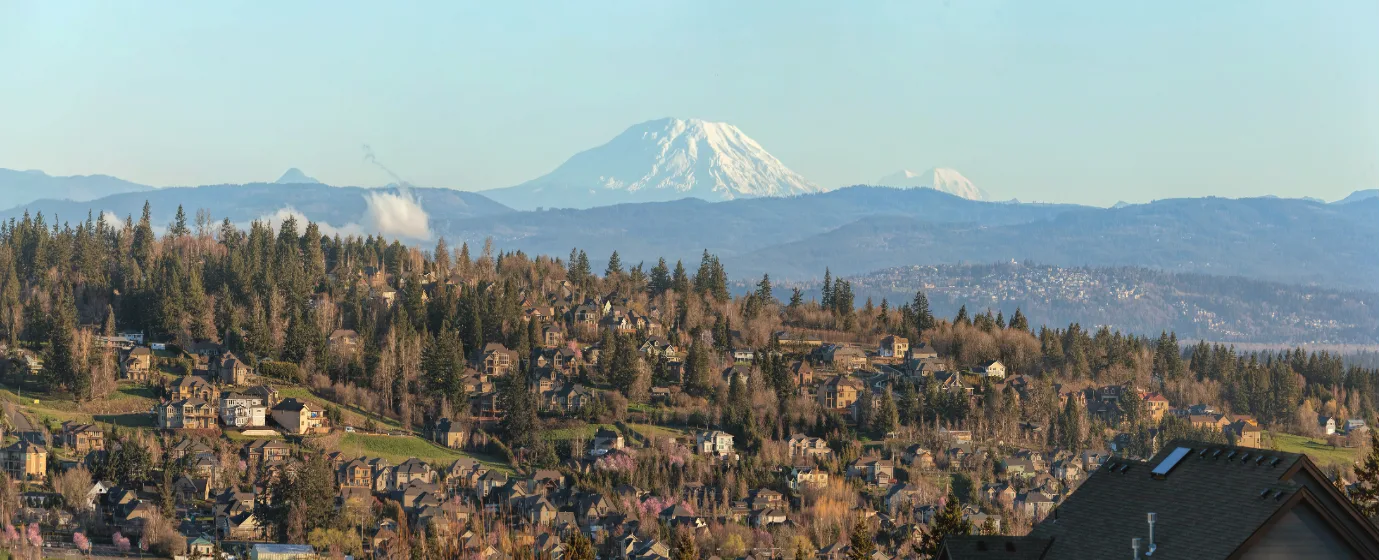
Most people moving to Happy Valley from Portland proper say the same thing in month three: they didn't realize how much green space they'd have, and they didn't realize how much they'd drive. This is a city that looks suburban on a map but lives closer to a Pacific Northwest nature retreat — Mount Talbert rises out of the tree line mid-city, Scouters Mountain anchors the eastern ridge, and the street grid gives way to forested hillsides faster than newcomers expect. It sits in the southeast corner of the Portland metro, in Clackamas County, served by OR-212 and OR-224 (both called the Clackamas Highway), with the Portland city limits roughly 15 minutes in one direction and rural Damascus in the other. The practical reality is a city built around the car, with a population of 26,738 that has exploded from fewer than 5,000 residents in 2000 — growth that still hasn't fully caught up with its own infrastructure.
The economic backbone here is the households, not a single factory or tech campus. The North Clackamas School District, which holds a B rating, according to Niche, is both the city's largest institutional employer and the main reason families with school-age children choose Happy Valley over other Clackamas County options. Beyond the district, Clackamas County government and a major regional health system round out the local employer base — but the more honest picture is that most working adults here commute out, typically about 25 minutes to Downtown Portland, where Portland-area tech, healthcare, and professional services jobs concentrate. The median household income of $122,151 tells you who tends to arrive: dual-income professionals, often with kids, who have been priced out of Portland's inner eastside and want space, newer construction, and strong schools without leaving the metro.
Housing prices sit noticeably below Portland's most competitive inner neighborhoods but above the entry point many first-time buyers hope for — the typical home price is $686,520 (Zillow Home Value Index, July 2026), which buys substantially more square footage here than in Southeast Portland proper. The city sees 142 sunny days a year, with warm summers in the 70s and 80s and mild winters rarely dipping below freezing for long. Snow averages about two inches annually. The outdoor access is genuinely exceptional for a suburb: two nature parks with miles of forested trails are inside or immediately adjacent to city limits, and Happy Valley Park's 24 acres serve as the community's social gathering point through the warm months. For cost of living context, including taxes and rent, the cost of living page breaks it down fully.
Whether you're considering a move or still in the research phase, the sections below cover Happy Valley's character and growth story, what daily life actually looks like, the current housing market, how people get around, and the local spots worth knowing about.
Happy Valley at a Glance
Looking to buy in Happy Valley? Estimate your payment.
Enter your numbers to see an estimated monthly mortgage payment.
Estimate only. Excludes HOA fees and mortgage insurance. The interest rate above is a starting point, not a quoted rate — replace it with your own to see real numbers. Insurance is a flat placeholder, not a Happy Valley quote.
Why Are People Moving to Happy Valley?
Happy Valley's growth is one of the most dramatic in the Portland metro. Incorporated in 1965 with a small-town footprint, it has added over 18,000 residents since 2000 — a roughly 400% population increase in two decades, far outpacing Clackamas County's overall growth during the same period. That isn't an accident of geography; it's the result of families actively choosing this city when Portland's inner eastside stopped penciling out.
The Schools Pull
The North Clackamas School District, which holds a B rating, according to Niche, is consistently the first thing parents bring up. With 16,864 students enrolled in 2025-26, it's a large district with enough resources to offer broad programming. On 2024-25 state assessments, 30.2% of students reached math proficiency and 41.4% reached reading proficiency — figures that trail top-rated metro districts but still draw families away from Portland Unified's more variable results. For a deeper look at schools and boundaries, see the Happy Valley schools page.
New Construction and Space
Happy Valley offers something genuinely rare this close to Portland: new construction at scale. The city has permitted thousands of new housing units over the past two decades, and the residential building activity that defined the 2010s has continued into the 2020s. Buyers who want a four-bedroom with a garage and a yard — and don't want to gut-renovate a 1960s ranch to get it — find more options here than almost anywhere else within a 25-minute drive of downtown.
The Growth Comes With a Catch
The same pace of development that creates opportunity also creates friction. OR-212 and OR-224 — the two highways serving the city — carry commuter and through traffic that the road network wasn't originally built to handle. A 2025 Clackamas County study of the Sunrise Gateway Corridor near Happy Valley documented congestion levels officially classified as unacceptable, and proposed improvements that, if implemented, would add sidewalks, bike lanes, and intersection upgrades in the area. That plan is still under consideration, not yet approved.
People who move out of Happy Valley — and some do, after a few years — usually cite one of two things: the driving requirement for nearly every errand, or the feeling that the city's retail and dining scene hasn't kept pace with its population. Both are real, and worth weighing before committing.
What Daily Life Feels Like in Happy Valley
The easiest way to understand daily life here is to picture a neighborhood that got annexed into a city before the city had time to build the things a city normally has. The residential infrastructure — the streets, the subdivision loops, the parks — is excellent. The walkable commercial core, the downtown coffee row, the block-by-block dining scene: those are still catching up.
The Outdoor Life Is Genuinely Exceptional
Most suburbs gesture at outdoor access. Happy Valley delivers it in an unusual way, with two Metro-managed nature parks inside or immediately adjacent to city limits. Mount Talbert Nature Park is a forested volcanic butte with more than 4 miles of trails — paved accessible routes and steep footpaths through Oregon white oak woodland where deer, pileated woodpeckers, and Western tanagers are common sightings. Dogs and bikes aren't permitted, which keeps the habitat intact and the trails quieter than most Metro parks.
Scouters Mountain Nature Park offers a complementary 1.6-mile forested loop that regulars treat as the easier morning walk when Mount Talbert feels ambitious. Hidden Falls Nature Park rounds out the list. Families with kids use Happy Valley Park — a 24-acre anchor with a nationally recognized all-abilities playground, a splash pad, a dog park, a skate area, and a wetlands boardwalk along Mount Scott Creek — as the default social gathering point from late spring through fall.
Community Events That Feel Like a Small Town
The city leans hard into its community calendar. The annual summer festival at Happy Valley Park includes a morning hike, a community parade, live music, and food vendors. An Oktoberfest brings Wiener Dog Races and a pumpkin patch. The annual Tree Lighting Celebration draws most of the city. These events are the moments longtime residents point to when they explain why they stay despite the commute — it's the rare suburb where you actually run into your neighbors.
What Surprises People After Six Months
Newcomers consistently underestimate how car-dependent the daily routine is. Even short trips — coffee, a weeknight dinner out, a grocery run — require getting in the car. The city's geography works against walkable commercial density: the hillsides and nature parks that make Happy Valley beautiful are the same topography that keeps businesses spread out. Most residents make peace with this quickly, but buyers who sold a walkable inner-Portland condo expecting the same on-foot access will find the adjustment real.
For the parks, trails, and recreation programming in full detail, see the Happy Valley parks and recreation page.
The Happy Valley Housing Market Right Now
The typical home price in Happy Valley sits at $686,520 (Zillow Home Value Index, July 2026). That figure buys a lot more house here than it does in Portland's close-in eastside neighborhoods — typically newer construction, more square footage, and a garage — though it still clears the range many first-time buyers initially set as their ceiling. For a full breakdown of what ownership costs here including property taxes at the effective 1.13% rate, see the cost of living page.
The rental market reflects the city's demographic tilt toward ownership. Typical two-bedroom rents run $1,750–$2,130, with the city-wide typical rent at $1,903 per month (Zillow, July 2026). The rental stock is newer on average than in most Portland-adjacent cities, with a meaningful share of the multifamily units built in the past decade.
What the Supply Picture Looks Like
Happy Valley is one of the few Portland-metro cities where new construction continues to come out of the ground. The city has permitted substantial residential development across the past two decades, and some newer subdivisions are still being built around buyers when they move in — construction noise and incomplete neighborhood amenities are a real near-term reality in the newest communities on the hillsides.
Well-priced homes in established areas move quickly, while newer communities farther up the hillsides tend to have more inventory and more negotiating room. For deeper neighborhood-by-neighborhood character, visit the Happy Valley neighborhoods page.
Happy Valley Neighborhoods
Happy Valley has several distinct areas — each with its own character and appeal. Here’s a breakdown to help you narrow down where to focus your home search.
🏡 Rock Creek
A quieter, established pocket in the western part of the city, Rock Creek attracts families and long-term residents who value larger lots and mature landscaping. The neighborhood has a settled feel that newer subdivisions still lack.
🏠 Sunnyside
Sunnyside sits close to the Clackamas Town Center corridor, making it one of the more conveniently located neighborhoods for transit access and daily errands. It's a natural first landing spot for buyers who want proximity to the MAX Green Line connection without giving up the suburb feel.
🌳 Happy Valley Heights
Perched on the hillsides above the city floor, Happy Valley Heights offers elevated views and a mix of newer custom homes. It suits buyers who prioritize privacy and a quieter residential setting over proximity to commercial activity.
🏘 Scouters Mountain
Named for the nature park that defines its eastern edge, the Scouters Mountain area draws outdoor-minded households who want trail access immediately outside their door. The housing stock trends toward newer construction on larger lots.
🏔 Pleasant Valley
Pleasant Valley sits in a transitional zone between Happy Valley's built-out neighborhoods and the rural edge of the urban growth boundary. It's a fit for buyers who want elbow room and don't mind being a few minutes farther from the OR-212 corridor.
🌆 Eagle Landing
Eagle Landing is one of Happy Valley's more polished planned communities, with a neighborhood park, walking paths, and a consistent architectural character. It suits parents with school-age children who want a tidy, planned environment close to North Clackamas schools.
Pros & Cons of Living in Happy Valley
The Pros
- Highly rated North Clackamas schools with strong graduation rates
- Low violent crime relative to national and state averages
- Sweeping Mt. Hood and Cascade views from elevated neighborhoods
- New-construction homes and a rapidly growing local economy
The Cons
- Home prices run well above the county and state median
- Property crime is elevated near the retail corridor bordering Clackamas Town Center
- Limited public transit means residents are largely car-dependent
Getting Around & Commuting in Happy Valley
Happy Valley is, straightforwardly, a driving city. The two highways serving it — OR-212 and OR-224, both running as the Clackamas Highway — carry the vast majority of the traffic in and out. The commute to Portland is about 25 minutes to Downtown Portland under reasonable conditions, which makes this workable for daily commuters in tech, healthcare, and professional services. Rush hour on OR-212 and OR-224 is the unglamorous reality: the Sunrise Gateway Corridor near SE 172nd Avenue has been formally documented for congestion levels that are unacceptable by transportation planning standards, and the fixes are still working through the approval process.
Transit Exists, With a Transfer
TriMet bus service connects Happy Valley to the Clackamas Town Center Transit Center — the adjacent transit hub just outside city limits — which is the southern terminus of the MAX Green Line. From there, reaching Pioneer Courthouse Square takes roughly 39–45 minutes on the Green Line alone. The transit center has substantial park-and-ride capacity, and there's a second park-and-ride facility closer to the city. Most residents drive rather than use the transit option for daily commuting, but the park-and-ride model works well for those who want to hand off the wheel once they're on the freeway corridor.
Airport Access
Portland International Airport is approximately 14 miles from Happy Valley. The drive is straightforward for an early-morning flight; parking at PDX is the standard approach for most residents. A car remains the practical necessity for this leg, though the airport is close enough that the inconvenience is minimal by Oregon standards.
Biking and Walking
Recreational walking and trail running are excellent here — Mount Talbert's trails, Scouters Mountain, and the Happy Valley Park loop give residents real options outside the subdivision streets. Commuting on foot or by bike for daily errands is a different story; the terrain and the road design make it impractical for most. This is not a city where you'll skip the car payment and walk to the farmer's market on a weekday morning.
Schools in Happy Valley
Families relocating to Happy Valley have public, private, and higher-education options nearby. Here’s a quick overview.
🎓 School District
North Clackamas School District serves K–12 students across Happy Valley and the surrounding area. Rated B (source: Niche.com).
🏆 Graduation Rate
The 4-year high-school graduation rate here is approximately 87.9%.
📚 Higher Education
Oregon’s public universities — the University of Oregon, Oregon State University, and Portland State University — offer four-year degrees statewide, with a network of 17 community colleges providing two-year and workforce programs.
🌐 Online Learning
Oregon State University Ecampus and Portland State University Online offer fully accredited online degrees for remote learners across the state.
Safety in Happy Valley
A quick look at how Happy Valley compares on the numbers that matter most when weighing a neighborhood or a move.
🛡 Violent Crime
Approximately 3.1 per 1,000 residents.
🔒 Property Crime
Approximately 30.3 per 1,000 residents.
Compared to the most recent national figures from the Bureau of Justice Statistics (2024), Happy Valley’s violent crime is below the national average (about 3.7 per 1,000), and property crime is above the national average (about 18.4 per 1,000).
Against Oregon as a whole, Happy Valley’s violent crime is about the same as the state average, and property crime is somewhat above the state average (Bureau of Justice Statistics, Crime Known to Law Enforcement, 2024 (tables 2 and 3)).
Crime rates can vary a lot within a single city, so the citywide numbers above are only a starting point. Some neighborhoods in Happy Valley run well below these averages, while others run higher — the kind of block-by-block detail that matters most when you’re actually choosing where to live. The full guide below breaks it down neighborhood by neighborhood.
Working in Happy Valley
Happy Valley’s largest employers span several industries — here are some of the anchors of the local job market.
🎓 North Clackamas School District
Education
🏛 City of Happy Valley
Municipal government
🏛 Clackamas County
Municipal government
🏥 Providence Health & Services
Healthcare
Parks & Recreation in Happy Valley
Some of the outdoor spaces that shape everyday life in Happy Valley.
🌱 Mount Talbert Nature Park
🌱 Scouters Mountain Nature Park
🌱 Happy Valley Park
Happy Valley residents don’t have to go far for green space — spots like Mount Talbert Nature Park and Scouters Mountain Nature Park are part of everyday life here, whether that’s a morning walk, a weekend hike, or just somewhere to unwind outside. The full guide below covers more of what Happy Valley has to offer for parks and outdoor recreation.

Retiring in Happy Valley
Happy Valley draws retirees for its balance of amenities, outdoor access, and cost. Here’s what to weigh.
🌤 Climate
Happy Valley gets 142 sunny days a year, with warm summers in the 70s and 80s and mild winters where temperatures typically hold between 35°F and 45°F. Snow averages roughly 2 inches annually, mostly in December, so serious winter weather is rare. The wet season runs fall through spring — plan for gray and rainy stretches from October through March.
🍴 Lifestyle
The outdoor life is the draw: forested trails at Mount Talbert and Scouters Mountain, a 24-acre community park with a wetlands boardwalk, and a year-round community events calendar that keeps the social calendar full without requiring a drive to Portland. The local dining scene is growing, with a food cart pod, several independent restaurants, and a cluster of cafés serving the city.
🏚 55+ Communities
Happy Valley has no dedicated 55+ or active-adult housing communities. Retirees who settle here typically buy into the general residential market, often looking for single-level homes in established neighborhoods like Sunnyside or Pleasant Valley. The absence of an age-restricted community isn't unusual for a fast-growing suburb — the housing stock is newer and the inventory is broader than many Clackamas County alternatives.
✈ Getting Around
A car is essential for daily life in Happy Valley. Most destinations — groceries, medical appointments, restaurants — require driving. Portland International Airport is approximately 14 miles away, making travel straightforward for those flying regularly. Transit to Portland is available via bus connection and the MAX Green Line, but the drive remains the practical choice for most residents.
🏛 Oregon Taxes for Retirees — What to Know
- Social Security is not taxed — Oregon does not tax Social Security or Railroad Retirement benefits. Any amount included in your federal adjusted gross income is subtracted back out on the Oregon return.
- But other retirement income IS taxed — This is the trade-off that surprises people moving from Washington or Texas. Pension distributions and 401(k)/IRA withdrawals are taxed as ordinary income at Oregon’s regular rates — there is no blanket retirement-income exclusion.
- Graduated income tax — Oregon has four brackets — 4.75%, 6.75%, 8.75% and 9.9%. The 4.75% rate covers the first $10,000 of taxable income for a single filer ($20,000 filing jointly); the 8.75% rate starts at $125,000 ($250,000 jointly); and the top 9.9% rate applies above $250,000 ($500,000 jointly).
- No sales tax — Oregon levies no general sales tax.
- Property taxes, with senior deferral — Oregon’s Senior and Disabled Property Tax Deferral lets qualifying homeowners have the state pay their county property taxes, with a lien recorded against the home. The 2026 household income limit is $70,000, and deferred balances accrue 6% simple interest — it defers the bill rather than forgiving it.
- Estate tax — the one to plan for — Oregon has its own estate tax with a $1 million filing threshold — far below the federal exemption, and NOT indexed for inflation, so it reaches more estates every year in real terms. Retirement accounts and a long-held home count toward the taxable estate, so estates that feel modest can cross the line without the owner expecting it.
- No inheritance tax — Oregon has no separate inheritance tax and no gift tax.
Tax laws change frequently and individual situations vary. This is general information, not tax advice — always consult a qualified Oregon tax professional or CPA for personalized retirement tax planning.
Weekends & Local Favorites in Happy Valley
Happy Valley's dining and coffee scene punches above its size in a few specific ways, even if it doesn't yet have the density of a true commercial main street. The local options that exist are worth knowing before you write the city off as a drive-to-Portland-for-dinner suburb.
Food Worth Seeking Out
Happy Valley Station Food Carts is the city's most distinctive food destination — an outdoor cart pod that brings together multiple cuisines and draws a mix of families and regulars throughout the warmer months. Noodle Man is the go-to for a bowl of pho or Asian noodle dishes when the season turns gray. Hog Wild BBQ & Catering handles the low-and-slow smoky end of the spectrum. For Mexican and Latin flavors, both Margarita Factory Happy Valley and Mezcaluna Mexican Cuisine & Lounge have strong local followings, with Mezcaluna running more toward a full sit-down lounge experience.
Coffee and Cafés
The café scene leans toward independent spots and Korean-influenced bakery concepts. TOUS les JOURS Bakery Café at Clackamas Town Center is a well-known Korean bakery chain that draws a dedicated following. Croffle Crew Cafe brings croffle-focused pastry culture to the mix, while Cafe Le Fleurs, Le Petit Café Happy Valley, and Plenty European Coffee Shop each offer a more classic café experience with a European lean — all distinct enough that you won't feel like you've walked into the same shop twice.
Nature as the Weekend Anchor
The trails at Mount Talbert Nature Park are where a lot of residents spend Saturday mornings — the forested climb through Oregon white oak woodland to the 750-foot summit is the kind of thing people move here specifically to have within a 10-minute drive. Scouters Mountain Nature Park provides an easier loop for a weekday morning or a walk with younger kids. Happy Valley Park hosts the city's biggest community gatherings: the annual summer festival with a parade and live music, an Oktoberfest featuring Wiener Dog Races, and a Tree Lighting Celebration that brings most of the city out to the same place at the same time — something genuinely harder to find in a suburb of 26,738 people than it should be.
Local favorites in Happy Valley
Restaurants
- Happy Valley Station Food Carts
- Margarita Factory Happy Valley
- Mezcaluna Mexican Cuisine & Lounge
- Hog Wild BBQ & Catering
- Noodle Man
Outdoors
- Mount Talbert Nature Park
- Scouters Mountain Nature Park
- Happy Valley Park
- Hidden Falls Nature Park
Coffee
- TOUS les JOURS Bakery Café - Clackamas Town Center
- Croffle Crew Cafe
- Cafe Le Fleurs
- Le Petit Café Happy Valley
- Plenty European Coffee Shop
Top Things Locals Say About Happy Valley
The best intel about a city comes from the people who actually live there. Here’s what Happy Valley residents say when newcomers ask the questions everyone’s thinking.
“I knew the commute would be fine, but I didn't expect to be walking to a trailhead through Oregon white oak trees five minutes from my house on a Tuesday morning. The other surprise was how quickly you get used to driving for everything else — even a coffee run. You just build it in.”
— Recent Happy Valley home buyer
“What's the most surprising thing about living in Happy Valley?”
How much nature is actually inside the city. Most people picture a suburb and think of strip malls and cul-de-sacs, but you've got Mount Talbert — a real forested volcanic butte with miles of trails — essentially in the middle of the city. Scouters Mountain is right there too. You can hike on a Tuesday morning and not see another person.
“What do locals love most about Happy Valley?”
The community events draw people out in a way that bigger cities don't manage. The summer festival at Happy Valley Park, the Oktoberfest with the Wiener Dog Races — these sound like small things, but they're the reason you actually know your neighbors. The schools are also consistently the thing families say they're most satisfied with after a couple of years here.
“What should newcomers to Happy Valley know?”
OR-212 toward Portland backs up hard during the morning commute, especially near the Sunnyside Road area. If you can shift your work hours even 30 minutes earlier or later, the difference is real. Also: plan your big shopping trips. A serious grocery or retail run often means heading toward Clackamas or Portland, not staying in the city — the local commercial options are growing but they're not everything yet.
“How much do you need a car in Happy Valley?”
A car is essentially required for daily life. Most errands — groceries, coffee, school pickups, dinner out — mean driving. The trail networks are a five-minute drive or less for most residents, and the transit connection to Portland works if you can get yourself to a park-and-ride, but there's no realistic car-free daily routine here. People who come from walkable Portland neighborhoods and expect to keep that rhythm will need to recalibrate.
Cities Near Happy Valley
Other communities near Happy Valley worth a look — each with its own character and price point.
| City | Distance | Best For | Vibe | Median Rent | Median Buy |
|---|---|---|---|---|---|
| Milwaukie | 6 mi | Buyers wanting walkability and urban feel | Established, compact, river-adjacent | $1,749 | $522,702 |
| Oregon City | 8 mi | Value-minded families and history buffs | Historic, hillside, blue-collar character | $1,955 | $605,330 |
| Clackamas | 4 mi | Retail access and easy freeway commuting | Suburban, commercial, convenient | $1,783 | $588,708 |
More Helpful Guides for Happy Valley
Going deeper on Happy Valley? Our blog series covers everything from first-time buying to retiring here — explore the guides below.
Local Expert Takeaway: Happy Valley rewards buyers who go in clear-eyed: it's a car-dependent, family-oriented suburb with exceptional trail access, newer housing stock, and a commute corridor that still has real congestion problems on OR-212 and OR-224. If you're trading a walkable Portland neighborhood for more square footage and North Clackamas schools, the math works for a lot of families. If you're expecting a self-contained walkable city with a dining district, you'll find the city is still building toward that. The trail to the top of Mount Talbert is genuinely one of the better things within 25 minutes of Downtown Portland, and it's in people's backyards here — that detail alone explains a lot about who stays.
Quick Takeaways & FAQs
✅ Two Metro-managed nature parks — Mount Talbert and Scouters Mountain — are inside or immediately adjacent to city limits, giving residents forested trail access that most Portland suburbs can't match.
⚠️ OR-212 and OR-224 both carry serious congestion during rush hour, and a 2025 county study formally documented unacceptable traffic levels near SE 172nd Avenue — the commute is manageable but not effortless.
📍 Happy Valley has no dedicated 55+ or active-adult housing communities; retirees here typically buy into the general residential market, often targeting single-level homes in established neighborhoods.
Is Happy Valley, Oregon a good place to raise a family?
How far is Happy Valley from Downtown Portland?
What is the typical home price in Happy Valley, OR?
Is Happy Valley safe?
Does Happy Valley have public transit?
Helpful Links for Moving to Happy Valley
Moving to Oregon?
Tell us what you need help with and we'll connect you with local resources.
