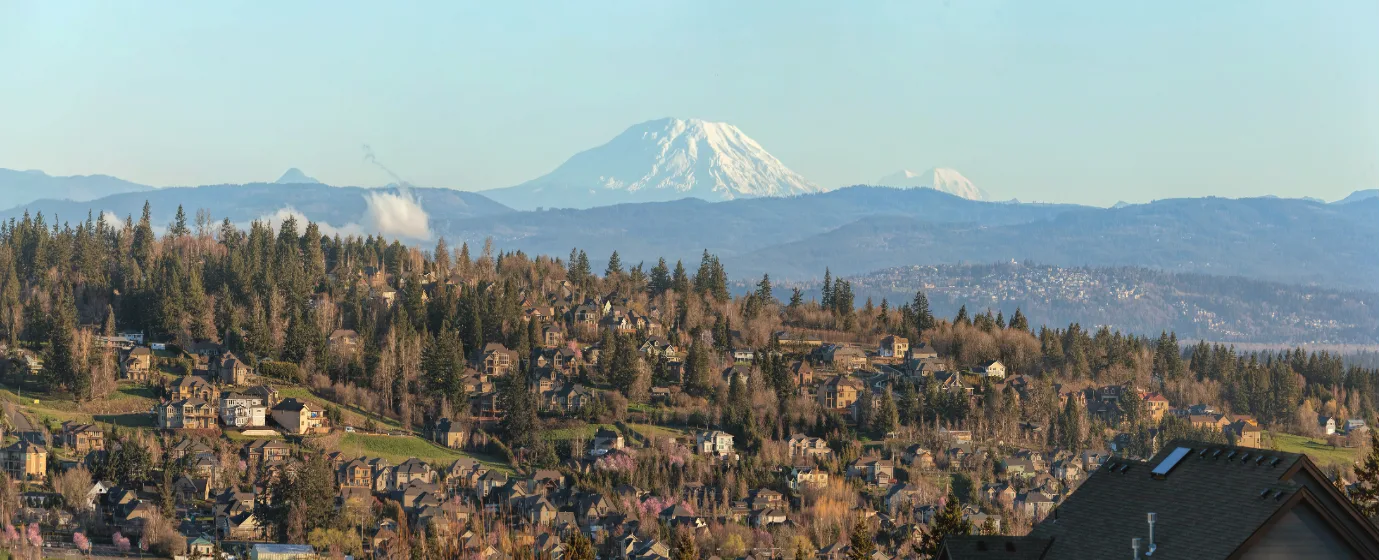
Maybe you have been priced out of Portland's inner eastside and someone pointed you toward Happy Valley. Maybe your company is in the Clackamas corridor and this suburb came up on your list. Either way, the first thing to understand about Happy Valley is that it does not feel like a discount. The city sits southeast of Portland, tucked into the hills of Clackamas County, and it has built a reputation — and a price tag — that reflects it. Happy Valley's overall cost of living runs roughly 25% above the U.S. national average, and housing is almost entirely responsible for that gap. Groceries, utilities, and day-to-day essentials are above average too, but only modestly; the housing line is where the real weight lands.
The economic picture here is anchored by a median household income of $122,151 — well above Oregon's statewide figure — but even that number falls short of what a buyer needs to carry the typical home. The North Clackamas School District holds a B rating, according to Niche, which draws families willing to pay for the zip code. Major public-sector employers like the school district itself, the City of Happy Valley, and Clackamas County anchor local government employment, alongside a regional health system on the healthcare side. The community skews toward dual-income professional households, and the housing market reflects that.
On the lifestyle side, Happy Valley is genuinely suburban in character — car-dependent, quiet, and oriented around parks and trails rather than restaurants and nightlife. Mount Talbert Nature Park and Scouters Mountain Nature Park sit within the city, and the adjacent Clackamas Town Center handles most retail needs without a drive into Portland. For day-to-day expenses, Oregon's complete absence of a sales tax is a real offset; what you pay at the register is the sticker price, which makes grocery and retail spending more predictable than in most West Coast states.
Whether you are doing early research or narrowing down your final list, the sections below break down Happy Valley's housing costs, everyday expenses, tax picture, and how the city compares in price to nearby Milwaukie, Clackamas, and other Portland suburbs.

What It Really Costs to Live in Happy Valley
Happy Valley is one of the more expensive suburbs in the Portland metro, and the gap between it and many neighboring cities is driven almost entirely by housing. Strip housing out of the index, and the city's cost profile looks closer to a Pacific Northwest average — groceries run modestly above the national baseline, utilities somewhat above it, and transportation above it too because the city is car-dependent. Put housing back in, and the picture shifts sharply.
The median household income of $122,151 sounds comfortable until you hold it against what the typical home actually requires. Happy Valley is not a city where the median earner can casually buy the median home — that gap is real and worth acknowledging before you run any numbers. For buyers coming from Portland's inner neighborhoods, the price-per-square-foot trade looks reasonable; for buyers relocating from somewhere cheaper, it can still feel steep even before the mortgage.
Compared with nearby cities, Happy Valley sits noticeably above Milwaukie, somewhat above Clackamas, and somewhat above Oregon City in housing cost. It is broadly comparable to the higher-priced pockets of the Portland metro's east side, and noticeably below the premium west-side suburbs like Lake Oswego. The city rewards buyers who need square footage, yard space, and newer construction — you get more of all three here than anywhere closer to the city core at this price point.
Housing: Rent vs Buy in Happy Valley
The typical home price in Happy Valley was $686,520 as of July 2026 (Zillow Home Value Index). That figure sits well above the Oregon statewide typical and reflects the city's newer housing stock, larger lot sizes, and suburban demand from Portland-area professionals. Entry-level homes — older construction, smaller lots, more dated interiors — can be found in the mid-$500,000s, though that range is competitive and rarely sits long. The Best Neighborhoods guide goes deeper on where different price points cluster within the city.
The effective property tax rate in Happy Valley is approximately 1.13%. Oregon does not have a state sales tax, which shifts more of the local tax burden onto income and property — so factor that rate into your total monthly picture alongside the purchase price. The engine's mortgage calculator below can help you model the full payment at current rates.
Renting is not a cheap alternative here. The typical two-bedroom rent runs between $1,750 and $2,130 per month, with the city-wide typical rent at $1,903 per month. That range puts Happy Valley among the higher-rent suburban pockets in Clackamas County. For buyers who expect to stay five or more years, purchasing tends to pencil out better than renting in this market — but the down payment threshold is real, and the gap between the median household income and the income needed to carry the typical home is meaningful enough that many buyers arrive here from equity gained elsewhere. If you are new to Oregon and evaluating your first purchase, the first-time homebuyer guide covers financing mechanics in detail.
Everyday Costs Beyond Housing in Happy Valley
| Category | Typical Monthly Cost | Notes |
|---|---|---|
| Housing (typical rent) | $1,903/mo | City-wide typical rent. Buying? Use the calculator above for a mortgage estimate. |
| Utilities | $190–$270/mo | Electricity, gas, water, sewer, trash |
| Groceries | $600–$820/mo | Food at home, household of 2–3 |
| Transportation & Gas | $200–$360/mo | Fuel, and transit where it is a real option |
| Phone & Internet | $110–$180/mo | Mobile plan plus home broadband |
| Misc / Discretionary | $280–$520/mo | Dining out, entertainment, subscriptions |
Non-housing figures are estimates for a household of two to three, not a sourced index; housing is the city-wide typical rent (Zillow ZORI, July 2026). Refreshed with the rest of the city data.
Utilities run approximately 9.4% above the national average in Happy Valley, combining electricity, water, heating, and waste disposal. The bigger cost driver for most households is not the rate — it is the demand. Winters in the Portland hills are wet and cool, and the heating load in a larger Happy Valley home is meaningfully higher than in a compact city apartment. Budget more for heating from November through March than you might in milder climates.
Groceries run modestly above the national average — cost-of-living trackers consistently place the grocery index between 105 and 114 against a U.S. baseline of 100. The Sunnyside Road corridor carries most of the city's commercial activity, and the adjacent Clackamas Town Center handles the bulk of everyday retail without requiring a Portland drive. The one genuine offset that reshapes these numbers: Oregon levies no state or local sales tax, so the price on the shelf is the price you pay. For a household running $1,000 a month in groceries and retail, that is a real and recurring advantage. Transportation costs run well above the national average — cost-of-living indices place Happy Valley's transportation index in the 127–128 range — because this is a car-dependent city and most commutes mean driving. TriMet bus routes connect residents to the Clackamas Town Center Transit Center in adjacent Clackamas, where the MAX Green Line runs into Portland, but most Happy Valley residents drive rather than ride.
Looking to buy in Happy Valley? Estimate your payment.
Enter your numbers to see an estimated monthly mortgage payment.
Estimate only. Excludes HOA fees and mortgage insurance. The interest rate above is a starting point, not a quoted rate — replace it with your own to see real numbers. Insurance is a flat placeholder, not a Happy Valley quote.
Happy Valley vs Nearby Cities: Cost Comparison
| City | Typical Home Price | Typical Rent | Cost vs Happy Valley |
|---|---|---|---|
| Happy Valley (this city) | $686,520 | $1,903/mo | — |
| Milwaukie | $522,702 | $1,749/mo | 24% lower |
| Oregon City | $605,330 | $1,955/mo | 12% lower |
| Clackamas | $588,708 | $1,783/mo | 14% lower |
Source — home prices: Zillow ZHVI, July 2026; rent: Zillow ZORI, July 2026. Nearby-city figures are the same series, refreshed together.
The table below puts Happy Valley's housing and rent figures alongside the nearby cities most buyers compare it against — useful context for anyone choosing between suburbs in the southeast Portland corridor.
Taxes & the Bottom Line for Happy Valley
Oregon's tax structure has a clear split: no sales tax at all, but a state income tax that is among the steepest in the country. The state uses four progressive brackets ranging from 4.75% to 9.90%. That top rate applies to taxable income above $125,000 for single filers and above $250,000 for joint filers — which means a meaningful share of Happy Valley's dual-income professional households are paying in the 9.9% range on a portion of their earnings. Only a handful of states levy a higher top rate.
The property tax side is more moderate. At an effective rate of approximately 1.13%, Happy Valley falls roughly in line with Oregon's statewide norm, which tends to run lower than California's Mello-Roos-burdened equivalents and far lower than Texas or New Jersey. And the zero-sales-tax environment means that every dollar you spend on groceries, clothing, or home goods is worth a few cents more than it would be across the river in Washington.
Taken together, Happy Valley's tax picture rewards retirees and moderate earners more than it rewards high-income professionals. If you are earning well above $125,000 individually, Oregon's income tax is a real line item — and you will want to model it explicitly, not treat it as an afterthought. For buyers considering whether Happy Valley fits a retirement budget, the retiring in Happy Valley guide covers that picture in more detail.
The honest bottom line: Happy Valley suits households that have already built equity, bring in a combined income well above the median, and want newer construction with good schools and easy access to Portland — about 25 minutes to Downtown Portland on a typical day. It is a stretch for a single-income buyer at the city's median income, and it is not where you go to find the Portland metro's most affordable entry point. If the price point in this guide feels like a reach, Milwaukie and Clackamas both offer a noticeably or somewhat lower cost basis without giving up the metro's core advantages. For buyers who can meet the number, what they get is a well-built suburb with real outdoor amenity, low crime relative to the state, and a school district that families consistently rate as worth the premium.
Local Expert Takeaway: Happy Valley's cost profile is almost entirely a housing story. Strip out the home price and the city looks like a slightly above-average Pacific Northwest suburb on every other line item — no sales tax, moderate utilities, walkable retail access at Clackamas Town Center. The buyers who find it easiest to absorb are those bringing equity from a prior sale, often from California or from Portland's inner eastside, where they traded a smaller home for a larger one and kept the commute to about 25 minutes to Downtown Portland. If you are arriving without that equity cushion, the entry point takes real planning — and the gap between the median household income and what the typical home actually requires is wider here than most buyers expect.
Quick Takeaways & FAQs
✅ Happy Valley's typical home price of $686,520 (July 2026) buys significantly more square footage and lot size than comparable money can get in Portland's inner eastside or west-side premium suburbs.
⚠️ Oregon's 9.90% top income tax bracket kicks in at $125,000 for single filers — a real budget line for the dual-income professional households this city primarily attracts.
📍 There is no Oregon state or local sales tax, which provides a genuine and recurring offset on groceries and retail spending that buyers moving from Washington or California will notice immediately.
What is the typical home price in Happy Valley, Oregon?
Is Happy Valley expensive compared to the rest of Oregon?
What is the property tax rate in Happy Valley?
Does Happy Valley have public transit?
How does Oregon's lack of sales tax affect the cost of living in Happy Valley?
Moving to Oregon?
Tell us what you need help with and we'll connect you with local resources.
