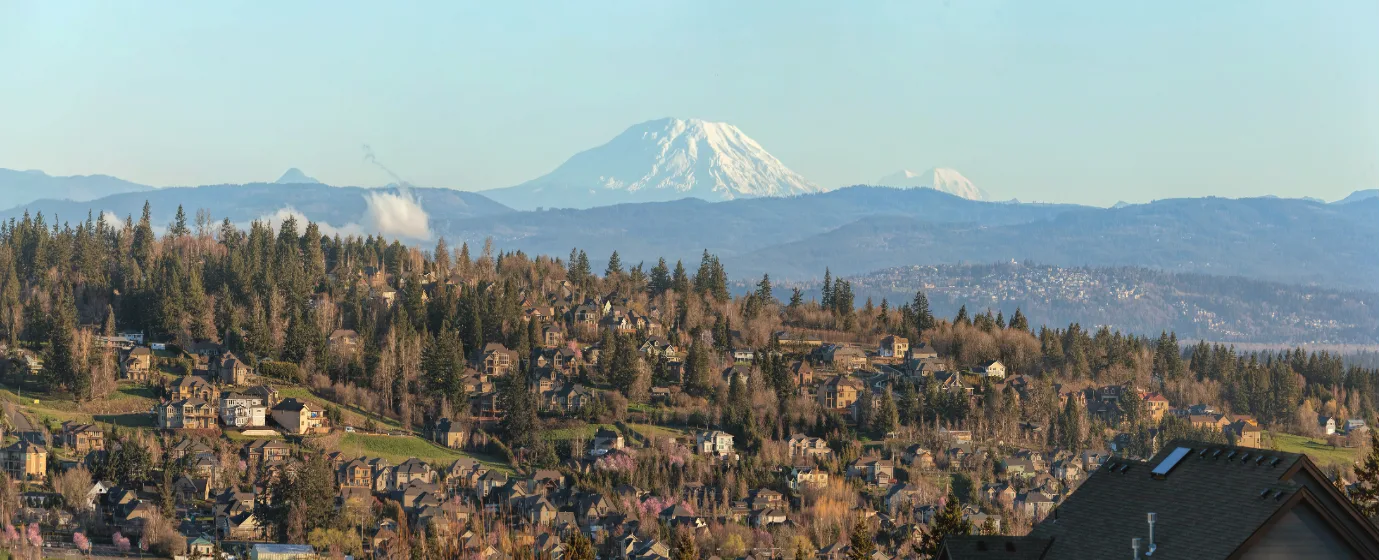
Most people who move to Happy Valley from Portland describe the same shift: you drive east on OR-212, the lot sizes grow, the noise fades, and something in your shoulders relaxes. That feeling tracks with the data. Happy Valley has a violent crime rate of 3.1 per 1,000 residents — below both the Oregon statewide rate and the national average. For a city of 26,738 sitting squarely inside the Portland metro, that is a genuinely meaningful number.
The property crime picture is more complicated, and understanding why matters before you decide on a neighborhood. Happy Valley has a property crime rate of 30.3 per 1,000 residents — but that number is being pulled upward by vehicle break-ins and retail theft clustered in the commercial corridor adjacent to Clackamas Town Center, not by incidents on residential streets. The city is measured against its own resident population of 26,738, while thousands of additional shoppers cycle through the western edge daily. That statistical pressure is real and worth understanding, not dismissing.
Resident sentiment reflects the ground-level reality more than the raw rate does. On Niche, roughly 54% of Happy Valley residents describe the city as very safe with no concerns, and 38% call it pretty safe — only 8% report regular safety worries. That split is consistent with a city where daily life in the subdivisions feels genuinely quiet, even as the shopping corridor generates the incidents that move the per-capita numbers.
Whether you are weighing a move here or comparing Happy Valley to nearby Milwaukie, Damascus, or Gresham, the sections below break down the crime data in context, explain how policing works, map the safety picture by neighborhood, and give you the practical habits that locals already treat as second nature.

The Numbers in Context: How Happy Valley Compares
| Measure | Happy Valley | Oregon | National | vs. national |
|---|---|---|---|---|
| Violent crime (per 1,000) | 3.1 | 3.3 | 3.7 | 16% lower |
| Property crime (per 1,000) | 30.3 | 24.5 | 18.4 | 65% higher |
State and national figures — Bureau of Justice Statistics, Crime Known to Law Enforcement, 2024 (tables 2 and 3). City figures — NeighborhoodScout. City rates come from a different reporting series than the state and national benchmarks, so read the comparison as a direction, not a precise multiple.
Reading a crime rate in isolation is how people end up with the wrong impression of a city. Happy Valley carries a violent crime rate of 3.1 per 1,000 residents — below the Oregon statewide rate of 3.3 per 1,000 and below the national figure of 3.7 per 1,000. For a suburb sharing a county with Portland, that position is not accidental. It reflects a city that was deliberately built and maintained as a family destination.
Happy Valley has a property crime rate of 30.3 per 1,000 residents — a number that generates questions, and fairly so, as it sits above the Oregon statewide rate of 24.5 per 1,000 and well above the national rate of 18.4 per 1,000. But the headline rate deserves an asterisk. Crime statistics are tabulated per capita using the resident population, and Happy Valley's resident count of 26,738 is the denominator. It does not account for the tens of thousands of visitors who enter the city's western commercial edge on any given day to shop at or near Clackamas Town Center. Vehicle break-ins in a mall parking area register against the city's resident population — that arithmetic inflates the number in a predictable and well-documented way.
The comparison that matters most for a family choosing a neighborhood: Happy Valley's crime profile compares favorably to nearby Portland, Gresham, and Milwaukie across both violent and property categories. That context does not erase the property crime rate, but it places it accurately.
How Policing Works in Happy Valley
Happy Valley does not run its own standalone police department. Instead, the city contracts with the Clackamas County Sheriff's Office (CCSO), with deputies specifically assigned to serve Happy Valley — giving the city a recognizable local presence while drawing on the staffing depth and investigative resources of a county agency.
The dedicated force is more substantial than many residents realize. It includes patrol deputies, full-time traffic deputies focused on proactive enforcement, a detective, patrol sergeants, a Community Service Officer, a School Resource Officer embedded in the district, and a Chief of Police. The operation is funded through a dedicated Public Safety Levy, voted on by Happy Valley residents every five years. The levy covers 24/7 patrols, investigations, crime prevention programming, traffic enforcement, school safety, and emergency response.
Because residents vote on the levy directly, there is an accountability loop that a general municipal budget line does not create — the community is, in a literal sense, choosing and funding its own safety service at regular intervals.
On the organized retail crime front, CCSO has conducted multiple multi-agency missions targeting retail theft in the corridor adjacent to Clackamas Town Center. Those operations are partially funded through Oregon's Organized Retail Theft Grant Program — created by Senate Bill 900 in 2023 and administered by the Oregon Criminal Justice Commission — with CCSO awarded funds in FY2024-25 for staffing and equipment. The enforcement response is active, not passive.
Where Crime Actually Concentrates: A Neighborhood Safety Map
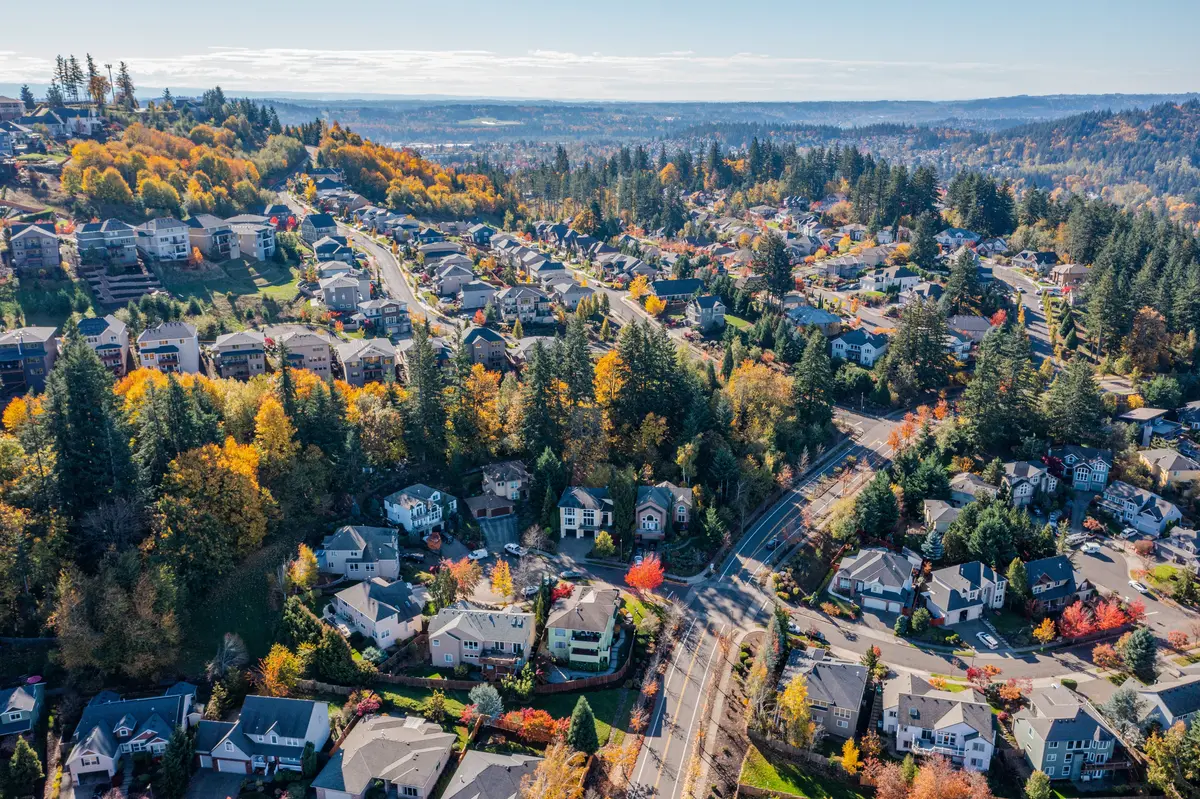
The single most useful thing to understand about crime in Happy Valley is that it is not evenly distributed. The gap between the western commercial edge and the residential interior is wide enough that choosing a neighborhood — not just a city — is the real safety decision.
The Western Commercial Corridor
Property incidents concentrate along OR-212 and Sunnyside Road, near the commercial zone adjacent to Clackamas Town Center. Vehicle break-ins and retail-related theft dominate here. This corridor is where the property crime rate is being driven upward, and it is genuinely worth being thoughtful about if you are parking regularly in surface lots on that side of the city. The incidents are crime-of-opportunity in character — doors left unlocked, valuables left visible — rather than anything more serious.
Sunnyside and Rock Creek
These neighborhoods sit closer to the commercial activity along the western edge and see a proportionally higher share of the city's property incidents as a result. That does not make them dangerous residential areas — violent incidents remain rare across the entire city — but buyers who want the quietest possible surroundings should factor in the proximity to shopping corridors. See the neighborhoods guide for a fuller picture of how these areas differ in character.
Happy Valley Heights, Taralon, and Jackson Hills
These established neighborhoods sit further from the retail spine and consistently report lower incident volumes. The streets here are quiet on a weeknight in a way that feels distinct from the city's western edge. Residents in these areas often describe Happy Valley's safety in terms that match the 54% who called it very safe on Niche — the commercial corridor's numbers simply do not translate to the daily experience of living here.
Scouters Mountain, Eagle Landing, and Pleasant Valley
The southeastern quadrant of Happy Valley — anchored by Scouters Mountain Nature Park and the quieter Pleasant Valley area — is where the city's residential character is most fully expressed. These neighborhoods report the quietest conditions in the city. Scouters Mountain Nature Park itself draws trail users from across the metro, but that traffic is recreational and diffuse in a way that does not carry the property crime dynamics of a retail zone. For families prioritizing residential calm alongside trail access, this part of the city is a genuine standout. More on how these areas compare on the neighborhood breakdown page.
Looking to buy in Happy Valley? Estimate your payment.
Enter your numbers to see an estimated monthly mortgage payment.
Estimate only. Excludes HOA fees and mortgage insurance. The interest rate above is a starting point, not a quoted rate — replace it with your own to see real numbers. Insurance is a flat placeholder, not a Happy Valley quote.
What Residents Actually Experience Day to Day
The gap between a city's crime rate and its lived texture is sometimes narrow and sometimes vast. In Happy Valley, it is vast — and the direction of the gap runs in the city's favor.
The most widely practiced local precaution is the simplest one: do not leave anything visible in a parked car near a shopping area. Experienced residents treat this as automatic. It is the kind of habit that fits the actual risk profile — opportunistic property crime near commercial zones — rather than anything that should affect how you feel walking your street at night or letting kids ride bikes in the neighborhood.
Mount Talbert Nature Park and Scouters Mountain Nature Park are both well-used by families, trail runners, and dog walkers without the kind of incident history that tends to follow parks in denser urban settings. Happy Valley Park is similarly low-key. The city's outdoor spaces feel safe to use because, by the numbers and by resident experience, they are.
Six months in, what surprises most newcomers from Portland is not that Happy Valley is safer — they expected that — but how different the ground-level feel is from anything the aggregate crime rate would suggest. The 8% of residents reporting regular safety concerns on Niche are not wrong, but they are concentrated in experiences tied to commercial areas rather than the residential fabric of the city. That distinction is the thing most relocation guides skip over.
One seasonal note worth flagging: the holiday shopping period — roughly November through January — brings significantly elevated traffic to the commercial corridor adjacent to Clackamas Town Center, and incident volumes in that zone rise with it. Locals who park near the mall during that stretch are more diligent than usual about clearing their vehicles. It is a predictable seasonal pattern rather than a structural problem, but newcomers who arrive in the fall and park without thinking often find it out the hard way.
How to Research Safety Before You Choose a Neighborhood
Happy Valley's overall numbers are encouraging, but the right question before settling on a specific neighborhood is more granular: how far is this street from the commercial corridor, and what does the incident map actually look like in this quadrant?
The Clackamas County Sheriff's Office publishes a community crime map that lets you filter by incident type and time range. Looking at it by category — separating vehicle break-ins from assault reports, for example — tells a more useful story than the aggregate rate. Most buyers researching Happy Valley find that violent incidents are sparse and scattered across the city, while property incidents cluster visibly near OR-212 and Sunnyside Road.
Niche's resident survey data is a useful cross-check, though it reflects perception rather than measured rates. The 54%/38%/8% split on that platform tracks closely with what the geographic incident distribution would predict: residents in the quiet interior report very few concerns; residents closer to the commercial edge are the ones accounting for most of the 8%.
If you are evaluating two neighborhoods that are otherwise equivalent on price and school access, ask specifically about proximity to the western commercial zone. The difference between a house two blocks from Sunnyside Road and one a mile into the Scouters Mountain foothills is not trivial from a property crime standpoint — even though violent crime patterns are similar across both. That is the practical distinction worth understanding before you commit to a specific area. The neighborhoods guide maps the character of each area in more detail.
One thing worth not overthinking: Happy Valley has a violent crime rate of 3.1 per 1,000 residents, below both the Oregon and national averages, and that figure holds across the city, not just in the quieter quadrants. The property crime story has geography to it; the violent crime story mostly does not. For the large majority of buyers, the relevant question is not whether Happy Valley is safe — it is — but which part of it best matches the lifestyle they are looking for.

Local Expert Takeaway: Happy Valley's safety case is genuinely strong on violent crime and honestly complicated on property crime — and the complexity is almost entirely geography. The commercial corridor along OR-212 near Clackamas Town Center is where the property crime numbers are generated; the residential interior, especially the southeastern neighborhoods around Scouters Mountain and Happy Valley Heights, is as quiet as the metro area gets. Residents already know the one practical rule: never leave anything visible in a parked car near a shopping area. Master that habit and Happy Valley's day-to-day feel matches what the 54% of residents who called it very safe on Niche are describing.
Quick Takeaways & FAQs
✅ Happy Valley has a violent crime rate of 3.1 per 1,000 residents, sitting below both the Oregon state average and the national average — a meaningful safety advantage for a city this close to Portland.
⚠️ The property crime rate runs above the state figure, but it is driven almost entirely by vehicle break-ins and retail theft in the commercial corridor adjacent to Clackamas Town Center — not by incidents on residential streets.
📍 Policing is provided through a dedicated contract with the Clackamas County Sheriff's Office, funded by a resident-approved Public Safety Levy renewed every five years — giving Happy Valley direct democratic control over its own safety budget.
Is Happy Valley, Oregon a safe place to live?
What type of crime is most common in Happy Valley?
Does Happy Valley have its own police department?
Which neighborhoods in Happy Valley have the lowest crime?
How does Happy Valley's crime rate compare to Portland and nearby cities?
Moving to Oregon?
Tell us what you need help with and we'll connect you with local resources.
