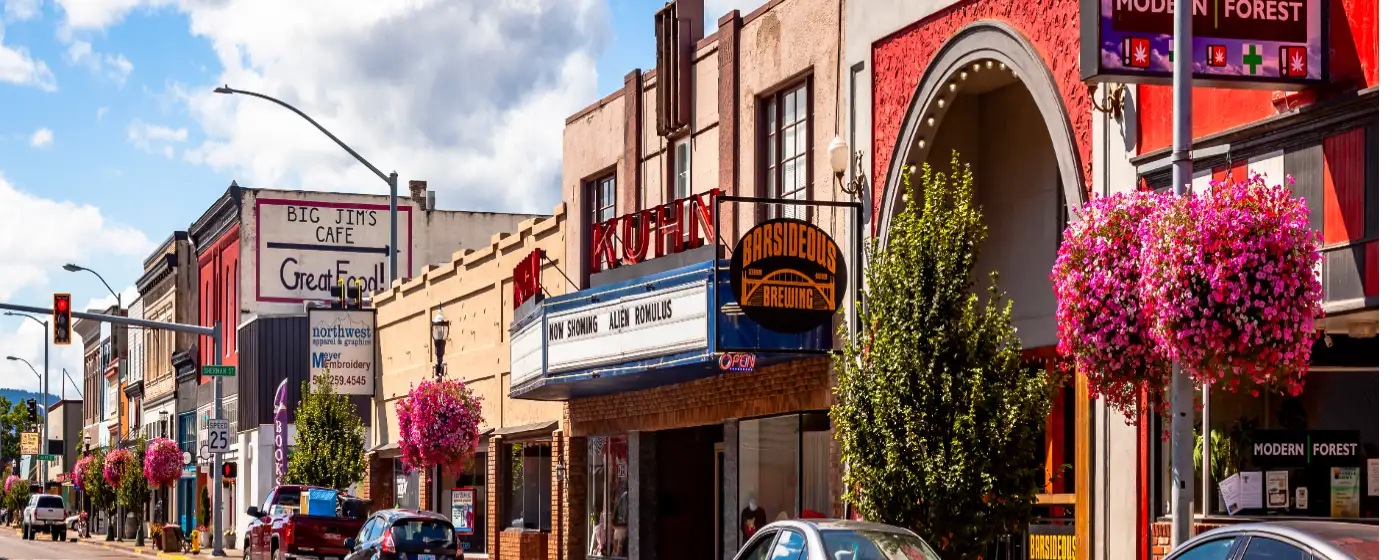
The question almost every buyer moving to Lebanon eventually asks is the same one: what's the crime situation, really? Not the headline number — the lived experience. Lebanon is a working-class Willamette Valley city of 19,950 people, positioned along US-20 (Santiam Highway) roughly 20 minutes to Albany and within reach of both Corvallis and Eugene. It is not a resort town or a tech corridor, and it does not carry the sanitized reputation of some of its neighbors. What it does carry is a crime profile that the raw numbers suggest is considerably safer than Oregon's state average and meaningfully safer than the national average — and a trend line that has been moving in the right direction for several years.
The numbers behind that claim come from federal crime reporting data, 2024: Lebanon records a violent crime rate of 2 per 1,000 residents and a property crime rate of 10.9 per 1,000 residents. Oregon's statewide figures for the same year run to 3.3 per 1,000 for violent crime and 24.5 per 1,000 for property crime — making Lebanon's property crime rate less than half the state average. The national comparison is similar: the national violent crime rate is 3.7 per 1,000 and the national property crime rate is 18.4 per 1,000. Those gaps are real and worth taking seriously. The engine renders a full comparison table immediately below the first section, so you can see the figures side by side.
Trend matters as much as snapshot. Property crime in Lebanon has decreased for four consecutive years, and violent crime has decreased for two, according to SafeWise's 2026 Oregon reporting. That kind of sustained downward movement across both categories is more meaningful than a single-year figure. At the same time, Lebanon is not crime-free, and the distribution across the city is uneven — something that matters a great deal when you are choosing a specific neighborhood. The east side is consistently regarded as the quietest part of the city; the commercial corridors closer to the western side see more activity.
Whether you are weighing Lebanon against Albany, considering specific neighborhoods, or simply trying to understand what safety looks like day to day in a small Oregon city, the sections below walk through the data, the geographic picture, what the police department is doing locally, and what residents actually notice on the ground.
How Lebanon's Crime Rate Compares to Oregon and the Nation
| Measure | Lebanon | Oregon | National | vs. national |
|---|---|---|---|---|
| Violent crime (per 1,000) | 2 | 3.3 | 3.7 | 46% lower |
| Property crime (per 1,000) | 10.9 | 24.5 | 18.4 | 41% lower |
State and national figures — Bureau of Justice Statistics, Crime Known to Law Enforcement, 2024 (tables 2 and 3). City figures — NeighborhoodScout. City rates come from a different reporting series than the state and national benchmarks, so read the comparison as a direction, not a precise multiple.
Lebanon's headline numbers hold up well against any reasonable benchmark. The city records a violent crime rate of 2 per 1,000 residents, which sits well below both Oregon's 3.3 per 1,000 and the national figure of 3.7 per 1,000. The city also records a property crime rate of 10.9 per 1,000 residents — well below Oregon's 24.5 per 1,000, a gap large enough to be meaningful rather than statistical noise.
All four figures come from the same federal crime reporting series for 2024, which means the comparison is direct. Mixing reporting series — say, using one source's figures for Lebanon alongside a different survey's national baseline — can make differences look larger or smaller than they actually are. Keeping the same series across all four benchmarks is what makes the comparison trustworthy.
What the numbers don't tell you is anything about where within Lebanon those incidents happen. The city-wide rate is the average across all neighborhoods, commercial corridors, and the downtown core. As with almost every city of Lebanon's size, the distribution is not uniform — and that geographic picture is where the useful information for neighborhood-level decisions lives.
The Geographic Safety Picture: East vs. West
The most consistent finding from crime data is that Lebanon's east side is its quietest. Residents and local crime mapping both point to the eastern residential zones as the part of the city where incidents are fewest. That perception aligns with how incident data is distributed across the city.
The western and commercial areas of Lebanon, particularly near higher-traffic arterials along US-20, see more activity. This is not unusual for a city with industrial employment and through-traffic — those zones attract more foot traffic, more commercial activity, and consequently more of the opportunistic property crime that drives the property crime rate more than any other category.
What This Means by Neighborhood
Cascade Estates and Wagon Wheel Estates sit on the eastern and northeastern edges of the city and reflect the quieter character that the data associates with that part of Lebanon. Cheadle Lake and Burkhart Creek are also in the northeastern quadrant, anchored by Cheadle Lake Park and the South Santiam River corridor — areas that draw buyers who want outdoor access along with residential calm. These neighborhoods are covered in more depth on the best neighborhoods page.
Downtown Lebanon and Santiam Place occupy the commercial core and the corridors near it. Downtown's proximity to commercial foot traffic gives it a more active and less uniformly quiet character than the residential east side — the city's Downtown Building Restoration Program has been encouraging improvements that fit the area's historic style, which is a positive signal for long-term investment, but buyers drawn primarily to a quiet residential environment will find it on the other side of the city.
South Lebanon sits at the city median on the pricing scale and carries a mixed character — more residential than the downtown core, but without the remove from commercial corridors that the eastern neighborhoods provide. Patton Place, tucked further south, tends toward a quieter residential feel as well.
The practical takeaway: if you are comparing two properties in Lebanon and safety is a priority, the east-of-center neighborhoods are consistently where residents and the data point. That does not make the rest of the city unsafe by any statewide or national standard — it just means the distribution within the city is not flat.

Trend Lines: Is Lebanon Getting Safer?
The direction of travel is encouraging. Property crime has fallen for four consecutive years, and violent crime has decreased for two straight years — that is a sustained multi-year pattern rather than a single good year following a bad one. Trend data tracking through mid-2026 places Lebanon's crime rate noticeably below the U.S. average.
Five-year trend data shows declines in both violent and property crime over that window, which means the improvement predates any single administrative change and reflects something more structural about how the city is evolving. For a buyer evaluating Lebanon against the snapshot-based reputation a city sometimes carries, the trend line is as important as the current-year figure.
None of this means Lebanon has resolved every challenge a working-class Oregon city of its size faces. Property crime — vehicle break-ins, theft from cars and yards — remains the category that shows up most in resident conversations. That category is also the one where individual choices about where you park, how you secure a vehicle, and which part of the city you live in make the most practical difference. The city records a property crime rate of 10.9 per 1,000 residents, which is low relative to Oregon and the nation, but it is not zero, and in a city this size, most residents will know someone who has had something taken.
Looking to buy in Lebanon? Estimate your payment.
Enter your numbers to see an estimated monthly mortgage payment.
Estimate only. Excludes HOA fees and mortgage insurance. The interest rate above is a starting point, not a quoted rate — replace it with your own to see real numbers. Insurance is a flat placeholder, not a Lebanon quote.
Lebanon Police Department: Staffing and Community Programs
Lebanon's Police Department is a locally staffed department whose patrol presence is visible across the city's commercial and residential areas. The programming the department runs goes beyond patrol — and that community engagement is part of what moves the numbers over time.
The LPD operates a Neighborhood Watch program across the city, which is one of the most effective community-level tools for suppressing opportunistic property crime. Active block-level watch programs tend to push down exactly the category — thefts, vehicle break-ins, vandalism — that drives Lebanon's property crime rate. If you are choosing between neighborhoods and community engagement is part of your thinking, it is worth asking which areas have active watch groups.
The department also runs a Citizens Police Academy — a program covering laws, firearms instruction, defensive tactics, and criminal investigation — and hosts Project ChildSafe, a firearms safety education program. Residential and business alarm permits are available through the city, reflecting a practical approach to reducing response time for incidents when they do occur.
The Citizens Police Academy in particular is the kind of program that signals a department trying to build actual community relationships rather than simply issue reports. It is open to residents and gives participants a working understanding of how local law enforcement operates — something that is easy to overlook until you are actually living somewhere and wondering who to call and what happens next.
What Residents Notice After Six Months
New residents who move to Lebanon from larger metro areas — Portland, Salem, even Eugene — often find the day-to-day safety picture less fraught than they anticipated. What does catch people off guard is how much of the property crime in Lebanon is concentrated around vehicle-related theft: items left visible in cars, unsecured bikes, and porch package theft. These are not unique to Lebanon, but in a city where many households are working-class and garages are not universal, leaving anything of value visible in a parked car is the single most reliably preventable risk. It is the kind of thing that feels obvious once someone tells you, and nobody warns you about it before you move.
Putting Lebanon's Safety in Context: Who This City Tends to Work For
Lebanon is safer than the Oregon state average and safer than the national average on both violent and property crime, measured by the same reporting series. That is a meaningful statement for a city that is not wealthy, not suburban-insulated, and not drawing buyers on the strength of a glossy downtown. The safety profile here is earned through sustained improvement, not structural privilege.
For families with school-age children, the eastern neighborhoods — Cascade Estates, Wagon Wheel Estates, Cheadle Lake, Burkhart Creek — offer the combination of residential calm and proximity to parks that tends to matter most. The improvements underway at Cheadle Lake Regional Park, including ADA-accessible parking, paths, lighting, and a restroom connection creating a continuous trail from south Lebanon to River Park, are the kind of infrastructure investments that reinforce long-term neighborhood stability. For more on how neighborhoods compare in character and livability, see the best neighborhoods page.
Buyers drawn to Historic Main Street and the downtown core are choosing a different trade-off: more walkable activity, an improving commercial streetscape supported by the city's Downtown Building Restoration Program, and a more mixed residential-commercial environment. That environment is not dangerous by any meaningful benchmark — it is simply less quiet than the east side, in the same way that every city's commercial core is less quiet than its residential edges.
If you are comparing Lebanon against Albany or Sweet Home on safety alone, the city-level data does not give you a dramatic difference that should drive the decision. What matters more at that level of comparison is neighborhood selection within Lebanon — the gap between the city's quietest areas and its most active corridors is larger than the gap between Lebanon and its nearby neighbors. A well-chosen block on the east side of Lebanon is, by the data, a genuinely calm place to live. For how Lebanon stacks up on cost of living and the broader picture of daily life, the cost-of-living page covers those details.
The case for Lebanon on safety is straightforward once you read past the surface: the city records a violent crime rate of 2 per 1,000 residents, a downward trend across five years is real, and a Police Department that runs Neighborhood Watch programs and community academies is doing the work that moves those numbers. The honest qualification is that property crime, while well below state and national averages, is the category that residents actually encounter — and it is concentrated enough in specific corridors and on specific behaviors that informed decisions about neighborhood and vehicle security go a long way.
Local Expert Takeaway: Lebanon's crime numbers are genuinely better than Oregon's state average — particularly on property crime, which runs less than half the statewide rate. The east side of the city, including neighborhoods like Cascade Estates and Cheadle Lake, is where both the data and local perception consistently point as the quietest part of town. Vehicle-related theft is the most common practical concern residents mention; it is also the most preventable. The Lebanon Police Department's Neighborhood Watch program and Citizens Police Academy reflect a department that is engaged beyond patrol. For buyers weighing Lebanon against nearby cities, the within-city geography matters more than the city-vs-city comparison — choose the right neighborhood and you are in one of the calmer corners of the Willamette Valley.
Quick Takeaways & FAQs
✅ Lebanon records a violent crime rate of 2 per 1,000 residents — well below both Oregon's statewide rate and the national figure, a genuine advantage that shows up in the data year after year.
⚠️ Property crime, while still below the state average, is the category residents most commonly encounter — and it concentrates near commercial corridors on the west side, not in the residential eastern neighborhoods.
📍 The Lebanon Police Department runs an active Neighborhood Watch program and a Citizens Police Academy open to residents — both worth looking into before settling on a specific block.
Is Lebanon, Oregon a safe place to live?
Which neighborhoods in Lebanon, Oregon are the safest?
How does Lebanon's crime rate compare to the rest of Oregon?
Is crime in Lebanon getting better or worse?
What does the Lebanon Police Department do to engage the community on safety?
Moving to Oregon?
Tell us what you need help with and we'll connect you with local resources.
