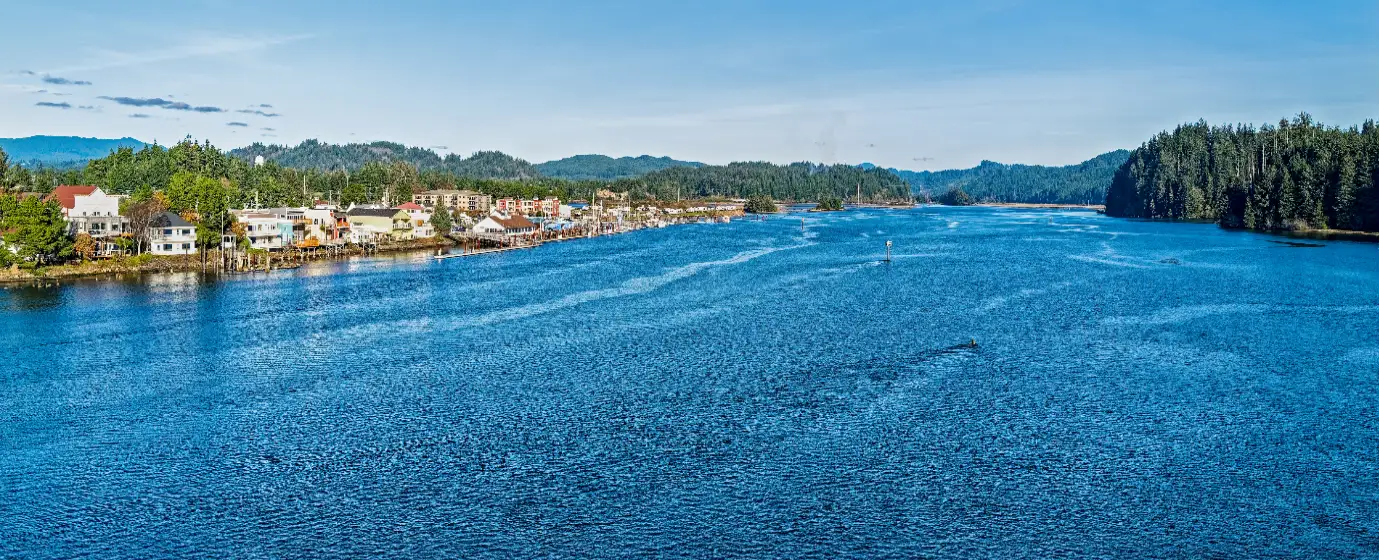
Florence sits on the Oregon coast where US-101 meets OR-126, roughly equidistant between the dunes and the mountains, and it carries a cost structure that surprises a lot of buyers. Housing is doing most of the heavy lifting on the above-average cost side — everything else in town is only modestly above national norms. What you're paying for, almost entirely, is a piece of the Oregon coast.
The city of 9,480 people has a narrow economic base anchored by the Siuslaw School District, PeaceHealth Peace Harbor Medical Center, the City of Florence itself, and Three Rivers Casino Resort. Remote workers and retirees have become an increasingly visible segment of the population, drawn precisely because Florence is affordable relative to the coastal towns between here and the California border — and because OR-126 gives you a route inland to Eugene when you need the full services of a university city. The Siuslaw School District, with 1,178 students enrolled in 2025-26, holds a B- rating, according to Niche — a realistic picture of a small district doing steady work with limited resources.
The median household income here is $53,333 — a figure that tells a real story about who lives in Florence and how they get by. That income level sits well below what's needed to comfortably carry a home at the current typical price, which means many residents are long-tenured owners, cash buyers arriving from higher-cost markets, or renters holding on. Groceries run modestly above the national average, utilities are higher than you'd expect for the Pacific Northwest, and most errands mean a drive. For groceries, appointments, and anything not on a bus route, a personal vehicle is a practical necessity.
Whether you're pricing out a retirement move, weighing a remote-work relocation from the Bay Area, or just trying to understand what the numbers actually mean before you make an offer, the sections below break down Florence's housing costs, everyday expenses, how it compares to nearby towns, and the full Oregon tax picture.
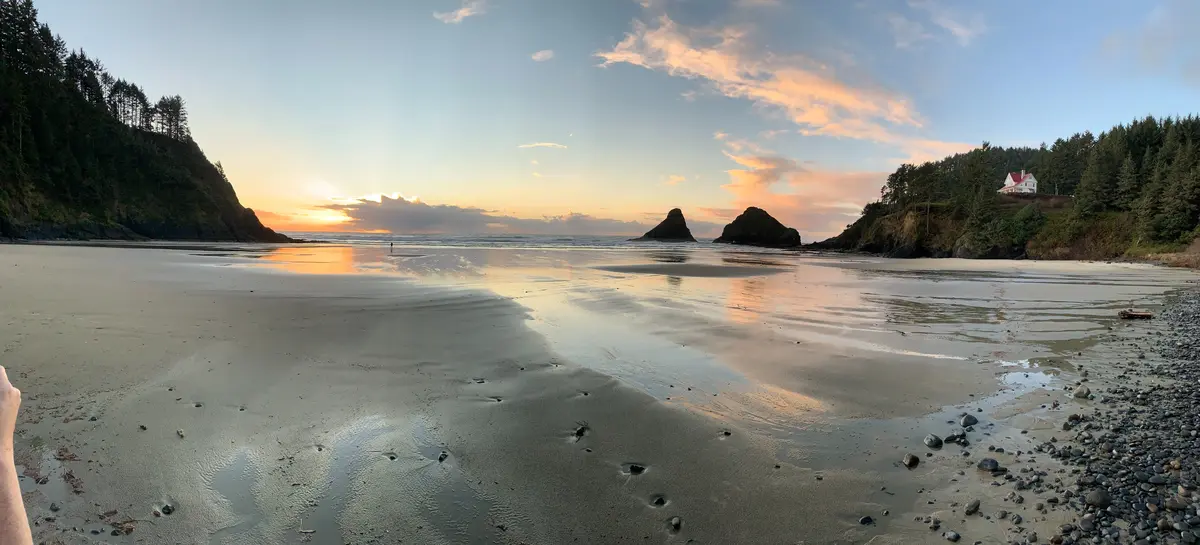
What It Really Costs to Live in Florence
Florence is not a cheap coastal town — but it is one of the more affordable ones on the Oregon coast. Above-average costs are concentrated almost entirely in housing. Non-housing line items — groceries, transportation, utilities — run only modestly above national norms, and the overall picture is broadly consistent with Oregon as a whole.
That structure means two households in Florence can have very different experiences depending on whether they own or rent, when they bought, and whether they commute to Eugene. A remote worker who bought several years ago at a lower basis lives in a genuinely reasonable coastal town. A first-time buyer entering the market today faces a meaningful affordability gap between Florence's typical home price and what the median local income can support.
The honest overall posture: Florence costs more than most inland Oregon cities, less than the desirable coastal towns to the north, and noticeably less than the California coastal markets that send a steady stream of buyers up US-101. It rewards buyers who come in with equity, cash, or a remote-work income that isn't pegged to Lane County wages. For those earning a local salary, the math is tighter than the scenery would suggest. The first-time homebuyer guide covers the financing tools available for buyers working with that gap.
Housing: Rent vs. Buy in Florence
The typical home in Florence was priced at $452,369 as of July 2026, according to the Zillow Home Value Index. That figure reflects the sustained premium attached to Oregon coast real estate — a market shaped as much by retirees, second-home buyers, and remote workers as by local wage earners.
Entry-level inventory does exist, generally in the form of older manufactured homes, smaller single-family houses away from the waterfront, and properties needing work. Buyers who want to stay south of that typical price point will find their options concentrated in the less scenic, less convenient pockets of the city — and even then, finding something well under $350,000 in livable condition takes patience. The neighborhood guide maps out where the different price tiers actually cluster.
The affordability math is worth understanding plainly: the median household income here is $53,333, and that figure falls well short of what's needed to carry the typical home comfortably. That gap is why Florence's buyer pool skews toward equity-laden relocators and retirees rather than local first-time buyers. If you're coming from a higher-cost market and selling before you buy, the numbers look very different than if you're a Lane County wage earner buying for the first time.
The effective property tax rate is approximately 0.86%. That sits near the middle of Oregon's statewide range and is meaningfully below the rates buyers encounter in California — a real factor for the coastal California transplant doing side-by-side comparisons. The mortgage calculator on this page will let you model the monthly picture at current rates with your own down payment.
Renting in Florence is a practical choice for anyone who isn't certain they're staying, anyone waiting for the right property to come available, or anyone who arrived from out of state and wants to learn the city before committing. The rental market here is not deep — Florence is a small city and inventory turns slowly — which means good rentals tend to go quickly and the selection at any given moment is limited. Buyers who can wait for the right property while renting often come out ahead of those who rush a purchase in a thin market.
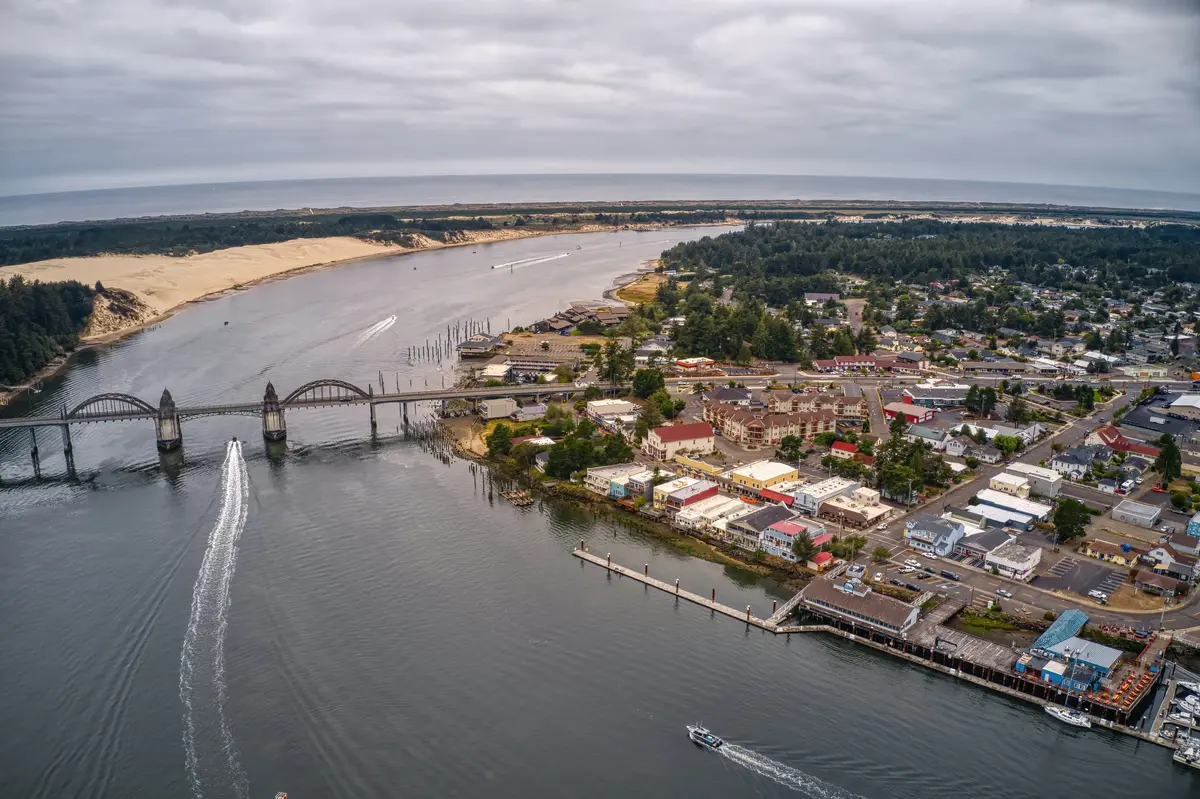
Everyday Costs Beyond Housing in Florence
| Category | Typical Monthly Cost | Notes |
|---|---|---|
| Utilities | $190–$270/mo | Electricity, gas, water, sewer, trash |
| Groceries | $560–$760/mo | Food at home, household of 2–3 |
| Transportation & Gas | $200–$340/mo | Fuel, and transit where it is a real option |
| Phone & Internet | $110–$180/mo | Mobile plan plus home broadband |
| Misc / Discretionary | $220–$420/mo | Dining out, entertainment, subscriptions |
Non-housing figures are estimates for a household of two to three, not a sourced index; housing is the city-wide typical rent. Refreshed with the rest of the city data.
The coastal climate is the single biggest driver of Florence's above-average utility bills. This stretch of the Oregon coast doesn't get extreme cold, but it is persistently damp, foggy, and cool — the kind of climate that runs a heat pump or a baseboard heater almost every month of the year. Combined electricity, gas, water, and trash costs run approximately $199 per month, noticeably above the national average. The electricity itself is a relative bargain through Central Lincoln PUD, whose rates run well below the national average — it's the volume of year-round use that pushes the combined bill up, not the rate. The city approved adjustments for water, wastewater, and stormwater services effective July 1, 2026, as part of its 2025–27 biennial budget cycle.
Groceries run modestly above the national norm, reflecting the standard premium that rural, coastal Oregon towns pay for goods transported over distance. Monthly grocery spending for a typical household lands around $450–$500, which is higher than Eugene or Corvallis but comparable to other small coastal communities in the region.
Transportation costs are shaped almost entirely by car ownership. Most errands mean a drive, and a personal vehicle is a practical necessity for daily life in Florence. The Link Lane Eugene-Florence Connector bus offers a lower-cost alternative for the run inland, and the Lane Transit District's Rhody Express covers an in-town circuit — useful, but not a substitute for a car for the full range of daily needs. Factor vehicle costs as a fixed and significant line item, particularly if you're making the roughly 60-minute run to Eugene via OR-126 on any regular basis.
Looking to buy in Florence? Estimate your payment.
Enter your numbers to see an estimated monthly mortgage payment.
Estimate only. Excludes HOA fees and mortgage insurance. The interest rate above is a starting point, not a quoted rate — replace it with your own to see real numbers. Insurance is a flat placeholder, not a Florence quote.
Florence vs. Nearby Towns: The Cost Trade-Off in Words
Florence sits at a middle tier among the coastal and near-coastal towns in its orbit. Smaller communities like Reedsport and Mapleton carry noticeably lower home prices than Florence, and Waldport is somewhat lower as well. The catch with each of those alternatives is real: Reedsport is more isolated and has a thinner service base, Mapleton is genuinely rural with longer drives for nearly everything, and Waldport offers a quieter coastal character but fewer local amenities. Florence's deeper inventory and broader local services — the hospital, the casino resort, the more varied retail — partly explain why it commands a premium over those neighbors.
On the other side, Lincoln City and Newport are broadly comparable to Florence on price or carry a higher typical figure, and they bring more tourist infrastructure with them. More services often means more traffic and more seasonal congestion, which is the trade many buyers are explicitly trying to avoid when they choose Florence instead.
Eugene, inland via OR-126, carries higher home prices than Florence and no coast access — but it offers a university city's full range of employers, schools, and amenities. A significant share of Florence residents maintain that link on a regular basis, either for work, medical care, or the kind of shopping that a serious trip out of town provides. That 60-minute corridor is one of the more important geographic facts shaping daily life and household budgets here.
California coastal markets — the towns many Florence buyers are arriving from — sit in a different category entirely. Florence's housing prices look moderate by that comparison, its property tax rate is substantially lower, and the overall cost structure is friendlier even accounting for Oregon's income tax. The moving from California guide works through that comparison in detail.
Taxes & the Bottom Line for Florence
Oregon's Tax Structure: The Trade-Off You Need to Understand
Oregon has no general sales tax. Every grocery run, hardware purchase, and clothing buy happens at the sticker price. For a household that tracks its discretionary spending closely, this is a genuine and recurring saving — one of the most tangible financial advantages of living anywhere in Oregon.
The trade-off is on the income side. Oregon's state income tax is progressive, with four brackets running from 4.75% to 9.9% for the 2025 tax year. The top 9.9% rate applies to single filers above $125,000 of taxable income. For households earning in the $53,333 range that characterizes Florence's median, the effective rate lands well below the top bracket — but it is still a real bite compared with states that use sales tax as the primary revenue mechanism.
Oregon does not tax Social Security or Railroad Retirement Board benefits, which is a meaningful structural advantage for the retirees who make up a significant share of Florence's population. For a full picture of how Oregon's tax structure interacts with a retirement income, the retiring in Florence guide goes deeper.
Property Tax: Below the State Midpoint
The effective property tax rate of approximately 0.86% is at or slightly below the Oregon statewide average, depending on the year. Applied to the price point discussed earlier, it produces a tax bill that many California transplants find genuinely low — California's Proposition 13 creates an unusual baseline for that comparison, but even against non-Prop-13 states, Oregon's coastal property tax load is moderate.
Who Florence's Budget Fits
Florence is a realistic financial fit for remote workers earning salaries benchmarked to larger markets, for retirees arriving with equity from a higher-priced region and fixed income that doesn't depend on local wages, and for buyers willing to accept a longer commute to Eugene in exchange for the coast. It is a genuine stretch for buyers relying solely on local wages, for households that need urban amenities close at hand, and for anyone who looks at the income-to-home-price gap and finds it unbridgeable without outside equity. The landscape, the Oregon Dunes National Recreation Area, the pace of life, and the tax structure are real draws. The housing cost relative to local incomes is the honest counterweight, and anyone doing the math seriously should start there.

Local Expert Takeaway: Florence's cost picture is simpler than it looks: housing is the only line item that's genuinely elevated, and everything else sits only modestly above national norms. The buyers who make the math work are almost always coming in with equity from a higher-cost market — California, the Portland metro, coastal Washington — and treating the OR-126 commute to Eugene as an occasional rather than daily commitment. If you're a first-time buyer working a local salary, the gap between the median household income and the typical home price is real and requires a strategy, not just a mortgage pre-approval. Start with the first-time homebuyer guide, then use the neighborhood comparison to find where entry-level inventory actually clusters.
Quick Takeaways & FAQs
✅ Florence's effective property tax rate of approximately 0.86% is at or slightly below the Oregon statewide average — and well below what California transplants are used to paying.
⚠️ The median household income of $53,333 falls well short of what's needed to comfortably carry the typical Florence home, making local affordability a genuine challenge for first-time buyers without outside equity.
📍 Central Lincoln PUD keeps electricity rates well below the national average, but the coastal climate's year-round heating demands push the combined monthly utility bill to approximately $199 — noticeably above the U.S. norm.
Is Florence, Oregon expensive to live in?
What is the property tax rate in Florence, Oregon?
Does Oregon have a sales tax that affects Florence residents?
What are typical utility costs in Florence, Oregon?
Is it cheaper to live in Reedsport or Waldport than Florence?
Moving to Oregon?
Tell us what you need help with and we'll connect you with local resources.
