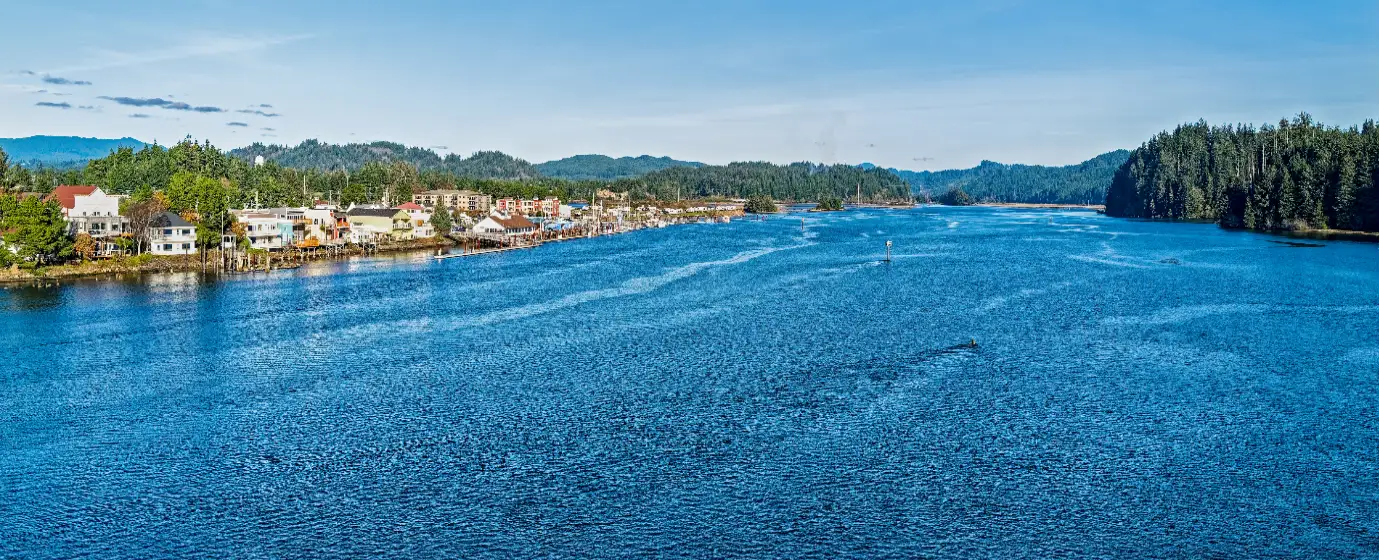
Oregon ranked first in the nation for inbound migration in the United Van Lines 2025 National Movers Study, and California was the single largest source — accounting for 22% of all arrivals. A meaningful share of those Californians end up on the coast, and Florence keeps appearing on the shortlist. It sits at the mouth of the Siuslaw River on the central Oregon Coast, connected north and south by US-101 and linked inland to Eugene by OR-126. The draw is real: oceanfront living, old-growth dunes, a river-mouth town with an actual main street, and prices that look almost impossible compared to what you left behind.
Florence is a city of 9,480 people — genuinely small, in a way that San Diego or Sacramento residents underestimate until month two. The Siuslaw School District 97J holds a B- rating, according to Niche, with 1,178 students enrolled in 2025-26. The employer base is anchored by the school district, the city government, Three Rivers Casino Resort, and the tourism economy that runs along US-101. A significant portion of the working population either commutes about 60 minutes to Eugene or works remotely — a fact worth sitting with before you make an offer if you need a local job market.
On the cost side, Florence's overall cost of living runs modestly above the U.S. average, with housing as the primary driver — but that framing exists relative to national norms, not to California. The typical home price here was $452,369 as of July 2026 (Zillow Home Value Index), against a cost-of-living picture where groceries run below the national average and there is no state sales tax to add to every purchase. The weather trades California sunshine for something greener and grayer: Florence averages 160 sunny days a year, and the fog that softens every summer morning is either atmospheric or exhausting depending on where you're standing.
Whether you're pricing out the move or deciding between Florence and somewhere inland, the sections below walk through what the California-to-Florence shift actually looks like in numbers and in daily life — home prices, the tax picture, the lifestyle trade, what Californians tend not to expect, and where to look once you've decided to stay.
The Home Price Reality: What Your California Budget Buys Here
The number that stops most Californians mid-scroll is the typical home price: $452,369 as of July 2026 (Zillow Home Value Index). Compared with California's statewide typical home value of $773,735, Florence's figure is noticeably lower — and for buyers coming from coastal California metros, the gap is wider still.
What that price buys in Florence is different from what it buys inland. This is a coastal town where oceanfront and river-view properties command a premium, and where the inventory of newer construction is thinner than buyers from growth-corridor California are used to seeing. Entry points exist in areas like Three Mile Prairie and Florence West; Old Town Florence and Heceta Beach pull prices upward. A California budget that felt tight at home can look genuinely competitive here — but it does not guarantee a turnkey waterfront property.
One thing worth understanding before you assume cash-out equity makes Florence easy: the median household income in Florence is $53,333, which is well below what it takes to carry the typical home at current rates. That gap tells you something about who buys here — retirees, remote workers with California salaries, and equity-rich transplants — and it also tells you that local comps are not driven by local wages. If you are bringing a California salary with you, you are in a structurally different position than the local buyer pool.
Oregon's Property Tax Protection
Oregon's effective property tax rate on a Florence home runs approximately 0.86% — higher than California's effective property tax rate of 0.71%, but not dramatically so. The more meaningful difference is structural. Oregon's Measure 50 caps the annual increase in a home's assessed value at 3% per year after purchase, regardless of market appreciation — a protection that works similarly to California's Proposition 13. Californians who understand Prop 13's logic will recognize the mechanic: your tax bill grows slowly even when the market does not.
For a full breakdown of what you pay beyond the mortgage — property tax, grocery costs, utilities — see the Florence cost-of-living page.
| Factor | California (Statewide) | Florence, Oregon |
|---|---|---|
| Typical home value | California's statewide typical home value of $773,735 | $452,369 (July 2026, Zillow ZHVI) |
| Effective property tax rate | California's effective property tax rate of 0.71% | ~0.86% |
| Assessed-value growth cap | Proposition 13 (2% annual cap) | Measure 50 (3% annual cap) |
| State sales tax | California's statewide base sales tax rate of 7.25% (higher locally) | None (0%) |
| Top state income tax rate | California's top state income tax rate of 13.3% | 9.9% (above $125K single filer) |
| Nearby coastal alternative | — | Waldport: somewhat lower than Florence |
* ZHVI = Zillow Home Value Index.
Taxes: The Full Picture, Not Just the Headline
The most-quoted number in every California-to-Oregon comparison is the income tax, and it deserves an honest reading. California's top state income tax rate of 13.3% applies only to the highest earners — incomes above $1 million for single filers. Oregon's top rate of 9.9% kicks in at $125,000 of taxable income for single filers. That compression matters: many middle-income earners pay a higher effective state income tax rate in Oregon than they would have in California on wages alone.
The Oregon income tax advantage is clearest for high earners and remote workers who were previously subject to California's top bracket. If you are a software engineer, a consultant, or anyone whose California income put you near or above the 13.3% threshold, the move to Florence is a meaningful tax improvement. Once you establish Oregon residency, you pay Oregon income tax — not California's — on income earned remotely.
Where Oregon Clearly Wins: Zero Sales Tax
For most Florence transplants, the single clearest financial improvement is the sales tax. Oregon has no state sales tax — one of only five states with a 0% rate. California's statewide base sales tax rate of 7.25% already adds up on a household spending $40,000 to $55,000 annually on taxable goods; in cities where local additions push the combined rate to 10.25% or higher, the annual bill on everyday spending runs into thousands of dollars. In Florence, every one of those dollars stays in your pocket.
The practical effect shows up immediately: groceries, clothing, furniture, a kayak for the dunes — none of it carries a sales-tax line in Oregon. For retirees living on fixed income, that is a persistent, compounding advantage. For families with kids, it makes the weekly shop feel meaningfully cheaper than the sticker price.
What to Know If You Work Remotely
California is aggressive about taxing former residents who continue to earn California-sourced income after leaving. Once you establish a genuine Oregon domicile — full-time residence, Oregon driver's license, voter registration, the whole relocation — income you earn from non-California clients or employers is taxed by Oregon, not California. Remote workers moving to Florence should document the transition carefully; it is worth a conversation with a tax professional in the move year, when the split-year calculation is most consequential.
Daily Life Trade-offs Californians Don't Expect
Six months in, the thing most California transplants mention is not the rain — it is the pace. Florence is a city of 9,480 people, and it functions like one. There is no freeway interchange, no big-box retail corridor, and no coffee chain on every corner. A serious shopping run means driving out of town. Eugene, about 60 minutes inland on OR-126, is where Florence residents go for the things a small coastal city cannot support: a larger grocery selection, specialty retail, medical specialists, and the airport.
The tradeoff is real, and it sorts people quickly. Californians who moved from a mid-sized suburb and still want suburban amenities within five minutes tend to find Florence under-equipped. Californians who moved because they wanted to be done with that kind of city find it exactly right.
The Weather Reality
Florence averages 160 sunny days a year. That is not a typo, and it is not coastal fog being euphemistically rebranded as sunshine. The Oregon Coast is genuinely overcast through much of the year — cool, damp summers are the norm rather than the exception. Californians from the Bay Area adapt faster than those from San Diego or the Inland Empire, where 300-plus sunny days are the actual baseline. The fog that rolls in off the Pacific most summer mornings burns off, sometimes. It does not always.
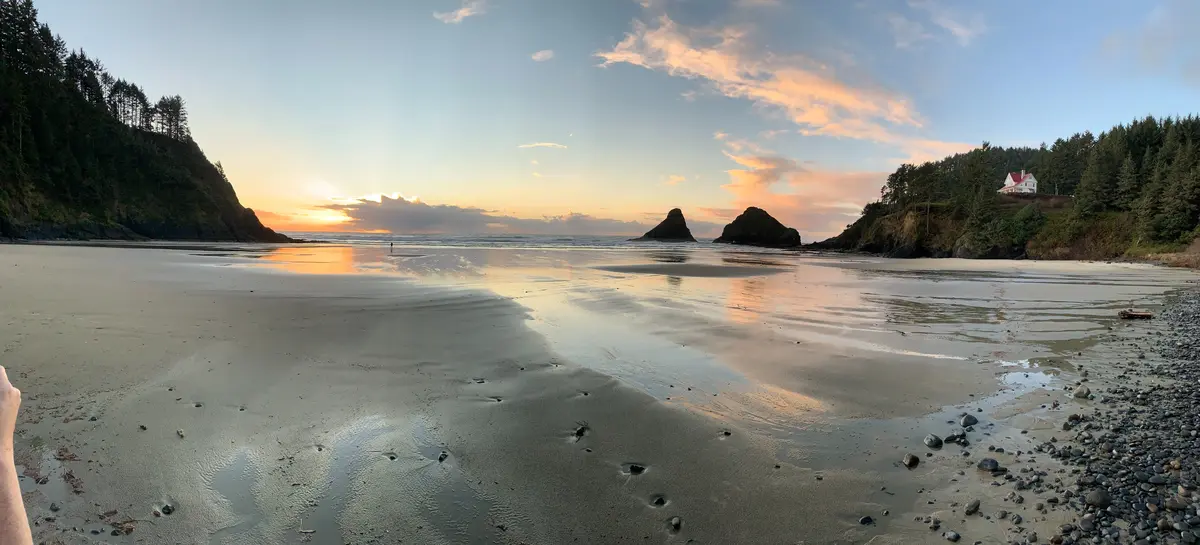
What the coast offers instead is green — intensely, permanently green — and a quietness on the beach in February that no California coastal city can match at any price. Heceta Head Lighthouse State Scenic Viewpoint on a clear winter afternoon is a different kind of beautiful from anything on the California coast, and locals know it. The people who stay lean into the gray as scenery rather than resenting it as weather.
The Affordability Paradox
Florence's cost of living runs modestly above the U.S. average, with housing as the leading factor. Food costs run below the national average. But the median household income of $53,333 is well below what it takes to carry the typical home, which means Florence is not naturally affordable for the people who already live here — it is affordable for people arriving with California equity or California salaries. That dynamic shapes the social fabric of the city in ways worth understanding before you move: this is a town where many longtime residents rent, where the local job market is thin, and where the buyer pool is disproportionately retirees and remote workers.
Health insurance premiums run noticeably below what you were paying in California, though you will drive farther for specialist care, with advanced care available about 60 minutes inland in Eugene.
Looking to buy in Florence? Estimate your payment.
Enter your numbers to see an estimated monthly mortgage payment.
Estimate only. Excludes HOA fees and mortgage insurance. The interest rate above is a starting point, not a quoted rate — replace it with your own to see real numbers. Insurance is a flat placeholder, not a Florence quote.
Weekends and Local Favorites
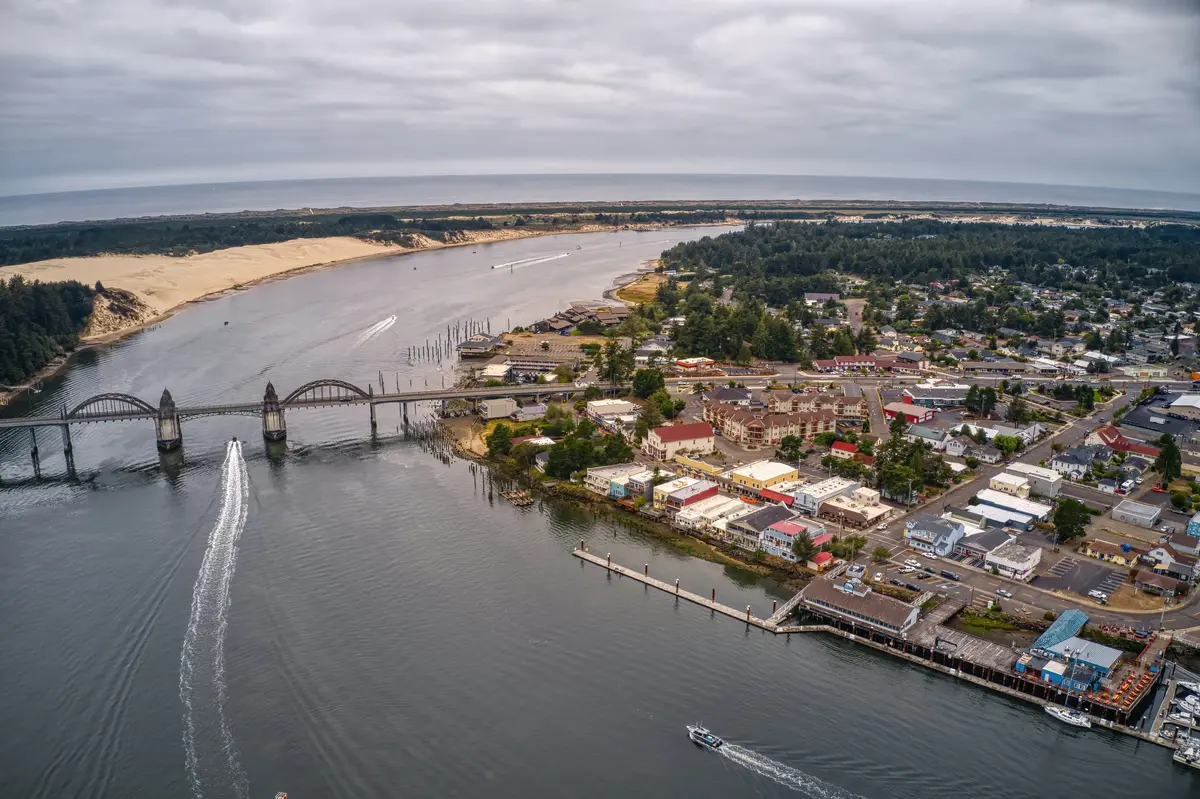
Florence's identity is built around the river and the dunes, and the weekly rhythm reflects that. The Siuslaw River waterfront boardwalk is where the city gathers on a good Saturday — especially in summer, when the Florence Farmers Market draws vendors and residents downtown. Historic Old Town Florence is compact but genuine: a handful of independent restaurants, coffee shops with water views, and a working waterfront that has not been converted entirely into tourism infrastructure.
The food scene worth knowing about: Mo's Seafood & Chowder is the long-running coastal institution for chowder; Waterfront Depot Restaurant occupies a converted historic building on the river and is a reliable dinner anchor. For breakfast and lunch, Little Brown Hen Cafe and 1285 Restobar both hold loyal local followings. For coffee, River Roasters, Old Town Coffee Company, The Dunes Cafe, and Fresh Harvest Cafe each have their regulars — the town is small enough that you will pick one and stick with it. Lovejoy's Restaurant & Tea Room offers something genuinely different: a proper tea service that stands apart from anything else on the central coast. Three Rivers Casino Resort adds a full entertainment and dining anchor that draws both residents and visitors.
The outdoors here is not a weekend add-on — it is the point. The Oregon Dunes National Recreation Area stretches roughly 40 miles, covering approximately 31,500 acres, with dunes reaching up to 500 feet. Cleawox Lake at Jessie M. Honeyman Memorial State Park offers swimming and boat rentals alongside access to the dunes. The Sea Lion Caves, the Darlingtonia Botanical Wayside, and Heceta Head Lighthouse State Scenic Viewpoint are all within a short drive and all genuinely worth a visitor's time — even after years of living nearby.
What Florence does not have is a performing arts center, a major league sports team, or the density of cultural programming that California metros normalize. Residents who need that kind of calendar make the drive to Eugene. People who want a slower, quieter rhythm find that Florence fills the hours just fine.
Should You Buy in Florence or Look Nearby?
Florence is not the cheapest point on the central Oregon Coast. Reedsport and Mapleton both carry noticeably lower typical home prices — smaller towns with thinner services and fewer amenities, but genuinely lower entry points if budget is the first filter. Waldport, north along US-101, is somewhat lower than Florence, with a quieter feel and easier access to Newport. None of those alternatives are wrong choices; they are different trade-offs.
For Californians specifically, Florence tends to win the comparison because it has the infrastructure a transplant expects: a known set of neighborhoods, a recognizable historic downtown, a local school district the Siuslaw School District 97J holds a B- rating, according to Niche — and a regional medical presence within city limits. The schools page covers the district in full, including what the proficiency data means for families with kids. The safety picture is broadly positive relative to state and national benchmarks.
The Neighborhoods in Brief
Old Town Florence and Shelter Cove attract buyers who want walkability and water proximity. Florentine Estates and Greentrees Village serve the 55-plus buyer looking for an established community. Three Mile Prairie and Munsel Lake / Munsel Creek Estates appeal to buyers who want more space and a quieter setting. Heceta Beach and Florence West round out the inventory on the western and northern edges. For a deeper look at what each area offers, the neighborhoods page walks through the character of each.
For Remote Workers and Retirees
The two groups who consistently land well in Florence are remote workers arriving with California incomes and retirees arriving with California equity. Remote workers get Oregon's income tax structure, zero sales tax, and a cost base that is dramatically lower than any California coastal equivalent — while keeping a salary calibrated to a more expensive market. Retirees get a paid-off or near-paid-off home in a place where the outdoors is the primary entertainment and the community is small enough to actually know. Neither group should expect Florence to feel like California eventually; it feels like itself from day one, which is either the whole point or the first sign it is not the right fit.
For buyers uncertain about the purchase process in Oregon — which differs from California in several respects — the first-time homebuyer page covers what to expect, and the living in Florence overview addresses the broader question of who the city suits.

Local Expert Takeaway: The Californians who thrive in Florence are the ones who stopped needing the city to perform. The $452,369 typical home price (July 2026) is real, the zero sales tax shows up on every receipt, and the Oregon Dunes are out the door and down US-101. What you give up is the infrastructure you stopped noticing you were using — the specialty retailers, the cultural calendar, the specialists available within twenty minutes. Eugene is about 60 minutes inland on OR-126, and for anything the coast does not carry, that is the answer. Make peace with that drive before you make an offer.
Quick Takeaways & FAQs
✅ Florence's typical home price of $452,369 (July 2026) is noticeably below California's statewide typical home value of $773,735, and Oregon's complete absence of a state sales tax adds a compounding financial advantage for everyday spending.
⚠️ The local job market is thin — the median household income sits well below what the typical home requires, and many residents either work remotely or commute about 60 minutes to Eugene — so arriving without a portable income or sufficient equity is a genuine risk.
📍 Florence averages only 160 sunny days a year; the fog and overcast that define the Oregon Coast are not a seasonal quirk but the year-round baseline, and California coastal transplants adjust to this at very different rates.
Is it cheaper to live in Florence, Oregon than in California?
What is the property tax rate in Florence, Oregon?
Can I keep working remotely for my California employer if I move to Florence?
What should California buyers know about Florence's real estate market?
How does Florence handle the lack of urban amenities compared to California cities?
Moving to Oregon?
Tell us what you need help with and we'll connect you with local resources.
