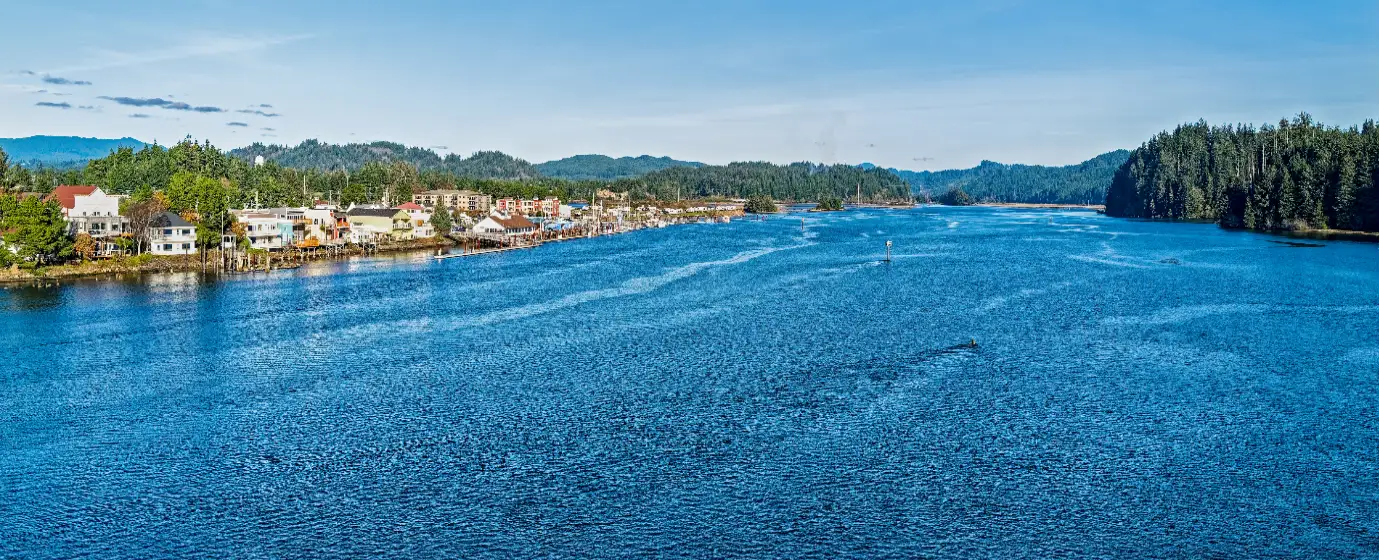
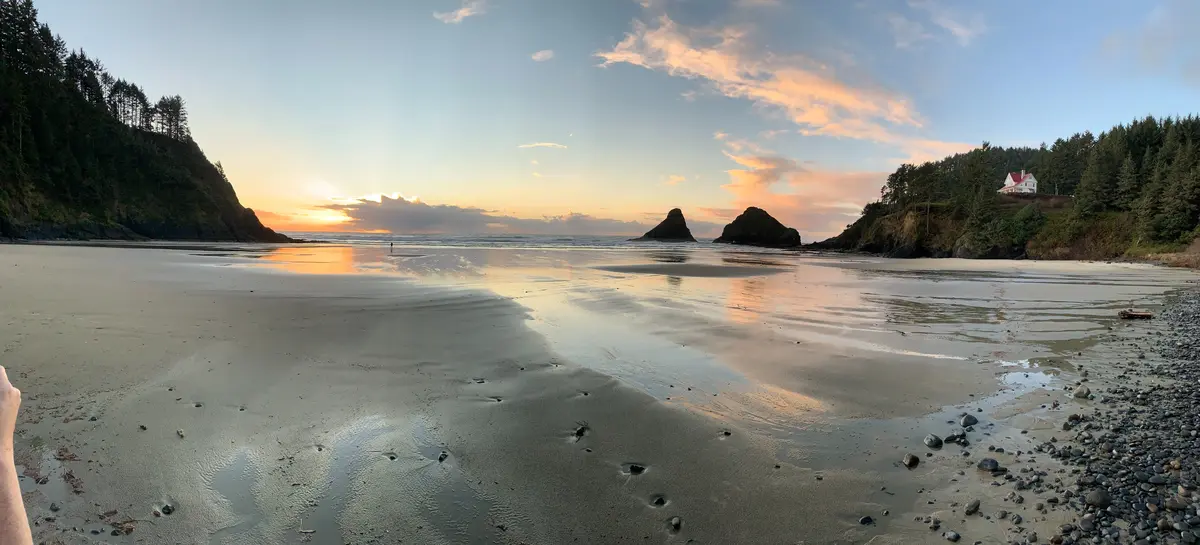
The first thing most people notice about Florence is the scenery — the Siuslaw River, the Oregon Dunes, Heceta Head Lighthouse on the bluff. The second thing, if they're researching a move, is the property crime rate. That number sits a little above the national average, and it stops some buyers cold. What those buyers often don't know is that Florence's permanent population of 9,480 swells to somewhere between 15,000 and 20,000 people every summer, according to the Florence Police Department. When crime rates are calculated against the permanent resident count rather than the actual daily population at the height of tourist season, the raw number looks heavier than the lived experience actually is.
Florence's violent crime picture is straightforwardly reassuring. The city carries a violent crime rate of 1 per 1,000 residents — compared to a state average of 3.3 per 1,000 and a national average of 3.7 per 1,000 (Bureau of Justice Statistics, Crime Known to Law Enforcement, 2024, tables 2 and 3). That gap is not marginal. Residents here face meaningfully lower personal-safety risk than most Oregonians, and far lower than the national baseline. Property crime is the more complicated story, and it is worth understanding in geographic detail before you decide on a neighborhood.
A property crime rate of 21.3 per 1,000 residents sits above the national figure of 18.4 per 1,000, but below Oregon's statewide average of 24.5 per 1,000. Oregon as a whole runs high on property crime relative to the rest of the country, so Florence's position — above the nation, below the state — reflects that regional pattern more than it reflects anything specific to this town. The crimes driving that number are auto theft, vehicle break-ins, and retail theft, not residential burglary. The distinction matters enormously when you are deciding where to live.
The sections below break down how crime distributes across Florence's neighborhoods, what the tourist-season surge actually means for safety, what the city is doing on the infrastructure and community side, and what coastal hazards mean for anyone thinking long-term about this specific stretch of the Oregon coast.
Florence Crime Rates in Context
Florence carries a violent crime rate of 1 per 1,000 residents — well below both the Oregon state average of 3.3 per 1,000 and the national average of 3.7 per 1,000, according to the Bureau of Justice Statistics, Crime Known to Law Enforcement, 2024 (tables 2 and 3). For a small coastal city, that is a meaningful distinction — not a marginal one.
A property crime rate of 21.3 per 1,000 residents is the number that gives some buyers pause. It sits above the national average of 18.4 per 1,000, though below Oregon's statewide average of 24.5 per 1,000. Oregon's property crime baseline has historically run elevated compared to the national figure, which means Florence is tracking with the state rather than standing out from it.
The engine below renders the full comparison across all four benchmarks. What the table can't show on its own is the denominator problem: those rates are calculated against Florence's 9,480 permanent residents, not the 15,000 to 20,000 people the city actually holds during peak summer months. A rate built on the resident count and applied during a period of near-doubled population reads higher than the underlying risk level for someone who actually lives here year-round.
Both violent crime and property crime have declined over the past five years — a trend line that the annual snapshot alone doesn't capture. Florence is not trending in the wrong direction.
Where Crime Concentrates: The Geographic Reality
Florence is not uniformly anything when it comes to crime. The distribution across neighborhoods is sharply uneven, and that unevenness is the most useful thing a prospective resident can understand.
The south end of the city — where commercial density concentrates along the US-101 corridor — accounts for a disproportionate share of the city's incidents. The north end of the city, by contrast, logs far fewer. That is not a small difference. It means the city's aggregate rate is being pulled significantly by one geographic area, and that area is commercial rather than residential in character.
What Drives the Southern Numbers
The crimes clustering in the south are auto theft, vehicle break-ins, and retail theft. High-turnover tourist parking near Historic Old Town Florence and along the southern retail strip creates exactly the conditions those crimes require: unfamiliar vehicles, distracted visitors, and transient foot traffic concentrated between May and September. Residential burglary is not the pattern here.
Crime heat maps that flag the Old Town waterfront area as elevated are reflecting visitor volume and parking turnover more than any elevated danger to residents. A local who lives north of the tourist core, in a neighborhood like Three Mile Prairie or Munsel Lake, is looking at a fundamentally different crime environment than the aggregate city rate implies.
Neighborhood Safety at a Glance
| Neighborhood | Character | Primary Safety Consideration | Best For |
|---|---|---|---|
| Three Mile Prairie | Residential, elevated terrain, quieter | Low incident count; away from tourist corridors | Families Quiet |
| Munsel Lake / Munsel Creek Estates | Semi-rural, lake-adjacent, low density | Among the lowest incident areas in Florence | Nature Privacy |
| Florentine Estates | Established residential, 55+ presence | Residential area; away from commercial corridors | Families Quiet |
| Heceta Beach | Coastal, low density, seasonal | Low incident volume; remote from retail strip | Views Nature |
| Florence West | Mixed residential, US-101 adjacency | Proximity to commercial corridor warrants awareness | Commuter First-Time |
| Old Town Florence | Historic, walkable, high tourist traffic | Vehicle break-ins during tourist season; low personal danger | Walkable Renter |
| South Florence | Commercial-residential mix, US-101 retail | Highest property crime concentration in the city | Value |
| Shelter Cove | Waterfront, marina-adjacent, quieter | Low residential incident count; seasonal parking near water | Views Nature |
The practical takeaway: if property crime is your primary concern, the north and west residential neighborhoods look considerably calmer than the aggregate city rate suggests. South Florence and the Old Town tourist zone are where the numbers concentrate, and those numbers are driven by visitor-facing crime categories.
See the full neighborhood breakdown, including housing character for each area, on the Florence neighborhoods page.
The Tourist Surge and What It Means for Residents
Florence draws visitors for the Oregon Dunes National Recreation Area, Sea Lion Caves, and the Heceta Head Lighthouse — and it draws them in volume. The city's permanent population of 9,480 can reach 15,000 to 20,000 during summer, per the Florence Police Department's own estimate. That is not a tourism footnote. It is a near-doubling of the people on the ground, in the parking lots, and in the shops.
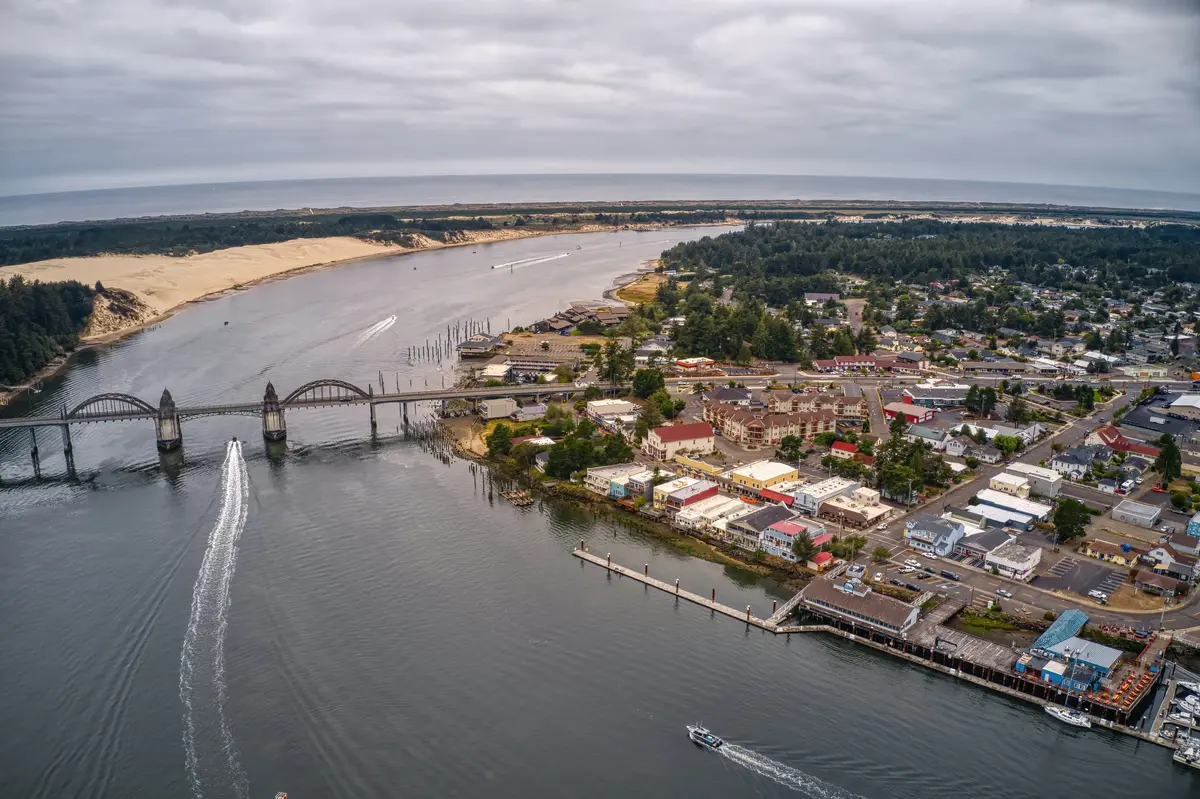
What surprises residents who move here from inland Oregon is how dramatically the summer months change the texture of daily life in certain parts of the city. The Old Town waterfront area — normally a calm stretch of restaurants and shops overlooking the Siuslaw River Bridge — becomes a high-traffic zone from late spring through early fall. Vehicle break-ins spike because out-of-state visitors leave valuables visible in rental cars. Retail theft rises with retail volume. The residents who live well away from the tourist corridor — in Three Mile Prairie or Munsel Lake — barely notice the surge in any way that affects their safety.
What Locals Know About Summer
Long-term Florence residents tend to have strong opinions about parking near Old Town during tourist season. Leaving anything visible in an unattended vehicle, anywhere near the waterfront or the southern US-101 commercial strip, is the single most common property crime risk in the city. This is not a reflection of Florence's resident community — it is a reflection of high parking turnover in an area that draws hundreds of thousands of visitors annually to the dunes and coast.
The good news is that the pattern is predictable and seasonal. Year-round residents who understand the geography of where incidents concentrate can largely route around the risk. The crimes that drive Florence's property crime rate are overwhelmingly opportunistic rather than targeted, and overwhelmingly tourist-area rather than residential in location.
Looking to buy in Florence? Estimate your payment.
Enter your numbers to see an estimated monthly mortgage payment.
Estimate only. Excludes HOA fees and mortgage insurance. The interest rate above is a starting point, not a quoted rate — replace it with your own to see real numbers. Insurance is a flat placeholder, not a Florence quote.
What the City Is Doing on Safety Infrastructure
Florence has made deliberate investments in technology and community engagement over the past two years, and the decisions behind those investments are worth knowing if you are evaluating the city long-term.
Automated License Plate Readers
In April 2024, the Florence Police Department deployed its first automated license plate reading camera near the US-101 and OR-126 intersection. A grant from the Three Rivers Foundation funded five additional cameras, bringing the total to six Flock Safety units by early 2026. The Florence City Council voted in February 2026 — with the mayor casting the deciding vote — to continue the city's contract with Flock Safety despite community debate over privacy. Police Chief John Pitcher noted that data collected in Florence is accessible only to Oregon law enforcement agencies.
The camera network is oriented toward vehicle-related crime, which maps directly onto the property crime categories that drive Florence's elevated rate. Whether residents view the program as a meaningful deterrent or a privacy concern is a genuinely divided question in this community — both positions have been argued at city council — and that local debate is worth knowing about before you move here.
Neighborhood Watch and Community Programs
The Florence Police Department runs an active Neighborhood Watch program, with several groups already operating across the city. The Florence Police Auxiliary coordinates materials and can help any neighborhood start a new group. The department also runs an annual Youth Police Academy, which reflects a broader investment in community relationships alongside patrol and investigation.
For a city of 9,480, Florence has a locally engaged police presence. The department is small enough that officers know the neighborhoods, and the community programs reflect that scale — this is not an anonymous urban force operating at distance from the people it serves.
Coastal Hazards: The Safety Factor Most Buyers Miss
Crime statistics are only one dimension of safety in Florence. The other dimension — and the one that many buyers from the Willamette Valley or California entirely overlook — is coastal hazard risk, specifically the Cascadia Subduction Zone.
The Tsunami Hazard Zone
Florence has adopted a formal Tsunami Hazard Overlay Zone, known locally as the "Beat the Wave" code, unanimously approved by City Council in October 2018. The code restricts certain high-density and critical-facility uses within mapped inundation areas. The Oregon Department of Geology and Mineral Industries has published dedicated tsunami inundation maps for the Florence area covering Cascadia Subduction Zone scenarios — and those maps are worth looking at before you decide on a specific neighborhood, not after.
The guidance for Florence residents is specific and carries no ambiguity: if you feel the earth shaking, move immediately to higher ground without waiting for official sirens. A locally generated Cascadia Subduction Zone tsunami could reach the Siuslaw River mouth within 10 to 15 minutes of a significant earthquake. That window is not long enough to wait for a warning system to activate.
What This Means Practically
Neighborhoods at higher elevation — Three Mile Prairie is the clearest example — sit outside the primary inundation zone in ways that low-lying coastal and waterfront areas do not. Heceta Beach, Shelter Cove, and parts of Old Town Florence sit closer to the river and ocean and are worth examining against the Oregon Department of Geology and Mineral Industries inundation maps specifically.
This is not a reason to avoid Florence. Hundreds of thousands of people live on the Pacific Coast with this risk as background context. It is, however, a reason to understand which neighborhood you are choosing and what the evacuation route looks like from your specific address. The city has done the planning work; the hazard overlay and the inundation maps are publicly available and genuinely useful.
Oregon's coast also brings wildfire risk, though Florence's immediate coastal environment — maritime climate, moderate year-round temperatures, proximity to water — makes it considerably less exposed than the interior valleys and eastern Oregon. The tsunami risk, by contrast, is the coastal-specific hazard that warrants the most attention here.
Best for buyers who research before choosing a neighborhood: Review the Oregon Department of Geology and Mineral Industries tsunami inundation map for Florence alongside a crime heat map tool such as CrimeGrade.org. The two together give you a more complete picture of where to focus your search than either one alone. For the full neighborhood-by-neighborhood picture, see the Florence neighborhoods guide.
Local Expert Takeaway: Florence carries a violent crime rate of 1 per 1,000 residents — among the lowest you will find on the Oregon coast — and the property crime story is more about tourist-corridor vehicle break-ins than anything affecting residential neighborhoods. The numbers that look alarming in the aggregate are heavily concentrated in the south end and Old Town during peak season. If you're looking at Three Mile Prairie, Munsel Lake, or Florentine Estates, you're looking at a fundamentally different safety picture than the city-wide rate implies. The coastal hazard piece — specifically tsunami inundation zone mapping from the Oregon Department of Geology and Mineral Industries — is the safety research step that most in-bound buyers skip and shouldn't.
Quick Takeaways & FAQs
✅ Florence carries a violent crime rate of 1 per 1,000 residents, well below both the Oregon and national averages — personal safety here is a genuine strength.
⚠️ Property crime concentrates heavily in tourist-facing areas along US-101 and Old Town, driven by vehicle break-ins during summer rather than residential burglary — but it does pull the city's aggregate rate above the national figure.
📍 Florence has adopted a formal Tsunami Hazard Overlay Zone ('Beat the Wave' code), and checking the Oregon Department of Geology and Mineral Industries inundation map for your specific neighborhood is a practical step no coastal buyer should skip.
Is Florence, Oregon a safe place to live?
What type of crime is most common in Florence, OR?
Which Florence neighborhoods are safest?
Does Florence have a tsunami risk, and should it affect where I buy?
How does Florence's crime rate compare to the rest of Oregon?
Moving to Oregon?
Tell us what you need help with and we'll connect you with local resources.
