
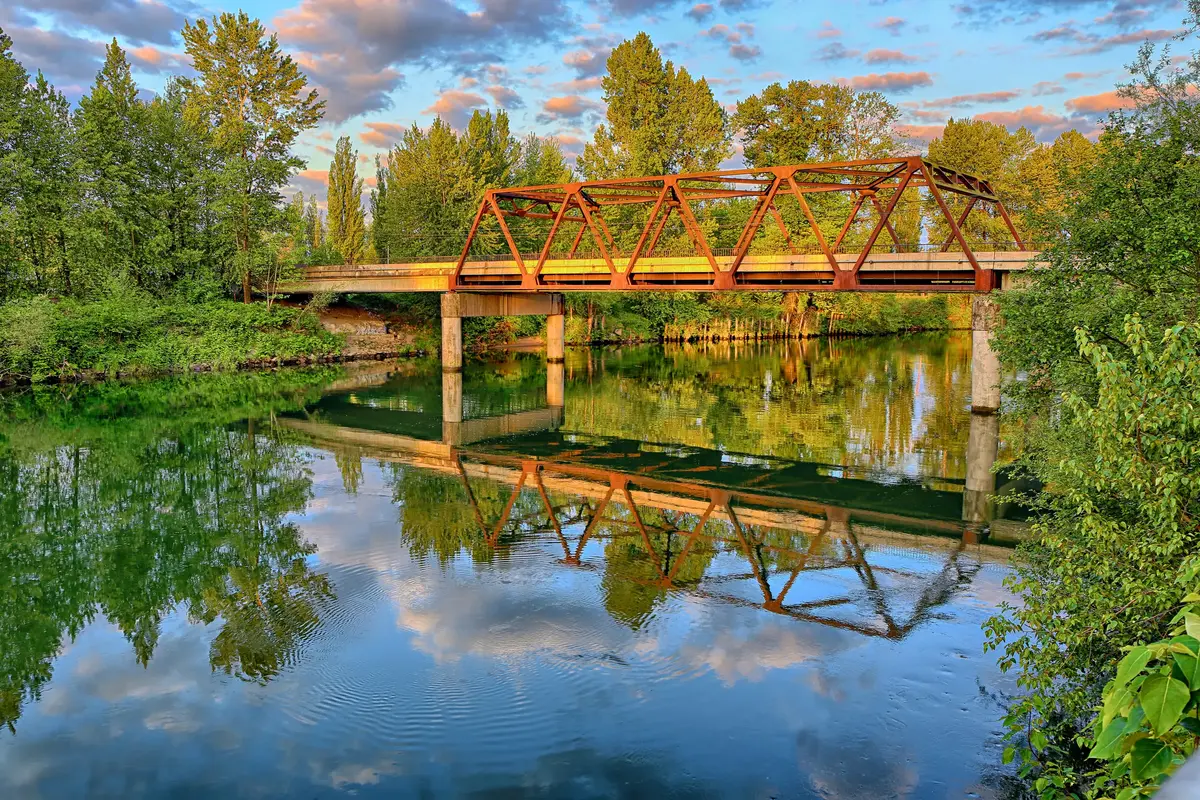
Most people who retire to Snohomish didn't plan on it. They drove through on a weekend antiquing trip, walked First Street, ate pie from a bakery on the corner, watched the Snohomish River move slow and green below the bluff — and started doing the math. What surprises them is that the math sometimes works. For a city incorporated in 1890 and listed on the National Register of Historic Places, Snohomish carries the kind of small-town density — walkable blocks, a real downtown, genuine civic pride — that most Seattle-area suburbs stopped having decades ago. It sits along US-2 about 30 miles northeast of Seattle, with Everett just to the west and the Cascade Range rising to the east, and its daily rhythms feel deliberately unhurried in a region that generally is not.
The honest tension in retiring here is the price of admission. The typical home value in Snohomish is $891,252 (Zillow Home Value Index, June 2026) — a figure that screens out a lot of fixed-income buyers and puts serious pressure on anyone downsizing from a less expensive market. What you get for that price is a city with genuine character, low crime, and Washington's famously retiree-friendly income-tax structure. No state income tax means Social Security, pension checks, and IRA withdrawals all land untouched by Olympia. For retirees coming from California, Oregon, or any state that taxes retirement income, the tax environment alone can meaningfully change the math. See the full cost-of-living breakdown for how that plays out day to day.
The draw beyond taxes is the texture of the place. Historic downtown is genuinely walkable for downtown residents — brick storefronts, independent restaurants, the Snohomish Pie Company on First Street, and a cluster of cafés a few doors down. The Centennial Trail starts here and runs north through the county. Ferguson Park sits on Blackmans Lake. Lord Hill Regional Park offers serious hiking less than ten minutes from downtown. For retirees who want to stay physically active without getting in a car, Snohomish offers more than its size suggests — and the city is actively investing in making that better with its 2025 First Street Master Plan. The sections below cover healthcare access, budget realities, walkability, downsizing options, and an honest comparison with nearby retirement alternatives.
Why Retirees Are Choosing Snohomish
Snohomish works best for retirees who want a genuine small-town feel without full rural isolation — and who have the equity to afford it. The city's Historic Downtown District is the kind of place people actually use: evenings at The Oxford Saloon on First Street, weekend mornings at the Snohomish Pie Company, community events in a downtown that has been continuously occupied and cared for since the 1880s. If your retirement picture involves walking to coffee, knowing your neighbors, and having something to do without driving 20 minutes first, the downtown core genuinely delivers that.
The buyers this city fits least are retirees on tight fixed incomes who need to maximize purchasing power, and anyone who prioritizes a car-free lifestyle across the whole city rather than just the downtown blocks. Most of Snohomish beyond First Street requires a vehicle for daily errands. And the entry price — with a typical home value sitting near $891,252 — means the equity conversation has to happen before the lifestyle conversation. Retirees who have built substantial equity in a higher-priced market and want to stay in the greater Seattle region without living in a subdivision will find Snohomish compelling. Those starting from scratch on a fixed income will likely find better value in Monroe or Arlington.
What pulls people across the finish line is usually the combination of factors that don't show up in a spreadsheet: the pace, the historic fabric, the river, the sense that the city has a personality. Snohomish is the oldest city in Snohomish County, and it wears that identity visibly. For retirees who have spent careers in anonymous suburbs, that specificity matters.
Healthcare & Medical Access in Snohomish
The most important healthcare fact about Snohomish is what the city does not have: a major hospital within its own limits. For routine care, primary-care physicians, and specialist offices, Snohomish has adequate options. For anything serious — emergency surgery, cardiac events, cancer treatment, Level II trauma — you are heading to Everett.
Providence Regional Medical Center Everett
Providence Regional Medical Center Everett is the regional anchor, roughly 10 miles west on US-2. It is the only Level II adult trauma center in Snohomish County, with a 24/7 emergency department operating 79 private treatment rooms and round-the-clock acute care surgeons and hospitalists on site. For retirees, that Level II designation matters: it means the hospital can handle complex trauma and major emergencies that would require a transfer at a smaller facility. In good traffic, the drive from downtown Snohomish runs about 20 minutes. In the corridor's frequent congestion, budget 30–35.
In-City and Post-Acute Options
Snohomish Health and Rehabilitation of Cascadia, at 800 10th Street inside the city, is a Medicare-certified skilled nursing facility covering skilled nursing, physical therapy, occupational therapy, speech therapy, and memory care. For retirees who need post-acute recovery after a hospital stay — or who are planning ahead for long-term care — this is a meaningful asset: most small cities this size have nothing comparable in-city.
Pacifica Senior Living Snohomish offers assisted living and memory care with 24-hour staffing, housekeeping, and a courtyard environment. It is one of more than 70 senior care options documented across the broader Snohomish County area, though in-city licensed facilities remain limited relative to Everett or Mill Creek.
Medicare Advantage: A Planning Note
Snohomish County's Medicare Advantage market runs heavily through UnitedHealth Group/Optum, which held roughly 42% market share as of 2024, with Humana at around 17%. A January 2026 contract dispute between Humana and Optum Care Washington disrupted coverage for some local enrollees mid-year — a reminder that network stability in this county is not guaranteed and plan selection deserves careful annual review. Before committing to a Medicare Advantage plan, confirm which local physicians and Providence facilities are in-network for that plan year.
The Retiree Budget in Snohomish
Washington's Income-Tax Advantage
Washington levies no personal income tax — none. Social Security benefits, pension distributions, IRA withdrawals, and 401(k) income pass through entirely free of state tax. For retirees relocating from Oregon, California, or states that tax retirement income at rates of 5–13%, the annual savings can be substantial enough to offset Snohomish's higher home prices over a retirement horizon.
Washington does impose a 7% capital-gains tax on long-term gains above $270,000 annually, but retirement-account distributions, Roth conversions, and home sales are specifically exempt. A retiree living on Social Security, a pension, and retirement-account withdrawals will almost certainly never owe it. The main tax trade-off in Washington is sales tax: the combined state-plus-local rate runs approximately 9.2–9.29%. Prescription drugs and groceries are exempt, which softens the daily impact for retirees on fixed incomes — but any major purchase, from a car to appliances, will carry that rate.
Property Taxes
Snohomish's effective property tax rate is approximately 0.93% — close to the Washington state average and meaningfully lower than many comparable markets in California or the Northeast. On a home in Snohomish's typical price range, that rate produces a significant annual obligation; the interactive calculator below can run your specific scenario. The rate itself is stable and predictable, which matters for retirement budget planning more than the headline number.
Daily Cost of Living
Groceries and prescriptions escape sales tax entirely, which helps. Dining on First Street runs the full range — a slice and coffee at Snohomish Pie Company is an affordable daily habit, while a dinner at Pace Kitchen on First Street sits at a moderate Pacific Northwest price point. For full context on how Snohomish's cost of living compares to nearby cities, the cost-of-living page has the complete breakdown.
Looking to buy in Snohomish? Estimate your payment.
Enter your numbers to see an estimated monthly mortgage payment.
Estimate only. Excludes HOA fees and mortgage insurance. The interest rate above is a starting point, not a quoted rate — replace it with your own to see real numbers. Insurance is a flat placeholder, not a Snohomish quote.
Walkability, Community & Staying Active in Snohomish
The Walkability Reality
Downtown residents — those within a few blocks of First Street — can genuinely manage coffee, lunch, dinner, and light shopping on foot. The Oxford Saloon, Pace Kitchen, and Snohomish Pie Company are all within a short walk of each other along First Street's brick corridor. The city launched a formal First Street Master Plan in 2025, working with design firm First Forty Feet LLC to improve accessibility, pedestrian flow, and vibrancy — a signal that the city is investing in this corridor rather than letting it coast.
Beyond downtown, the picture changes. Most of Snohomish's residential areas require a car for grocery runs, pharmacy trips, and medical appointments. The terrain is gently rolling rather than flat — manageable for most active retirees but worth walking before you buy if mobility is a consideration. A vehicle is not optional for most people living outside the immediate downtown core.
The Centennial Trail and Active Outdoors
Snohomish marks the southern terminus of the Centennial Trail, a paved multi-use path that extends north through Snohomish County. For retirees who walk, bike, or use mobility aids on smooth surfaces, this is a genuine daily amenity — not a weekend drive-to destination. The city's nine developed parks span 167 acres, with Ferguson Park on Blackmans Lake and several Snohomish River access points among the most used. Lord Hill Regional Park, just outside the city, offers miles of forested trails for retirees who want more elevation. See the full parks and recreation guide for trail details.
Community and Social Life
Snohomish's social fabric runs through its downtown events calendar — farmers markets, seasonal festivals, First Street gallery walks, and community gatherings at the Carnegie Building. The antique district draws visitors every weekend, which keeps the downtown alive in a way that smaller towns without that draw can struggle to maintain. For retirees who find community through civic participation, the city's small size (around 10,500 residents) means volunteer roles in local government, the arts, and community organizations are genuinely accessible rather than competitive.
One thing that surprises retirees after six months: the weekend tourist traffic on First Street during the warmer months can feel crowded in a city this size, with antique shoppers and day-trippers from Seattle filling the sidewalks. Most longtime residents find it energizing; some find it overwhelming. It's worth spending a weekend afternoon there before deciding.
Right-Sizing: Downsizing in Snohomish
The Inventory Challenge
Snohomish's housing stock skews toward single-family homes, many of them historic Craftsman and Victorian-era builds that carry charm and maintenance costs in equal measure. True single-level living — the ranch homes and patio homes that downsizing retirees typically seek — exists but competes with strong demand from all buyer types in the city. Inventory turns quickly, and purpose-built 55+ communities within Snohomish city limits are limited.
What's Available Inside the City
The most realistic downsizing path for retirees who want to stay inside Snohomish proper is a smaller single-family home in the Historic Downtown area or the Blackmans Lake vicinity. Some of these are single-level or have primary-suite main-floor configurations. Condominiums exist but represent a small share of Snohomish's housing mix — this is not a city with a deep condo inventory the way Everett or Mill Creek offer. Buyers prioritizing a lock-and-leave lifestyle or a truly maintenance-free unit will likely need to look at neighboring communities.
Assisted Living and Memory Care
Pacifica Senior Living Snohomish provides an in-city assisted living and memory care option for retirees who are planning ahead or who need support now. For skilled nursing and post-acute rehab, Snohomish Health and Rehabilitation of Cascadia on 10th Street is Medicare-certified and within the city. These two facilities cover the core continuum, though retirees with specialized needs — Parkinson's care, complex dementia programs, or continuing-care retirement community (CCRC) structures — will find broader options in Everett or the Mill Creek corridor.
The Nearby-Market Option
Many retirees who want the Snohomish lifestyle but need better downsizing inventory end up buying in Monroe or Lake Stevens, then treating Snohomish's downtown as their social hub. The drive is short enough that this hybrid approach works practically — and home prices in those markets can provide meaningfully more purchasing power for a single-level home. It is a compromise worth considering if the right unit inside Snohomish does not materialize within your timeline.
Snohomish vs Nearby Retirement Destinations
| City | Cost vs Snohomish | Primary Hospital | Walkability | Senior Living Depth | Overall Retirement Fit |
|---|---|---|---|---|---|
| Snohomish | Anchor | Providence Regional (10 mi) | Strong downtown core; car needed elsewhere | Moderate — in-city SNF and AL; limited condo stock | Quiet Nature Best for equity-rich retirees wanting small-town character |
| Everett | Noticeably cheaper | Providence Regional (on-site) | Stronger — more walkable corridors and transit options | Deep — multiple CCRCs, AL, memory care, condo inventory | Transit Value Best for retirees prioritizing healthcare proximity and urban convenience |
| Monroe | Moderately cheaper | EvergreenHealth Monroe (in-city) | Limited — car-dependent outside small downtown | Growing — some AL options; less depth than Everett | Value Quiet Best for budget-conscious retirees who want a rural feel with some services |
| Lake Stevens | Roughly similar | Providence Regional (15–20 mi) | Low — suburban layout, car essential | Limited — newer market with fewer established senior facilities | Families Best for retirees who want newer construction and don't mind driving for services |
| Mill Creek | About the same to slightly pricier | Providence Regional (15 mi) | Moderate — planned community with some walkable nodes | Good — established AL and memory care options along the 527 corridor | Quiet School Best for retirees who want polished suburban amenities near family |
| Arlington | Noticeably cheaper | Providence Regional (25+ mi) | Low — small-town commercial strip, car-dependent | Limited — fewer options; improving slowly | Nature Value Best for retirees who want maximum space and value and are comfortable with longer drives for care |
Everett is the clearest alternative for retirees who want to stay close to Snohomish but need better purchasing power, deeper healthcare access, or a more robust senior living selection — Providence Regional Medical Center is on-site rather than a 20-minute drive away, and the downtown Everett corridor and Colby Avenue area offer more walkable options at a meaningfully lower price point.
Monroe makes sense for retirees who are downsizing more aggressively and want a quiet town feel without Snohomish's premium pricing; EvergreenHealth Monroe provides reasonable local emergency coverage that Snohomish itself cannot match. Arlington offers the most purchasing power of any of these options, but the honest trade-off is that you are adding meaningful distance to advanced care — a calculation that matters more as health needs increase.
Snohomish holds its own for retirees who have the equity, who want an authentically historic downtown as their daily environment, and who view the Centennial Trail, the Snohomish River, and Lord Hill's trails as non-negotiable. It is a specific fit, not a universal one.

Local Expert Takeaway: Snohomish is one of the few places in the greater Seattle metro where retiring into a genuinely historic, walkable small town is still possible — but the entry price is real, and the healthcare distance to Providence Regional Medical Center Everett is a factor worth stress-testing before you commit. Retirees who live within a few blocks of First Street, walk the Centennial Trail from its southern terminus, grab morning coffee at one of the independent cafés along the downtown corridor, and drive 20 minutes to Everett for medical care tend to stay and be glad they came. Those who need deeper in-city senior housing inventory, lower price points, or immediate hospital proximity are usually better served starting their search in Everett or Monroe and treating Snohomish as a day trip.
Quick Takeaways & FAQs
✅ Washington's zero state income tax means Social Security, pension, and retirement-account withdrawals are all state-tax-free — one of the strongest income-tax environments for retirees in the country.
⚠️ The nearest Level II trauma center is Providence Regional Medical Center Everett, roughly 10 miles away — a commute that matters in a genuine emergency and should factor into your decision if you have serious health concerns.
📍 Historic First Street is genuinely walkable for downtown residents, with the Centennial Trail's southern terminus, Ferguson Park on Blackmans Lake, and a cluster of independent restaurants and cafés all within easy reach — but most of Snohomish beyond the downtown core requires a car.
Is Snohomish, WA a good place to retire on a fixed income?
What hospital do Snohomish retirees use for serious medical care?
Are there 55+ or active-adult communities in Snohomish?
Does Washington State tax Social Security or pension income?
How does retiring in Snohomish compare to retiring in Everett?
Moving to Washington?
Tell us what you need help with and we'll connect you with local resources.
