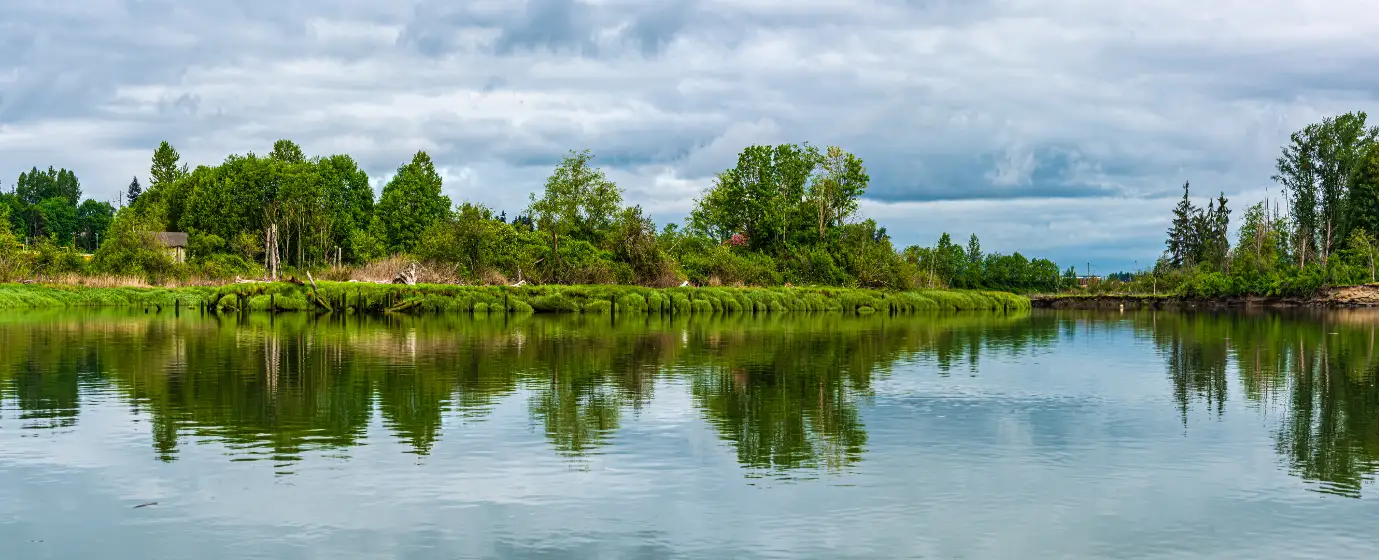
Parents moving to Snohomish from Seattle's inner ring — or from somewhere with a well-funded IB magnet — often arrive expecting a small-town district that punches below its weight. What they find instead is a district that holds an A- rating, according to Niche, two high schools competing in WIAA state playoffs, and a youth soccer club with a competitive pathway serious enough to include ECNL and semi-professional men's and women's teams playing right in town. Snohomish School District is not the flashiest in the region, but it is solid, and for the right family, it is genuinely excellent.
The district serves approximately 9,639 students across 18 schools — nine elementary campuses, two middle schools, three high schools, plus an alternative program and an early childhood education assistance program. That footprint is larger than the city's population of around 10,500 would suggest, because attendance boundaries extend into the surrounding unincorporated county. Roughly 30% of students identify as minorities, and approximately 15.8% qualify as economically disadvantaged — numbers that reflect a district more diverse than many families expect when they hear "small historic river town." The Snohomish School District has been the city's single largest employer for years, and that alignment between the institution and the community it serves shows up in staff retention and parent engagement.
On the activity side, Snohomish gives families a legitimate argument for skipping the commute to club sports in Bellevue or Kirkland. Stocker Fields — a 50-acre multi-pitch complex within minutes of First Street — hosts Snohomish United, a club that runs everything from recreational fall soccer for five-year-olds through ECNL-level competitive play. The parks and recreation infrastructure more broadly supports the outdoor culture that makes this city work for active families. Year-round organized youth sports, plus school-based WIAA athletics at both the 3A and 4A levels, mean kids here have meaningful options without leaving city limits.
Whether you're weighing a move to the Historic Downtown area or looking at a newer development near the Highlands East, the sections below break down the Snohomish School District's structure, the standout schools worth knowing by name, youth sports options from rec leagues to competitive club, and the honest cases for — and against — this district for your specific family.
Snohomish School District at a Glance
The district's strong overall rating reflects a consistent, well-organized system rather than a handful of elite outlier schools lifting a mediocre average. Performance is broadly solid, support programs are in place, and the district has earned state-level recognition for growth among traditionally underserved student populations — a meaningful signal that the system is working for more than just the easiest-to-educate kids.
The Numbers That Matter
| Metric | Figure |
|---|---|
| Overall district rating | A- (Niche) |
| Total enrollment (2024–25) | ~9,639 students |
| Number of campuses | 15 campuses / 18 programs |
| Elementary schools | 9 |
| Middle schools | 2 |
| High schools | 3 (including one alternative) |
| Minority enrollment | ~30% |
| Economically disadvantaged | ~15.8% |
Those enrollment numbers mean neither high school feels like a massive anonymous institution, but both are large enough to offer real program depth — dual enrollment, CTE pathways, and competitive athletics across a full range of WIAA-sanctioned sports.
What Makes the District Work
Consistent performance across all three levels — elementary, middle, and high school — rather than one flagship campus pulling up the average is what earns the district its standing. State-recognized growth at two elementary schools in 2025 signals that the district is improving outcomes for students who need support most, not just maintaining scores for the families who would have succeeded anywhere.
The district's boundaries pull in students from across unincorporated Snohomish County, so the range of family backgrounds in any given classroom is broader than the city's small downtown footprint suggests. For parents who value that kind of diversity without sacrificing academic rigor, that combination is harder to find than it looks on a map.
Standout Schools Worth Knowing by Name
Glacier Peak High School — WIAA 4A, STEM & CTE Focus
Glacier Peak, at 7401 144th Place SE, is the newer of the district's two comprehensive high schools, opened around 2007–2008. Its WIAA 4A classification puts the Grizzlies against the largest schools in the state — Glacier Peak competes in the WESCO conference, the same league that includes schools from Everett and Marysville. That competitive context means student-athletes here are tested against serious competition every week of the season.
The school's reputation for STEM and Career and Technical Education (CTE) pathways is well-established. For a family relocating a student interested in engineering, health sciences, or applied technology, Glacier Peak's program depth is the strongest argument for this district over neighboring options. The school enrolled 1,642 students in 2024–2025 — exceeding its 1,500-student design capacity — so class sizes and resource pressure are real factors worth discussing with counselors before enrolling.
Best for: STEM-focused students CTE pathways
Snohomish High School — WIAA 3A, AP & Dual Enrollment
The Panthers at 1316 5th Street are the district's legacy campus, a 3A school enrolling roughly 1,496–1,525 students. The student-to-teacher ratio runs approximately 22–23:1, which is in line with comparable districts in the region. State Smarter Balanced Assessment (SBAC) data from 2024–25 shows approximately 73% of students at or above proficiency in reading — a genuinely strong figure — while math proficiency sits at approximately 45%, which is more typical for Washington state schools of this size and classification.
The college credit picture here is real but not exceptional. Snohomish High School offers four pathways to earning college credit while still in high school, including AP courses and dual enrollment through Washington State's Running Start program. Running Start in particular is well-used at the school: students who qualify can spend their junior and senior years taking courses at a local community college, graduating with both a high school diploma and significant college credit simultaneously. That's a meaningful financial and academic advantage families often overlook when comparing school ratings side by side.
Best for: Running Start candidates AP coursework
Totem Falls & Riverview Elementary — State-Recognized Growth
In 2025, the Washington State School Recognition Program honored two Snohomish School District elementary schools for measurable student growth. Totem Falls Elementary was recognized for growth among students in one or more racial or ethnic groups and for low-income students. Riverview Elementary was recognized for growth among low-income students. Both recognitions are based on 2025 Washington School Improvement Framework data — not a participation award, but a state-verified signal that these campuses are moving outcomes in the right direction for students who often get left behind.
For families with elementary-age kids who are assigned to either campus, that recognition matters. It reflects instructional practice and staff effectiveness, not just the demographic luck of serving an already-advantaged population. These are schools worth taking seriously.
Best for: Families with elementary-age kids Growth-focused campuses
The Robotics Program Nobody Tells You About
The joint Glacier Peak and Snohomish High School robotics team — known as the Sonic Squirrels — won the Pacific Northwest competitive robotics district championships in both 2015 and 2025. That decade-long span between titles is actually a meaningful data point: it suggests a program with sustained institutional support, not a one-year fluke driven by a single exceptional class.
The Sonic Squirrels draw from both high schools, which means students from across the district's attendance boundaries can participate together. For families with kids who are serious about engineering, computer science, or manufacturing — and who would otherwise be drawn to districts with more polished marketing — this program is a genuine differentiator that rarely shows up in school rating summaries.
The 2025 championship win is recent enough that the program's current momentum is real, not historic reputation. If robotics matters to your family, ask the high school counselors about the team's tryout and application process early — demand typically exceeds the roster spots available for the main competitive season.
Looking to buy in Snohomish? Estimate your payment.
Enter your numbers to see an estimated monthly mortgage payment.
Estimate only. Excludes HOA fees and mortgage insurance. The interest rate above is a starting point, not a quoted rate — replace it with your own to see real numbers. Insurance is a flat placeholder, not a Snohomish quote.
Youth Sports & Kids Activities in Snohomish
The case for Snohomish as a place to raise an athletic kid starts at Stocker Fields and builds from there. The 50-acre complex sits within minutes of Historic Downtown and functions as one of the most capable youth soccer facilities in Snohomish County, with up to 17 grass fields available on a single site. That's not a park with a few painted lines — it's the kind of infrastructure that draws regional tournaments and supports genuine competitive development year-round.
Snohomish United: From Rec to Semi-Pro
Snohomish United traces its roots to the 1970s, when it operated as Snohomish Youth Soccer. Today it runs the full spectrum: recreational fall soccer for kids ages 5–18 runs from August through November, making it the entry point for most families new to the area. Above that, the club offers competitive pathways through the Regional Club League, North Puget Sound League, and ECNL — the Elite Clubs National League, which represents the upper tier of youth club soccer in the country.
Two additions make Snohomish United unusual for a city this size. In spring 2025, the club fielded its first USL League Two men's roster — a semi-professional level of play — with home matches at Stocker Fields. In spring 2026, the first USL W League (women's) roster followed. For a teenage player who wants to watch high-level soccer within walking distance of their own practice fields, that's a rare combination. It also signals that the club has the organizational infrastructure and financial backing to sustain serious programs, not just recreational ones.
The club also operates Washington's largest TOPSoccer program, which provides adapted soccer for players with physical and cognitive disabilities. That breadth matters: it tells you something about how the club is run and what it prioritizes beyond winning league titles.
i9 Sports: Rec Leagues for the Youngest Athletes
For families with younger kids — or kids who aren't ready for the commitment of a club program — i9 Sports runs recreational leagues at Snohomish High School Stadium. Programs start at age 3, and the format is deliberately low-pressure: no tryouts, short seasons, and a structure designed around skill-building rather than standings. Participant reviews from as recently as April 2026 confirm the program is active and well-organized at the Snohomish venue specifically.
The combination of i9 at the younger ages and Snohomish United's recreational tier above it means families don't face a gap where their kid is too old for beginner programs but not yet ready for competitive club commitments. That ladder exists here in a way it doesn't in every smaller city.
WIAA High School Athletics
Both high schools carry active WIAA athletic programs, and both have recent results to point to. Snohomish High School's Panthers compete at the 3A level; the baseball team reached WIAA 3A State Round 2 in May 2026, which is a meaningful postseason run for a program at that classification. Glacier Peak's Grizzlies compete at the 4A level in the WESCO conference, where they regularly face the largest public schools in the region.
The Washington Interscholastic Activities Association (WIAA) sanctions competition across a full range of sports — football, basketball, soccer, swimming, cross country, wrestling, tennis, golf, and more — at both campuses. The 4A vs. 3A split matters for recruiting visibility and competitive intensity: a standout athlete at a 3A school competes against a different pool than the same athlete would face at 4A. Families with a student-athlete serious about playing at the next level should factor that classification difference into their high school boundary research.
Beyond Soccer and School Sports
The youth activity landscape in Snohomish extends past organized athletics. Lord Hill Regional Park and the Centennial Trail — both within easy reach of city neighborhoods — provide the kind of outdoor access that makes recreational running, cycling, and hiking genuinely part of family life here rather than a weekend-only event. The river and surrounding terrain support youth fishing, kayaking, and paddling programs through Snohomish County Parks. For families whose kids are more drawn to arts and performance than athletics, the district runs school-based music and drama programs at both high schools, though these are not the marquee offerings the way the robotics team or WIAA athletics are.
Who This District Is — and Is Not — Right For
The Snohomish School District earns its strong overall standing by being consistently good rather than exceptional in any single dimension. That's genuinely the right fit for a large share of families who move here. But it's worth being direct about who tends to be disappointed after a year.
The District Works Well For
| Family Type | Why It Works |
|---|---|
| Families with student-athletes | Two WIAA schools (3A and 4A), Snohomish United's full competitive ladder, i9 Sports rec leagues — the infrastructure is real and well-supported |
| Running Start candidates | Snohomish High School's dual enrollment pathway lets motivated students earn significant college credit at no tuition cost during junior and senior years |
| STEM/CTE-interested students | Glacier Peak's CTE pathways and the district-wide Sonic Squirrels robotics program offer genuine depth beyond classroom coursework |
| Families relocating from outside WA | The district's size and stability make transitions easier; counselors handle out-of-state credit transfers with more consistency than smaller districts |
| Elementary-age kids | Nine elementary campuses, two of them state-recognized for growth in 2025, with a stable staff retention record across the system |
Where the District Falls Short
Families prioritizing a dense International Baccalaureate (IB) program or an unusually concentrated AP course menu may find the offerings at Snohomish's secondary schools thinner than they expected. Neighboring districts — including several Everett schools — have more developed IB and AP concentrations. If that's a non-negotiable for your high schooler, it's worth auditing the current AP catalog before assuming equivalency with your prior district.
The math proficiency figure at Snohomish High School — approximately 45% at or above grade level on the 2024–25 SBAC — is honest context. Reading at 73% is strong; math at 45% is below where many competitive districts land. That gap doesn't disappear in a single year, and families moving with a student who needs advanced math acceleration should ask specifically about course sequencing into calculus and statistics rather than relying on the overall district rating as a proxy.
One friction point that surprises families after the first year: middle school transition. The district runs two middle schools serving the whole district's geography, which means some students travel farther than their elementary school commute prepared them for. The boundary lines are worth confirming early, especially if you're buying in a neighborhood near the edges of the attendance zone.
A Straight Answer on Who Should Look Elsewhere
If your family's primary decision driver is IB access, a dense AP course menu at the 20+ course level, or a magnet-style specialized program within the district itself, Snohomish is probably not your best fit. Everett's magnet options or Lake Stevens' newer facilities may warrant a closer look. The Snohomish district is excellent for what it is — a well-run, community-grounded, athletically strong system with real growth at the elementary level. It is not trying to be a specialty academic pipeline, and it wouldn't be honest to frame it as one.
Practical Details Before You Enroll
Enrollment, Boundaries & Open Enrollment
Snohomish School District uses attendance boundaries to assign students to elementary schools, with both Snohomish High School and Glacier Peak serving the secondary population from different geographic zones. The boundary between the two high school attendance areas runs roughly through the eastern portion of the city, with newer developments near Highlands East and some Blackmans Lake area addresses assigned to Glacier Peak while Historic Downtown and Cascade-area neighborhoods typically feed into Snohomish High School. Confirming your specific address before closing on a home takes about five minutes on the district website — do it before you make assumptions about which campus your student will attend.
The district does maintain an open enrollment process that allows transfers between schools when space permits, but it is not automatic and availability varies by grade level and year. If the STEM and CTE profile at Glacier Peak is your reason for choosing the district but your address falls in the Snohomish High School zone, contact the district office about the transfer process before assuming it's straightforward.
Calendar, Start Times & Transportation
The district follows a traditional school year calendar, generally starting in early September and running through mid-June, aligned with Washington state requirements. Both high schools operate on a later start time than elementary schools — Washington passed legislation phasing in later start times for secondary schools, and Snohomish has implemented this, which matters for families with teenagers who have after-school jobs or afternoon athletic commitments. Bus service covers most of the district's attendance area, though families in some of the rural unincorporated zones near Machias and Cathcart should verify their stop location and timing early.
After School & Summer Programs
The district runs an early childhood education assistance program for income-qualifying preschool families — one of the often-overlooked benefits for families arriving with very young children. Beyond the school day, the combination of Snohomish United's year-round soccer calendar, i9 Sports rec leagues, and WIAA-sanctioned school sports means the after-school hours are well-structured for families who need predictable programming. Summer options are thinner than during the school year — most families supplement with county parks programs and private camps — but Snohomish United runs summer training sessions at Stocker Fields that fill quickly.
Local Expert Takeaway: The Snohomish School District holds an A- rating, according to Niche, earned by the whole system rather than carried by one flagship school. The Sonic Squirrels robotics team's 2025 Pacific Northwest championship, Glacier Peak's CTE depth, and Snohomish United's full competitive ladder from rec soccer to USL semi-pro all sit within city limits. The honest gap is on the IB and dense AP side — if your high schooler needs that specific pipeline, have a real conversation with Everett's options before you close. For families where athletics, Running Start access, and elementary stability matter more than a specialized academic magnet, this district delivers reliably.
Quick Takeaways & FAQs
✅ Snohomish School District holds an A- rating, according to Niche, with two state-recognized elementary schools for growth in 2025 and a joint robotics team that won the Pacific Northwest competitive robotics district championship in 2025.
⚠️ Math proficiency at Snohomish High School runs approximately 45% on state assessments, and the district's IB and AP offerings are thinner than what families from Bellevue or Kirkland-area districts may expect.
📍 Stocker Fields — a 50-acre, 17-field complex minutes from First Street — is home to Snohomish United, which runs everything from recreational soccer for five-year-olds through ECNL competitive play and semi-professional USL teams.
What rating does the Snohomish School District have?
What is the difference between Snohomish High School and Glacier Peak High School?
What youth soccer options exist for kids in Snohomish?
Does Snohomish School District offer IB or a strong AP program?
What is the Sonic Squirrels robotics team, and how do students join?
Moving to Washington?
Tell us what you need help with and we'll connect you with local resources.
