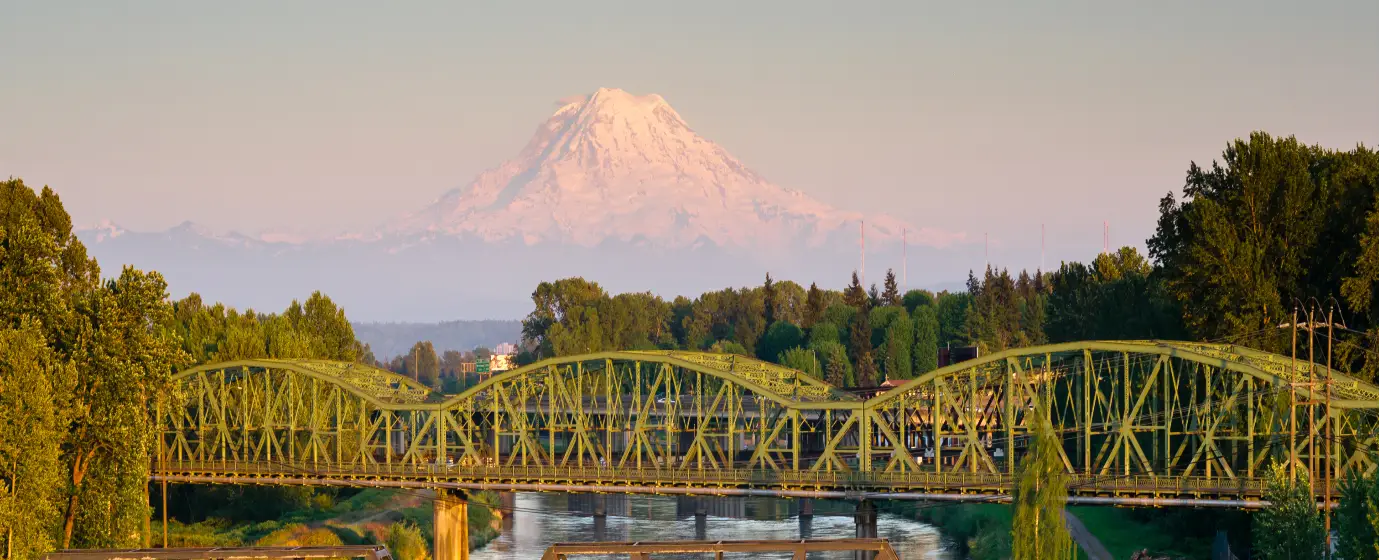
Most people thinking about retirement in the Pacific Northwest picture Seattle or maybe Olympia — somewhere with a name that requires no explanation. Puyallup rarely makes that first list, which is exactly why it rewards a closer look. Sitting at the base of Mount Rainier's foothills where SR-167 meets SR-512 in Pierce County, about 35 miles south of Seattle, it is a genuine mid-size city — not a bedroom suburb, not a rural town — with its own hospital, its own historic downtown, and a community calendar built around two of Washington's biggest annual events. The Puyallup River runs through it. The daffodil fields that once defined the valley are mostly gone, but the small-city rhythm they left behind is very much still here.
What keeps retirees looking seriously at Puyallup is the combination of Washington's famously retiree-friendly tax structure and a cost of living that is noticeably below Seattle and Tacoma's most desirable neighborhoods. MultiCare Good Samaritan Hospital sits right in the city — not a satellite clinic, a full regional hospital — which matters more than almost any other single factor when you're deciding where to spend the next 20 years. The Washington State Fairgrounds brings hundreds of thousands of visitors through every September, and the Daffodil Festival and Parade each spring gives the city a genuine civic identity that newer planned communities tend to lack.
On a fixed income, Puyallup is more workable than much of the Puget Sound region, though it is not cheap. The Zillow Home Value Index put the typical home price at $573,027 in July 2026 — meaningful money, but well below what comparable space costs closer to Seattle. The compromise is real: most of the city requires a car for daily errands, and winter brings the gray, wet weather that catches retirees from drier climates off guard by February. For those who go in with eyes open, the value proposition is strong. For an honest read on the full cost-of-living picture, that page covers groceries, utilities, and rent in detail.
Whether you're seriously considering a move or still narrowing your list, the sections below break down Puyallup's healthcare access, retirement budget math, walkability and senior social life, downsizing options, and how the city stacks up against the most relevant nearby alternatives.

Why Retirees Are Choosing Puyallup
The retirees who land in Puyallup and stay tend to share a few things: they want a real city — walkable at the core, with restaurants, a farmers market, and a sense of place — without paying Seattle or Bellevue prices. They want a hospital they can drive to in 10 minutes, not 40. And they want Washington's no-income-tax advantage to actually show up in their monthly cash flow. Puyallup delivers on all three.
It fits particularly well for retirees who have roots in the Pierce County area — people retiring from long careers in the region who want to stay close to the community they built. It also attracts buyers from California who, after factoring in Washington's tax structure, find that Puyallup's typical home price of $573,027 (Zillow Home Value Index, July 2026) represents meaningful equity preservation compared to what they left behind.
Who should look elsewhere? Retirees who genuinely need to walk everywhere — to the pharmacy, the coffee shop, the bank — without a car will find most of Puyallup frustrating outside of the historic downtown core. Retirees who need Level I trauma care or highly specialized cancer or cardiac surgery will need to travel to Tacoma or Seattle for those services; Puyallup's hospital is strong, but it is not a quaternary referral center. And retirees drawn to a warmer, sunnier climate should be honest with themselves: Puget Sound winters are long, overcast, and damp, and that reality hits differently at 70 than it did at 40.
Healthcare & Medical Access in Puyallup
MultiCare Good Samaritan: What's Right Here
MultiCare Good Samaritan Hospital at 401 15th Ave SE is the anchor of healthcare in Puyallup, and it punches above its weight for a community hospital. U.S. News & World Report rates it High Performing in Heart Arrhythmia, Heart Attack, and Hip Replacement — three categories that matter enormously to retirees evaluating long-term medical access. That rating puts it in the top tier for a Pierce County community hospital.
The services on-site go well beyond what most people expect from a non-urban hospital. Good Samaritan operates a Level III trauma center and emergency department, inpatient and outpatient cancer care, a comprehensive mental health program, and a breast clinic that brings advanced surgical and diagnostic services to Puyallup directly. Family medicine clinics are embedded throughout the MultiCare system nearby. For the majority of what retirees need — cardiac monitoring, orthopedic care, cancer screening, emergency response — you do not have to leave Puyallup.
When You Need More
The honest caveat: complex neurosurgery, Level I trauma response, and highly subspecialized oncology still route to Tacoma or Seattle. A major regional trauma center is roughly 20–25 minutes west depending on traffic. For truly advanced care — major cancer centers, complex cardiac surgery, transplant programs — you're looking at University of Washington Medical Center or a large Seattle health system, typically 45–60 minutes by car or reachable by Sounder commuter rail from Puyallup Station.
That distance is manageable for planned care. It matters more for spontaneous emergencies, which is precisely why the Level III designation at Good Samaritan matters: it means stabilization and a broad range of acute intervention happen here, with transfer only when a higher level of care is genuinely required. For most retirees, most of the time, that's a workable arrangement.
The MultiCare System Advantage
Because Good Samaritan is part of the MultiCare network, referrals and records move seamlessly between Puyallup, Tacoma, and other MultiCare facilities. You're not navigating a hand-off between competing health systems every time you need a specialist — your primary care, your cardiology follow-up, and your imaging are all within the same system. That coordination is a genuine quality-of-life advantage for managing chronic conditions in retirement.

The Retiree Budget in Puyallup
Washington's Tax Structure — the Real Headline
Washington State levies no personal income tax. That means your Social Security benefits, pension income, IRA withdrawals, and 401(k) distributions are entirely untaxed at the state level. For a retiree pulling $60,000–$80,000 a year from those sources, the savings versus a high-income-tax state are substantial and immediate.
Washington does have a capital gains tax — 7% on long-term capital gains above a $278,000 standard deduction for 2025, rising to 9.9% on gains above $1,000,000 — but it specifically exempts transactions through retirement accounts (401(k)s, IRAs, Roth IRAs, defined-benefit plans) and real estate sales. Most retirees are simply unaffected by it. High-net-worth retirees should verify current thresholds at the Washington Department of Revenue before finalizing plans.
Property Tax: Rate and Relief Programs
Puyallup's effective property tax rate is approximately 1.01%. Washington offers qualifying senior homeowners two meaningful programs: a property tax exemption that can freeze the assessed value used for tax calculation, and a deferral program that lets retirees postpone property tax payments entirely until the home is sold. Eligibility is based on age and income, and both programs are administered through Pierce County. If you're downsizing into a Puyallup home and your income qualifies, these programs can materially reduce the carrying cost of homeownership in retirement — worth investigating before you close.
Daily Cost of Living on a Fixed Income
Washington has no state income tax but does levy sales tax, and Pierce County's combined rate adds up on everyday purchases — groceries are exempt, but restaurant meals, clothing, and home goods are not. Retirees from no-sales-tax states notice this quickly. The full breakdown of groceries, utilities, and what daily life costs in Puyallup is covered on the cost of living page.
On balance, Puyallup sits in a comfortable middle position for the Puget Sound region: not as affordable as Bonney Lake or rural Pierce County, but noticeably less expensive than Tacoma's Stadium District or any Seattle neighborhood. Retirees who own their home outright and draw primarily from retirement accounts find the math works reasonably well here.
Looking to buy in Puyallup? Estimate your payment.
Enter your numbers to see an estimated monthly mortgage payment.
Estimate only. Excludes HOA fees and mortgage insurance. The interest rate above is a starting point, not a quoted rate — replace it with your own to see real numbers. Insurance is a flat placeholder, not a Puyallup quote.
Walkability, Community & Staying Active in Puyallup
The Walkability Reality
Puyallup's citywide Walk Score is 32 out of 100 — officially car-dependent. That number tells an accurate story for most of the city. Areas like South Hill, Crystal Ridge, and Summit are suburban in structure: wide streets, strip-mall commercial, and distances between errands that make a car essentially mandatory. If you're retired and envisioning leaving the car in the garage for daily life, those neighborhoods will disappoint you.
Downtown Puyallup is a different story. The historic core — centered on Meridian Avenue and the blocks around Pioneer Park — is genuinely walkable in a way that few Pierce County communities can claim. Independent shops, coffee spots, the Saturday Farmers Market, and wine and dining options along S Meridian are all within easy walking distance of each other. Retirees who choose to live in or near downtown can run most daily errands on foot and catch Pierce Transit or Sound Transit buses at Puyallup Station on West Main Ave without needing a car at all.
Senior Center and Community Programming
The City of Puyallup operates a senior center that serves as a genuine community hub — fitness classes, social events, day trips, and programming aimed specifically at active older adults. The Washington State Fair each September and the Daffodil Festival and Parade each spring give Puyallup a community calendar that most cities this size simply don't have. These aren't events you watch on TV — they're events where you volunteer, where you see your neighbors, where the city's identity becomes tangible.
Farm 12, a restaurant, café, and event venue on a restored farm in Puyallup operated as a social enterprise of the Step By Step nonprofit, has become an anchor of the local community scene and draws an intergenerational crowd. It's the kind of place retirees who want to feel woven into the community — not segregated from it — tend to gravitate toward.
Getting Around Without a Car
For retirees who want to reduce or eventually give up driving, Puyallup Station connects to the Sound Transit S Line Sounder commuter rail and multiple express and local bus routes. The park-and-ride expanded to 1,044 stalls in 2023. Realistically, transit works well for planned trips into Tacoma or Seattle; it is less useful for spontaneous daily errands in the outer neighborhoods. Planning your housing location with transit access in mind — specifically proximity to downtown and the station — is the single most important decision a car-light retiree can make here.
For parks and outdoor recreation, Pioneer Park and the Puyallup River trail system provide genuine daily-use green space within reach of the downtown core.
Right-Sizing: Downsizing in Puyallup
What the Market Offers
Puyallup has more senior housing depth than most cities its size. The senior living directory for the city lists over 20 options spanning independent living, assisted living, memory care, and adult family homes, with monthly rates ranging from approximately $2,969 to $8,790 depending on care level and community type. That range is meaningful: it means there's a realistic entry point for middle-income retirees, not just those with long-term care insurance or substantial savings.
Named communities include Bonaventure of Puyallup, which offers independent living, assisted living, and memory care on a single campus — the continuing care model that lets couples age in place together even if one partner's needs change faster than the other's. Highlands at South Hill provides independent living for more active retirees who want community structure without the assisted-living pricing. Both have been evaluated by U.S. News Best Senior Living, which at least confirms they're operating and meeting a baseline of standards.
Single-Level and Low-Maintenance Homeownership
For retirees who want to own rather than rent a community, Puyallup's broader housing stock includes a reasonable supply of rambler-style single-level homes — the ranch-layout houses built through the 1960s, 1970s, and 1980s that are increasingly in demand as buyers age. These tend to sit in the Northwest Puyallup and North Puyallup areas, where lots are flatter and the housing stock older. Patio homes and townhomes with low-maintenance exteriors exist throughout the city, particularly in newer sections of South Hill and Manorwood.
The honest inventory reality: genuinely one-level homes with no-step entries, wide doorways, and accessible bathrooms — the features retirees actually need for aging in place — are a smaller subset of that broader stock, and they move quickly when they hit the market. Buyers who know exactly what accessibility features they need should establish those criteria before they start visiting properties, not after. A local agent who regularly works with downsizing buyers will know which subdivisions and developments were built with these features versus which ones just have a "ranch" floor plan that still requires a step up from the garage.
The Timing Question
One thing retirees who move to Puyallup often say six months in: they wish they had moved closer to downtown rather than defaulting to a larger lot in South Hill or Summit because the lot size felt like a good deal. More space sounds appealing at purchase; maintaining a larger lot in your 70s is a different conversation. The most common regret isn't the city itself — it's choosing the wrong part of it.
Puyallup vs Nearby Retirement Destinations
| City | Cost vs Puyallup | Primary Hospital | Walkability | Senior Living Depth | Overall Retirement Fit |
|---|---|---|---|---|---|
| Puyallup | — | MultiCare Good Samaritan (on-site, High Performing) | Low citywide; downtown walkable core | Strong — 20+ communities, wide price range | Value Quiet Good for mid-budget retirees who want in-city hospital access |
| Tacoma | About the same to slightly pricier | Regional trauma center with broader specialty depth | Considerably higher — walkable districts along Sixth Ave and Stadium | Extensive — full urban spectrum of options | Walkable Better for retirees who prioritize on-foot access and cultural amenities |
| Sumner | Noticeably cheaper | No on-site hospital — relies on Puyallup and Tacoma facilities | Low — small-town commercial, car needed | Limited — smaller market, fewer communities | Quiet Appeals to retirees seeking lower costs and a slower pace; healthcare access is the catch |
| Bonney Lake | Noticeably cheaper | No on-site hospital — nearest is Puyallup or Tacoma | Very low — suburban arterial layout | Growing but limited | Nature Value Best for active retirees who love outdoor access and can tolerate driving for everything |
| Edgewood | About the same | No on-site hospital — uses Puyallup and Tacoma | Very low — unincorporated, rural feel | Minimal within city limits | Privacy Suits retirees who want space and quiet and are comfortable driving 10–15 minutes to any service |
| Fife | Slightly cheaper | No on-site hospital — relies on Tacoma and Puyallup | Low — freeway-adjacent commercial strip | Moderate — a handful of communities near the I-5 corridor | Commuter Rarely the top retirement choice; better positioned for convenience than lifestyle |
Tacoma beats Puyallup on walkability and specialty healthcare depth, and for retirees who want to walk to a waterfront restaurant or a concert without a car, the Stadium District or Proctor neighborhood of Tacoma is a stronger lifestyle match — at broadly similar or slightly higher cost. Sumner and Bonney Lake make sense on the budget side but both require driving to Puyallup or Tacoma for anything beyond routine primary care, which becomes a more serious consideration as you age. Puyallup's specific advantage is the combination of an on-site High Performing hospital, a legitimate downtown core, and senior housing inventory at multiple price points — a set of assets none of the immediately surrounding towns can fully replicate.
Local Expert Takeaway: Puyallup's retirement case rests on three things that are genuinely hard to find together in the Pierce County region: a community hospital rated High Performing in cardiac care and hip replacement sitting inside city limits, Washington's zero state income tax on retirement income, and a downtown core around Pioneer Park and Meridian Avenue that actually rewards walking. The downside is geography — most of Puyallup is car-dependent, and retirees who choose South Hill or Summit for the lot size often wish they'd bought closer to downtown instead. If you can get the location right and you need what Puyallup has, it's a strong fit. If you need Level I trauma or a truly walkable neighborhood for the long haul, look at Tacoma first.
Quick Takeaways & FAQs
✅ MultiCare Good Samaritan Hospital is right in the city and rated High Performing in Heart Arrhythmia, Heart Attack, and Hip Replacement — unusually strong medical access for a community of Puyallup's size.
⚠️ Most of Puyallup scores 32 out of 100 on walkability and requires a car for daily errands — retirees who need car-free independence should limit their search to the downtown core or plan around transit at Puyallup Station.
📍 Washington levies no state income tax on Social Security, pensions, IRA, or 401(k) withdrawals, and qualifying senior homeowners can access a property tax freeze or deferral program through Pierce County.
Is Puyallup a good place to retire on a fixed income?
What hospital serves Puyallup retirees, and how good is it?
Does Washington State tax Social Security or pension income?
What senior living communities exist in Puyallup?
Can you get around Puyallup without a car in retirement?
Moving to Washington?
Tell us what you need help with and we'll connect you with local resources.
