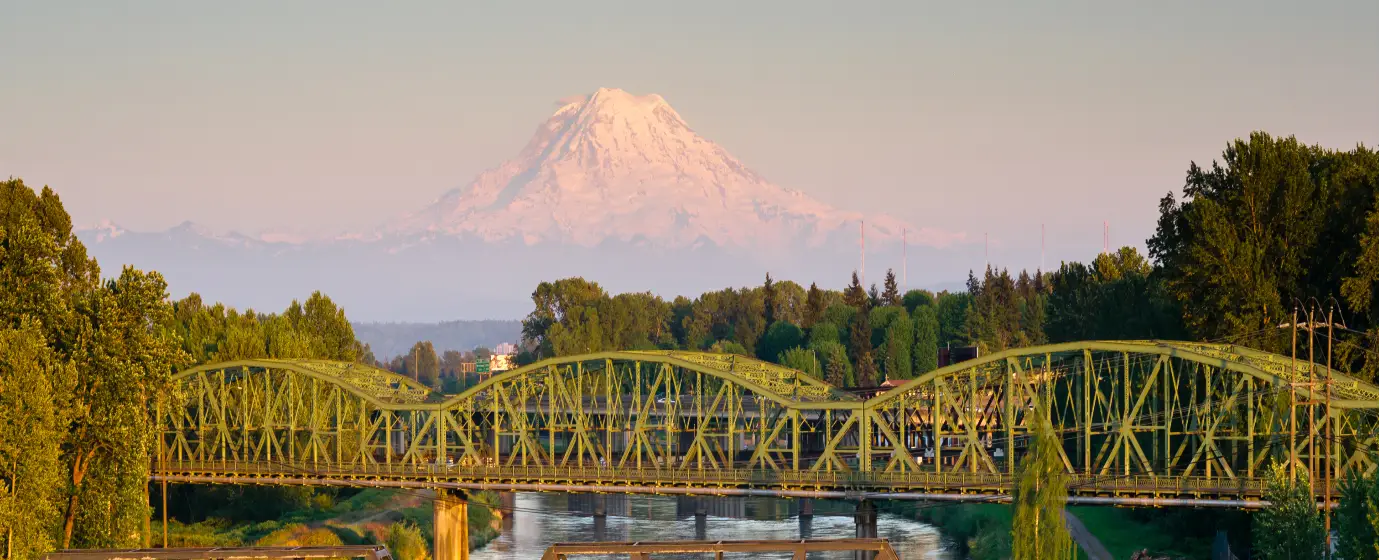
If you've spent time in the Bay Area or Southern California running the numbers on a move north, you already know the headline: Washington has no state income tax on wages or salaries, and home prices in Puyallup are a fraction of what you're paying in any major California metro. What the spreadsheet doesn't tell you is what Puyallup actually feels like — a working city of roughly 42,000 people tucked between the Puyallup River and the foothills of the Cascades, about 35 miles south of Seattle and 10 miles southeast of Tacoma. It sits at the intersection of SR-512 and SR-167, which puts Boeing's fabrication division, Pierce College, and the Washington State Fairgrounds all within minutes. The city is real and rooted, not a bedroom suburb that accidentally acquired a zip code.
The local economy doesn't run on tech alone. A regional healthcare network anchors employment on the west end of the city, the Puyallup School District — which holds a B+ rating, according to Niche, and is one of the larger districts in Pierce County — employs thousands, and the Washington State Fair each September draws more than a million visitors to the fairgrounds just off Meridian, briefly turning this otherwise quiet city into the biggest event in the Pacific Northwest. Californians moving here tend to come from two categories: remote workers who realized they can get a three-bedroom house with a yard for less than a Bay Area one-bedroom, and families relocating for Boeing or one of Tacoma's major employers who want good schools and a shorter commute than Seattle's suburbs offer.
Puyallup's overall cost of living runs approximately 16% above the U.S. national average — driven by housing and transportation — but that figure deserves context. San Jose, California is estimated to be more than 70% more expensive than Puyallup on a cost-of-living comparison basis. The Zillow Home Value Index pegged Puyallup's typical home value at $573,027 in July 2026; see the full cost-of-living breakdown for how that translates to monthly expenses. Health insurance premiums generally run noticeably below what most Californians were paying, though you may drive farther for certain specialist care than you did in a large metro.
Whether you're weighing the tax math, trying to understand which neighborhoods match your life, or just wondering if the Pacific Northwest weather will break you, the sections below cover the California-to-Puyallup comparison in detail: home prices and purchasing power, the tax picture, what day-to-day life actually looks like, the commute reality, and the honest reasons some people leave.
Home Prices: What Your California Equity Buys Here
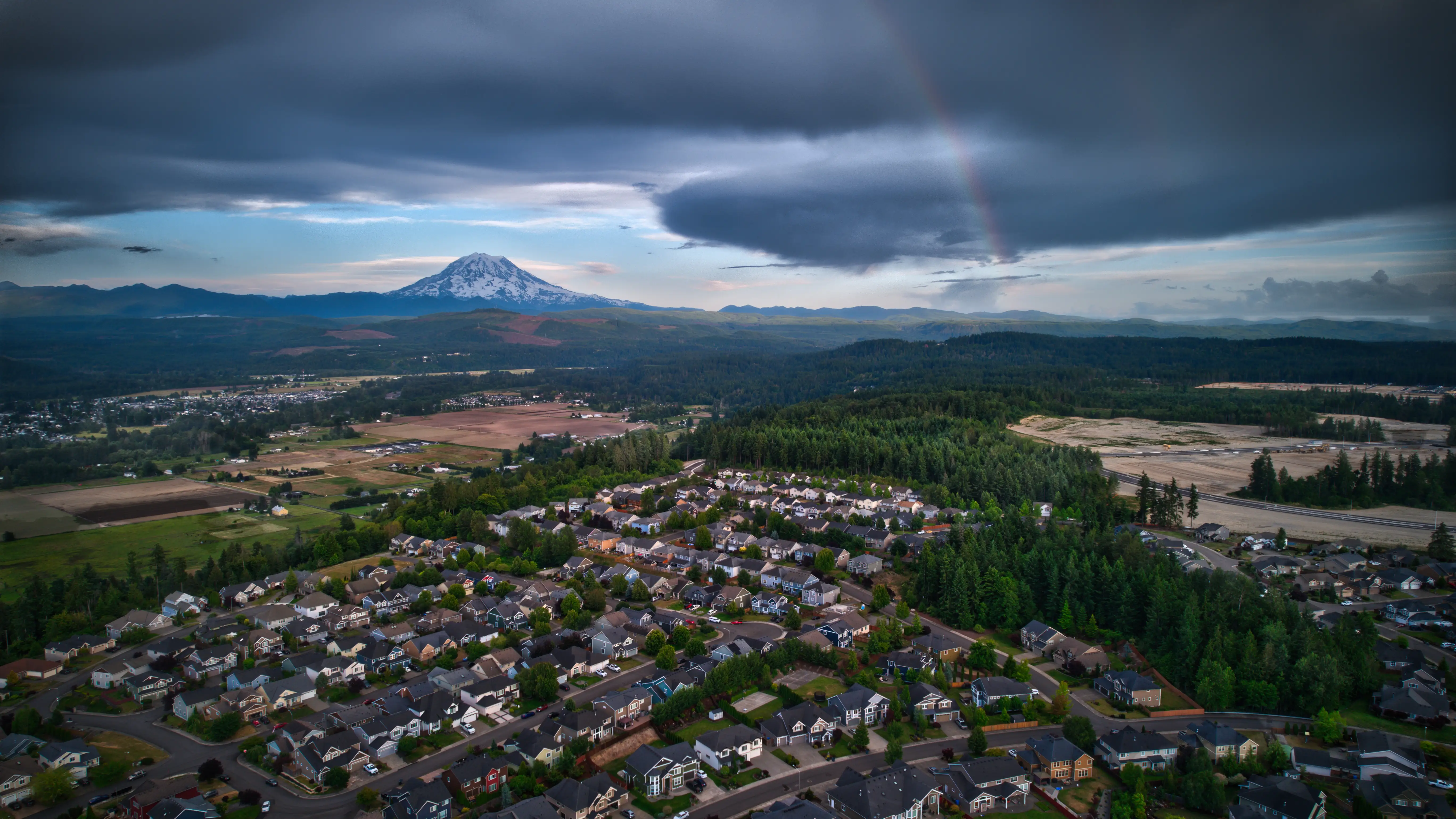
The number that stops most Californians mid-scroll is $573,027 — Puyallup's typical home value as of July 2026 (Zillow Home Value Index). In the context of what you're leaving behind, that figure looks almost implausible.
| Market | Typical Home Value (mid-2026) | Property Tax Rate (approx.) |
|---|---|---|
| Puyallup, WA | $573,027 | 1.01% |
| San Jose, CA | ~$1,400,000+ | ~1.1–1.2% |
| Los Angeles, CA | ~$900,000+ | ~1.1–1.2% |
| San Diego, CA | ~$950,000+ | ~1.0–1.2% |
| Sacramento, CA | ~$480,000–$530,000 | ~1.1–1.2% |
| Fresno, CA | ~$370,000–$410,000 | ~1.1–1.2% |
California figures are approximate mid-2026 market estimates for comparison context only. Puyallup figure is Zillow Home Value Index, July 2026.
Bay Area sellers arriving with substantial equity often find they can purchase in Puyallup with little or no financing — which reshapes the entire buying conversation. Southern California transplants landing in the $800,000–$950,000 range find that Puyallup's median buys a newer construction home with a two-car garage and a usable yard, not a teardown on a busy arterial.
What Entry-Level Looks Like
Entry-level in Puyallup — older 1970s–1980s construction, smaller lots, areas closer to SR-512 — starts roughly in the upper $400,000s. That's the range where first-time buyers from California's Inland Empire or Central Valley feel the most immediate purchasing-power parity. For buyers coming from Sacramento, the prices are broadly comparable; the difference is that Puyallup layers on no state income tax and a different rainfall pattern.
For details on how neighborhood character and geography affect where to buy, the neighborhood guide breaks down Puyallup's distinct areas. The property tax rate here is 1.01% effective — on a $573,027 home, that works out to roughly $5,787 annually, which is comparable to effective rates in many California counties despite the much lower purchase price.
The Equity Windfall Problem
Arriving with a large cash position from a California sale creates a real decision: do you buy outright, put a large down payment down and invest the rest, or upsize aggressively? Most financial advisors caution against the last option on instinct alone — Puyallup's market has appreciated steadily but is not immune to regional corrections. The smarter move for most transplants is to rent for 90 days, learn the geography, then buy with a clear sense of which side of SR-512 matches your lifestyle.
The Tax Shift: Washington's No-Income-Tax Reality
This is the part of the move that surprises Californians most in month two, when a full paycheck arrives with no state income tax withheld. Washington has a 0% individual income tax rate on wages and salaries — confirmed by the Washington Department of Revenue — and it does not tax Social Security benefits, pension distributions, 401(k) withdrawals, or IRA income, all of which California taxes as ordinary income.
| Tax Category | California | Washington (Puyallup) |
|---|---|---|
| State income tax (wages) | 1%–13.3% | 0% |
| State income tax (retirement income) | Taxed as ordinary income | Not taxed |
| Capital gains tax | Up to 13.3% (as ordinary income) | 7% on long-term capital gains above a $278,000 standard deduction for 2025, rising to 9.9% on gains above $1,000,000 |
| Social Security benefits | Taxed as ordinary income | Not taxed |
| Sales tax (combined, approx.) | 7.25%–10.75% depending on county | 10.3% (state 6.5% + local) |
| Groceries / prescription drugs (sales tax) | Groceries exempt; Rx varies | Both exempt |
The savings on income tax are real and immediate. A household earning $150,000 in California could easily pay $9,000–$12,000 annually in state income tax at marginal rates; in Washington, that line goes to zero.
Where Washington Catches Up
Puyallup has a combined state and local sales tax rate of 10.3%, which stings on large purchases — appliances, furniture, vehicles — but groceries and prescription drugs are exempt, which blunts the everyday impact for most households. The full cost-of-living page covers how Puyallup's tax picture affects a realistic monthly budget.
California transplants selling appreciated stock or investment property should pay attention to Washington's capital gains tax: 7% on long-term capital gains above a $278,000 standard deduction for 2025, rising to 9.9% on gains above $1,000,000. That's still dramatically lower than California's treatment of capital gains as ordinary income at rates up to 13.3%, but it's not the "no tax at all" picture some people assume. And one note for very high earners: Washington passed Senate Bill 6346, which creates a 9.9% tax on income exceeding $1 million, effective January 1, 2028. It won't affect most relocators, but it matters if you're in that range.
The Property Tax Reality
Puyallup's effective property tax rate of approximately 1.01% is broadly in line with California's effective rates — but the base is dramatically lower. The same tax rate applied to a Bay Area home at $1.4 million produces a tax bill nearly two-and-a-half times larger than on a Puyallup home at $573,027. For precise figures on how that rate interacts with your specific purchase price and income situation, a tax professional familiar with Pierce County assessments is worth a one-hour consultation before closing.
Daily Life in Puyallup: The Honest Picture
The first thing Californians notice — usually by week three — is how quiet it is relative to any metro they came from. Puyallup's downtown core runs along East Main Avenue and Meridian, with the Puyallup Historic Downtown district anchoring independent restaurants, coffee shops, and small retail. Powerhouse Restaurant & Brewery on E Main Ave is the kind of place you end up at on a Friday night when you want a real pint and a meal that didn't come out of a drive-through window.
The September Reality Check
Nobody warns California transplants about September. The Washington State Fair runs for three weeks each fall at the Washington State Fairgrounds just off Meridian, drawing over a million visitors. Meridian Avenue becomes genuinely gridlocked. Local families know to plan grocery runs before 10 a.m. or after 9 p.m., avoid the Meridian corridor entirely, and use the back streets through Sunrise or North Puyallup to get anywhere useful. If you close on a house in August and assume Puyallup is always this calm, September will recalibrate your expectations fast.
Parks, Trails, and the Outdoors
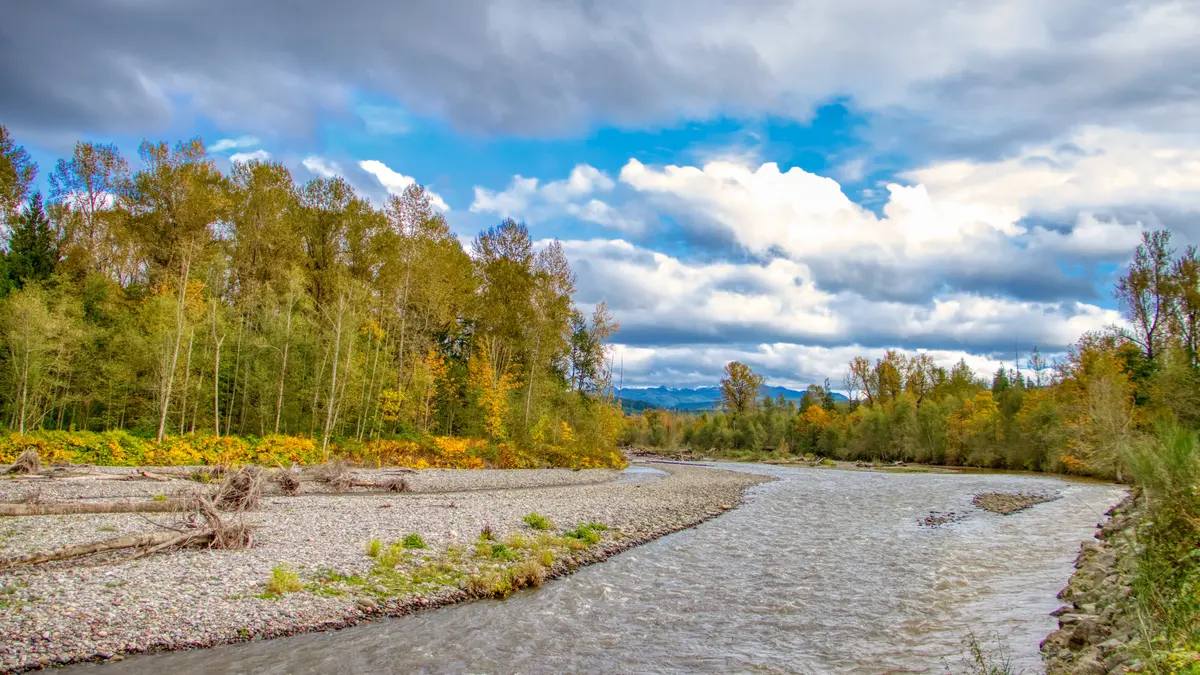
Pioneer Park is the city's central green space — a real park with old trees and room to breathe, not a manicured strip of sod between subdivisions. The Puyallup River trail system connects several neighborhoods and gives you a legitimate after-work run without getting in a car. For a deeper look at what Puyallup's outdoor options look like day-to-day, the parks and recreation page covers it fully.
The Cascades are not hypothetically nearby — they're visually present on a clear day, and Crystal Mountain is roughly an hour from most parts of the city. Californians accustomed to driving four hours to reach decent skiing tend to find this ratio meaningfully better.
What Californians Underestimate
The rain is overrated as a deterrent and underrated as an adjustment. Puyallup doesn't get hammered by dramatic storms the way coastal California does in wet years. What it does get is persistent gray — November through February can pass with weeks of overcast skies and light drizzle that never feels like enough to justify an umbrella but adds up psychologically. People who move here from San Diego specifically, rather than from the Bay Area or Sacramento, tend to feel it more acutely in year one.
Looking to buy in Puyallup? Estimate your payment.
Enter your numbers to see an estimated monthly mortgage payment.
Estimate only. Excludes HOA fees and mortgage insurance. The interest rate above is a starting point, not a quoted rate — replace it with your own to see real numbers. Insurance is a flat placeholder, not a Puyallup quote.
Getting Around: Commute and Transit
Puyallup sits at the convergence of SR-512 and SR-167, which gives it practical access to both Tacoma (roughly 25 minutes on a clear day) and Seattle's airport corridor. The highway access is a genuine selling point — most California suburbs require this level of freeway proximity to achieve the same commute math.
The Sounder Train Advantage
Puyallup Station at 131 W Main Ave is served by Sound Transit's S Line Sounder commuter rail, connecting downtown Puyallup to Seattle's King Street Station in approximately 49 minutes for a $3 fare. The park-and-ride was expanded to 1,044 stalls in 2023 with a new parking garage, which means actually getting a space is no longer the competitive exercise it was. For Californians who spent years on Caltrain or Metrolink, the Sounder will feel familiar — and the fare will feel almost insulting by comparison.
The S Line stops in South Tacoma, Tacoma, Puyallup, Sumner, Auburn, Kent, and Tukwila before reaching Seattle, which makes the whole southern Puget Sound corridor commutable from here. Tacoma employers are the most logical commute destination; Boeing's fabrication operations and Pierce College are within the city itself. For a fuller picture of how employers and commute patterns shape life in Puyallup, the living in Puyallup page covers it directly.
What Driving Here Actually Looks Like
SR-512 and Meridian Avenue are the two pressure points local drivers know. Meridian is the main commercial corridor and it backs up during school pickup, fair season, and any afternoon between 4 and 6 p.m. The streets through the Sunrise neighborhood and along the Puyallup River valley offer genuine bypass routes that newcomers take a few months to learn. A car is not optional in Puyallup — this is not a walkable city in the way that parts of Tacoma or Seattle are — but the driving distances are short enough that it rarely compounds the way California freeway commutes do.
Why People Leave — and Why Most Don't
The honest version of a relocation guide includes this section. After the first year in Puyallup, a minority of California transplants decide it's not right for them. The reasons are specific and worth naming.
The Reasons People Go Back
The biggest one is family. California is large, and if your parents, siblings, or adult children are in the Bay Area or Los Angeles, the distance from Puyallup is real — not just emotionally but logistically. Seattle-Tacoma International Airport is approximately 30 minutes north of Puyallup, and Alaska Airlines runs frequent service to California metros, which makes the connection manageable but not free. People who underestimate how often they'll want to fly back tend to feel it most acutely by month eight.
The second reason is career specialization. If your field is deeply concentrated in a specific California ecosystem — entertainment, biotech, certain corners of finance — Puyallup's proximity to Seattle helps but doesn't fully substitute. Remote work has changed this calculation significantly, but not entirely. People who need to be physically present in a dense professional network tend to find Pierce County's options thinner than they expected.
Why the Majority Stay
The tax math eventually wins. A household that was paying $10,000–$15,000 annually in California state income tax watches that number go to zero, and after a few years of reinvesting it — into mortgage principal, retirement accounts, or college savings — the idea of moving back starts to feel financially irrational. The Puyallup School District's strong ratings mean families with school-age children aren't sacrificing much educationally; the schools page covers the district's specific strengths and boundaries in detail.
Meeker Mansion, Pioneer Park, and the walkable blocks of Historic Downtown give Puyallup a sense of place that newer suburban cities lack. After six months, most transplants stop comparing it to California and start comparing it to Sumner, Bonney Lake, and Tacoma — which is the sign that the city has become home rather than a relocation experiment.
The One Thing Worth Knowing Before You Buy
Do not skip the 90-day rental period if you can possibly afford it. The difference between Puyallup's established neighborhoods closer to Historic Downtown and its newer-construction areas further south toward South Hill is significant — not in price alone, but in character, density, and how you'll actually feel on a Tuesday evening. Buying on a weekend visit alone is the most common mistake California transplants make here. Rent first, drive the routes to work for a month, then make the offer.
Local Expert Takeaway: The California-to-Puyallup move works best when you treat it as a deliberate trade, not just an escape from high prices. You give up the density, the weather certainty, and proximity to California's professional networks. You gain the income tax savings on day one, a $573,027 median home price where Bay Area equity goes a long way, a real commuter rail line from Puyallup Station to Seattle for $3, and a city with enough history — Meeker Mansion, Pioneer Park, the September State Fair chaos — to feel like somewhere rather than anywhere. The people who stay long-term are the ones who rented first, learned the SR-512 and Meridian patterns before committing, and made their decision with a clear head rather than a spreadsheet that only told half the story.
Quick Takeaways & FAQs
✅ Washington's zero state income tax on wages is immediate and real — a household earning $150,000 in California could save $9,000–$12,000 annually just on that line item.
⚠️ Puyallup has a combined state and local sales tax rate of 10.3%, which offsets some of the income tax savings on large purchases — budget for it when furnishing a new home.
📍 Puyallup Station's Sounder commuter rail connects downtown Puyallup to Seattle's King Street Station in about 49 minutes for $3, with a 1,044-stall park-and-ride expanded in 2023.
Is Washington really a no-income-tax state for people moving from California?
How do home prices in Puyallup compare to where I'm moving from in California?
What is the property tax rate in Puyallup, and how does it compare to California?
What is the sales tax rate in Puyallup, Washington?
Can I realistically commute from Puyallup to Seattle without driving every day?
Moving to Washington?
Tell us what you need help with and we'll connect you with local resources.
