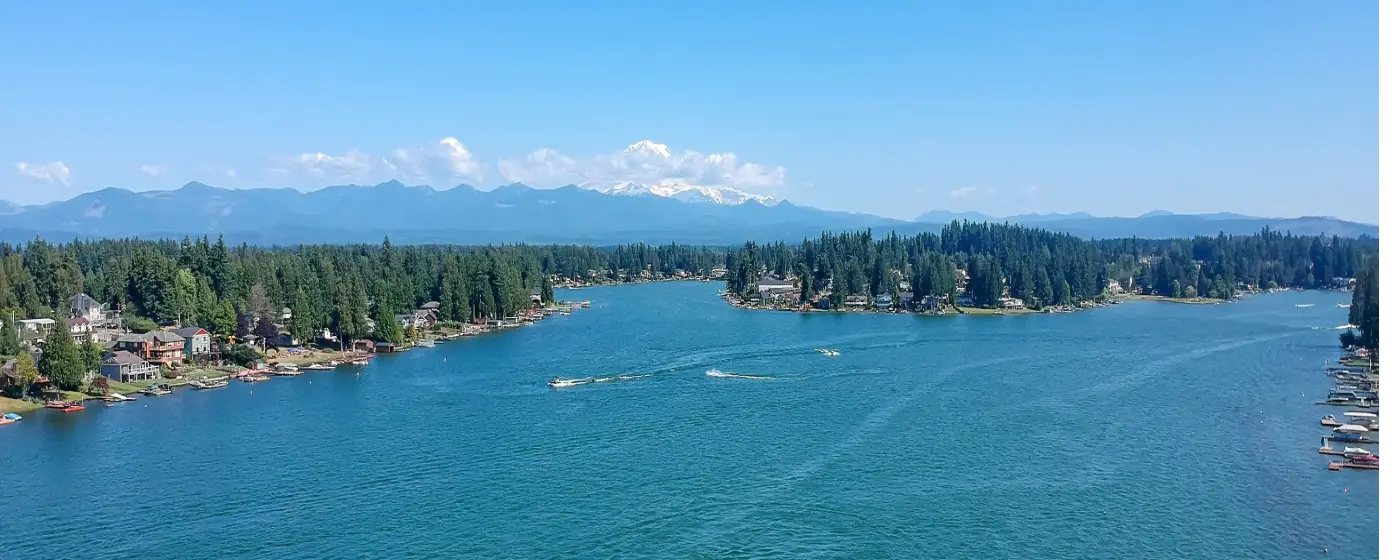
What Is Living in Sumner, Washington Like?
Most people discover Sumner one of two ways: their employer is in the industrial corridor off Valley Avenue, or they've been priced out of Renton and Auburn and someone mentioned a small Pierce County city with a Sounder station. What surprises them once they arrive is how genuinely town-like Sumner feels — a walkable Main Street E with breakfast at The Buttered Biscuit, a historic downtown that still hosts a Grand Floral Parade route each spring, and a population just under 11,000 that makes the city feel more like a community than a suburb. Sumner sits at the confluence of the Stuck and Puyallup Rivers, about 35 miles south of Seattle via SR-167, and its location between Tacoma (roughly 20 minutes southwest) and the employment corridor to the north is what shapes nearly everything about daily life here.
The economy around Sumner is bigger than the city itself suggests. REI, Amazon, Costco Wholesale, Kellogg's, and Green Mountain Coffee Roasters — along with Dillanos Coffee — all operate distribution or manufacturing facilities in the city's industrial corridor, making Sumner a blue-collar and logistics powerhouse tucked inside a small-town frame. That mix pulls in a wide range of residents: warehouse and operations workers who live close to their shifts, remote workers who want Tacoma prices with Sounder access to Seattle, and families drawn to the Sumner-Bonney Lake School District. The city's median age of 37.6 and a poverty rate of just 4.9% point to a working-age, financially stable population.
Housing here runs noticeably below what you'd pay in Bellevue or even Auburn's newer developments. The Zillow Home Value Index for Sumner stood at $555,065 in 2026 — down modestly from post-pandemic highs, which has reopened doors for buyers who sat out the last few years. Over 800 housing units are in the city's permit pipeline, with Sumner projecting roughly a 25% population increase within three years, so the small-town feel is real for now but won't stay static. For day-to-day life, Field's Riverway Park along the Puyallup River, Rhubarb Days each June on Main Street, and the Sounder station at 810 Maple Street define the rhythm of the place more than any shopping center does.
Whether you're considering a move or just researching the area, the sections below break down Sumner's neighborhoods, housing market, commute options, local employers, and what daily life here is really like in 2026.
Sumner at a Glance
Looking to buy in Sumner? Estimate your payment.
Enter your numbers to see an estimated monthly mortgage payment.
Estimate only. Excludes HOA fees and mortgage insurance. The interest rate above is a starting point, not a quoted rate — replace it with your own to see real numbers. Insurance is a flat placeholder, not a Sumner quote.
Why Are People Moving to Sumner?
The honest answer is: Sumner offers something rare in the South Puget Sound — a town center that actually functions as one, combined with a logistics-economy job base and direct rail access to Seattle. That combination is hard to find at this price point in Pierce County.
The Industrial Corridor Draw
Sumner's employment base is unusually dense for a city its size. REI's retail distribution operation, Costco Wholesale's regional distribution center, Amazon's logistics facility, Kellogg's food manufacturing plant, and both Green Mountain Coffee Roasters and Dillanos Coffee all operate here. For workers in operations, distribution, and manufacturing, living in Sumner means a sub-10-minute commute to work — a genuine rarity in the region.
That job density also stabilizes the local economy in ways that pure bedroom suburbs don't enjoy. When one sector softens, others often hold. Longtime residents point to this as one reason Sumner weathered the post-pandemic market correction without the dramatic vacancy swings seen elsewhere in Pierce County.
The Sounder Factor
For remote workers or hybrid commuters with Seattle obligations, the Sounder S Line station at 810 Maple Street is the deciding factor. The commuter rail connects Sumner to Seattle's King Street Station — Tacoma and Seattle reachable in under 40 minutes — primarily during weekday peak hours. In 2024, the station logged 95,835 total boardings. A new parking garage and pedestrian bridge are expected to expand capacity to over 600 stalls, easing one of the station's persistent friction points.
Who Actually Moves Here
| Buyer / Renter Type | Why Sumner Works | Best For |
|---|---|---|
| Logistics & distribution workers | Live minutes from REI, Amazon, Costco, Kellogg's corridors | Commuter |
| Hybrid Seattle commuters | Sounder rail; no driving into the city on rail days | Transit Commuter |
| Families with school-age children | Sumner-Bonney Lake School District; quieter streets than Tacoma | Families School |
| First-time buyers priced out of Auburn/Kent | City-wide median noticeably below nearby King County comparables | First-Time Value |
| Remote workers wanting town character | Walkable Main Street E; independent dining and taproom scene | Walkable |
| Retirees downsizing from larger metros | Lower density, river parks, Sounder access without driving to Seattle | Quiet Transit |
What you give up is proximity to the coast and the cultural density of Tacoma's arts district. Sumner is emphatically a town, not a city, and buyers who expect urban amenity density tend to feel it within the first few months.
What Daily Life Feels Like in Sumner
Six months in, almost every newcomer says some version of the same thing: "I didn't expect to actually use Main Street." Most Pierce County suburbs orbit a strip mall. Sumner's Main Street E is a real pedestrian corridor — The Buttered Biscuit for weekend brunch, Township 20 for a post-work taproom stop, The Windmill Bistro and Pura Brasa for dinner, Rivers Edge Cafe & Brews for a midday coffee break. None of it requires a car once you're parked downtown.
The Agricultural Identity Nobody Expects
Sumner is the self-declared Rhubarb Pie Capital of the World, and that's not just a novelty sign. German immigrant Adam Knoblauch first planted rhubarb here in the late 1800s; by the 1940s the Puyallup Valley was shipping 150 carloads annually. Rhubarb Days each June (the 2026 edition ran June 20–21) draws over 200 vendors and a dozen food trucks to Main Street — it's the community gathering that newcomers stumble into their first summer and immediately put on the calendar for next year.
The Grand Floral Parade, which traces its origins to a 1926 garden party on a rural Sumner estate, now sends floats through multiple Pierce County cities each spring. For a city of under 11,000 people, the event calendar punches well above its weight.
The Old Cannery, and What It Says About Sumner
The Old Cannery Furniture Warehouse tells you something important about Sumner's personality: it's a furniture store with 7 scale miles of model trains running through the building, a fudge shop offering 28 rotating flavors, and animatronics throughout. It shouldn't work. It absolutely does. It's the kind of destination that brings families from across Pierce County on a Saturday and makes locals quietly proud.
What Surprises People After Six Months
The seasonal traffic around Rhubarb Days and the Grand Floral Parade catches newcomers off guard — Main Street becomes genuinely gridlocked, and parking near the Sounder station disappears for the duration. Plan for it early; longtime residents either walk in from adjacent neighborhoods or leave well before the crowds arrive.
The other surprise is how quickly the city's growth pipeline becomes visible. Over 800 permitted housing units are in development, and construction activity on the edges of downtown is constant. The small-town feel is real and worth moving here for — just know it's actively in transition, not frozen in place.
For a deeper look at outdoor spaces and where the community gathers, the parks and recreation page covers Field's Riverway Park and Ryan House Park in detail.
The Sumner Housing Market Right Now
Sumner's Zillow Home Value Index stood at $555,065 in 2026, down 4.9% from the prior year. That modest correction has brought buyers back into conversations they'd stepped away from during 2022 and 2023 peak pricing — and inventory has opened up enough that multiple-offer pile-ons are less automatic than they were.
The market is still tight by historical standards, not crashed. Homes in genuinely move-in condition in walkable proximity to the Sounder station tend to move quickly. Properties that need work or sit farther from the downtown core give buyers more time and negotiating room.
Growth on the Horizon
The pipeline figure matters here: over 800 housing units are permitted and in development, with the city projecting a roughly 25% population increase within three years. Some of that new construction will absorb demand; some of it will accelerate the transformation of what currently feels like a small town. Buyers who want Sumner's current character should be clear-eyed that the city in 2028 will look meaningfully different from the city today.
Some parts of the city command a premium over others — proximity to the Sounder station and the Main Street corridor is consistently reflected in price — but neighborhood-by-neighborhood breakdowns live on the best neighborhoods page. For the full cost picture including rent ranges, property tax rates, and how Sumner compares to neighboring cities, see the cost of living page.
What $555,065 Gets You
At the city-wide median, buyers are typically looking at established single-family homes with three or four bedrooms — older construction in the downtown-adjacent neighborhoods, newer builds in areas like Lakeland and Bridgewood farther from the core. Entry-level options do exist below the median for condos and older ranch-style homes, though inventory in that tier moves fastest when it appears.
The effective property tax rate in Sumner is approximately 1.01% — close to the Washington state average and not a significant outlier relative to nearby Pierce County cities.
Sumner Neighborhoods
Sumner has several distinct areas — each with its own character and appeal. Here’s a breakdown to help you narrow down where to focus your home search.
🏡 Downtown Sumner
The most walkable part of the city — steps from the Sounder station, Main Street E restaurants, and Ryan House Park — Downtown Sumner suits buyers who want to leave the car parked on weeknights and weekends. Housing here skews toward older single-family homes and a smaller number of attached units.
🏠 Sumner Town Center
The transitional zone between the historic downtown core and the city's newer residential growth, Town Center blends established homes with newer infill development. It suits buyers who want proximity to Main Street amenities without paying the premium of the closest downtown blocks.
🌳 East Sumner
East Sumner sits farther from the Sounder station and Main Street, giving it a quieter, more residential character that appeals to families with school-age children who prioritize yard space and neighborhood calm over walkability.
🏘 Lakeland
Lakeland is one of Sumner's newer-construction pockets, with larger homes on more recent floorplans attracting families looking for updated square footage. The trade-off is a longer walk — or a short drive — to the downtown core and Sounder platform.
🏔 Sumner Ridge
Sumner Ridge sits on elevated ground at the city's edge, offering views of the Puyallup Valley and a quieter suburban feel. It suits buyers who want separation from the busier downtown corridor and don't mind the commute to the Sounder station.
🌆 Bridgewood
Bridgewood is a family-oriented pocket with established streets and a neighborhood feel, positioned for buyers who want a quieter setting while remaining within a reasonable drive of both Sumner's downtown and Puyallup's broader amenities.
Pros & Cons of Living in Sumner
The Pros
- Charming historic downtown with local shops and restaurants
- Sounder commuter rail gives a car-free option into Tacoma and Seattle
- strong sense of community with long-running local festivals
- good access to outdoor recreation near the Puyallup and White Rivers
The Cons
- Home prices and rents run well above the national average
- property crime rates are notably higher than nearby similarly sized cities
- frequent gray
- wet winters typical of the Puget Sound lowlands
Getting Around & Commuting in Sumner
Sumner is one of the few cities in Pierce County where you can actually choose between driving and rail for a Seattle commute. That choice shapes how people experience the city differently depending on where they work.
The Sounder S Line
The Sumner Sounder Station at 810 Maple Street sits squarely in the heart of downtown, which means boarding the train and stopping for coffee at Rivers Edge Cafe & Brews before a Seattle meeting is a realistic morning routine — not a theoretical one. The S Line runs from Lakewood through Tacoma, Puyallup, Sumner, Auburn, Kent, and Tukwila to King Street Station, operating primarily on weekday peak-hour schedules. Average weekday boardings in 2024 were 408, meaning the platform isn't crushing — you'll generally find a seat.
The catch: Sounder runs on freight railroad tracks, which means delays aren't uncommon during high freight periods, and the peak-hour-only schedule makes midday or evening train travel impractical. Anyone with a non-traditional work schedule should plan on driving for off-peak trips.
Driving to Seattle and Tacoma
The SR-167 north toward Auburn is the primary highway corridor. On a clear morning departure before 6:30 a.m., Seattle is around 45 minutes. Leave after 7:00 a.m. and the Valley Freeway between Puyallup and Auburn routinely adds 20 to 30 minutes to that estimate. Tacoma via SR-167 or US-410 southwest runs about 20 minutes — significantly more forgiving than the Seattle direction.
The SR-167/SR-410 interchange near Sumner is the area's recognized chokepoint. Southbound evenings are particularly slow, and the merge from eastbound SR-410 onto northbound 167 catches people off guard until they learn to account for it. Locals heading to Seattle for an early evening commitment often take the Sounder out and drive home after peak hours clear — a practical split that the station's location makes easy.
Local Mobility
Within Sumner itself, Main Street E is genuinely walkable for errands, dining, and the Sounder platform. Pierce Transit bus routes serve the broader corridor, connecting Sumner to Puyallup and Auburn. For anything beyond those corridors, a car is the practical reality — this is not a city where car-free living is comfortable for most households.
| Destination | Mode | Typical Travel Time | Notes |
|---|---|---|---|
| Seattle King Street Station | Sounder S Line | ~38–42 min | Weekday peak hours only |
| Seattle downtown | Drive (SR-167 N) | 45–75 min | Highly variable; pre-6:30 a.m. is fastest |
| Tacoma downtown | Drive (SR-167 SW) | ~20 min | Much more consistent than Seattle direction |
| Puyallup | Drive | ~10 min | Closest city; SR-410 or Valley Ave |
| Auburn | Drive or Sounder | ~12–15 min | One stop north on S Line |
| Seattle-Tacoma Airport | Drive | ~35–45 min | Via SR-167 N to I-5 or SR-99 |
The station parking expansion — expected to add capacity beyond 600 stalls with a new garage and pedestrian bridge in 2026 — will reduce the current scramble for spots on busy commute mornings, though timing should be confirmed with Sound Transit's project tracker before counting on it.
Schools in Sumner
Families relocating to Sumner have public, private, and higher-education options nearby. Here’s a quick overview.
🎓 School District
Sumner-Bonney Lake School District serves K–12 students across Sumner and the surrounding area.
🏆 Graduation Rate
The 4-year high-school graduation rate here is approximately 93.5%.
📚 Higher Education
Washington’s public universities — the University of Washington, Washington State University, and Western Washington University — offer four-year degrees statewide, with a network of 34 community and technical colleges (SBCTC) providing two-year and workforce programs.
🌐 Online Learning
University of Washington Continuum College and Washington State University Online offer fully accredited online degrees for remote learners across the state.
Safety in Sumner
A quick look at how Sumner compares on the numbers that matter most when weighing a neighborhood or a move.
🛡 Violent Crime
Approximately 2.25 per 1,000 residents.
🔒 Property Crime
Approximately 57.95 per 1,000 residents.
Compared to the FBI’s most recent national data (2024), Sumner’s violent crime is below the national average (about 3.6 per 1,000), and property crime is above the national average (about 17.6 per 1,000).
Against Washington as a whole, Sumner’s violent crime is roughly two-thirds of the state average, and property crime is about double the state average (Bureau of Justice Statistics, Crime Known to Law Enforcement, 2024 (tables 2 and 3)).
Crime rates can vary a lot within a single city, so the citywide numbers above are only a starting point. Some neighborhoods in Sumner run well below these averages, while others run higher — the kind of block-by-block detail that matters most when you’re actually choosing where to live. The full guide below breaks it down neighborhood by neighborhood.
Working in Sumner
Sumner’s largest employers span several industries — here are some of the anchors of the local job market.
🛒 REI
Retail distribution
🛒 Costco Wholesale
Retail distribution
💼 Amazon
Logistics/e-commerce
🛒 Kellogg's
Food manufacturing
🏭 Green Mountain Coffee Roasters / Dillanos Coffee
Coffee manufacturing
Parks & Recreation in Sumner
Some of the outdoor spaces that shape everyday life in Sumner.
🌱 Ryan House Park (former Ryan House Museum site)
🌱 Field's Riverway Park
Sumner residents don’t have to go far for green space — spots like Ryan House Park (former Ryan House Museum site) and Field's Riverway Park are part of everyday life here, whether that’s a morning walk, a weekend hike, or just somewhere to unwind outside. The full guide below covers more of what Sumner has to offer for parks and outdoor recreation.
Retiring in Sumner
Sumner draws retirees for its balance of amenities, outdoor access, and cost. Here’s what to weigh.
🌤 Climate
Sumner sits in the Puyallup Valley rain shadow — not dramatically drier than Seattle, but noticeably so. Winters are mild and gray with temperatures rarely dropping below freezing, summers are warm and increasingly dry through July and August, and the valley's agricultural history is visible in how green the surrounding landscape stays well into fall.
🍴 Lifestyle
Main Street E offers a compact but genuine dining and café scene — The Windmill Bistro, Township 20, and Pura Brasa cover most evening occasions without leaving downtown. Field's Riverway Park provides river-access walking paths close to the core, and the annual Rhubarb Days festival and Grand Floral Parade give the community calendar a distinctive agricultural-heritage character that feels nothing like a generic suburb.
🏚 55+ Communities
Sumner and the immediately surrounding Puyallup Valley area have active-adult and senior housing options, with more substantial inventory in neighboring Puyallup. The city's growth pipeline includes residential development that will add options over the next few years. The retiring page covers senior living in greater detail.
✈ Getting Around
Most retirees in Sumner drive — the city is laid out for cars beyond the downtown walkable core. The Sounder station is a genuine asset for Seattle day trips without highway driving. Seattle-Tacoma International Airport is approximately 35 to 45 minutes north via SR-167, making it realistic for regular travel without an overnight-before-flight stay.
🏛 Washington Taxes for Retirees — What to Know
- No state income tax — Washington does not tax personal income, so Social Security, pensions, and 401(k)/IRA withdrawals are all untaxed at the state level. There is no state return to file and no retirement exclusion to claim — the rate is simply zero.
- Military and public pensions — Because there is no income tax, military retirement pay and public-employee pensions are untaxed at the state level along with everything else.
- Sales tax is the tradeoff — The state sales tax is 6.5%, and local add-ons bring the combined rate in Sumner to 9.7% (Washington State Department of Revenue, Q3 2026 local sales & use tax rate table, July 2026). Groceries and prescription drugs are exempt.
- Property taxes, with senior relief — The effective property tax rate is roughly 0.9%. Homeowners 61+ (or unable to work due to disability, or a qualifying disabled veteran) who own and occupy their home may qualify for a reduction. Income limits are set against each county’s median household income, so the threshold differs by county — check with your county assessor. A separate deferral program is available for those who don’t qualify for the exemption.
- Capital gains tax — but not on retirement income — Washington taxes 7% on long-term capital gains above a $278,000 standard deduction for 2025, rising to 9.9% on gains above $1,000,000. Retirement accounts and real estate sales are both exempt. It therefore does not reach ordinary retirement income or the sale of a home.
- Estate tax — the one to plan for — Unlike most no-income-tax states, Washington has its own estate tax. For deaths on or after July 1, 2026, the exemption is $3 million with graduated rates topping out at 20%. Retirement accounts count toward the taxable estate, so long-time homeowners with sizable balances can cross the line without expecting to.
- No inheritance tax — Washington has no inheritance tax, and no gift tax.
- WA Cares payroll premium — Working Washingtonians pay 0.58% of gross wages into the WA Cares Fund, the state long-term care program, with no income cap. It applies to W-2 wages, so retirees who have stopped working do not pay it — but anyone relocating while still employed will see it. The private-insurance opt-out closed at the end of 2022 and is not available to new applicants; the remaining exemptions are narrow (living outside Washington, military spouses, certain visa holders, and veterans with a 70%+ service-connected rating).
- The Oregon border effect — Oregon has no sales tax, so Washington residents near the river — Vancouver, Camas, Washougal, Longview — often cross over for large purchases. Washington use tax technically applies to goods brought back for use in-state, though it is rarely enforced on ordinary personal purchases.
Tax laws change frequently and individual situations vary. This is general information, not tax advice — always consult a qualified Washington tax professional or CPA for personalized retirement tax planning.
Weekends & Local Favorites in Sumner
For a city under 11,000 people, Sumner packs a surprising amount into its weekends — mostly because the agricultural and civic traditions here are genuinely old and genuinely local, not manufactured.
Main Street on a Saturday
The Main Street E corridor is where the week resets. Weekend mornings at The Buttered Biscuit draw a consistent crowd of families and couples; by midday the sidewalk in front of Township 20 and The Windmill Bistro starts filling. Pura Brasa draws dinner crowds looking for something a step above casual. The strip is short enough to walk end-to-end in 10 minutes, which is both its charm and its limitation — when you want more variety, Puyallup is 10 minutes away and Tacoma's 6th Avenue restaurant corridor is 25.
The Events That Define the Year
Two events anchor the Sumner calendar in ways that residents either love immediately or learn to plan around. Rhubarb Days each June — the 2026 dates were June 20–21 — fills Main Street with 200-plus vendors, a dozen food trucks, live music, and genuinely excellent rhubarb desserts. The Grand Floral Parade each spring sends floats through downtown Sumner as part of a multi-city route through Pierce County; the festival itself celebrated its 93rd year in 2026 and traces directly back to a 1926 garden party hosted on a Sumner estate.
Both events close streets, fill parking, and are simultaneously the best days to experience the city and the worst days to try to run a quick errand. New residents learn this distinction in year one.
The Old Cannery and the River
The Old Cannery Furniture Warehouse is a legitimate weekend destination — not just for locals, but for Pierce County families who drive specifically for the 7 scale miles of model trains, the 28-flavor fudge shop, and the animatronic characters scattered through the building. It reads as eccentric on paper and delivers in person.
Field's Riverway Park along the Puyallup River is the quiet counterpoint: walking paths, river access, and the kind of open space that makes a small city feel larger than its footprint. Ryan House Park, at the former Ryan House Museum site, has continued as green space in the downtown core. For a full breakdown of trails and outdoor amenities, the parks and recreation page has the details.
What's Nearby on a Day Off
Mount Rainier National Park's Carbon River entrance is roughly 45 minutes east on SR-410 — a drive that Sumner residents make on a Saturday morning in a way that most Seattle residents have to commit an entire day to. Crystal Mountain ski area is about 90 minutes. The Puyallup River corridor connects the city to a broader trail network. For a city without a coastline, the outdoor access from Sumner is genuinely strong.
Top Things Locals Say About Sumner
The best intel about a city comes from the people who actually live there. Here’s what Sumner residents say when newcomers ask the questions everyone’s thinking.
“I knew the Sounder would be convenient, but I didn't realize I'd actually stop driving to Seattle almost entirely. The train plus Main Street for everything else means I go weeks without getting on the highway for anything but a Costco run.”
— Recent Sumner home buyer
“What's the most surprising thing about living in Sumner?”
How real the downtown actually is. Most people expect a strip mall with a train station nearby. Main Street E has a breakfast spot, a taproom, a bistro, dinner options — all walkable from the Sounder platform. After six months you realize you've built an actual routine around a two-block stretch, and that almost never happens in a Pierce County city this size.
“What do locals love most about Sumner?”
The scale of it, and what that scale makes possible. You know your neighbors. The Rhubarb Days festival in June genuinely shuts down Main Street and everyone shows up. The Grand Floral Parade comes through every spring and it's not ironic — people actually line up for it. And being 20 minutes from Tacoma and under 45 to Seattle means you get the small-town feel without giving up access to everything.
“What should newcomers to Sumner know?”
Two things: first, the SR-167 interchange near the SR-410 split is the bottleneck that rules your life if you drive north toward Auburn or Seattle after 7:00 a.m. — either take the Sounder or leave earlier than feels necessary. Second, Rhubarb Days in June and the Grand Floral Parade in spring will close streets and fill every parking spot within six blocks of Main Street. Learn the schedule the week you move in.
“Can you live in Sumner without a car?”
For the Seattle commute specifically, yes — the Sounder station is genuinely walkable from much of the downtown core. For day-to-day errands beyond Main Street, no. Pierce Transit connects Sumner to Puyallup and Auburn, but service frequency is limited and the coverage gaps are real. Most households here run one or two cars. If you're a single person working in Seattle with a Sounder-served schedule and can handle your grocery runs on foot or by bike, car-free is doable but requires deliberate planning.
Cities Near Sumner
Other communities near Sumner worth a look — each with its own character and price point.
| City | Distance | Best For | Vibe | Median Rent | Median Buy |
|---|---|---|---|---|---|
| Puyallup | 4 mi | Families, new construction, more amenities | Larger, suburban, event-driven | $2,000 | $520,000 |
| Bonney Lake | 6 mi | Families wanting newer builds, lake access | Newer, hillside, quieter pace | $2,100 | $560,000 |
| Auburn | 8 mi | Commuters, value seekers, King County access | Urban edge, transit-connected, diverse | $1,950 | $500,000 |
More Helpful Guides for Sumner
Going deeper on Sumner? Our blog series covers everything from first-time buying to retiring here — explore the guides below.
Local Expert Takeaway: Sumner's real value proposition in 2026 is the combination: a functioning Main Street with The Buttered Biscuit, Township 20, and Pura Brasa within walking distance of each other; a Sounder station that makes Seattle genuinely optional on commute days; and a housing market that has softened enough to make entry realistic again. The catch is that 800-plus units in the permit pipeline mean this small-town feel is on a clock. Buy here for what it is now, not what it was five years ago — and read the growth projections before assuming the neighborhood you tour today will feel the same in three years.
Quick Takeaways & FAQs
✅ The Sounder S Line station at 810 Maple Street puts Seattle's King Street Station under 40 minutes away on weekday mornings — rare for a Pierce County city at this price point.
⚠️ Over 800 housing units are permitted and in development, with the city projecting a 25% population increase within three years — Sumner's small-town character is real but actively in transition.
📍 Sumner is the self-declared Rhubarb Pie Capital of the World, and the annual Rhubarb Days festival each June closes Main Street E to traffic — plan around it in your first summer or just embrace it.
How long is the commute from Sumner to Seattle?
What is the typical home price in Sumner, WA in 2026?
What are the biggest employers in Sumner, WA?
Is Sumner, WA a good place for families?
Is Sumner, WA safe?
Helpful Links for Moving to Sumner
Moving to Washington?
Tell us what you need help with and we'll connect you with local resources.
