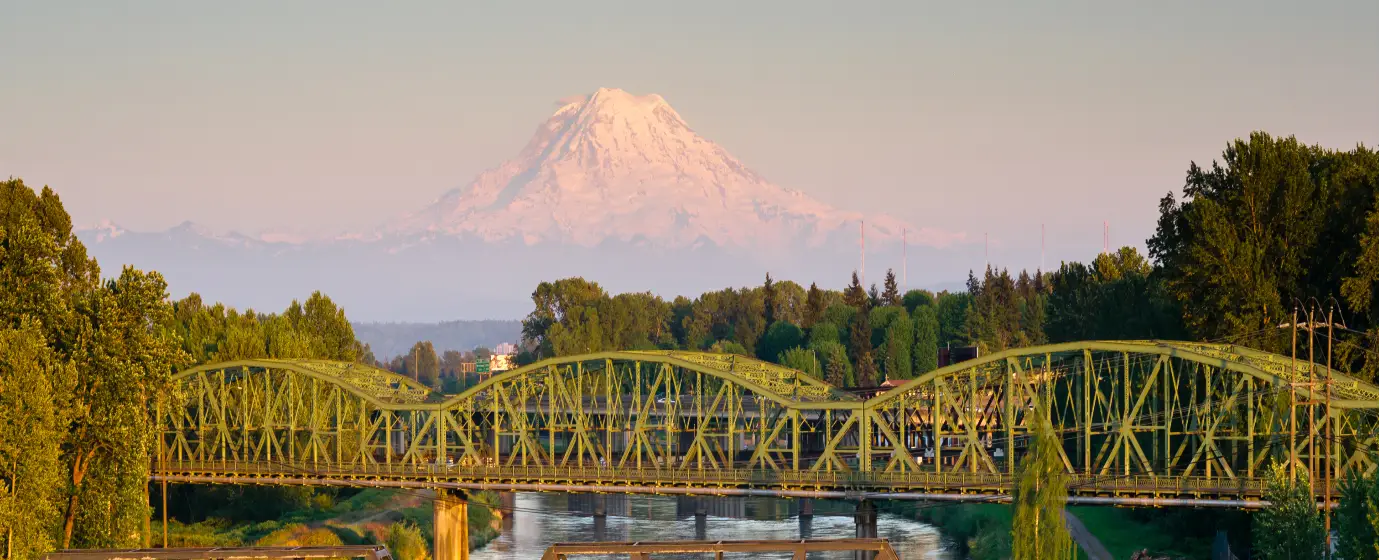
Maybe you've been priced out of Seattle or Bellevue and someone mentioned Puyallup. Maybe your company is relocating you to Pierce County and you've pulled up a map and thought: where, exactly? The surprise most people get in month one is that Puyallup isn't one thing. It's a city of distinct geographic personalities — the sprawling, newer subdivisions of South Hill to the south, the compact historic core near the Sounder rail station downtown, the valley-floor neighborhoods along the Puyallup River, and the hillside areas with long views of Mount Rainier. State Route 512 and Meridian Avenue E don't just carry traffic; they organize the city's social and real-estate logic in ways that take outsiders a while to learn.
The Puyallup School District earns a B+ rating and serves the entire city, drawing families with school-age children who want suburban stability without Seattle prices. The Washington State Fairgrounds — host to the fair that draws over 1 million visitors each September — anchors the local economy alongside a regional health system, the school district itself, and aerospace fabrication. That economic mix produces a genuinely working-class-to-middle-class city with pockets of newer construction that skew wealthier, particularly on South Hill. The city-wide Zillow Home Value Index sat at $573,027 in July 2026 — see the full cost-of-living breakdown — which remains noticeably below comparable suburbs closer to Seattle.
Day-to-day life here runs on cars, with one major exception: the Sound Transit Sounder station at 131 West Main Avenue puts downtown Seattle within reach on weekday mornings without touching I-5. The 22-mile Foothills Trail begins at the edge of the city and winds toward Orting past open fields and Mount Rainier sightlines. Pioneer Park sits at the heart of the historic district. The catch — and it's real — is that SR-512 congestion during fair season in September turns a 20-minute commute into a 45-minute one, and that's not a quirk you read about in listing descriptions.
Whether you're looking at your first home, upgrading to a larger lot, or trying to land within a specific school boundary, the sections below break down Puyallup's eight neighborhoods, the price ranges that define each one, the common mistakes buyers make, and where renters find the most options.
The Puyallup Reality
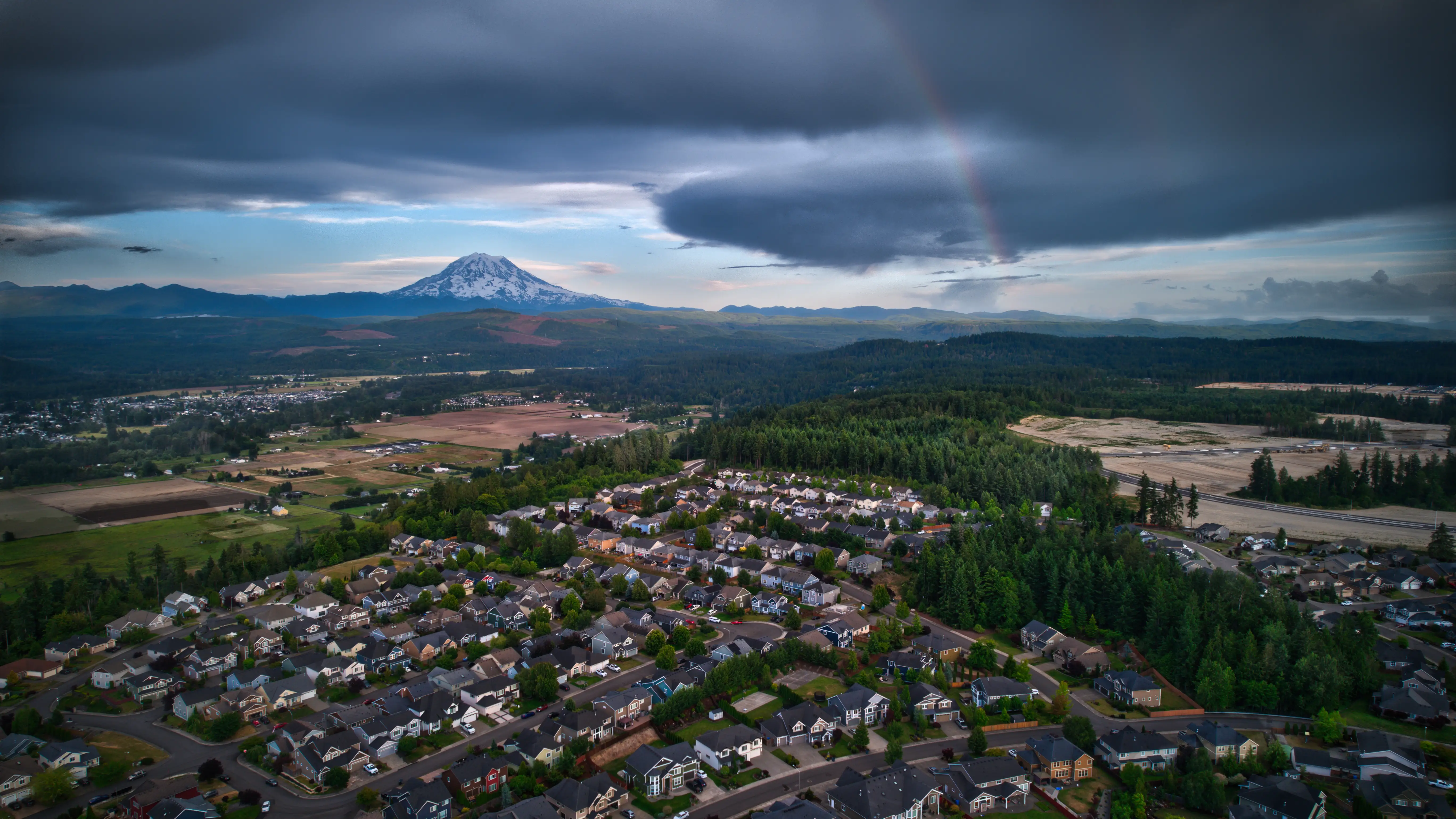
The single most important thing to understand before buying in Puyallup is the elevation divide. South Hill sits above the city proper on a plateau, connected to the valley floor primarily via Meridian Avenue E and Canyon Road E. That geography means South Hill operates almost like a separate suburb — newer construction, more chain retail along Meridian, and a different commute pattern than the neighborhoods that drain toward downtown and the SR-512/SR-167 interchange.
School boundaries matter here, but not in the way outsiders expect. The entire city falls within the Puyallup School District, so boundary shopping within city limits is less about district-hopping and more about which elementary feeds into which middle school cluster. Where it gets complicated is the fringe: parts of unincorporated South Hill (technically Pierce County, not the City of Puyallup) share the same zip code and the same district, but carry different property tax structures. If you're shopping in the 98375 zip code, confirm with the county assessor whether the parcel you're considering is inside or outside city limits — the line is not obvious from a street-level drive.
The SR-512 corridor is the city's practical spine and its biggest daily friction point. Neighborhoods east of Meridian, particularly North Puyallup and the valley floor, sit closest to the on-ramps — convenient for Tacoma-bound commuters but also the first areas to feel the September fair traffic that backs up across the entire interchange. If you work in Tacoma and plan to drive, that 25-minute commute is accurate for 11 months of the year and a genuine test of patience for one.
Puyallup Neighborhoods at a Glance
| Neighborhood | Best For | Price Range | Vibe |
|---|---|---|---|
| South Hill | Families Schools | $580,000–$780,000 | Suburban plateau; newer builds, Meridian retail corridor, Rainier views |
| Downtown Puyallup | Walkable Transit | $430,000–$580,000 | Historic core; Sounder access, Pioneer Park, active redevelopment |
| Sunrise | Families Quiet | $520,000–$650,000 | East-side hillside; established lots, Sunrise Blvd corridor, low turnover |
| North Puyallup/Puyallup Valley | First-Time Value | $400,000–$530,000 | Valley floor; older stock, flat terrain, quick SR-512 access |
| Crystal Ridge | Luxury Views | $700,000–$950,000 | Elevated, custom homes; long Rainier views, larger lots, quiet streets |
| Northwest Puyallup | Commuter First-Time | $420,000–$560,000 | Transitional west side; near fairgrounds, close to Tacoma/Fife access |
| Manorwood | Privacy Nature | $560,000–$720,000 | Semi-rural southeast; larger parcels, greenbelt feel, long drives to retail |
| Summit | Families Schools | $550,000–$700,000 | South Hill adjacent; newer planned communities, cul-de-sac streets, parks |
Best Neighborhood by Buyer Type
| Buyer Type | Best Neighborhood | Why |
|---|---|---|
| First-Time Buyer | North Puyallup/Puyallup Valley | Entry-level price points starting around $400,000 give first-time buyers the best chance of landing below the city median without sacrificing Puyallup School District access. |
| Luxury Buyer | Crystal Ridge | Custom construction, oversized lots, and unobstructed Mount Rainier sightlines justify the premium, and turnover here is low enough that inventory rarely sits. |
| Walkability Seeker | Downtown Puyallup | The only neighborhood where you can walk to the Sounder station, Pioneer Park, Powerhouse Restaurant & Brewery on E Main Ave, and Anthem Coffee & Tea on W Pioneer Ave without a car. |
| Families with Kids | South Hill | Newer elementary schools, the Nathan Chapman Memorial Trail running through the neighborhood, and a concentration of parks and recreational facilities along the Meridian corridor make this the default family destination. |
| Commuters | Downtown Puyallup | The Sounder park-and-ride expanded to 1,044 stalls in 2023, and weekday S Line service to Tacoma and Seattle makes this the only neighborhood where you can genuinely leave the car at home on workdays. |
| Large-Lot Buyers | Manorwood | Parcels here regularly exceed a quarter-acre and back up to natural greenbelts, which is rare for any neighborhood this close to the SR-512 interchange. |
| Renters | Northwest Puyallup | The highest concentration of apartment inventory outside downtown, with newer complexes near the fairgrounds keeping options available even in a tight rental market. |
Looking to buy in Puyallup? Estimate your payment.
Enter your numbers to see an estimated monthly mortgage payment.
Estimate only. Excludes HOA fees and mortgage insurance. The interest rate above is a starting point, not a quoted rate — replace it with your own to see real numbers. Insurance is a flat placeholder, not a Puyallup quote.
Most Popular Neighborhoods in Puyallup
1. South Hill
South Hill is Puyallup's growth engine — subdivisions along Meridian Avenue have been adding homes steadily for two decades, and the plateau's elevation delivers the kind of Mount Rainier sightlines that look good in listing photos and better in person. The trade-off is traffic: Meridian Avenue is the plateau's only practical artery, and afternoon southbound backups between Canyon Road and 176th Street E are a daily reality, not an occasional inconvenience. Homes here run $580,000–$780,000 for newer construction with open floor plans and two-car garages.
Best for: Families with school-age children, buyers who want newer construction and don't mind suburban-style retail as their daily backdrop.
2. Downtown Puyallup
Downtown is mid-transformation — the Sounder station at 131 West Main Avenue already anchors the neighborhood, and projects like Seasons on Meeker (a food hall, brewery, and approximately 115 apartments in a 5-story building) and the Rainier mixed-use development on 3rd St SW signal where the city wants this area to go by the late 2020s. Buyers who get in now find prices in the $430,000–$580,000 range and on-foot access to Powerhouse Restaurant & Brewery, Anthem Coffee & Tea on W Pioneer, and Pioneer Park — but they also accept that the neighborhood is still more construction site than finished product in spots. Meeker Festival Street engineering began in 2025, with construction expected 2026–2027.
Best for: Commuters, buyers who value walkable streets and a neighborhood with momentum rather than one that's already peaked.
3. Sunrise
Sunrise runs along the eastern hillside above the valley floor, with Sunrise Boulevard E as its spine and an established, low-turnover character that keeps it off many buyers' radar — which is exactly why prices here often come in below South Hill for comparable square footage. You're looking at $520,000–$650,000 for well-maintained 1990s and early 2000s homes on decent lots. Anthem Coffee & Tea has a location on Sunrise Blvd E if your morning routine matters; the catch is that on-foot access to much else requires a car, and the Sounder station is a 15-minute drive rather than a walk.
Best for: Families who want quiet, established streets and don't need to be walkable to the train.
4. North Puyallup / Puyallup Valley
The valley floor neighborhoods north and east of downtown are the city's most affordable entry point — older ranch-style homes, smaller lots, and the flat terrain that comes with sitting near the Puyallup River. Prices in the $400,000–$530,000 range give first-time buyers a realistic foothold in a seller's market where homes citywide are selling at 99.6% of asking price after a median of 21 days. The honest downside: some streets here flood in high-water years, and buyers should pull FEMA flood map data before making an offer anywhere within a few blocks of the river.
Best for: First-time buyers, buyers prioritizing price over square footage or lot size.
5. Crystal Ridge
Crystal Ridge is where Puyallup's luxury market lives — custom homes on larger lots at elevations that produce long, clear views of Mount Rainier on the days the mountain shows itself. The $700,000–$950,000 range here buys genuine space and quality of construction that stands apart from the production-built subdivisions dominating South Hill. Inventory turns slowly by design: owners don't leave easily, and when something does come to market it tends to attract multiple offers from buyers who've been watching the neighborhood for years.
Best for: Luxury buyers, buyers who want a custom-built feel and are willing to wait for the right listing.
6. Northwest Puyallup
Northwest Puyallup is the city's transitional zone — west of downtown, close to the Washington State Fairgrounds, and connected to Tacoma and Fife via River Road. The $420,000–$560,000 price band makes it one of the more accessible entry points in the city, and the apartment inventory here gives renters real choices. The catch for buyers is that the fairgrounds proximity means September brings a month of serious traffic and noise that some people underestimate until they've lived through it once.
Best for: Commuters heading toward Fife or Tacoma, renters and first-time buyers who want proximity to downtown without downtown prices.
7. Manorwood
Manorwood sits in the southeast quadrant with a semi-rural character that's genuinely hard to find this close to the SR-512 interchange. Lots are larger, streets are quieter, and the greenbelt buffers between properties create a sense of separation you won't find in the newer subdivisions a few miles north. Prices in the $560,000–$720,000 range reflect that premium on space and privacy. What you give up is convenience: a Costco run or a school pickup requires planning in a way it simply doesn't in South Hill or Sunrise.
Best for: Buyers who prioritize lot size and natural surroundings over proximity to retail and services.
8. Summit
Summit occupies the South Hill–adjacent territory with a planned-community feel — cul-de-sac streets, neighborhood parks, and the kind of HOA-managed consistency that either reassures or constrains buyers depending on their personality. Homes here run $550,000–$700,000 and skew toward the 2000s and 2010s build era, which means better energy efficiency than North Puyallup's older stock without the full premium of Crystal Ridge. The school access mirrors South Hill's, which is the main reason families with younger kids end up here when South Hill inventory runs dry.
Best for: Families who want South Hill's school access and neighborhood feel at a slight discount, buyers who value a maintained, consistent streetscape.
Common Mistakes Buyers Make in Puyallup
Assuming South Hill and the City of Puyallup Are the Same Thing
South Hill is one of the most-searched addresses in Pierce County, but a meaningful portion of it lies in unincorporated county jurisdiction rather than inside the City of Puyallup. The Puyallup School District boundary doesn't match the city-limits line, and neither does the property tax structure. Confirm the parcel's jurisdiction with Pierce County before assuming you're buying a city-limits home with city services.
Overlooking the September Fair Effect
The Washington State Fair draws over 1 million visitors each September. For residents near Northwest Puyallup, the fairgrounds area, or anywhere along Meridian between SR-512 and 80th Street E, that means four weeks of parking spillover, extended commute times, and Friday-night traffic that makes a 15-minute errand into a 45-minute ordeal. Buyers who tour homes in October fall in love with the neighborhood and don't experience this until their first September. Drive through on a fair-season Friday before you make an offer.
Chasing Square Footage on the Valley Floor Without Checking Flood Maps
North Puyallup and Puyallup Valley offer the city's best value per square foot, and that attracts buyers who are comparing bedroom counts and garage sizes on Zillow without pulling the FEMA flood map. The Puyallup River has a history of high-water events, and some streets within a few blocks of the river carry flood insurance requirements that materially change the true monthly cost of ownership. Check the map before the inspection, not after.
Underestimating the Meridian Avenue Bottleneck on South Hill
Meridian Avenue E is essentially the only north-south artery for the entire South Hill plateau. Canyon Road E provides a parallel option, but both funnel to the same SR-512 interchange. Buyers moving from cities with grid-based street networks consistently underestimate how much this single chokepoint shapes their daily routine. If your job requires consistent arrival times in Tacoma or Seattle, run your actual commute on a Tuesday at 7:45 a.m. before closing — not on a Sunday afternoon when you visited the open house.
Best Areas to Rent in Puyallup
| Area | Ideal For | Typical Rent Range | Trade-off |
|---|---|---|---|
| Downtown Puyallup | Commuters, walkability seekers | $1,600–$2,100/mo (1–2 BR) | Inventory is limited and moving fast; new units from Seasons on Meeker won't arrive until late 2020s |
| Northwest Puyallup | Renters wanting apartment options near Tacoma access | $1,500–$1,950/mo (1–2 BR) | Fairgrounds noise and traffic in September; older complexes mixed with newer builds |
| South Hill (Meridian corridor) | Families, longer-term renters who want newer units | $1,800–$2,400/mo (2–3 BR) | Car-dependent for everything; Meridian traffic is a daily variable |
| Sunrise | Renters who want quiet, residential streets | $1,700–$2,200/mo (2–3 BR) | Very limited rental inventory; mostly single-family rentals that turn over infrequently |
| North Puyallup/Valley Floor | Budget-conscious renters, first-time renters | $1,400–$1,800/mo (1–2 BR) | Older housing stock; flood-zone awareness applies to renters with basement or ground-floor units too |
Puyallup's rental market runs tight — 2.9 months of purchase inventory in mid-2026 pushes renters who can't yet buy to compete for the same limited pool of units. Renters willing to sign a 13- or 14-month lease rather than a standard 12-month term often find landlords more flexible on price, particularly in the Sunrise and valley-floor areas where turnover is lower and landlords prefer stability over maximizing every dollar.
Local Expert Takeaway: Downtown Puyallup is the neighborhood with the most upside right now — Seasons on Meeker, the Rainier project on 3rd St SW, and the Meeker Festival Street redesign are all moving simultaneously, and buyers who get in at $430,000–$580,000 before those projects deliver will be sitting on a materially different block in five years. If you need space and quiet today rather than upside tomorrow, Manorwood and Crystal Ridge deliver that at opposite ends of the luxury spectrum. And if you have kids starting elementary school in the next year or two, the South Hill plateau is still where most families end up — just drive Meridian northbound at 8 a.m. before you commit.
Quick Takeaways & FAQs
✅ The Puyallup Sounder station's 1,044-stall garage makes Downtown Puyallup one of the few Pierce County neighborhoods where a car-free weekday commute to Seattle is genuinely practical.
⚠️ The Washington State Fair's 1 million September visitors turn the entire Meridian/SR-512 corridor into a month-long traffic event that catches nearly every buyer who tours in any other season completely off guard.
📍 A meaningful portion of South Hill sits in unincorporated Pierce County rather than inside city limits — the school district boundary and the city-limits line do not match, and the difference affects your property tax structure and which city services you receive.
What is the most affordable neighborhood in Puyallup?
Which Puyallup neighborhood is best for commuters to Seattle or Tacoma?
Is South Hill part of the City of Puyallup?
What are home prices like in Crystal Ridge compared to the rest of Puyallup?
How does the Washington State Fair affect living near downtown or Northwest Puyallup?
Moving to Washington?
Tell us what you need help with and we'll connect you with local resources.
