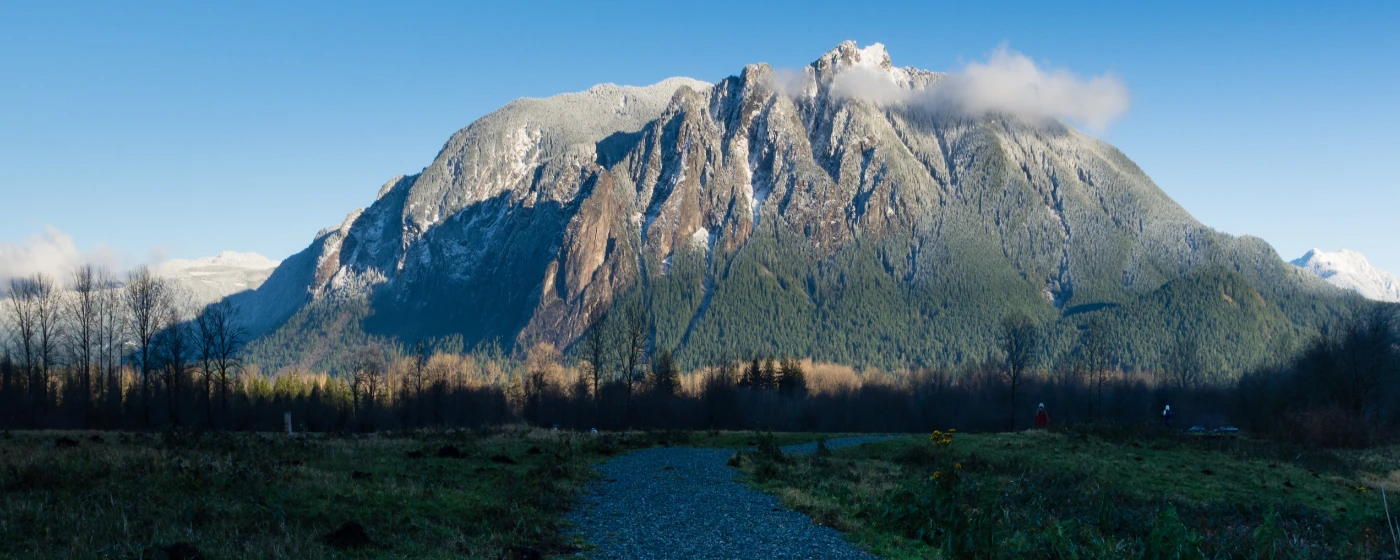
Most people who retire to North Bend arrive because of a view — Mount Si filling the windshield as you pull off I-90, the Snoqualmie River threading through the valley floor, the kind of landscape that makes the Seattle suburbs feel very far away. What surprises them in month three is how much of daily life still depends on a car. North Bend is not a walkable retirement village. It is a small mountain-gateway town of roughly 8,200 people, 45 minutes east of Seattle and Bellevue along I-90, where the trade-off is clear from the start: extraordinary natural access in exchange for limited local services.
The people who thrive here in retirement tend to share a few traits: they are active, they genuinely want the Cascades as a backyard rather than a weekend destination, and they have either already cashed out of a higher-cost market or they are bringing enough equity that North Bend's $1,287,230 median sold price (Redfin, May 2026) does not require a stretch. Washington's zero personal income tax is a meaningful structural advantage — Social Security checks, pension distributions, and IRA withdrawals all land without a state tax bite. That tax posture, combined with the scenery, explains why the Snoqualmie Valley has quietly become a draw for early retirees in their late 50s and early 60s who want outdoor-oriented retirement without leaving the Pacific Northwest.
The honest caveat is healthcare depth. Snoqualmie Valley has expanded its local footprint, but complex specialty care still means a drive west toward Issaquah or Seattle. For retirees managing serious chronic conditions or who anticipate frequent specialist visits, proximity to a major medical center matters more than the mountain view — and that should be part of your calculation before you make an offer. For retirees who are healthy, active, and comfortable with that reality, North Bend's cost-of-living advantages on the tax side and its unmatched outdoor access make a compelling case.
The sections below cover what healthcare is actually available in and near North Bend, what a realistic retiree budget looks like under Washington's tax rules, how walkable and socially connected daily life can be, what downsizing options exist, and how North Bend stacks up against nearby towns worth considering.
Why Retirees Are Choosing North Bend
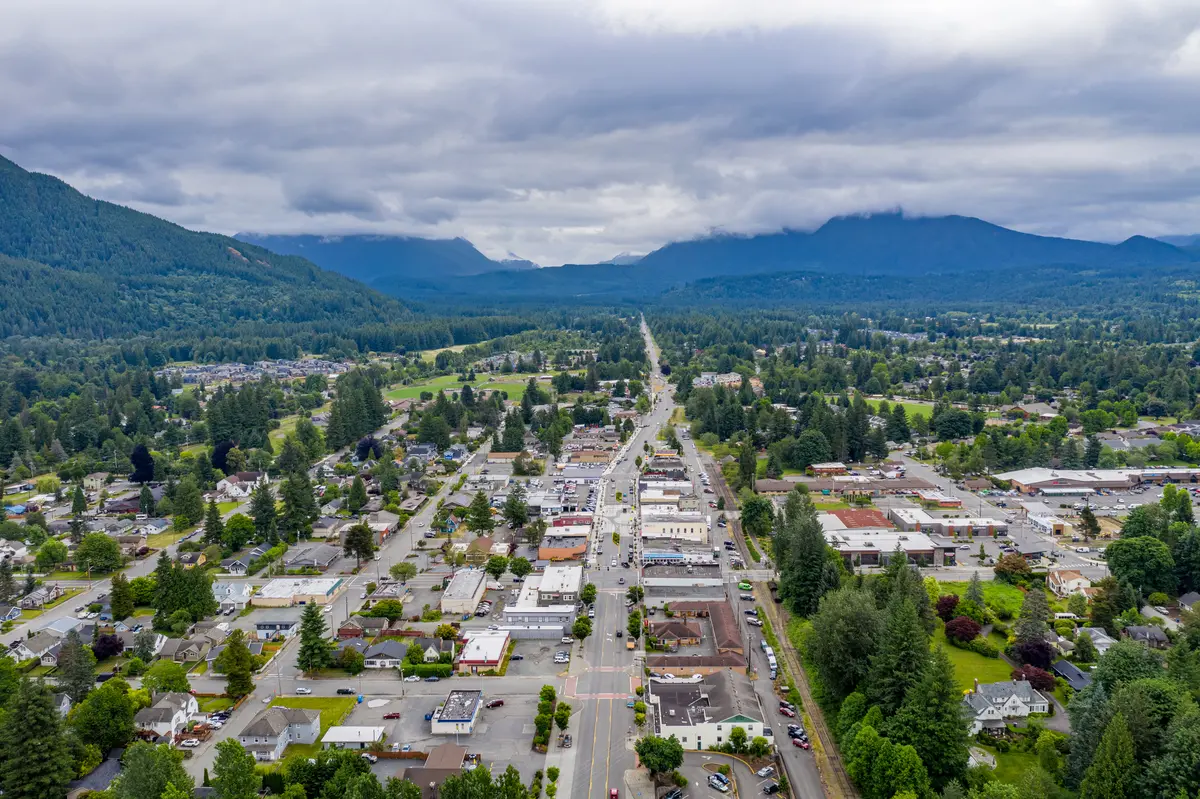
North Bend genuinely fits retirees who treat the outdoors as infrastructure, not recreation. When your version of a good Tuesday involves the Iron Horse Trail before lunch and a farmers market pickup on the way home, this town is sized exactly right. The historic downtown core along North Bend Way — anchored by the 1922 McGrath Cafe and Hotel building — has the bones of a walkable small-town center, and the community is tight enough that you will recognize faces at Twede's Cafe within a few months of moving in.
The entry price is the honest filter. With a median sold price of $1,287,230 (Redfin, May 2026), North Bend is not a budget retirement move — it is a lifestyle-and-tax-position retirement move. Retirees who arrive here typically come with equity from a prior sale, often from the Eastside suburbs, and they are trading square footage and suburban convenience for acreage, views, and the kind of quiet that noise maps cannot fully capture once you are north of the highway.
Who should look elsewhere: retirees who rely heavily on public transit, those managing conditions that require frequent specialist care, and anyone whose fixed income would be strained by King County property taxes on a high-assessed home. North Bend has no light rail, no dense walkable retail corridor, and a senior living inventory that is thin compared to larger suburban markets. If you want the mountain-town retirement but need more medical infrastructure within five minutes, Issaquah — which sits about 12 miles west — gives you substantially more of that without fully leaving the Cascades foothills.
Healthcare & Medical Access in North Bend
What's Available In Town
The most significant recent development for North Bend retirees is the October 2025 opening of a Snoqualmie Valley Health primary-care clinic at 712 SW Mt Si Blvd — the former Chase Bank building — with six exam rooms and plans for rotating specialty services. This fills a real gap: previously, even a routine primary-care visit required driving into Snoqualmie or further west. The clinic is intended to expand as patient volume grows, which means the specialty access picture should improve over the next few years.
For skilled nursing and post-acute recovery care, North Bend Post Acute is a 64-bed, Medicare-certified facility at 219 Cedar Ave S, operated by Foundation Healthcare Services. Having an in-town skilled nursing option is meaningful for retirees and for families managing a parent's recovery after a procedure — it is not a given in a town this size.
The Distance-to-Specialty Reality
Advanced specialty care — cardiology, oncology, orthopedics, and geriatric medicine — means leaving North Bend. The nearest hospital with affiliated geriatric medicine specialists is a regional medical center in Issaquah, approximately 12 miles west. On a clear mid-morning, that is a 20-minute drive. On a Friday afternoon in summer, with outlet traffic backed up near the highway exit, it can take considerably longer.
For truly complex care — major surgery, neurology, cancer treatment — the realistic destination is a major hospital system in Seattle, roughly 45 minutes west under normal conditions. Retirees who have managed health situations that require monthly or weekly specialist appointments consistently describe this drive as the single biggest friction point of North Bend retirement. It is not disqualifying for most people, but it deserves an honest weight in the decision.
There is no VA clinic serving North Bend directly. Veterans in the Snoqualmie Valley typically access VA care through the Seattle VA Medical Center or the community-based outpatient clinic in Bellevue.

The Retiree Budget in North Bend
Washington's Tax Advantage
Washington State levies no personal income tax — full stop. Your Social Security benefit, pension check, and IRA or 401(k) distributions arrive without a state income tax deduction. For retirees moving from Oregon, California, or most Midwestern states, this is a structural shift that meaningfully changes the math of a fixed income. There is no complex pension-exclusion rules to decode. Washington does tax long-term capital gains — 7% on long-term capital gains above a $278,000 standard deduction for 2025, rising to 9.9% on gains above $1,000,000 — which can affect retirees selling appreciated assets, but for income-based retirement budgets the state tax picture is favorable compared to most of the country. See the full cost-of-living breakdown for a side-by-side tax comparison.
Property Tax and the Senior Exemption
North Bend's effective property tax rate runs approximately 0.83%, which on a high-assessed home produces a notable annual bill — reason enough to understand the senior exemption program before you buy. Washington offers a Senior Citizen Property Tax Exemption for homeowners age 61 or older who own and occupy their primary residence. In King County, the 2026 income ceiling for eligibility is $88,998 in household income.
Qualifying retirees are exempted from all excess levies and Part 2 of the state school levy, and their assessed value is frozen at the level it holds in the year they first qualify — a meaningful inflation hedge in a market where values have risen sharply. Starting with tax year 2025, the program expanded to include one accessory dwelling unit on the property within the exemption definition, which matters for retirees considering a mother-in-law unit as a rental or caregiver space.
Day-to-Day Budget Reality
Groceries in North Bend run through the QFC on North Bend Way — solid selection, King County pricing. Dining out on North Bend Way or at one of the small cafés along the main corridor costs roughly what you would expect in any Seattle-metro community: not cheap, not extreme. The outlet mall on the south end of town is a practical resource for clothing and household goods at reduced prices, which locals genuinely use rather than treat as a tourist destination.
The budget friction that surprises retirees most is transportation cost. Without transit options, two cars remain a practical necessity for most households — or one car and very careful scheduling. Fuel costs, insurance, and maintenance compound on a fixed income in ways that urban retirees with transit access do not face. Factor this into your monthly budget before assuming the lower state tax burden covers the gap.
Looking to buy in North Bend? Estimate your payment.
Enter your numbers to see an estimated monthly mortgage payment.
Estimate only. Excludes HOA fees and mortgage insurance. The interest rate above is a starting point, not a quoted rate — replace it with your own to see real numbers. Insurance is a flat placeholder, not a North Bend quote.
Walkability, Community & Staying Active in North Bend
The Walkability Reality
North Bend is car-dependent for most errands. The QFC, the post office, the pharmacy, and the cluster of shops along North Bend Way are reachable on foot from a handful of downtown-adjacent addresses — but most of the city's residential areas require a car for anything practical. If you are downsizing from a suburban home and expecting to walk to a grocery store, the city's layout will likely disappoint. This is not a knock on North Bend specifically; it is simply the reality of a small mountain-gateway town that grew around the highway, not a walkable grid.
What replaces traditional walkability is trail access, and that is genuinely exceptional. The Iron Horse Trail — also known as the John Wayne Pioneer Trail — is accessible directly from North Bend and runs more than 100 miles along the old Milwaukee Road rail corridor. The grade is flat, the surface is wide and graveled, and significant stretches are accessible to wheelchair users and those with mobility limitations. This is not a hiking trail with elevation gain; it is a rail trail, meaning a 65-year-old with a bad knee can do four miles without drama.
Community and Social Life
The Si View Metropolitan Park District is the organizational backbone of active social life in North Bend. The district runs organized hiking outings, trail cleanup days, and community recreation programs open to all ages — it is where newly arrived retirees often find their first real social foothold in town. Programs rotate seasonally, so the calendar in October looks very different from July.
The downtown core around McGrath Hotel and Twede's Cafe on North Bend Way functions as the informal gathering hub. On weekend mornings, Twede's — the Twin Peaks filming-location diner — fills with a mix of hikers heading to Mount Si and locals who have been coming in for years. It is genuinely the kind of place where regulars know each other's names. For retirees who want to plug into that social fabric quickly, showing up consistently at the same counter seat is a time-tested strategy.
Volunteering options include trail stewardship programs through the Si View district and the U.S. Forest Service Ranger Station, which coordinates volunteer trail maintenance throughout the surrounding national forest. For retirees who want purposeful engagement beyond recreation, these programs provide it with flexibility on hours.
Right-Sizing: Downsizing in North Bend
The Inventory Challenge
North Bend's downsizing inventory is the honest limiting factor for retirees who want to right-size here. The city does not have a robust pipeline of purpose-built 55+ communities, patio homes, or single-level condos the way larger suburban markets do. Most of the housing stock is single-family homes, often on larger lots, which suits buyers wanting space but leaves fewer options for retirees who specifically want to reduce maintenance burden.
Red Oak Residence of North Bend at 650 E North Bend Way provides senior care housing options in the community — one of the few dedicated senior living addresses in the city proper. For retirees who need assisted living or memory care support, options within North Bend itself are limited; Issaquah and the broader Eastside suburban market have substantially deeper senior living inventories across the care-level spectrum.
What the Market Actually Offers
Single-level living exists in North Bend, but you find it primarily in older ranch-style homes and in select newer construction — not in dedicated active-adult communities with shared amenities. Buyers specifically seeking a single-story footprint need to filter carefully and should expect to compete for those listings when they appear, since the pool of interested buyers is not small.
Retirees who own significant equity and want a low-maintenance option sometimes consider a smaller primary residence in downtown North Bend combined with an ADU arrangement — the 2025 expansion of the senior property tax exemption to include one ADU on the property makes this more financially interesting than it was before. It is not a traditional downsizing path, but in a small inventory market, creative configurations are worth considering.
The practical advice for retirees determined to stay in the Snoqualmie Valley: set up alerts, be patient, and consider whether a home in nearby Snoqualmie — which has newer construction and marginally more condo inventory — might serve the same lifestyle goals with more housing flexibility.
North Bend vs Nearby Retirement Destinations
| City | Cost vs North Bend | Medical Access | Walkability | Senior Living Depth | Overall Retirement Fit |
|---|---|---|---|---|---|
| North Bend | Anchor | Snoqualmie Valley Health clinic (in-town); regional hospital ~12 mi west | Car-dependent; exceptional trail access | Thin — limited 55+ inventory | Strong for active, outdoors-first retirees with equity |
| Issaquah | About the same, sometimes slightly higher | Full-service regional hospital with on-site geriatric specialists | Meaningfully more walkable; historic downtown district | Moderate — more options than North Bend | Better fit for retirees prioritizing medical access and walkable errands |
| Snoqualmie | Noticeably cheaper | Snoqualmie Valley Hospital (Snoqualmie campus) | Car-dependent; newer sidewalk infrastructure | Slightly deeper than North Bend; newer builds | Good value alternative with similar valley scenery |
| Fall City | Moderately cheaper | No in-town hospital; Issaquah or Seattle | Rural; not walkable | Very limited | Best for rural privacy seekers comfortable with full car dependence |
| Preston | Noticeably cheaper | No in-town hospital; Issaquah is closest | Minimal; unincorporated rural area | Essentially none | Niche fit — very rural, tight community, not a mainstream retirement choice |
| Bellevue | Pricier overall | Major full-service medical center (full range of specialties) | Highly walkable in core neighborhoods | Deep — full range from independent to memory care | Best fit for retirees who want urban amenities and comprehensive care nearby |
Issaquah is the comparison that matters most for the majority of North Bend retirees. It offers a regional hospital with on-site geriatric medicine, meaningfully better on-foot access in its historic downtown area, and more senior living options — all at a price point that runs roughly similar to North Bend. The compromise is that Issaquah feels considerably more suburban and less mountain-immersed.
Snoqualmie is the value play within the valley. Homes price noticeably below North Bend, Snoqualmie Valley Hospital's Snoqualmie campus provides closer acute care, and the Snoqualmie Ridge development added modern housing stock with some single-level options. For retirees whose budget is stretched by North Bend's median, Snoqualmie deserves a serious look before they rule out the valley altogether.
Bellevue is the full-service alternative for retirees who want to stay in the King County Pacific Northwest context but need everything close: a major hospital, transit, walkable retail, and a deep senior housing market. The cost is higher and the mountain views require a drive, but the trade is a level of infrastructure that North Bend simply cannot match.

Local Expert Takeaway: North Bend retirement works best when you treat the Iron Horse Trail and Mount Si as genuine daily infrastructure rather than weekend perks — and when you have done the math on driving 12 miles to Issaquah for anything beyond a primary-care visit. The senior property tax exemption through King County is worth investigating early: if your household income falls under $88,998, the assessed-value freeze and levy exemption could significantly offset the carrying cost on a high-valued home. Plant yourself at Twede's Cafe on a Saturday morning, watch the mix of locals and hikers, and ask yourself honestly whether that community rhythm fits your retirement vision. For the right person — active, equity-rich, genuinely outdoor-oriented — it does.
Quick Takeaways & FAQs
✅ Washington levies no personal income tax, meaning Social Security, pension, and IRA withdrawals are all free of state income tax — a structural advantage that compounds meaningfully on a fixed retirement income.
⚠️ North Bend is car-dependent for daily errands, and complex specialty care requires a 12-plus mile drive to Issaquah or further into Seattle — retirees with frequent specialist needs should weigh this carefully before committing.
📍 The Iron Horse Trail trailhead is accessible directly from North Bend and offers flat, wide, graveled trail stretching over 100 miles — making it genuinely usable for retirees with limited mobility, not just serious hikers.
Is Washington State a good state to retire in for taxes?
What is the closest hospital to North Bend, WA?
Does North Bend have a senior property tax exemption?
Is North Bend walkable for retirees?
Are there 55+ or active-adult communities in North Bend?
Moving to Washington?
Tell us what you need help with and we'll connect you with local resources.
