
Maybe you've been priced out of Bellevue and someone told you North Bend is where the value went. Maybe you drove I-90 on a clear day, saw Mount Si rising above the valley floor, and started doing math in your head. Either way, you should know the honest number before you go further: the median sold home price in North Bend hit $1,287,230 in May 2026, placing it firmly in the upper tier of the entire Seattle metro. This is not a mountain-town bargain. It is a premium mountain-adjacent community where the price reflects both the Cascade scenery and the 45-minute corridor to Bellevue and Seattle.
What sustains those prices is a combination of constrained land, high household incomes — the city's median household income sits at $175,109 — and consistent demand from tech and finance workers who want more square footage and a quieter setting without abandoning the metro orbit entirely. North Bend Premium Outlets and a handful of local employers provide some local economic activity, but most residents earn their income somewhere else along the I-90 or SR-202 corridor.
Outside housing, North Bend's cost structure is a mixed picture. Electricity runs noticeably below the national average thanks to the Pacific Northwest's hydropower grid, groceries land about 11% above average, and transportation costs are meaningfully higher than the national norm — partly because almost everything requiring a car trip adds freeway miles. Washington's zero-income-tax policy is a genuine financial benefit that offsets some of the sticker shock, especially for higher earners. North Bend has a combined state and local sales tax rate of 9.2%, which is the flip side of that deal.
Whether you're evaluating a move or just trying to understand what your dollar actually buys here, the sections below break down North Bend's housing market, rent versus buy calculus, everyday expenses, how the city stacks up against Snoqualmie, Issaquah, Fall City, and Preston, and the tax picture in full.
What It Really Costs to Live in North Bend
North Bend's overall cost of living index lands somewhere between 149 and 164 on a scale where 100 is the national average — placing it among the 20 most expensive cities in Washington state. Housing drives that number almost entirely; every other category is elevated but not extraordinary by Puget Sound standards.
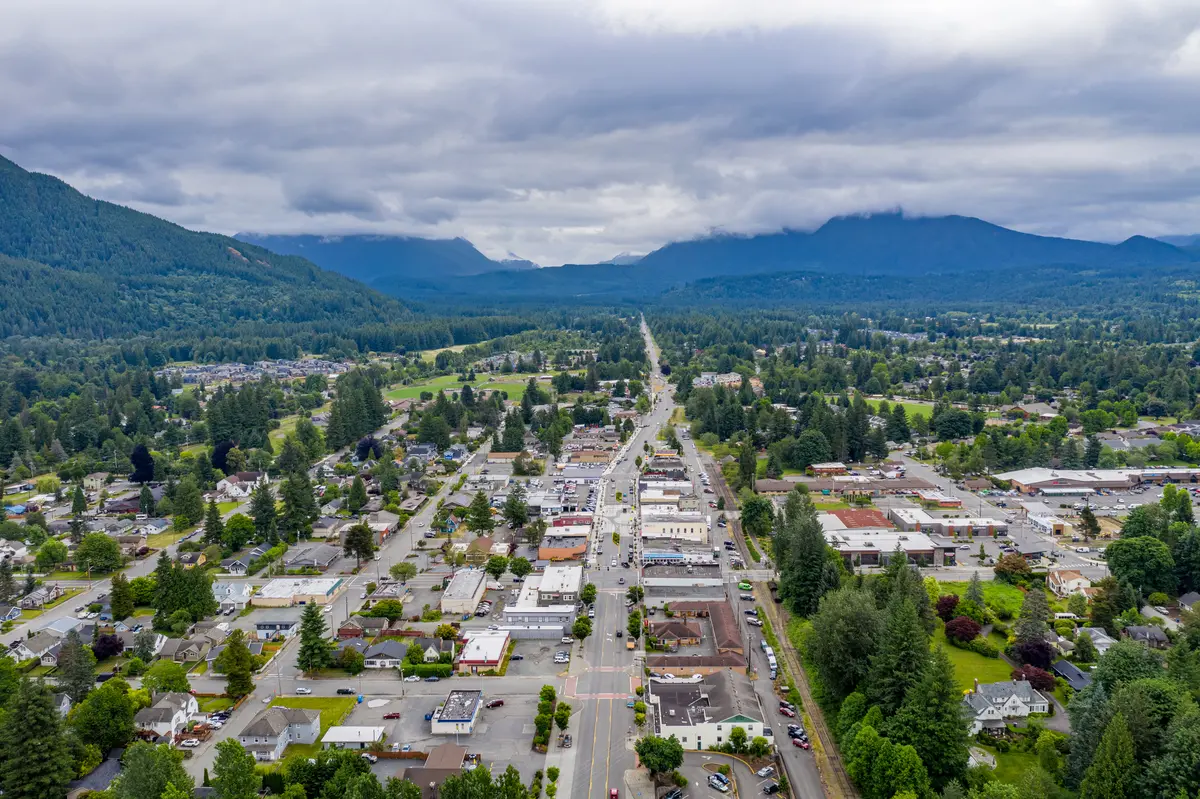
The median sold home price of $1,287,230 (Redfin, May 2026) is the number that defines the city's cost profile. That figure sits noticeably above the Washington state median and well above most communities in the eastern Cascades foothills, but it tracks closely with other premium Eastside suburbs. What makes North Bend distinct is that you're paying Seattle-area prices in a community of roughly 8,000 people with one main commercial corridor and no urban density to show for it. The premium is almost entirely about access and environment: a trailhead to Mount Si at the edge of town, the Iron Horse Trail, and a commute to Bellevue that works on a good traffic day.
Compared to Issaquah — the most natural point of comparison for families weighing this corridor — North Bend runs slightly lower on home prices but meaningfully higher on the trade-off of distance and services. Compared to Snoqualmie just four miles west, prices are roughly comparable, with the two towns forming essentially one housing market. The honest posture: if your household income is comfortably above $150,000 and you value mountain proximity over urban convenience, the numbers can work. Below that income threshold, the math gets tight quickly, especially for buyers.
Housing: Rent vs Buy in North Bend
Buying in North Bend means clearing a significant entry bar. Entry-level single-family homes — older construction, smaller lots, deferred updates — typically start in the mid-to-upper 800,000s. The city-wide median sold price of $1,287,230 (May 2026) reflects the full market, which skews toward newer construction on larger lots with mountain views. There is no true starter-home segment in the sub-$700,000 range; that category essentially does not exist here.
The effective property tax rate in North Bend is approximately 0.83% — one of the lower rates in King County, and meaningfully below what you'd pay on the same assessed value in many other Washington cities. On a home near the median, that rate produces an estimated annual tax bill worth keeping in mind, but the mortgage calculator below this section will give you a full monthly payment picture based on your actual purchase price and down payment.
Renting is an option in North Bend, but the supply is limited. The average rent across all unit types ran approximately $3,234 per month as of August 2025, reflecting a market dominated by single-family homes rather than large apartment complexes. Two-bedroom units — where available — generally fall in the $2,400–$3,200 range, though inventory turns over slowly and the rental pool shrinks considerably compared to Issaquah or Bellevue.
Renting makes the most sense here if you're new to the area and want time to understand the valley before committing, or if your timeline is short. The catch is that rental supply is thin enough that many households end up buying sooner than they planned, simply because finding a long-term rental in North Bend is its own challenge. If you're planning to stay five-plus years and have the down payment, the ownership math tends to favor buying — not because appreciation is guaranteed, but because the rental alternative is nearly as expensive and far less stable.

Everyday Costs Beyond Housing in North Bend
Electricity in North Bend runs approximately 14 cents per kilowatt-hour (EnergySage, February 2026), roughly 26% below the national average. The Pacific Northwest's hydropower grid is the reason — and it makes a real difference on monthly utility bills, especially during the cool, damp winters when heating loads rise. The city bills water, sewer, and storm drainage monthly; stormwater and flood control alone increased to $22.36 per month as of January 2026.
Groceries run about 11% above the national average. A loaf of bread is approximately $4.55, a gallon of milk around $5.27, and a carton of eggs near $5.21 — all notably higher than Midwest baselines but consistent with King County norms. Gas at the pump runs around $4.11 per gallon locally, and transportation costs overall come in approximately 34% above the national average, reflecting both fuel prices and the reality that almost every errand here involves a car. The table below builds a realistic monthly snapshot for a renter household.
| Category | Typical Monthly Cost | Notes |
|---|---|---|
| Housing (2BR rent) | $2,400 – $3,200 | Rental inventory is limited; owners should use the mortgage calculator above for a purchase estimate |
| Utilities (electric, water, sewer, stormwater) | $150 – $220 | Electricity rate is well below national average; stormwater fee is $22.36/mo as of Jan 2026 |
| Groceries | $600 – $900 | Roughly 11% above national average; QFC on North Bend Way is the primary full-service option |
| Transportation & Gas | $300 – $550 | ~$4.11/gal locally; nearly all errands require a car; budget higher if commuting to Seattle daily |
| Phone & Internet | $120 – $200 | Major carriers available; fiber options vary by neighborhood; cell signal can be spotty in canyon areas |
| Dining & Entertainment | $200 – $500 | Volition Brewing Co. on W North Bend Way, South Fork North Bend, and North Bend Bar & Grill on E North Bend Way cover most local options; larger variety requires a drive toward Issaquah |
| Miscellaneous / Personal | $150 – $300 | Clothing, household goods, personal care; North Bend Premium Outlets helps on apparel |
A renter household spending conservatively lands around $3,920–$5,370 per month before housing — meaning total monthly outlay including a mid-range 2BR rental runs roughly $6,320–$8,570. That figure underscores why the city's median household income of $175,109 is not just a statistic but a practical floor for comfortable renting here.
Looking to buy in North Bend? Estimate your payment.
Enter your numbers to see an estimated monthly mortgage payment.
Estimate only. Excludes HOA fees and mortgage insurance. The interest rate above is a starting point, not a quoted rate — replace it with your own to see real numbers. Insurance is a flat placeholder, not a North Bend quote.
North Bend vs Nearby Cities: Cost Comparison
| City | Median Home Price | Typical 2BR Rent | Cost vs North Bend |
|---|---|---|---|
| North Bend, WA | $1,287,230 (May 2026) | $2,400 – $3,200/mo | Baseline |
| Snoqualmie, WA | $1,100,000 – $1,250,000 (approx.) | $2,200 – $3,000/mo | Slightly lower; same housing market orbit |
| Issaquah, WA | $1,350,000 – $1,500,000 (approx.) | $2,600 – $3,400/mo | Noticeably higher; more services and transit |
| Fall City, WA | $900,000 – $1,100,000 (approx.) | $1,900 – $2,600/mo | Moderately cheaper; more rural feel, less inventory |
| Preston, WA | $850,000 – $1,050,000 (approx.) | $1,800 – $2,400/mo | Cheaper entry point; very limited rental supply |
| Seattle, WA | $850,000 – $950,000 (approx., city-wide median) | $2,200 – $3,000/mo | Lower median but urban density; no mountain setting |
Snoqualmie and North Bend function as a single housing market in practice — the difference in median price is modest and inventory often overlaps. Issaquah commands a clear premium over North Bend but delivers more walkable retail, a Park & Ride with express bus service, and a slightly shorter commute window to Bellevue.
Taxes & the Bottom Line for North Bend
Washington has no personal income tax — full stop. Every dollar you earn in North Bend is sheltered from state-level income taxation, which represents a genuine and significant advantage for households earning above $150,000. For a dual-income household at the city's median income of $175,109, the absence of a state income tax functions as a meaningful offset against the region's elevated home prices.
The trade-off arrives at the register. North Bend has a combined state and local sales tax rate of 9.2%, built from Washington's 6.5% state base plus local add-ons specific to ZIP code 98045. The one meaningful carve-out: groceries are fully exempt from Washington sales tax, which softens the everyday impact for families with large grocery budgets. Everything else — clothing, electronics, home goods, restaurant meals — is taxed at the full 9.2% rate.
Property taxes come in at approximately 0.83% effective rate, which is below the King County average and well below what buyers in many other high-cost Washington cities face. That rate applied to your specific purchase price gives you the clearest picture — use the calculator in the housing section rather than scaling from the median.
The bottom line: North Bend fits households who are high earners, own their income rather than relying on a paycheck that barely clears expenses, and are trading urban convenience for space, scenery, and a slower pace at the edge of the Cascades. The no-income-tax advantage is real, the property tax rate is reasonable, and the sales tax is the predictable Washington compromise. Where the budget breaks down is for households stretching to buy at or above the median on incomes below $150,000 — the monthly obligations pile up faster than they do on paper, and the limited rental market offers no easy fallback. If that describes your situation, Snoqualmie or Fall City are worth modeling before ruling out the valley entirely.
One seasonal reality worth knowing before you commit: I-90 east of North Bend closes unpredictably during winter storm events, and Snoqualmie Pass chain requirements can make even a Costco run into an event. Residents who work in Seattle adapt their schedules accordingly, but newcomers from milder climates routinely underestimate how much winter weather shapes the practical rhythm of life here — and how much it can affect a car-dependent budget when you're adding snow tires, chains, and occasional detours to the annual ledger.

Local Expert Takeaway: North Bend's cost of living is high by almost any measure, and housing is the dominant driver. But the city's 0.83% property tax rate, zero state income tax, and electricity costs well below the national average provide real offsets that don't show up in headline price comparisons. The household that thrives here financially earns above $150,000, owns rather than rents, and treats the I-90 commute to Bellevue as a reasonable exchange for Cascade-adjacent living. Stop in at South Fork North Bend or grab a pint at Volition Brewing on W North Bend Way on a Tuesday evening and you'll notice quickly: the people who stay are not here despite the price — they've decided the mountain views, the trail access, and the small-town pace are worth the premium. The ones who leave usually do so because that calculation shifted when commutes got longer or the budget stopped stretching.
Quick Takeaways & FAQs
✅ Washington's zero state income tax is a genuine financial advantage for North Bend's high-earning households, putting meaningfully more take-home pay in your pocket compared to most other states.
⚠️ The median sold home price of $1,287,230 (May 2026) means North Bend is among the priciest small cities in Washington — there is no true starter-home tier, and the rental market is thin and nearly as expensive.
📍 Electricity in North Bend runs approximately 14 cents per kilowatt-hour — about 26% below the national average — thanks to the Pacific Northwest's hydropower grid, which provides a real offset on monthly utility bills.
What is the median home price in North Bend, WA?
What is the average rent in North Bend, WA?
Does Washington state have an income tax, and how does that affect living in North Bend?
How do utility costs in North Bend compare to the national average?
Is North Bend more or less expensive than Issaquah or Snoqualmie?
Moving to Washington?
Tell us what you need help with and we'll connect you with local resources.
