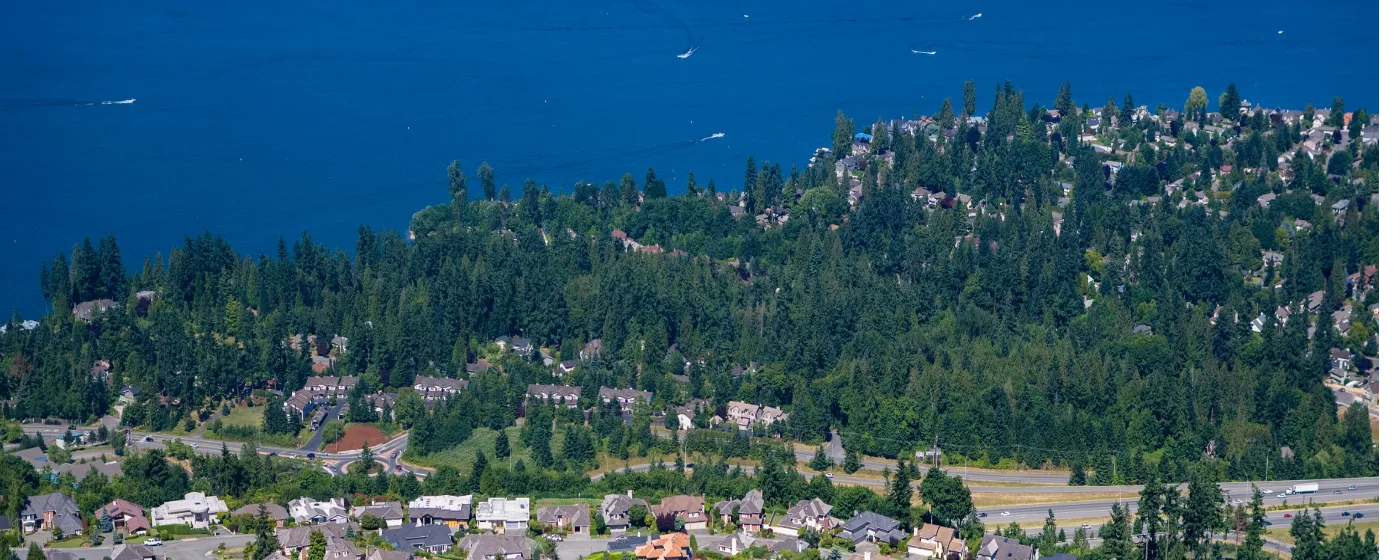
You've probably already done the rough math and flinched. Issaquah sits 17 miles east of downtown Seattle in King County, and its price tag reflects every bit of that address. The Zillow Home Value Index put the typical home price at $1,018,909 as of June 2026 — crossing the million-dollar threshold that still surprises people who picture Issaquah as a quiet, smaller Eastside town rather than one of the region's more expensive communities. What drives the number isn't just proximity to Seattle; it's the combination of highly regarded schools, a walkable historic core along Front Street, direct freeway access via I-90, and the kind of Pacific Northwest setting — backed by Cougar Mountain Regional Wildland Park and minutes from Lake Sammamish State Park — that commands a sustained premium.
The household income here supports those prices better than most markets can claim. The median household income in Issaquah is $154,669, reflecting the concentration of tech, healthcare, and professional workers who commute to Bellevue, the broader Eastside, and Seattle. Costco Wholesale's retail headquarters is the city's signature employer, and strong local schools keep parents with school-age children firmly in the buyer pool even when prices push higher. That demand floor is real — and it's a big part of why prices here haven't softened the way some outer suburbs have.
Issaquah's overall cost of living runs roughly 42% above the U.S. national average, with housing as the clear primary driver. Outside of housing, the picture is more mixed: electricity rates run noticeably below the national average thanks to Washington's hydropower grid, and Washington's complete absence of a personal state income tax is a genuine offset that Issaquah residents feel every April. The catch that trips up newcomers from California or out-of-state is the 10.5% combined sales tax rate — one of the higher combined rates in the region — which adds up quickly at the grocery store, the hardware store, and everywhere else you spend money day to day.
Whether you're comparing Issaquah to Bellevue, weighing a rental against buying, or just trying to figure out what a real monthly budget looks like here, the sections below break down housing costs, everyday expenses, a side-by-side city comparison, and what Washington's tax structure means for your bottom line.
What It Really Costs to Live in Issaquah
Issaquah is not a bargain relative to its neighbors, but it's not the most expensive Eastside city either. The Zillow Home Value Index stood at $1,018,909 in June 2026 — placing it meaningfully above Renton and North Bend, roughly in line with Snoqualmie's upper end, and noticeably below Bellevue's stratospheric median. For buyers relocating from inland Washington cities or most of the Mountain West, that figure represents a significant adjustment. For buyers coming from the San Francisco Bay Area or coastal Southern California, Issaquah can feel relatively accessible by comparison — though the gap is narrower than it once was.
Housing is unambiguously the cost driver. Once you step outside of it, Issaquah's everyday expenses are high but not extreme by Pacific Northwest standards. Washington's hydropower grid keeps electricity bills below what most of the country pays. The state levies no personal income tax. Groceries and dining run above average, but not dramatically so. The compounding effect of a seven-figure home price on a mortgage or even on property taxes, however, means the headline monthly obligation for owners is substantial before a single other line item.
The honest overall posture: Issaquah costs real money, and most of that money goes toward housing. If you're moving here on a dual tech-professional income or a senior single-earner salary, the math works. If you're stretching to get in, the non-housing costs — especially that 10.5% sales tax on everything from a cup of coffee to a full appliance replacement — will add friction you may not have budgeted for.
Housing: Rent vs Buy in Issaquah
Buying
The city-wide median home price sits at $1,018,909 as of June 2026. Older condos and smaller townhomes represent the lower end of the ownership market, while newer construction, larger square footage, and view properties routinely run $1.3 million to $1.8 million or higher. For a detailed look at how prices vary across specific parts of the city, the Best Neighborhoods in Issaquah guide covers that in depth.
The effective property tax rate is approximately 0.88% — low by national standards and notably below the U.S. effective average of roughly 1.0–1.1%. Washington also has no personal state income tax, which is a genuine financial benefit for high earners. Use the mortgage calculator below this section to model your actual monthly ownership costs; the combination of purchase price, rate, down payment, and that 0.88% tax rate will determine the real number for your specific situation.
Renting
Issaquah's rental market skews toward apartment complexes and newer townhome rentals, particularly in the Issaquah Highlands area and along the SR-900 corridor. A two-bedroom apartment in a newer building typically runs $2,400–$2,900 per month. Older or smaller units can dip closer to $2,100–$2,300, though those are increasingly scarce. Three-bedroom single-family rentals are uncommon and tend to list above $3,200 when they appear.
Renting makes sense in Issaquah primarily if you're on a one-to-two-year horizon — long enough to know the city, short enough that transaction costs on a purchase would eat any appreciation. For longer horizons in this market, the math typically favors buying if your finances support it. The catch is that Issaquah's entry price is high enough that many households who want to buy need to make significant down payment tradeoffs to get there.

Everyday Costs Beyond Housing in Issaquah
Electricity is the one utility category where Issaquah residents consistently come out ahead of the national average. At approximately 15 cents per kilowatt-hour as of August 2026 — about 26% below the U.S. average — monthly electric bills for a typical household run meaningfully lower than what many newcomers from California or the Northeast are used to paying. Washington's hydropower-heavy grid, which draws roughly 66% of its electricity from renewable sources, is the reason. Water, sewer, and stormwater are billed on a bi-monthly cycle by the City of Issaquah, with a 6.0% municipal utility tax applied to the total bill — factor that surcharge into any utility estimate you run.
Groceries run above the national average. A single adult typically spends around $302 per month on groceries in Issaquah, with benchmark prices like roughly $4.85 for a loaf of bread and $3.04 for a gallon of milk illustrating the premium over Midwest or Sun Belt baselines. Issaquah has solid grocery options — including a Costco warehouse conveniently located given the company's headquarters here — but no amount of membership discounts fully offsets a high-cost market.
| Category | Typical Monthly Cost | Notes |
|---|---|---|
| Housing (2BR rent) | $2,400–$2,900 | Newer apartments/townhomes; owners should use the mortgage calculator above for an ownership estimate |
| Electricity | $80–$130 | ~15¢/kWh; lower than the national average due to WA hydropower |
| Water, Sewer & Stormwater | $80–$120 | Billed bi-monthly by the City of Issaquah; includes a 6% municipal utility tax |
| Groceries | $300–$420 | Estimate for 1–2 adults; above U.S. average; Costco membership offsets some costs |
| Transportation & Gas | $200–$400 | Car-dependent for most errands; Sound Transit 554 express to Seattle ~$3/ride or ~$99/month ORCA pass |
| Phone & Internet | $130–$200 | Competitive carrier options; gigabit internet widely available in newer builds |
| Dining & Discretionary | $300–$600 | Dinner for two at a mid-range spot on Front Street runs $60–$90 before the 10.5% sales tax; budget accordingly |
The 10.5% sales tax rate — covering the 6.5% state base plus 4.0% in local add-ons across both Issaquah ZIP codes (98027 and 98029) — is the line item most newcomers underestimate. It applies to dining, retail, and most services, and it compounds quickly for households with active spending habits.
Looking to buy in Issaquah? Estimate your payment.
Enter your numbers to see an estimated monthly mortgage payment.
Estimate only. Excludes HOA fees and mortgage insurance. The interest rate above is a starting point, not a quoted rate — replace it with your own to see real numbers. Insurance is a flat placeholder, not a Issaquah quote.
Issaquah vs Nearby Cities: Cost Comparison
| City | Median Home Price | Typical 2BR Rent | Cost vs Issaquah |
|---|---|---|---|
| Issaquah | $1,018,909 (Zillow Home Value Index, June 2026) | $2,400–$2,900/mo | — Baseline — |
| Bellevue | ~$1,350,000–$1,500,000 | $2,800–$3,400/mo | Noticeably higher across the board |
| Sammamish | ~$1,100,000–$1,200,000 | $2,500–$3,000/mo | Moderately higher; comparable lifestyle |
| Newcastle | ~$950,000–$1,050,000 | $2,300–$2,700/mo | About the same; slightly lower median |
| Renton | ~$700,000–$800,000 | $2,000–$2,400/mo | Noticeably cheaper; broader price range |
| Snoqualmie | ~$850,000–$975,000 | $2,100–$2,500/mo | Somewhat cheaper; more rural feel |
| North Bend | ~$700,000–$850,000 | $1,900–$2,300/mo | Cheaper; trade-off is longer commutes |
Renton and North Bend offer the most meaningful price relief relative to Issaquah, but both involve trade-offs in commute time or urban amenities. Sammamish is geographically adjacent and similarly priced, making the Issaquah-versus-Sammamish decision less about cost and more about community character and specific neighborhood fit.
Taxes & the Bottom Line for Issaquah
No State Income Tax
Washington is one of nine states with no personal income tax. For a household earning the city's median of $154,669, that means zero dollars owed to the state on wages or salaries — a meaningful annual savings compared to California (where that income would face a marginal rate above 9%), Oregon (above 8%), or most of the Mountain West. This is the single most frequently cited financial upside among people who relocate here from high-income-tax states.
Sales Tax: The Real Offset
The state recoups revenue through consumption. Issaquah's combined sales tax rate of 10.5% as of January 1, 2026 — comprising 6.5% state base plus 4.0% in local additions — applies to nearly every retail transaction in both the 98027 and 98029 ZIP codes. A household spending $4,000 per month on taxable goods and services is paying roughly $420 in sales tax each month. That is a real and recurring cost that doesn't show up in the income-tax-free headline.
Property Tax
The approximately 0.88% effective property tax rate is low by national standards, but when applied to the home prices discussed above, the absolute annual bill is still substantial. The rate itself is competitive — lower than most of the Midwest and South on a percentage basis — and it's one reason the region attracts buyers who are used to 1.2–1.5% rates elsewhere. Use the calculator in the Housing section to see what this rate produces for your specific purchase price.
Who Fits This Budget
The bottom line: Issaquah rewards high earners, particularly dual-income households in tech, healthcare, or professional services, who can absorb the seven-figure entry price while benefiting from the income-tax advantage and below-average electricity costs. Single-income households stretching toward that median home price often find that the combination of a large mortgage, above-average groceries, and a 10.5% sales tax leaves less margin than the income-tax savings restores. Buyers who tend to find Issaquah a genuine fit are those for whom the strong local schools, the I-90 access, and the proximity to Eastside employment centers justify paying a premium over Renton or Snoqualmie — and who have the income to make that premium sustainable rather than stressful.

Local Expert Takeaway: The number that surprises most Issaquah newcomers after six months isn't the mortgage — they planned for that. It's the 10.5% sales tax turning up on every receipt: dinner for two on Front Street, a weekend run to the hardware store, a month of delivery orders. Washington's no-income-tax policy is real and valuable, but in a city where daily spending is above average and housing already consumes a large share of income, the sales tax functions as a quiet but consistent drag. Budget for it explicitly rather than discovering it after the first few credit card statements.
Quick Takeaways & FAQs
✅ Washington's zero personal income tax is a genuine financial advantage for Issaquah's high-earning households — especially those relocating from California or Oregon.
⚠️ The 10.5% combined sales tax rate (as of January 2026) applies to nearly every purchase in both Issaquah ZIP codes and catches most newcomers off guard.
📍 Sound Transit Route 554 runs express from Issaquah Transit Center to downtown Seattle roughly every 30 minutes for $3 a ride — or about $99/month with an ORCA pass.
What is the typical home price in Issaquah, WA in 2026?
How much does it cost to rent a two-bedroom apartment in Issaquah?
Does Washington State have an income tax, and how does that affect Issaquah residents?
What is the property tax rate in Issaquah?
Is Issaquah cheaper or more expensive than Bellevue and Sammamish?
Moving to Washington?
Tell us what you need help with and we'll connect you with local resources.
