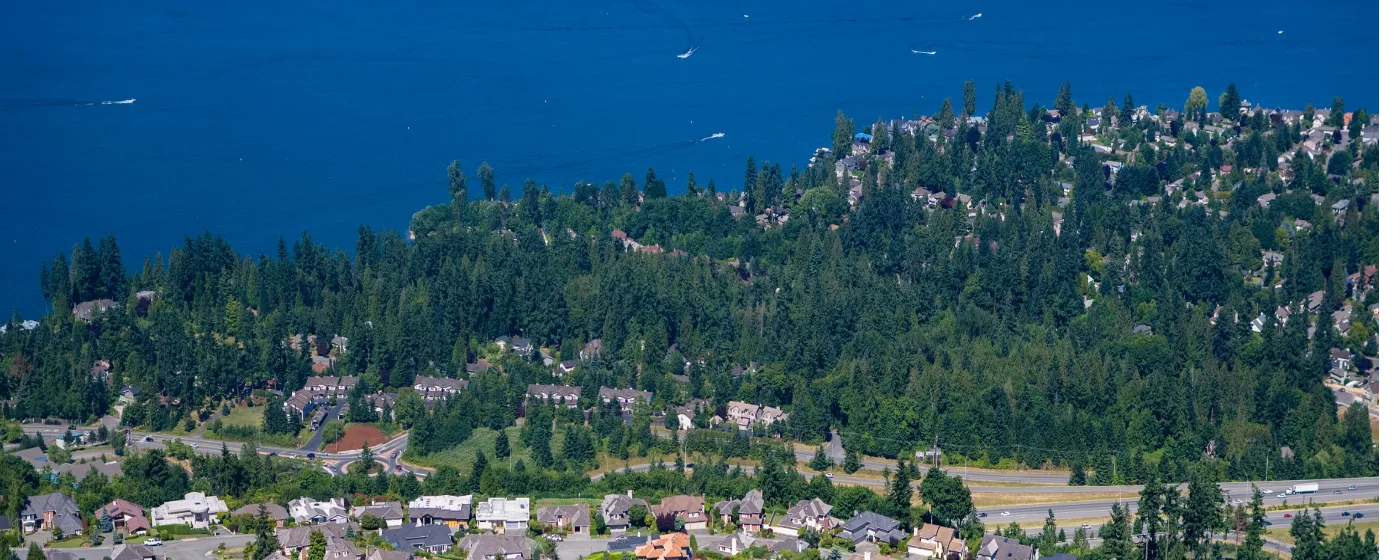
People moving to the Seattle metro from out of state usually ask about traffic, home prices, and schools first. Safety comes up later — sometimes after they've already toured Issaquah Highlands twice and driven down historic Front Street. That's understandable, because Issaquah reads as safe on the surface: planned neighborhoods climbing into the Cascade foothills, well-lit retail corridors off I-90, families walking dogs along Gilman Boulevard. But surface impressions aren't data. What the 2024 FBI crime numbers actually show is that Issaquah earns the reputation it projects.
The headline figure: Issaquah recorded a violent crime rate of 1 per 1,000 residents in 2024 — a rate that CrimeGrade.org confirms is below both the Washington state average and the national average. The property crime rate of 33.3 per 1,000 tells a more complicated story, one that requires context to understand correctly, because Washington state carries a well-documented property-crime burden that inflates nearly every city's numbers. Issaquah is no exception, but it's also not an outlier. City-Data's 2024 crime index puts Issaquah at 178 — compared to a U.S. average of 235.3 — and the city's overall crime rate dropped 19% between 2023 and 2024.
The Issaquah–Sammamish corridor is genuinely one of the quieter pockets of the greater Seattle area. Sammamish, literally minutes away, ranked as the safest reporting city in Washington state by FBI 2024 data. That geographic proximity matters: the two cities share similar demographics, similar income levels, and similar policing approaches. Issaquah isn't riding Sammamish's coattails — it has its own numbers to stand on — but the regional context helps explain why families relocating from Bellevue or Renton consistently describe Issaquah as feeling calmer than where they came from.
Whether you're weighing a specific neighborhood or trying to understand what the crime data means for daily life here, the sections below break down Issaquah's violent and property crime numbers, put them in state and national context, walk through how safety varies across Issaquah Highlands, Talus, Klahanie, the historic downtown core, and the city's other neighborhoods, and explain what the Issaquah Police Department does to keep those numbers moving in the right direction.
Issaquah's Crime Numbers in Context: Violent Crime First
The single most reassuring number in Issaquah's safety profile is its violent crime rate. At 1 per 1,000 residents (2024 FBI data), Issaquah sits well below where most people expect a city this close to Seattle to land. CrimeExplorer's five-year tally (2019–2024) shows Issaquah's average violent crime rate of 41 per 100,000 — 61.4% below the national average over that same period.
To put that in plain terms: the national violent crime rate in 2024 was 359 per 100,000 people. Issaquah's was roughly a tenth of that. That's not a small gap.
Washington state's 2024 violent crime rate was 326–329 per 100,000 — modestly below the U.S. average. Issaquah runs substantially below the state figure, which means it's outperforming not just the country but its own state on the metric most people care about most. NeighborhoodScout's characterization of Issaquah's violent crime as "about average for all communities in America" is technically accurate by their methodology — but it undersells how low the absolute number is for a city of nearly 40,000 people.
| Geography | Violent Crime Rate (per 100k, 2024) | Comparison to Issaquah |
|---|---|---|
| Issaquah, WA | ~100 | — |
| Washington State | 326–329 | Noticeably higher |
| United States | 359 | Substantially higher |
| Sammamish, WA (neighbor) | Part of 567 total/100k | Comparable corridor |
| Issaquah 5-yr avg (2019–2024) | 41 | Base reference |
| National 5-yr avg (approx.) | ~380 | ~9× Issaquah's rate |
Over the five-year period from 2019 to 2024, Issaquah recorded 823 violent crimes total — against 7,164 property crimes. The 9:1 ratio is the key to reading Issaquah's overall crime number correctly: this is a city where the overwhelming driver is property crime, not violence.
Property Crime: The Real Story Behind the 33.3 Figure
Issaquah's property crime rate of 33.3 per 1,000 residents is the number that gives some relocating families pause. On its face, it's elevated — and it is real. But three pieces of context keep it from being a disqualifying red flag.
Washington's Statewide Property Crime Problem
Washington state's property crime rate runs approximately 40% above the national average. That's not an Issaquah quirk — it's a statewide pattern rooted in the state's historically lenient vehicle-theft laws and dense retail corridors. The WASPC's 2024 annual report showed stolen vehicles statewide dropping from over 52,000 to 34,294 between 2023 and 2024 — a dramatic improvement, but still a high baseline. Issaquah's I-90 corridor and the Costco retail cluster near the interchange generate significant through-traffic, which brings opportunistic property crime with it.
Larceny/Theft, Not Burglary, Drives the Number
The property crime figure is overwhelmingly composed of larceny and theft — items taken from vehicles, retail theft in commercial areas — rather than residential burglaries. That distinction matters when you're assessing the safety of a neighborhood you're considering moving into versus the safety of leaving your laptop bag visible in a parking lot off I-90.
The Trend Is Moving the Right Direction
Issaquah's overall crime rate fell 19% from 2023 to 2024. That tracks with the statewide decline: Washington's total crime dropped 14.1% over the same period. Both numbers are meaningful because they represent real reductions, not statistical noise.
| Crime Type | Issaquah Rate | National Rate (2024) | Context |
|---|---|---|---|
| Violent crime | 1 per 1,000 | 3.59 per 1,000 | Well below national |
| Property crime | 33.3 per 1,000 | 17.6 per 1,000 | Elevated; WA-wide pattern |
| 5-yr violent crime avg | 41 per 100k | ~380 per 100k | 61.4% below national avg |
| Overall crime index (City-Data) | 178 | 235.3 (U.S. avg) | Issaquah below average |
| Year-over-year crime change | −19% (2023→2024) | −5.4% violent, −9% property | Issaquah improving faster |
| Registered sex offenders | 5 (ratio: 7,181:1) | WA avg much higher | Well below state average |
* Crime index from City-Data.com (2024 data); violent/property rates from NeighborhoodScout (FBI UCR 2024). Methodologies differ slightly across aggregators; figures above reflect the authoritative sources cited in the fact sheet.
The practical takeaway: the risk profile in Issaquah is primarily about opportunistic theft in commercial zones — not the kind of threat that changes whether a neighborhood feels safe to live in day-to-day.

Neighborhood-by-Neighborhood Safety: Where to Focus Your Research
Issaquah's geography produces real safety variation — not because any neighborhood is dangerous, but because planned master communities in the hills above the valley floor have structurally different crime profiles than the older commercial corridor running through the historic downtown core. Understanding that distinction before you narrow your search to specific streets is worth your time. For a fuller picture of what each neighborhood is like to live in, the Issaquah neighborhoods guide goes deeper on character and livability.
Issaquah Highlands and the Northeast Quadrant
CrimeGrade.org's neighborhood-level mapping identifies the northeast part of Issaquah — anchored by Issaquah Highlands — as the city's safest area. That's consistent with what residents report. The Highlands is a master-planned community at elevation, with limited through-traffic, controlled access points at many streets, and an active homeowners association that coordinates with the police department. The combination of low through-traffic and community oversight keeps opportunistic property crime notably lower than the I-90 corridor below.
Talus and Klahanie
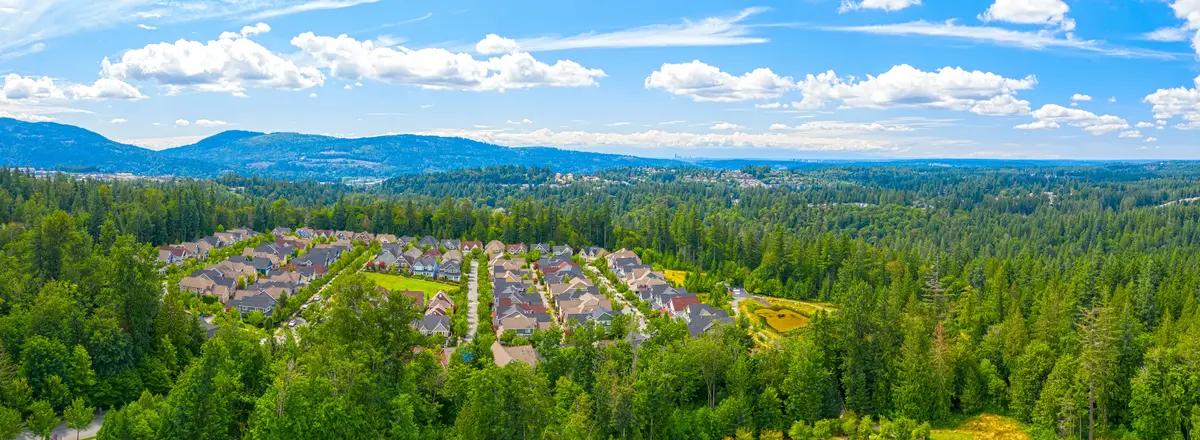
Both Talus and Klahanie sit in similar planned-community settings — hillside neighborhoods with cul-de-sac street patterns, strong HOA presence, and limited commercial traffic. They share the same structural advantages as the Highlands: the street design itself discourages opportunistic vehicle break-ins and package theft. Residents who've moved from Bellevue or Renton tend to describe both neighborhoods as quieter than what they left.
Providence Point
Providence Point is a gated 55+ community near Lake Sammamish, and its access-controlled layout means it operates almost entirely outside the property crime patterns that affect the commercial corridor. It's one of the most structurally protected neighborhoods in the city, though its age restriction makes it relevant only to a specific buyer profile.
Downtown Issaquah and the I-90 Corridor
Historic Front Street and the blocks around Gilman Village see more foot traffic, more retail, and more vehicle turnover than any other part of the city — which means a proportionally higher share of the city's property crime concentrates here. That's not a reason to avoid the downtown core; the area has real neighborhood character, with independent restaurants and shops along the main street. But if you're choosing between a residence a block off Front Street and one up in the Highlands, you're making a genuine safety trade-off, not just a lifestyle preference.
North Issaquah, Newport, and Squak Mountain
North Issaquah and Newport occupy the transition zone between the valley floor and the hillside — quieter than the downtown corridor, less insular than the Highlands. Squak Mountain properties sit at the edge of Squak Mountain State Park, with minimal through-traffic by definition. These areas don't appear in crime mapping as problem spots; their relative obscurity in the data is itself informative.
Looking to buy in Issaquah? Estimate your payment.
Enter your numbers to see an estimated monthly mortgage payment.
Estimate only. Excludes HOA fees and mortgage insurance. The interest rate above is a starting point, not a quoted rate — replace it with your own to see real numbers. Insurance is a flat placeholder, not a Issaquah quote.
What the Issaquah Police Department Actually Does
Issaquah's crime numbers don't stay low by accident. The Issaquah Police Department runs a more robust community engagement infrastructure than most cities of comparable size, and that infrastructure directly connects to the property crime prevention gap.
Block Watch and Paws on Patrol
The department's Block Watch program is a formal neighborhood-watch framework — not a Facebook group, but an organized structure where block captains coordinate directly with patrol officers. The Paws on Patrol program is what it sounds like: registered dog-walkers who serve as eyes on the street in residential neighborhoods. In practice, it means that in neighborhoods like Klahanie or North Issaquah, someone is consistently moving through blocks at unpredictable hours — exactly the kind of deterrence that suppresses vehicle break-ins.
Vacation Security Checks
One thing many newcomers don't realize until after their first summer here: Issaquah experiences a wave of residents heading to Eastern Washington or the coast for extended stretches in July and August. The department's Vacation Security Check service sends officers to drive by and inspect registered homes while owners are away. It's a small thing that matters when you're leaving a hillside property unoccupied for two weeks.
Transparency and Accountability
The department publishes a weekly crime blotter and a monthly activity report covering crimes reported, call-center volume, and officer response data — all part of its formal Police Accountability, Equity and Human Services Action Plan. For anyone who wants to track what's actually happening block-by-block before settling on a neighborhood, those reports are public and searchable at issaquahwa.gov.
Issaquah also has only 5 registered sex offenders as of May 2026 — a resident-to-offender ratio of 7,181:1, well below the Washington state average. That figure, combined with the neighborhood watch density in planned communities, gives families with young children a concrete data point to work with.
The Honest Tradeoffs: What People Learn After Six Months Here
Issaquah's safety profile is genuinely strong. But two things tend to surprise people after they move in — neither of which shows up in the crime index.
The I-90 Corridor Is a Different City After Dark
The stretch of Front Street North and the commercial blocks near the Costco complex at the I-90 interchange carry a meaningfully different feel at 11 p.m. than the residential hills above them. Vehicle break-ins in surface parking lots near the interchange happen, and they happen disproportionately in that zone. If you're evaluating a property near the interchange — rather than up in the Highlands or out in Klahanie — it's worth checking the department's monthly activity reports for that specific beat before you decide. The data is public and free. Use it.
Property Crime Follows Retail Traffic, Not Just Residents
One thing the aggregate 33.3 per 1,000 figure obscures: a significant portion of Issaquah's property crime involves people who don't live in Issaquah. High-volume retail draws opportunistic theft. I-90 makes it easy to arrive, steal from a vehicle, and leave. This is a statewide pattern, not an Issaquah failure — but it means the property crime rate overstates the risk you actually face as a resident in a planned neighborhood like Talus or Issaquah Highlands, while understating it slightly for anyone parking regularly in the commercial core.
Why People Move Out (The Safety Edition)
Issaquah rarely loses residents because they feel unsafe. The departures driven by safety concerns are almost always retirees who've decided they want a truly gated environment with 24-hour security — something Issaquah doesn't offer outside Providence Point. Families moving away tend to cite cost more than crime. That framing matters: safety is not what breaks Issaquah for most people who leave.
The bottom line is that Issaquah's violent crime rate is among the lowest of any city in the greater Seattle metro. Property crime requires attention and a few basic habits — don't leave valuables in vehicles near the interchange, register with Block Watch in your neighborhood — but it doesn't alter the fundamental character of daily life here. This is a city where kids walk to school, neighbors know each other's names, and the weekly crime blotter is more likely to list a catalytic converter theft than anything more alarming.

Local Expert Takeaway: Issaquah's violent crime rate is genuinely low — well below Washington state and national figures — and the city's overall crime index improved 19% in 2024 alone. The property crime number (33.3 per 1,000) is real but driven almost entirely by larceny and theft concentrated near the I-90 corridor and Costco retail cluster, not in the residential planned communities that cover most of the city. If you're researching specific neighborhoods, the northeast quadrant anchored by Issaquah Highlands consistently maps as the city's safest area. Check the Issaquah Police Department's public monthly activity reports at issaquahwa.gov before settling on a block — the data is specific, current, and far more useful than any aggregate crime index.
Quick Takeaways & FAQs
✅ Issaquah's violent crime rate of 1 per 1,000 residents is roughly a tenth of the 2024 national average — one of the strongest safety numbers in the Seattle metro.
⚠️ Property crime at 33.3 per 1,000 is elevated, but it's driven by larceny near the I-90 interchange and retail corridor, not residential neighborhoods — a pattern typical across Washington state.
📍 The Issaquah Police Department publishes a free weekly crime blotter and monthly activity reports at issaquahwa.gov — the most granular tool available for researching safety on a specific block before you decide on a neighborhood.
Is Issaquah, WA a safe place to live?
How does Issaquah's crime rate compare to nearby cities like Sammamish and Bellevue?
What type of crime is most common in Issaquah?
Which Issaquah neighborhoods are the safest?
Does Issaquah's police department have community programs residents can join?
Moving to Washington?
Tell us what you need help with and we'll connect you with local resources.
