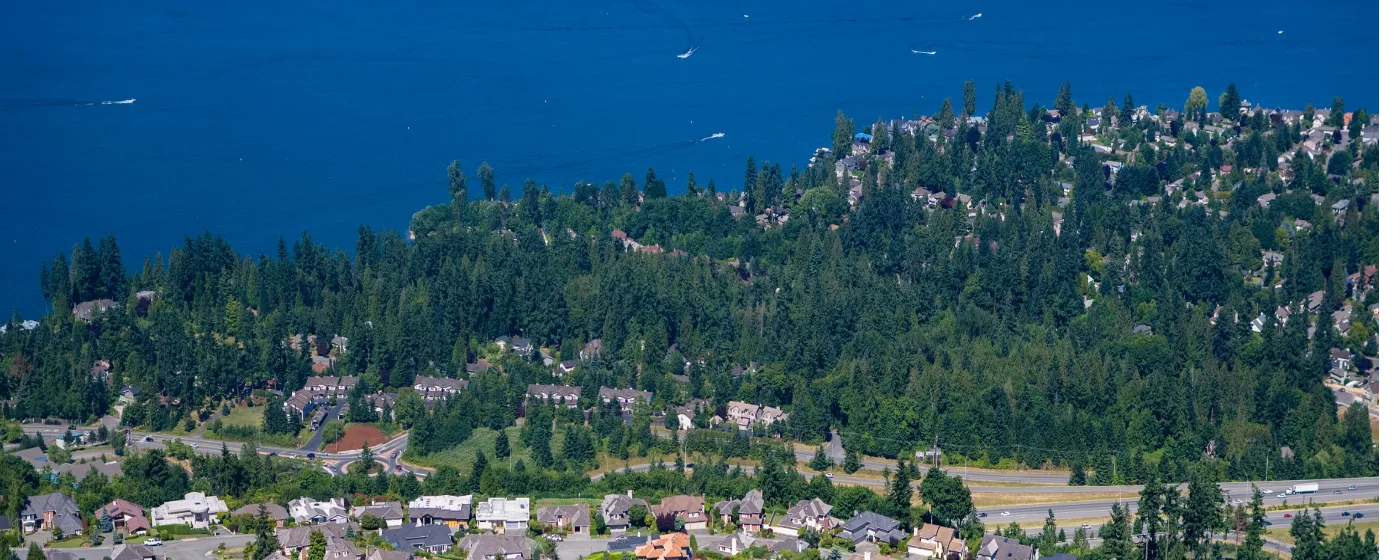
If you're deciding between staying in California and buying in Issaquah, the conversation usually starts with the income tax math — and it's hard to ignore. Washington has no individual state income tax on wages or salaries, which means a household earning $200,000 in California was likely handing over $14,000 to $16,000 or more annually to Sacramento. That money stays in your pocket in Issaquah. What surprises most California transplants after six months isn't the rain — it's how much further their paycheck goes, and how quickly the Pacific Northwest lifestyle becomes the plan rather than the experiment. Issaquah sits about 17 miles east of Seattle along I-90, in the foothills of the Cascade Range, close enough to downtown Bellevue and Seattle to commute but grounded in its own distinct identity.
The economic engine here runs on tech and retail at a global scale. Costco Wholesale's global headquarters anchors the city and draws a layer of corporate professionals who could live almost anywhere in the metro. The Issaquah School District No. 411 — ranked third in Washington state by Niche in 2026 and carrying an A+ grade — draws families with school-age children who made the calculation that private school tuition in the Bay Area or Los Angeles was unsustainable. The school district's adjusted five-year cohort graduation rate was district-reported at 97% for the class of 2023, and proficiency rates in math and reading both run noticeably above Washington state averages. For parents who relocated partly for education quality, those numbers hold up to scrutiny.
The cost of living runs approximately 42% above the U.S. national average, driven by housing, food, and transportation — so nobody is pretending Issaquah is cheap. What it offers is a specific exchange: you trade California's warm winters and urban density for Cascade Mountain access, lower taxes, and a city where the Issaquah Alps trail system — Cougar Mountain Regional Wildland Park, Tiger Mountain State Forest, and the surrounding ridgelines — begins at the edge of neighborhoods rather than a two-hour drive away. Lake Sammamish is a genuine amenity, not a marketing line. On-foot access to serious trails from a suburb this close to a major metro is unusual anywhere on the West Coast. The full cost-of-living breakdown covers utilities, groceries, and transportation in detail.
Whether you're being relocated by a tech employer, escaping California's tax structure, or looking for a school district that can match what you were paying private tuition for, the sections below break down Issaquah's tax picture, the home price reality, what the California-to-Washington lifestyle shift actually looks like day to day, what the schools deliver, and the honest trade-offs that don't make it onto the chamber of commerce brochure.
The Tax Shift: What Leaving California Actually Means for Your Wallet
The headline is accurate and worth stating plainly: Washington levies no individual state income tax on wages or salaries. California's marginal rates climb to 13.3% at the top bracket — among the highest of any state in the country. For a dual-income household earning a combined $300,000, the annual difference can easily exceed $25,000 in take-home pay, and that's before accounting for anything else.
The Income Tax Picture
California taxes income on a graduated scale starting at 1% and reaching 13.3% above approximately $1 million in individual income. Washington has no equivalent mechanism for wages — none. This is not a deduction or a credit; it is a structural absence. A senior engineer earning $180,000 who moved from San Jose to Issaquah effectively gave themselves a raise without changing jobs.
One nuance worth knowing: Washington's Legislature passed Senate Bill 6346 in 2026, establishing a 9.9% income tax on adjusted gross income exceeding $1 million for individuals, effective January 1, 2028. This does not affect the vast majority of relocating households, but high-earning California transplants — particularly those with capital gains, equity payouts, or stock vesting above that threshold — should factor it into long-term planning.
Sales Tax: The Trade-Off California Transplants Don't Expect
Washington funds its state government largely through sales tax rather than income tax, and you will feel it at the register. Issaquah has a combined state and local sales tax rate of 10.5%, which applies to most goods. Groceries and prescription drugs are exempt, which blunts the daily impact, but furniture, clothing, electronics, and vehicles cost noticeably more at the point of sale.
California's base sales tax rate is 7.25%, with most counties and cities adding local measures that push totals to 9% to 10.75% depending on jurisdiction. So for many Bay Area or Los Angeles households, Issaquah's combined state and local sales tax rate of 10.5% is modestly higher — or in some high-tax California jurisdictions, roughly comparable. The real savings come from income, not the register.
Property Tax: A Structural Advantage
Issaquah's effective property tax rate is approximately 0.88% of assessed value. California's Proposition 13 caps the base rate at 1% but layers supplemental levies on top, with effective rates in competitive metros often landing closer to 1.1% to 1.3% — and, critically, those taxes are calculated on the purchase price rather than a long-held assessed value. A California buyer who purchased decades ago pays very little; a buyer purchasing today at current prices faces the full calculation. On a home priced at Issaquah's typical level, 0.88% represents a lower annual obligation than what most recent California purchasers pay in similarly priced markets.
| Tax Category | California | Issaquah / Washington |
|---|---|---|
| State income tax (wages) | 1%–13.3% marginal rate | None (wages/salaries) |
| Income tax on retirement income | Taxed as ordinary income | Not taxed (no state income tax) |
| Effective property tax rate | ~1.1%–1.3% (recent purchase) | ~0.88% |
| Combined sales tax (typical) | ~9%–10.75% (varies by city) | 10.5% (state and local combined) |
| Capital gains tax (state) | Taxed as ordinary income | 7% on long-term capital gains above a $278,000 standard deduction for 2025, rising to 9.9% on gains above $1,000,000 |
| Retirement account distributions | Taxed as ordinary income | Not taxed (no state income tax) |
Washington taxes 7% on long-term capital gains above a $278,000 standard deduction for 2025, rising to 9.9% on gains above $1,000,000 — something California tech workers liquidating stock should account for, even if it is still far below California's rate on the same gains.
Home Prices: What $1 Million Buys You Here vs. There
The typical Issaquah home value was $1,018,909 per the Zillow Home Value Index for June 2026. That figure will feel immediately familiar to anyone relocating from the Bay Area or coastal Southern California — you're not moving somewhere dramatically cheaper. You are, however, moving somewhere where that price point gets you substantially more space, usually a yard, and often a garage, compared to what the same number purchased in San Jose or in dense coastal markets.
What the Price Gets You
In the Bay Area, $1 million in mid-2026 typically purchased a smaller home, often without significant land, in a market where bidding wars remain routine. In Issaquah, that same budget is closer to the median — meaning half the market trades above it and half below. Entry-level homes in older areas of the city start noticeably below the median, while newer construction in planned communities like Issaquah Highlands trades above it. For neighborhood-by-neighborhood character, the neighborhoods page has the full breakdown.
Buyers from inland California — Sacramento, Fresno, the Inland Empire — will feel a real price adjustment upward. Issaquah is not a value market by national standards. It is a premium suburb of one of the fastest-growing tech metros in the country, and the prices reflect that fully.
What Californians Often Underestimate
The first surprise is how fast offers move. Multiple-offer situations on well-priced homes in Issaquah are not rare, particularly in spring. Coming from a California market, you may already know this rhythm — but the specific contingencies Washington buyers use, and the norms around inspection rights, differ from California practice. The buying process page covers the mechanics in detail.
The second surprise is that Issaquah's market is not monolithic. A home backing to open trail system land in the Squak Mountain area and a newer townhouse near the Issaquah Highlands ridge carry very different price points and very different daily experiences. Treating the city as a single price bucket will lead you to make an offer in the wrong pocket.
| Metric | Bay Area (approx.) | Issaquah, WA (June 2026) |
|---|---|---|
| Typical home value | $1.3M–$1.6M+ (San Jose / core metros) | $1,018,909 (Zillow ZHVI) |
| Effective property tax rate | ~1.1%–1.3% (recent purchase) | ~0.88% |
| State income tax on $200K income | ~$14,000–$16,000+ | $0 |
| Typical lot / space | Often under 5,000 sq ft in core cities | Typically larger; varies by neighborhood |
| Commute to major employment hub | 30–60+ min to San Jose / San Francisco core | ~30 min to Seattle/Bellevue |
| School district Niche rating | Varies widely by district | A+ (#3 in WA, 2026) |
* ZHVI = Zillow Home Value Index.
For most Bay Area households making this move, the numbers show a lower home price combined with a significantly lower ongoing tax burden. The lifestyle shift — from California sun to Pacific Northwest rain and mountains — is where the real decision lives.
Daily Life: What Changes When You Cross the State Line
Most Californians who move to Issaquah say the adjustment takes about three months. Month one is excitement — the trails, the trees, the absence of a state income tax withholding line on the pay stub. Month two is the rain. Not a storm, just a grey, persistent drizzle that arrived in October and seems to have no firm checkout date. By month three, you've either bought the right rain jacket and stopped caring, or you've started Zillow-searching back in Sacramento.
The Outdoor Access Is Genuine
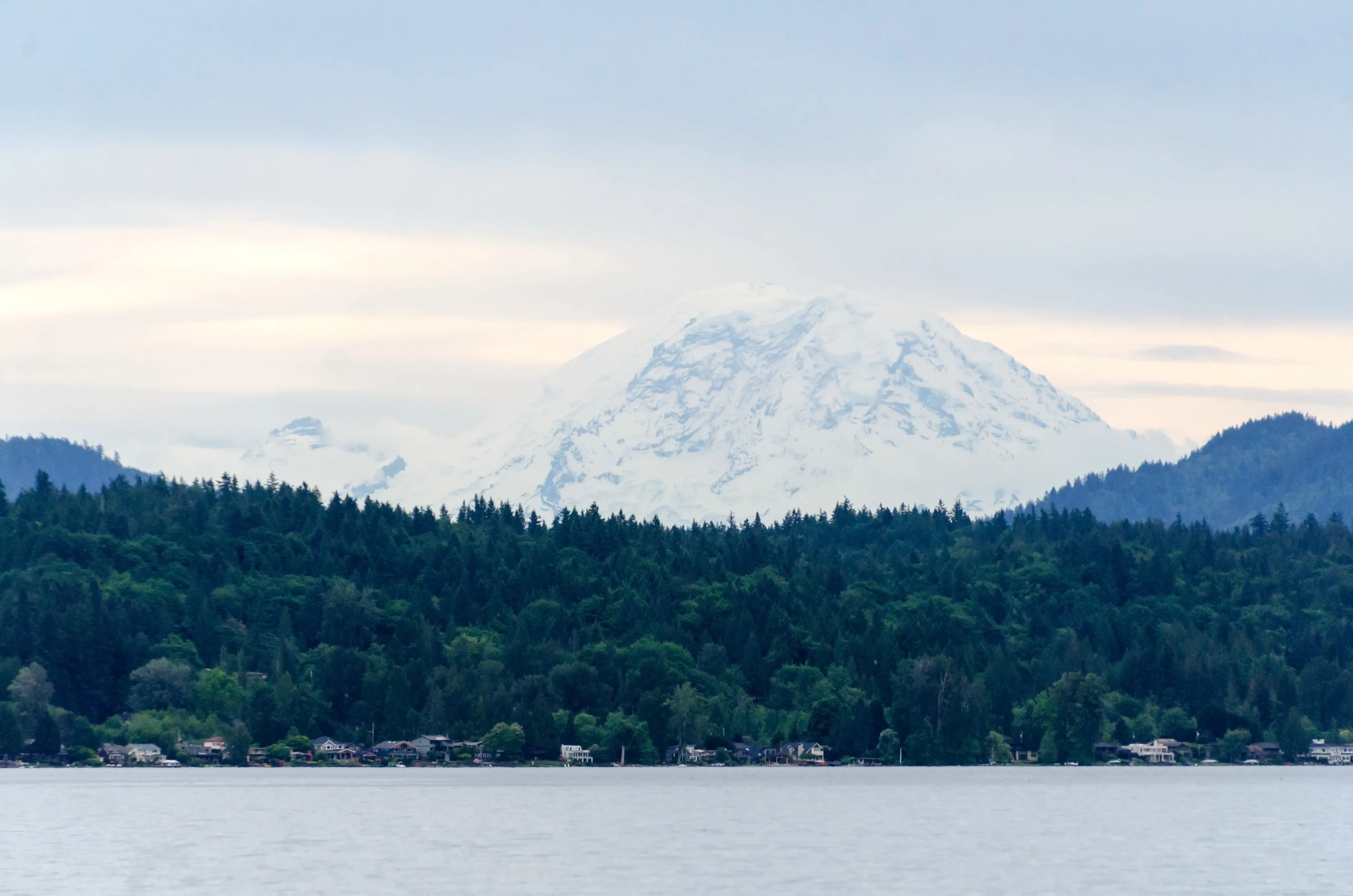
This is not a talking point. The Issaquah Alps trail system — Cougar Mountain Regional Wildland Park, Tiger Mountain State Forest, and the connected ridgeline routes — offers hundreds of miles of trails accessible directly from residential neighborhoods. You can leave your front door on foot and gain several thousand feet of elevation before noon. Lake Sammamish State Park sits at the city's edge and provides a genuine swimming and paddling destination from Memorial Day through September. Californians who spent weekends driving two hours to reach serious outdoor terrain find the proximity genuinely disorienting at first. For the full parks and recreation picture, that page covers the specifics.
What You Leave Behind
Issaquah has a walkable historic downtown along Front Street and Gilman Village, with independent shops and cafés in a preserved mill-town setting. It is not San Francisco's Mission District or Los Angeles's dense urban cores. The density of urban amenities — concert venues, late-night dining variety, ethnic food neighborhoods — is measurably lower than what a Los Angeles or Bay Area transplant is used to. You are twenty minutes from Bellevue and thirty from Seattle, and both cities fill most of those gaps, but the gap exists and it's worth being honest about before you sign.
Formula Brewing on NW Poplar Way is a genuinely local option for an evening out — a neighborhood brewpub with the kind of low-key, Pacific Northwest atmosphere that becomes the default Friday spot for many Issaquah residents. If your California life revolved around a dense walkable entertainment district, that is the honest trade-off in moving here.
Weather: The One Thing No One Warns You About Enough
Western Washington receives roughly 37 inches of precipitation per year — less than Atlanta or New York, and far less than most people from California expect after hearing the word "Seattle." What catches newcomers off guard is not the volume but the duration: overcast skies from October through April, with clear blue days interspersed. The summers — June through early September — are among the best in the country. Warm, dry, low humidity, with evening light until nearly 9 p.m. in July. Californians who make it through a full winter consistently say the summers made it worth it. The ones who leave tend to go in February.
Healthcare Costs in Context
Health insurance premiums for comparable employer-sponsored plans generally run noticeably below what households paid in California, partly reflecting Washington's insurance market structure. The practical trade-off: routine and specialty care is accessible in the Issaquah area and in Bellevue, but highly specialized advanced care draws people toward Seattle. The retiring in Issaquah page covers this picture in greater depth.
Looking to buy in Issaquah? Estimate your payment.
Enter your numbers to see an estimated monthly mortgage payment.
Estimate only. Excludes HOA fees and mortgage insurance. The interest rate above is a starting point, not a quoted rate — replace it with your own to see real numbers. Insurance is a flat placeholder, not a Issaquah quote.
Schools and Families: Why This Is the Most Common Reason People Move Here
Ask ten California families why they chose Issaquah specifically, and roughly seven will mention the schools. Issaquah School District No. 411 ranked third among all Washington state districts on Niche's 2026 rankings and earned an A+ overall grade. For families paying $30,000 to $50,000 annually in private school tuition in the Bay Area or Los Angeles, that number carries weight.
What the Numbers Show
District-reported proficiency rates for 2024–2025 placed 75% of students at or above proficiency in math and 79% in reading — both well above Washington state averages. The adjusted five-year cohort graduation rate was district-reported at 97% for the class of 2023. These are not cherry-picked figures from a single high-performing campus; they reflect 19,258 students across 29 schools in the 2024–2025 school year.
The school boundary question matters here. Which neighborhood you buy into determines which elementary school your children attend, and boundaries within the Issaquah district do not always follow the logic newcomers expect. Families from Issaquah Highlands, Klahanie, and Talus feed into different buildings, and the quality variation is real even within an A+ district. The schools page maps the boundaries and covers what parents actually say about each campus.
The Comparison to California
California's public school system varies enormously — some districts are genuinely excellent, many are not. The Bay Area contains both top-ranked districts and deeply struggling ones, often within a few miles of each other. Washington's funding model and Issaquah's local tax base produce more consistent outcomes across the district than California families accustomed to obsessive school-ranking research might expect. The variability is lower, and the floor is higher.
Parents who move here from California sometimes arrive expecting to replicate the hypercompetitive private-school prep culture of certain Los Angeles or Bay Area communities. Issaquah's public schools are competitive and college-focused, but the atmosphere is noticeably less pressure-cooked. Whether that reads as relief or a downgrade depends entirely on the family.
The Honest Trade-Offs: What California Transplants Actually Miss
People who move from California to Issaquah and stay tend to have made peace with a specific set of compromises. People who leave tend to have underestimated the same set. Naming them clearly upfront saves a lot of second-guessing at the eighteen-month mark.
The Sun Gap Is Real
California light — that particular quality of afternoon sun in October — is genuinely irreplaceable. Western Washington's grey winters are not dramatic or dangerous. They're just persistent. If your mental health is weather-sensitive, this is not a minor lifestyle footnote. It is the most common reason California transplants move back. Nobody who lives here is pretending otherwise.
The Density Gap Closes, But Doesn't Disappear
Bellevue's downtown has grown rapidly into a genuine urban center. Seattle offers most of what any major city offers. But Issaquah itself — despite its historic downtown along Front Street and Gilman Village's converted mill complex — is a suburb. The variety of dining, nightlife, cultural venues, and spontaneous walkable activity that defines life in dense California cities doesn't exist at the neighborhood level here. You will drive more. That is simply the shape of this place.
What You Stop Missing Faster Than You Expected
California traffic is genuinely worse than what most Issaquah commuters experience. The I-90 corridor into Seattle is congested at peak hours — Sound Transit express bus service offers a real alternative for Seattle-bound commuters — but the baseline of daily driving is less punishing than the 405 or a Bay Area commute at rush hour. For the full commute picture, the living in Issaquah page covers it.
The cost math, once internalized, also tends to stop feeling abstract. A household that was paying $14,000 to $18,000 annually in California state income tax watches that number go to zero and finds other things to spend it on — mortgage principal, a trail vehicle, a ski pass to Snoqualmie Pass forty minutes up I-90. The lifestyle those dollars fund in Issaquah is specific and particular to this place, and most transplants who stay say it took about a year to feel like home rather than an experiment.
Safety and Community
Issaquah consistently ranks among the safer communities in King County. For the specific figures, the safety page has the full breakdown. What California transplants often note is a different social texture — the Pacific Northwest reserve is real, especially in the first year. Neighbors are not unfriendly; they are measured. Community connections tend to form around outdoor activity, the school community, and local gathering spots rather than through the more spontaneous sidewalk culture of dense California neighborhoods. It takes longer to feel embedded. Most people who stay say it was worth the patience.
Local Expert Takeaway: The California-to-Issaquah move makes financial sense on paper — no state income tax on wages, a lower effective property tax rate, and a school district ranked third in Washington state that holds up to any comparison with what families were paying private tuition for in the Bay Area. The honest version of that picture includes: a typical home price at $1,018,909 (Zillow Home Value Index, June 2026) that isn't a bargain by any national measure, a combined state and local sales tax rate of 10.5% on non-grocery purchases, and a grey winter that runs from October to April with a stubbornness that surprises almost everyone. The families who stay tend to be the ones who found Formula Brewing on NW Poplar Way by month two, bought the right rain jacket, hiked Cougar Mountain on the first clear Saturday in March, and stopped looking at Zillow listings in Sacramento.
Quick Takeaways & FAQs
✅ Washington's zero state income tax on wages can put $14,000 or more annually back into a household budget compared to California's top marginal rates — one of the most concrete financial reasons Californians move here.
⚠️ Issaquah's home prices average just over $1 million (Zillow Home Value Index, June 2026), and while that's noticeably below Bay Area medians, it is not an affordable market — and the grey winters from October through April are genuinely the most common reason transplants eventually leave.
📍 The Issaquah Alps trail system — Cougar Mountain Regional Wildland Park and Tiger Mountain State Forest — puts hundreds of miles of serious hiking and trail running at the edge of residential neighborhoods, a proximity to backcountry terrain that's unusual for a suburb this close to a major metro.
Do I really pay zero state income tax if I move to Issaquah from California?
Is the Issaquah housing market less expensive than California?
How do Washington's property taxes compare to California's for a new buyer?
What's the biggest lifestyle adjustment California transplants underestimate?
Are the Issaquah schools actually worth the move, or is that marketing?
Moving to Washington?
Tell us what you need help with and we'll connect you with local resources.
