What Is Living in Denton, Texas Like?
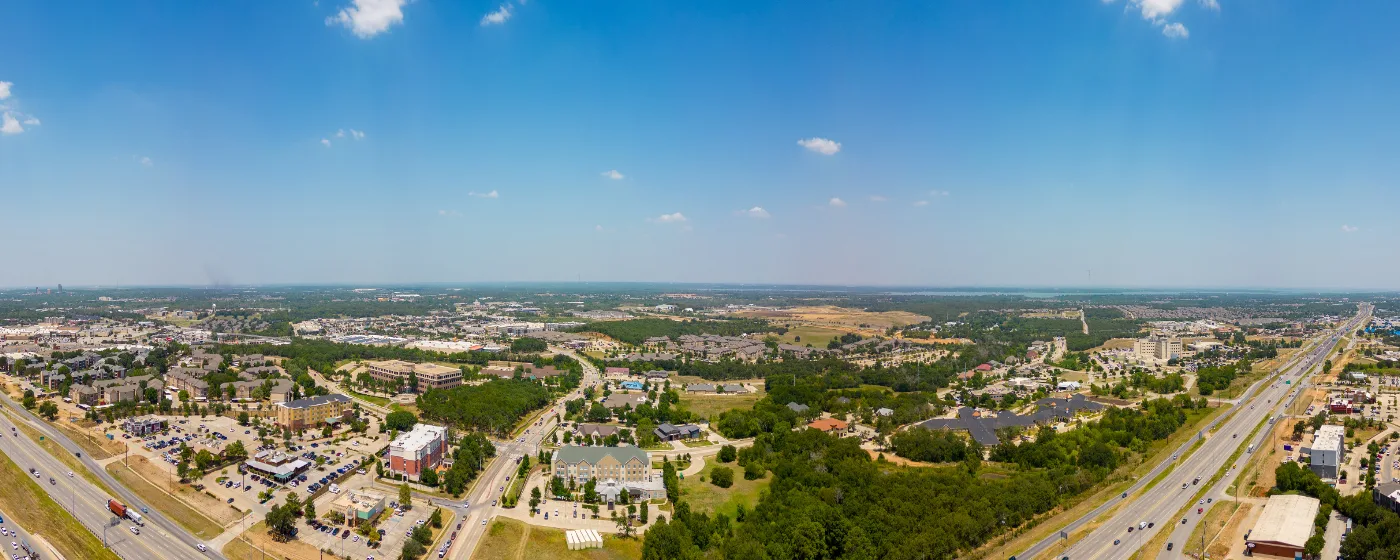
If you're choosing between Denton and somewhere deeper in the Dallas-Fort Worth Metroplex, the decision usually comes down to one real trade-off: you get more house, a genuine arts scene, and a city with its own identity — but you are sitting at the northern edge of the metro, and that distance from the employment cores of Dallas and Fort Worth shapes everything from your morning drive to where your kids' friends' parents work. Denton is the 19th-largest incorporated city in Texas, home to 169,431 people, and growing faster than it can comfortably absorb. I-35 splits into I-35E and I-35W right here — a geographic fact that makes Denton a crossroads rather than a suburb, and that split is the skeleton the whole city is built around.
Two universities — the University of North Texas and Texas Woman's University — define the economic and cultural spine of Denton in a way that is hard to overstate. Together they draw tens of thousands of students and sustain a live-music culture, independent-business density, and street-level energy that most cities this size simply don't have. The Denton Independent School District 33,177 students enrolled in 2025-26 and holds a B rating, according to the Texas Education Agency. The largest employers are Denton ISD itself, the City of Denton, UNT, Texas Woman's University, Peterbilt Motors Company (truck manufacturing, headquartered here since 1993), and a major regional health system. The university presence keeps the average resident age at 32.4 — well below the national average.
The typical home price in Denton sits at $350,224 (Zillow Home Value Index, July 2026), which puts it meaningfully below what buyers pay in Corinth or Flower Mound to the south. The median household income is $76,019, and it runs below what's needed to comfortably carry the typical home here — something worth factoring into your budget before you fall in love with a listing. The city has no state income tax, Texas's effective property tax rate applies at roughly 1.73% here, and the city-wide typical rent runs $1,533 per month. For outdoor access, Denton punches well above its weight: Clear Creek Natural Heritage Center puts 2,900 acres of free trails inside city limits, and Ray Roberts Lake State Park is right in Denton County and draws crowds from across the region year-round.
Whether you're being relocated here for work, pricing yourself out of the mid-cities, or drawn by the university town energy, the sections below break down Denton's neighborhoods, housing market, commute reality, schools, local favorites, and what daily life here actually feels like.
Denton at a Glance
Looking to buy in Denton? Estimate your payment.
Enter your numbers to see an estimated monthly mortgage payment.
Estimate only. Excludes HOA fees and mortgage insurance. The interest rate above is a starting point, not a quoted rate — replace it with your own to see real numbers. Insurance is a flat placeholder, not a Denton quote.
Why Are People Moving to Denton?
Denton County has seen sustained population growth over the past several years, and Denton sits at the center of that pressure. People arrive from three directions: priced-out buyers from Frisco and Plano, remote workers who can live anywhere in the metro and are chasing square footage and character, and university-tied families who came for school and decided to stay.
The University Effect
UNT and Texas Woman's University don't just employ people — they fundamentally shape who lives here and what the city values. More than 1,500 music majors cycle through UNT's College of Music alone, which is why Denton was certified Music-Friendly by the Texas Music Office and why a live show is genuinely available almost any night of the week. That's not marketing copy; it's a structural fact about the city's workforce and culture.
The young demographic skew is real: roughly 52% of Denton residents are Millennials or Gen Z, compared to 46% nationally. That translates into independent coffee culture, arts programming, and a downtown that feels genuinely occupied rather than staged for a weekend.
The Growth Pipeline
The Landmark by Hillwood master-planned development — a 3,200-acre project with 1,100 acres committed to parks, trails, and preserved Cross Timbers Forest — is planned to add 6,200 single-family homes and three Denton ISD schools. That's a meaningful signal about where new construction is heading and what the northwest side of the city will look like in five to ten years.
The economy has historically leaned on education, healthcare, and manufacturing. City leaders are actively working to attract higher-wage corporate and financial employers, and recent investments in high-speed computing infrastructure point toward that diversification. For now, the honest picture is that many residents commute south — see the full employer breakdown — and remote work accounts for a significant share of the professional class here.
What Brings Families, Specifically
Parents with school-age children often cite the combination of Denton ISD's rating, the relative affordability versus Southlake or Flower Mound, and the city's size — large enough to have real amenities, small enough that you're not gridlocked every time you need to run an errand. The Denton Community Market and the city's parks system give family life a texture that feels rooted rather than transactional. For a full look at Denton ISD schools and boundary details, that page goes deep.
Crime context matters too: Denton reports a violent crime rate of 2 per 1,000 residents and a property crime rate of 19 per 1,000 residents — both below Texas state averages of 4 per 1,000 and 20.7 per 1,000 respectively, and the violent rate sits below the national figure of 3.7 per 1,000. The safety page breaks that down by area.
What Daily Life Feels Like in Denton
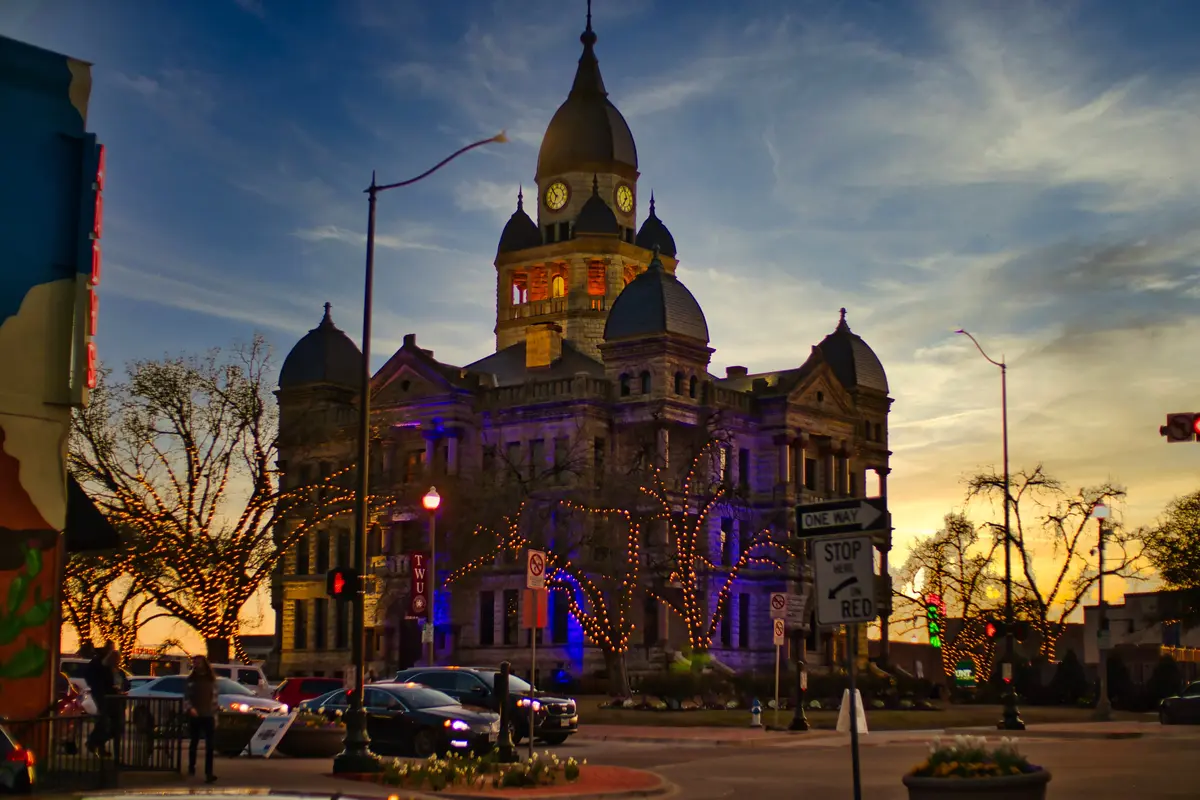
Six months after moving to Denton, most people say the same thing: they expected a college town, and they got one — but the college town turned out to have a lot more going on than they anticipated. The Historic Denton County Courthouse-on-the-Square, built in 1896, anchors a downtown that's genuinely walkable within a few blocks and genuinely weird in the best sense — dozens of public murals cover the surrounding historic buildings, and a long-vacant theater on the square is being revived for concerts and events.
The Downtown Reality
Downtown Denton works on foot once you're in it. The square draws a mix of students, longtime residents, and newcomers on any given evening, and the density of independent businesses is real rather than curated. What it is not: a place you can live car-free in the broader sense. Most neighborhoods require a drive for groceries, school pickup, and the kinds of errands that define a week.
The Music and Arts Calendar
The Denton Arts & Jazz Festival at Quakertown Park near the historic square has run since 1981, is free and multi-stage, and fills the park to capacity each fall — it's the kind of event that makes people who were already considering Denton go ahead and make an offer. Beyond that, Paste Magazine has recognized Denton's music scene nationally — and with the UNT College of Music feeding the local ecosystem, the live-music calendar fills itself.
Upward of 50 annual festivals and events means something is almost always happening, which matters if you're moving from a city where you relied on that kind of programming to feel connected to where you live.
What Newcomers Don't Expect
The summer heat in Denton is genuinely intense, and it lasts longer than the calendar suggests — the stretch from late May through early October can feel relentless, and the city only averages 228 sunny days a year, which means the heat isn't always accompanied by the wide-open blue skies people imagine. Most outdoor activity migrates to early mornings or evenings from June through September. Families who move from moderate climates typically need a full summer to recalibrate their expectations about what "going outside" means here.
The other thing people underestimate: Denton's size. At 169,431 residents, it's a real city with real traffic, real development pressure, and real infrastructure challenges — not a quiet college town where everything is ten minutes away. I-35 through the city can back up significantly during rush hour, and Loop 288 is the route most residents use to avoid it.
Schools and Kids' Activities
Denton ISD runs active UIL athletics programs, and Friday night football fills the stands at local high schools in a way that is genuinely communal. On 2024-25 state assessments, 39% of students reached math proficiency and 54% reached reading proficiency — numbers that reflect the district's mixed demographic range and are worth weighing against the B rating, according to the Texas Education Agency. For youth sports, recreation programs, and boundary-level school details, the schools page has the full picture.
The Denton Housing Market Right Now
The typical home price in Denton is $350,224 (Zillow Home Value Index, July 2026). That figure puts Denton noticeably below Flower Mound and Corinth to the south, and it reflects a market where the entry point is meaningful but the median household income of $76,019 runs below what's needed to comfortably carry the typical home here. That gap is one of the most important things to understand before you start shopping.
The city-wide typical rent of $1,533 per month gives renters a reasonable foothold while saving for a down payment. For a full breakdown of what renting versus buying looks like across the city, the cost-of-living page has both figures in context.
Where Prices Land by Neighborhood
Robson Ranch, Oakmont, and Southridge all run above the city-wide median — Robson Ranch is Denton's primary 55+ master-planned community and carries a premium reflecting its amenities. Downtown Denton and Preserve at Pecan Creek sit below the median, making them the more accessible entry points for first-time buyers or buyers stretching their budget. The neighborhoods page goes deep on character, geographic feel, and what each area is actually like to live in.
New Construction and the Development Pipeline
The Landmark by Hillwood project is the largest active development story in Denton right now, adding thousands of single-family homes on the city's edge with preserved green space woven in. Rayzor Ranch Town Center anchors another growth corridor. The City of Denton amended its Development Code in October 2024 to add nine incentives for residential projects that include affordable housing — a sign that the city is aware of the affordability pressure and trying to address it structurally, though the impact on the overall market will take years to register.
Some areas of Denton are seeing significant new construction activity, while established neighborhoods closer to the square hold their character at a higher price per square foot. Well-priced homes in desirable areas tend to move without sitting long, particularly those zoned to schools families are actively seeking.
Denton Neighborhoods
Denton has several distinct areas — each with its own character and appeal. Here’s a breakdown to help you narrow down where to focus your home search.
🏡 Downtown Denton
The historic square and the streets surrounding the 1896 courthouse define this neighborhood — it's where Denton's independent businesses, live-music venues, and public murals concentrate. Buyers here trade square footage for walkability and genuine neighborhood energy, and prices sit below the city-wide median.
🏠 Robson Ranch
Denton's primary 55+ master-planned community, Robson Ranch delivers a full suite of active-adult amenities and a large, established resident base. Prices run above the city median, reflecting the community's amenity level and dedicated age-restricted status.
🌳 Oakmont
Oakmont is an established single-family neighborhood with a mix of longtime residents and families drawn by its relative proximity to Denton's major employers and schools. Prices here run above the city median, consistent with its appeal to buyers looking for a settled, residential feel.
🏘 Southridge
Southridge offers newer construction in a quieter residential setting on Denton's south side, with pricing that runs above the city median. Parents with school-age children are drawn to the neighborhood's suburban character and access to Denton ISD campuses.
🏔 Preserve at Pecan Creek
One of Denton's more accessible entry points, Preserve at Pecan Creek sits below the city median and draws first-time buyers and value-conscious buyers who want a conventional single-family neighborhood without a premium price. The Pecan Creek greenway corridor runs nearby.
🌆 Villages of Carmel
Villages of Carmel is a master-planned community with a mix of housing sizes and styles, oriented toward families and buyers who want a structured neighborhood with HOA-maintained common areas. It sits on Denton's south side with reasonable access to I-35.
Pros & Cons of Living in Denton
The Pros
- Home to two major universities, giving the city a youthful, energetic vibe
- More affordable housing than many inner DFW suburbs
- A nationally known live-music and arts scene centered on the historic downtown square
- Still within commuting range of the broader DFW job market
The Cons
- Property crime runs above the national average, concentrated near the university core
- I-35 corridor traffic and congestion are worsening with rapid growth
- Property tax bills are high relative to home values due to overlapping city, county, and school district levies
Getting Around & Commuting in Denton
Denton's geography is shaped by I-35 splitting into I-35E and I-35W at the southern edge of the city — one of the few places in Texas where this happens. That split matters practically: I-35E carries traffic toward Dallas, and I-35W angles toward Fort Worth and its suburbs. Most commuters choose their route based on where they're headed in the metro, and buyers actively think about which side of Denton positions them better for their specific office location.
The Drive to Dallas
The commute to Dallas runs about 45 minutes under normal conditions — that qualifier matters, because I-35 through southern Denton and into Lewisville backs up consistently during morning rush hour, and the real-world number can stretch significantly on bad days. Buyers who commute daily to downtown Dallas or the Uptown corridor should test the drive at 7:30 a.m. before making an offer, not just on a Saturday afternoon.
Loop 288 is the route most Denton residents use to move around the city itself without touching I-35. US-380 (University Drive) is the main east-west corridor and carries a heavy load during peak hours near the university district.
The A-Train Option
The Denton County Transportation Authority operates the A-train, a 21-mile commuter rail line that connects Denton to the DART Green Line at Trinity Mills Station in Carrollton. From there, riders can access the broader Dallas rail network. DCTA also runs local Connect bus service, GoZone on-demand rideshare within defined zones, and the North Texas Xpress commuter bus toward Fort Worth. The system sees consistent ridership, reflecting real use rather than theoretical availability.
For riders whose Dallas or Fort Worth destination is accessible from the Green Line, the A-train removes the daily stress of I-35 entirely. It's underused by people who discover it six months after moving here and realize they'd been sitting in traffic unnecessarily.
Airport Access
Dallas/Fort Worth International Airport is 27 miles from Denton — a drive that varies from 30 minutes off-peak to over an hour during rush hour given the I-35 approach. For frequent flyers, proximity to DFW is one of Denton's genuine advantages over cities that sit farther from a major hub.
Who Denton Suits, Commute-Wise
| Buyer Type | Commute Fit | Best For |
|---|---|---|
| Remote workers | Ideal — no daily commute dependency | Value Walkable |
| Dallas CBD commuters | Workable via A-train or I-35E; plan for 45+ minutes | Commuter |
| Fort Worth commuters | I-35W or North Texas Xpress bus; 30–45 minutes typical | Commuter |
| UNT / TWU employees | Excellent — live and work in the same city | Walkable First-Time |
| Denton ISD / City employees | Short local drive; minimal commute stress | Families Value |
| DFW-area hybrid workers | Good — flexibility makes the distance manageable | Families Tech |
The honest version: Denton works exceptionally well for people who work inside the city or work remotely. It works acceptably for people who commute to Dallas a few days a week. It works poorly as a daily long-haul commute to the Dallas CBD or Uptown if you're driving five days a week and starting before 7 a.m.
Schools in Denton
Families relocating to Denton have public, private, and higher-education options nearby. Here’s a quick overview.
🎓 School District
Denton Independent School District serves K–12 students across Denton and the surrounding area. Rated B (source: Texas Education Agency, 2025 A-F accountability rating (2024-25 school year)).
🏆 Graduation Rate
The 4-year high-school graduation rate here is approximately 97.4%.
📚 Higher Education
Texas’s public universities — the University of Texas at Austin, Texas A&M University, and the University of Houston — offer four-year degrees statewide, with one of the largest community college systems in the country (50+ public community college districts) providing two-year and workforce programs.
🌐 Online Learning
UT Austin Online and Texas A&M University Online offer fully accredited online degrees for remote learners across the state.
Safety in Denton
A quick look at how Denton compares on the numbers that matter most when weighing a neighborhood or a move.
🛡 Violent Crime
Approximately 2 per 1,000 residents.
🔒 Property Crime
Approximately 19 per 1,000 residents.
Compared to the most recent national figures from the Bureau of Justice Statistics (2024), Denton’s violent crime is below the national average (about 3.7 per 1,000), and property crime is about the same as the national average (about 18.4 per 1,000).
Against Texas as a whole, Denton’s violent crime is roughly half the state average, and property crime is about the same as the state average (Bureau of Justice Statistics, Crime Known to Law Enforcement, 2024 (tables 2 and 3)).
Crime rates can vary a lot within a single city, so the citywide numbers above are only a starting point. Some neighborhoods in Denton run well below these averages, while others run higher — the kind of block-by-block detail that matters most when you’re actually choosing where to live. The full guide below breaks it down neighborhood by neighborhood.
Working in Denton
Denton’s largest employers span several industries — here are some of the anchors of the local job market.
🎓 Denton Independent School District
Education
🏛 City of Denton
Municipal government
🎓 University of North Texas
Higher education
🎓 Texas Woman's University
Higher education
🏭 Peterbilt Motors Company
Manufacturing
🏥 Medical City Denton
Healthcare
Retiring in Denton
Denton draws retirees for its balance of amenities, outdoor access, and cost. Here’s what to weigh.
🌤 Climate
Denton gets 228 sunny days a year, with mild winters and hot, extended summers that run from late May well into October. Spring and fall are the standout seasons — warm, dry, and well-suited to the outdoor and festival calendar. Ice storms are rare but do occur in winter and tend to shut the city down when they do.
🍴 Lifestyle
The historic square and its surrounding independent restaurants and coffee shops give Denton a cultural density unusual for a city its size. The Denton Arts & Jazz Festival, a weekly farmers market, and the Clear Creek Natural Heritage Center's trail system provide year-round programming. For retirees who want a city that moves at its own pace but still has genuine arts and dining, Denton fits that profile.
🏚 55+ Communities
Robson Ranch is Denton's established 55+ master-planned community, offering a full amenity set and a large active-adult population. It runs above the city-wide typical home price and represents the most developed age-restricted option within city limits. For more detail on retiring in Denton, the retiring page covers healthcare access, lifestyle fit, and community options in full.
✈ Getting Around
Most daily errands in Denton require a car, and the city's size means driving is part of the routine. The A-train offers a rail link toward Dallas for those who want it. Dallas/Fort Worth International Airport is 27 miles away — a meaningful convenience for retirees who travel frequently to see family.
🏛 Texas Taxes for Retirees — What to Know
- No state income tax — Texas has no personal income tax — constitutionally protected under Article VIII, Section 24. Social Security, pensions, 401(k)/IRA withdrawals, and annuity payments are all untaxed at the state level, with no state return to file.
- Sales tax is the tradeoff — The state sales tax is 6.25%, and local add-ons bring the combined rate in Denton to 8.25% (Texas Comptroller of Public Accounts, city sales and use tax rates, July 2026). Groceries and prescription drugs are exempt.
- Property taxes — the real tradeoff — Texas’s effective property tax rate averages about 1.40%, among the highest in the country, since property tax (not income tax) funds most local government and schools.
- Over-65 homestead exemption and school-tax freeze — Homeowners 65+ (or disabled) get an additional $60,000 exemption from their home’s value for school district taxes, on top of the general homestead exemption — $200,000 off school taxable value combined, following November 2025’s Proposition 11 (SB 23), which raised the over-65 exemption to $60,000, and Proposition 13 (SB 4), which raised the general homestead exemption to $140,000. Once claimed, your school district tax bill is frozen at that year’s amount and cannot increase as home values rise, and the ceiling can transfer if you move to a new home within Texas.
- Deferral option if cash is tight — Homeowners 65+ can defer property tax payment entirely for as long as they live in the home, rather than paying it currently — interest accrues, but no forced sale.
- No estate or inheritance tax — Texas has no estate tax, no inheritance tax, and no gift tax.
- No separate capital gains tax — Because Texas has no state income tax, capital gains — including on investments and home sales — are not taxed at the state level at all, unlike states such as Washington that tax capital gains separately from income.
Tax laws change frequently and individual situations vary. This is general information, not tax advice — always consult a qualified Texas tax professional or CPA for personalized retirement tax planning.
Weekends & Local Favorites in Denton
Denton's weekend identity runs through the square, the trails, and the lakes — and through a music scene that generates real energy on a Tuesday night, not just during festivals. The city has enough critical mass of independent businesses and outdoor access that you rarely feel the need to drive an hour for a good weekend.
Food, Coffee, and Gathering Spots
LSA Burger Co. is the local burger anchor — straightforward, well-executed, and perpetually busy. Seven Mile Cafe draws the brunch crowd and the laptop-open crowd in equal measure, and Froth Coffee & Dessert Bar Denton adds a dessert-forward coffee stop to the mix. Jupiter House and West Oak Coffee Bar are the coffeehouses most associated with the downtown square scene — Jupiter House in particular has become a landmark for anyone spending time near the courthouse. Zera Coffee & Events and Aura Coffee round out a coffee landscape that punches well above typical for a city this size.
For sit-down meals, Oldwest Cafe Of Denton delivers a no-frills Texas breakfast and lunch, Cartwright's Ranch House leans into the Texas steakhouse tradition, and Rooster's Roadhouse carries the honky-tonk energy that Denton does better than most cities in the metro. Taken together, the dining and coffee scene reflects the city's independent-business streak — most of the places people actually talk about are locally owned.
Outdoor Life
Clear Creek Natural Heritage Center is the city's most underused asset — a roughly 2,900-acre preserve inside city limits with over 10 miles of free trails at the confluence of Clear Creek and the Elm Fork of the Trinity River. Free seasonal environmental workshops make it a regular destination for families with kids, not just hikers. North Lakes Park and South Lakes Park serve as the neighborhood-level gathering spots, and Lake Lewisville is accessible enough for a half-day on the water without a serious drive.
Ray Roberts Lake State Park, in Denton County, draws crowds from across the region year-round for its hiking, biking, equestrian, fishing, and camping facilities. The 20-mile Greenbelt Corridor trail alone makes it worth keeping a trail map in the car. On a fall weekend, the park fills early.
Markets and Community Anchors
The Denton Community Market and a rotating Farmer's Market give the city the kind of weekly rhythm that makes a place feel like a community rather than a subdivision. The Denton Arts & Jazz Festival at Quakertown Park — free, multi-stage, running since 1981 — is the single event most residents point to when asked why they love this city. The park fills to capacity each fall, and if you're visiting Denton to scout it as a place to live, timing your trip around the festival is not a bad idea.
Rayzor Ranch Town Center gives the city a more conventional retail node for the days when you need to run multiple errands in one trip, and Golden Triangle Mall remains the closest thing Denton has to a traditional regional mall. A serious shopping run beyond what's available locally means driving, but most day-to-day needs are covered without leaving the city.
Local favorites in Denton
Restaurants
- LSA Burger Co.
- Seven Mile Cafe
- Oldwest Cafe Of Denton
- Cartwright's Ranch House
- Rooster's Roadhouse
Outdoors
- Clear Creek Natural Heritage Center
- North Lakes Park
- South Lakes Park
- Lake Lewisville
- Ray Roberts Lake State Park
Coffee
- West Oak Coffee Bar
- Jupiter House
- Zera Coffee & Events
- Froth Coffee & Dessert Bar Denton
- Aura Coffee
Farmers Markets
- Denton Community Market
- Farmer's Market
Top Things Locals Say About Denton
The best intel about a city comes from the people who actually live there. Here’s what Denton residents say when newcomers ask the questions everyone’s thinking.
“I knew the commute to Dallas would be a thing, but I figured 45 minutes was fine. What I didn't account for was that 45 minutes turns into 70 minutes on a rainy Tuesday — and once I figured out the A-train, I felt genuinely embarrassed I hadn't used it from the start. Nobody told me that was a real option.”
— Recent Denton home buyer
“What's the most surprising thing about living in Denton?”
How much the city has going on independent of the universities. People assume the whole identity is college-town energy, and then they spend a Saturday on Clear Creek's trails or catch a show near the square on a Wednesday night and realize it's a real city with its own texture. The Denton Arts & Jazz Festival is genuinely one of the best free events in North Texas, and half the people moving here from Plano or Frisco have never heard of it.
“What do locals love most about Denton?”
The square, without question. The Historic Denton County Courthouse anchors a downtown that still has independent businesses, murals everywhere, and a music calendar that keeps it alive through the week — not just on weekends. West Oak Coffee Bar and Jupiter House are the kind of places where you run into neighbors, which sounds like a small thing until you've lived somewhere that doesn't have it.
“What should newcomers to Denton know?”
Learn Loop 288 before you learn anything else. It's how locals move around the city without touching I-35, and it'll save you 15 minutes on most cross-town trips. Also: the summer heat is longer and more serious than most people coming from other parts of Texas expect. Plan your outdoor time for early mornings from June through September and don't fight it. Ray Roberts Lake State Park fills up on fall weekends — go early.
“How much do you need a car in Denton?”
For most errands, you need a car. The downtown square is walkable once you're there, and if you live close to it you can manage a fair amount on foot — but groceries, school pickup, and most of daily life require driving. The A-train is a genuine option for Dallas commuters who live near a station, and GoZone on-demand rideshare covers some gaps for local trips, but Denton is fundamentally a car-centric city outside the downtown core.
Cities Near Denton
Other communities near Denton worth a look — each with its own character and price point.
| City | Distance | Best For | Vibe | Median Rent | Median Buy |
|---|---|---|---|---|---|
| Lewisville | 10 mi | Commuters and established families | Suburban, accessible, well-connected | $1,569 | $392,721 |
| Corinth | 8 mi | Families seeking quiet and good schools | Small, residential, low-traffic | $1,819 | $412,999 |
| Flower Mound | 15 mi | Upscale families and professionals | Polished, planned, higher price point | $2,431 | $610,100 |
More Helpful Guides for Denton
Going deeper on Denton? Our blog series covers everything from first-time buying to retiring here — explore the guides below.
Local Expert Takeaway: Denton's real competitive advantage is that it still has a genuine local identity — the historic square, the music scene, Clear Creek's trails, the Denton Arts & Jazz Festival — at a price point that's meaningfully below what the mid-cities charge. The catch is the commute: I-35 to Dallas is about 45 minutes on a good day, and good days aren't guaranteed. Buyers who work locally or remotely get the best of what this city offers. Buyers who commute daily to the Dallas CBD should budget the time honestly before they fall for the square.
Quick Takeaways & FAQs
✅ Denton's live-music scene is the real thing — certified Music-Friendly by the Texas Music Office and backed by UNT's College of Music, with events nearly every night of the week.
⚠️ The typical home price of $350,224 (July 2026) looks affordable on paper, but the median household income runs below what's needed to comfortably carry it — run the numbers carefully.
📍 The A-train commuter rail connects Denton to the DART Green Line in Carrollton, giving Dallas-bound commuters a real alternative to sitting on I-35 every morning.
Is Denton, TX a good place to raise a family?
How far is Denton from Dallas?
What is the housing market like in Denton, TX?
What is Denton, TX known for?
Is Denton, TX affordable compared to the rest of DFW?
Helpful Links for Moving to Denton
Moving to Texas?
Tell us what you need help with and we'll connect you with local resources.
