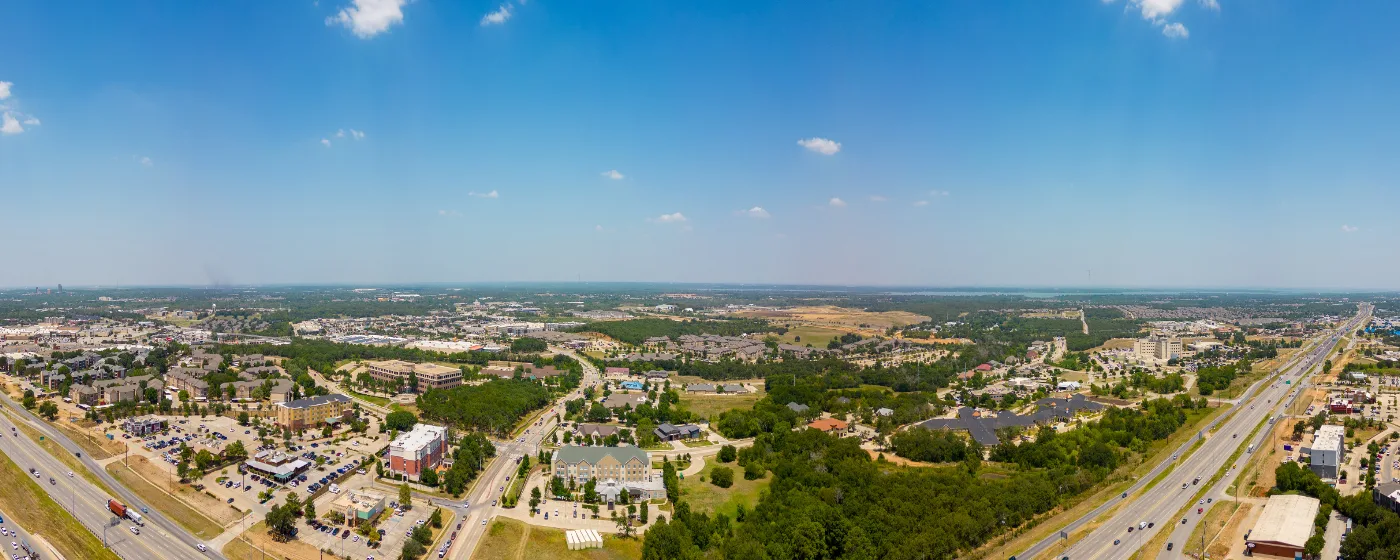
People who ask whether Denton is safe usually get two very different answers depending on who they ask. Talk to a longtime resident in Oakmont or Robson Ranch and the word "safe" sounds almost like an understatement. Talk to someone who spent a year near the university corridor and you'll hear a different story — mostly about car break-ins and package theft. Both people are describing the same city. The data helps explain why.
Denton is a city of 169,431 people anchored by two major universities — the University of North Texas and Texas Woman's University — plus a manufacturing base led by Peterbilt Motors Company and a municipal government that employs thousands. That mix means the city contains everything from quiet planned communities on its outer edges to high-foot-traffic commercial and student zones near its core. Crime patterns follow that geography almost exactly. The Denton Police Department, accredited through the Texas Police Chiefs Association and operating since 1873, takes an intelligence-led, data-driven approach that gives residents unusually good access to crime trend information at the local level.
The headline numbers are reassuring: Denton posts a violent crime rate of 2 per 1,000 residents — roughly half the Texas state average and well below the national figure. Property crime, at a property crime rate of 19 per 1,000 residents, sits close to the state average and slightly above the national figure. For most residents, the practical safety story in Denton is about property crime — and specifically about where in the city you live. The gap between the city's safest and most active zones is meaningful enough to matter in a neighborhood decision.
Whether you're narrowing a list of neighborhoods or trying to understand what daily life actually feels like here, the sections below break down Denton's crime trends, what the numbers mean at the neighborhood level, how the police department operates, and what you can do to research a specific street before deciding where to put down roots.

How Denton's Crime Rates Compare to Texas and the Nation
The comparison table that follows this section lays out the numbers side by side, but the context behind them is worth understanding before you scan the rows.
Denton posts a violent crime rate of 2 per 1,000 residents — well below both the Texas state average of 4 per 1,000 and the national average of 3.7 per 1,000 (Bureau of Justice Statistics, Crime Known to Law Enforcement, 2024). That is not a marginal difference — it is roughly half the state rate. For a city approaching 170,000 people, with two major universities generating consistent student population turnover, that figure is genuinely better than most Texas cities of comparable size.
The a property crime rate of 19 per 1,000 residents is a more complicated story. It sits noticeably below the Texas state figure of 20.7 per 1,000, and modestly above the national figure of 18.4 per 1,000 — essentially in the middle of the pack for American cities. The property crime that drives this number is overwhelmingly larceny-theft: small-value thefts, vehicle break-ins, and package theft dominate the reported offenses list, not burglary or robbery. That matters because the risk profile of petty theft is very different from the risk profile of crimes that put residents in direct danger.
The Trend That Makes the Numbers More Encouraging
Both categories have been moving in the right direction. The Denton Police Department reported that violent crime in 2024 reached its lowest point since 2019 — even as the city absorbed nearly 8,000 new residents during that same period. Property crimes dropped significantly from 2023 to 2024, and mid-2026 department data indicates that trend has continued. A growing city that is simultaneously posting declining crime totals is the combination most residents and prospective buyers want to see.
Fatal traffic incidents also fell sharply in 2024, a decline the department attributed to increased DWI enforcement, expanded traffic patrols, and speed limit reductions on several high-incident corridors. Road safety is often an afterthought in crime discussions, but for families with kids — or for anyone commuting to Dallas, about 45 minutes to Dallas on a typical day — it belongs in the same conversation.
The Geographic Reality: Where Denton Is Safer and Where It Is More Active
Denton's crime picture is not uniform across the city, and treating it as if it were leads to the most common research mistake newcomers make here: averaging out a city that does not average neatly.
The Northeast Advantage
Consistent analysis of Denton's crime geography — using FBI-sourced heat maps and per-capita breakdowns — points to the northeast quadrant as the city's lowest-crime residential zone. Neighborhoods in this part of Denton tend to be newer planned-community developments with less commercial foot traffic, fewer transient populations, and greater distance from the high-activity corridors that concentrate property crime. If minimizing property crime exposure is a primary concern, the northeast is where to look first.
Outer Suburbs and Master-Planned Communities
Oakmont, Southridge, and Robson Ranch consistently rank among Denton's safest neighborhoods in local safety assessments. Robson Ranch carries an additional structural factor: it is a gated 55+ community, which by design limits non-resident vehicle and foot traffic. Oakmont's planned-community layout produces a similar effect — low through-traffic, neighborhood familiarity, and limited commercial intrusion. These aren't just anecdotally safe areas; they show up that way in the underlying data, repeatedly. For more on what these neighborhoods look and feel like as places to live, the best neighborhoods guide goes deeper.
Downtown and the University Corridor
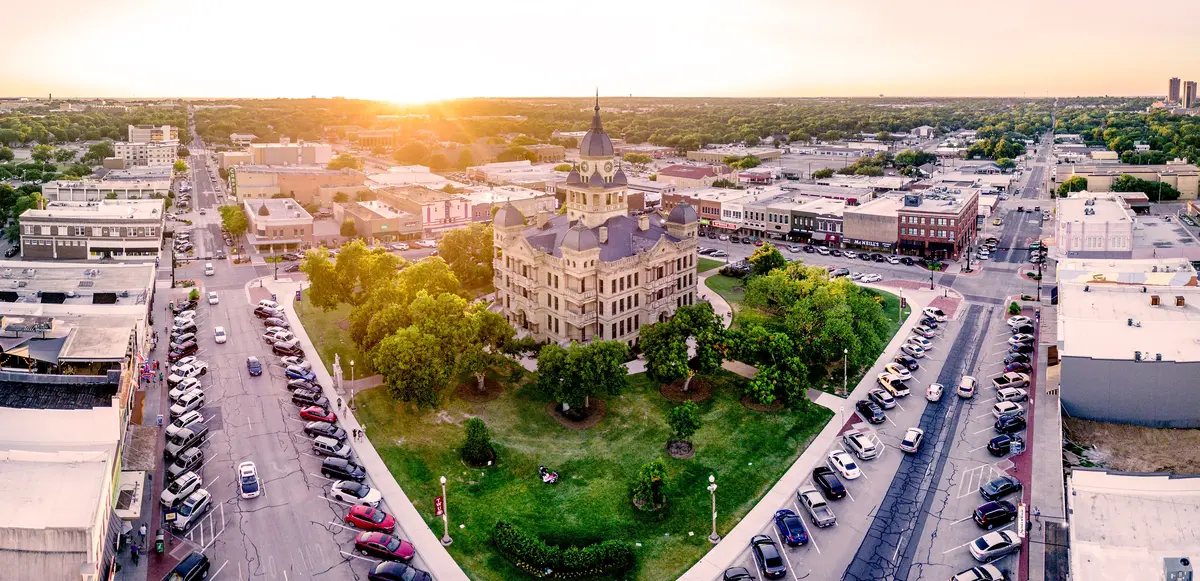
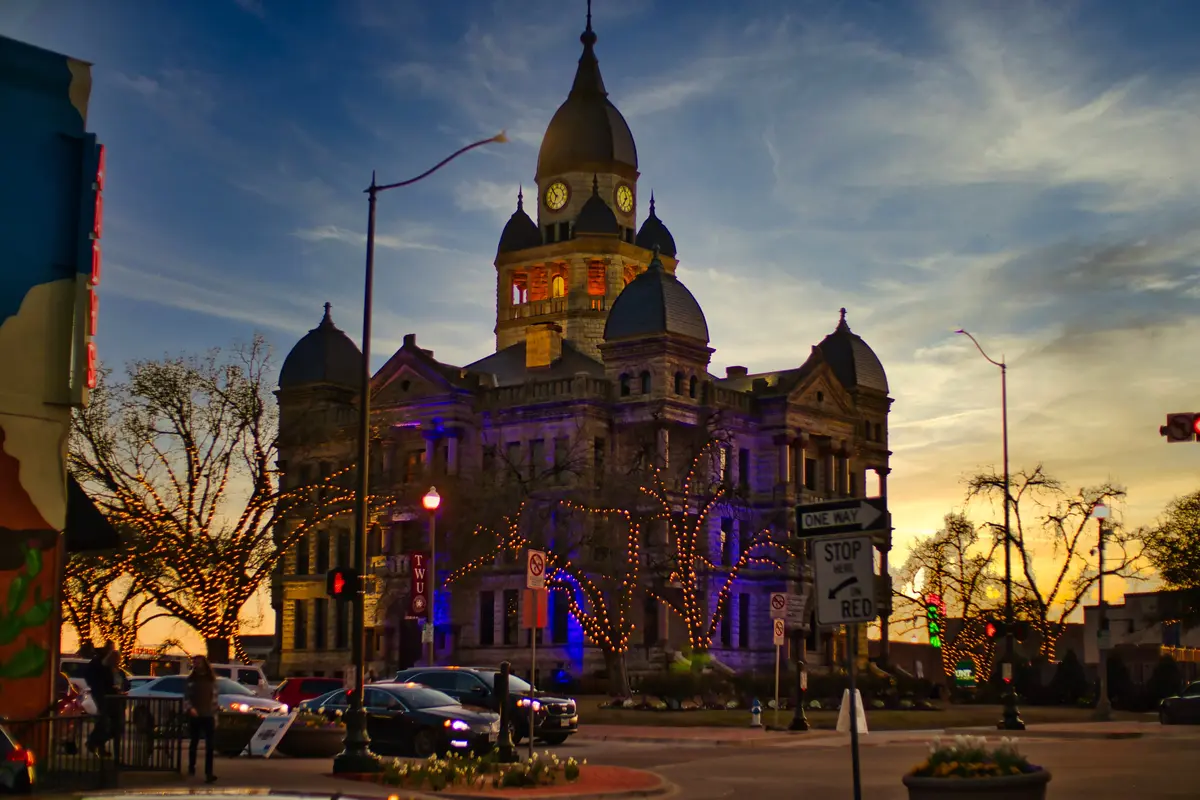
The elevated property crime near Downtown Denton and the zones surrounding the University of North Texas and Texas Woman's University is real — but the reason matters. These areas draw heavy visitor and pedestrian volume. The Historic Denton County Courthouse-on-the-Square, the retail and dining corridors, and the student-dense apartment zones all generate the kind of foot traffic that creates opportunity for opportunistic property crime: unlocked cars, unattended bags, and accessible packages. Analysts consistently note that these figures are driven more by visitor volume than by resident-on-resident crime. Someone who lives downtown and locks their car is navigating a different risk environment than the raw heat map suggests.
Rayzor Ranch and Villages of Carmel sit in Denton's growing commercial and residential mix. As newer development areas, they have less historical crime data, but their planned-community character and distance from the highest-activity core corridors place them closer to the outer-suburban end of the spectrum than to the downtown end.
What Locals Actually Report
On community platforms, Denton residents most commonly report vehicle break-ins and package theft — not violent incidents. The overwhelming consensus from people who live here is that Denton feels safe as a daily experience, with property-crime vigilance (locking vehicles, securing packages) being the primary practical adjustment newcomers learn to make.
Property Crime: The Real Day-to-Day Safety Story
Most people who move to Denton and later mention a safety concern are talking about property crime. Not always a crime that happened to them — often something that happened to a neighbor, or something they noticed on the neighborhood app. It is worth being direct about what that concern actually involves.
What Gets Stolen and Where
Larceny-theft is the single largest category of reported crime in Denton, and it has been for years. Within that category, vehicle break-ins and package theft are the most commonly discussed offenses on community platforms. These crimes cluster near commercial corridors, apartment complexes with high unit turnover, and areas close to the universities — all environments where large numbers of people move through spaces that are semi-public and difficult to monitor continuously.
The practical implication: the same neighborhood research that tells you about school access or park proximity should include a look at the specific block's crime history, not just the city-wide rate. A street in northeast Denton and a street adjacent to a university parking structure are in the same city but a different risk category.
One Honest Friction Point
New residents are often surprised by how quickly package theft becomes a topic in Denton's neighborhood groups. It is not unique to this city — it is a nationwide pattern — but Denton's combination of dense apartment living near the universities and active commercial corridors makes it more visible here than in quieter suburban markets. The practical response most long-timers have landed on: a video doorbell, a lockable mailbox or package locker, and delivery instructions that send packages to a secure location. None of these are dramatic measures, but they are the adjustments that matter most in Denton's specific property-crime environment.
Burglary numbers — actual forced or unlawful entry into a residence — are a much smaller share of the total and have been declining. The property crime concern in Denton is overwhelmingly about opportunistic theft in semi-public spaces, not home invasion.
Looking to buy in Denton? Estimate your payment.
Enter your numbers to see an estimated monthly mortgage payment.
Estimate only. Excludes HOA fees and mortgage insurance. The interest rate above is a starting point, not a quoted rate — replace it with your own to see real numbers. Insurance is a flat placeholder, not a Denton quote.
The Denton Police Department: How It Operates
The department that patrols this city is not a generic municipal police force. The Denton Police Department holds accreditation through the Texas Police Chiefs Association (TPCA) Texas Law Enforcement Accreditation Program — a distinction that means it meets or exceeds more than 170 defined best practices for Texas law enforcement. Accreditation is voluntary and requires ongoing compliance review, so it carries more weight than a simple staffing count.
A Data-Driven, Relational Model
The department operates as an intelligence-led, data-driven organization — it tracks crime patterns at a granular level and deploys resources accordingly, rather than responding reactively. That approach helps explain why declining crime totals in 2024 coincided with a period of significant population growth: the department was proactively targeting the corridors and offense types driving the numbers, not simply absorbing whatever came in.
The department also runs a Citizen Police Academy, open to any Denton resident, that walks participants through department operations and gives them direct access to officers. Graduates can join the Volunteers in Police Service program. These are not ceremonial offerings — they reflect a department that has structured genuine civilian engagement into its operating model, including the annual Denton 360 program that offers behind-the-scenes access to 911 dispatch and the department's drone team. For residents who care about police transparency, both programs are worth knowing about.
Recent Investments
The city's fiscal year 2025 budget funded the revival of the department's K-9 unit — two dogs for tracking and apprehension — and 11 sets of virtual reality training equipment for officer scenario training. These are operational investments in a department that is actively growing its capabilities alongside the city's population.
Traffic enforcement got its own focused push as well. The 50% reduction in fatal traffic crashes in 2024 was directly attributed to increased DWI enforcement and reduced speed limits on corridors the department had identified as high-risk. That is the kind of targeted, data-backed intervention that produces measurable results rather than just statistical noise.
How to Research Safety Before Choosing a Neighborhood
City-wide crime rates are the starting point, not the conclusion. Denton's overall numbers are favorable — but where within Denton you look matters more than the city average for anyone deciding between specific neighborhoods.
Use the Right Tools
CrimeGrade.org draws on FBI-sourced data and provides a neighborhood-level breakdown that maps meaningfully to Denton's geography. AreaVibes and CrimeoMeter pull from the same 2024 FBI release and offer different visual formats for the same underlying data. All three are useful for directional research — understanding which parts of the city trend quieter versus more active — but none of them replace a direct look at incident reports for a specific address.
The Denton Police Department publishes crime data and provides community-level access through its engagement programs. If you are researching a particular street or subdivision, looking at reported incidents within a defined radius over the past six to twelve months gives you a much more useful picture than any zip-code-level average.
What to Actually Look For
In Denton's context, the questions worth asking about a specific neighborhood are: How close is it to a high-traffic commercial corridor? Does the surrounding land use generate significant foot traffic from non-residents? Is the residential street a through-route or a cul-de-sac-style dead end? Is there consistent resident presence through the day, or does the block empty out during work hours? These factors are better predictors of property crime exposure than a neighborhood's distance from downtown in miles.
Outer-suburban neighborhoods like Oakmont and Southridge, and master-planned areas like the Preserve at Pecan Creek and Tuscan Hills, score well on most of these questions — low through-traffic, stable resident populations, and limited proximity to commercial crime generators. For a fuller picture of how these neighborhoods compare as places to live, the neighborhoods guide covers character, housing stock, and who each area tends to suit best.
The Honest Bottom Line
Denton is among the safer Texas cities of its size, and the trend in both crime categories is moving the right direction. The city is not uniform — downtown and university-adjacent zones carry elevated property crime that the outer suburbs do not — and that geographic variation is the most important safety fact for anyone deciding where in Denton to live. Lock your car, secure your packages, and put your address search in the right part of the city, and Denton's safety profile looks quite good for a North Texas city of nearly 170,000 people.
Local Expert Takeaway: Denton posts a violent crime rate of 2 per 1,000 residents — roughly half the Texas state average — and that headline is accurate and worth knowing. But the more useful local insight is this: Denton's safety story is almost entirely a property-crime story, and property crime in this city is concentrated near the universities, downtown, and commercial corridors where foot traffic is high. Residents in Oakmont, Southridge, Robson Ranch, and the newer northeastern neighborhoods consistently report a quieter, lower-incident experience. If you're researching a specific address, pull a six-month incident radius on CrimeGrade or AreaVibes, look at the surrounding land use, and check whether the street itself generates any meaningful through-traffic. That research takes thirty minutes and tells you more than the city-wide average ever could.
Quick Takeaways & FAQs
✅ Denton posts a violent crime rate of 2 per 1,000 residents — roughly half the Texas state average — a genuine strength for a city this size.
⚠️ Property crime near the university corridor and downtown is real and mostly takes the form of vehicle break-ins and package theft — not the kind that disappears from a city-wide average.
📍 The northeast quadrant and outer master-planned communities like Oakmont and Robson Ranch consistently post the city's lowest crime figures — neighborhood location matters more here than the city average.
Is Denton, TX a safe place to live?
Which Denton neighborhoods are the safest?
Is property crime a problem in Denton?
How does Denton's crime rate compare to other DFW cities?
What is the Denton Police Department doing about crime?
Moving to Texas?
Tell us what you need help with and we'll connect you with local resources.
