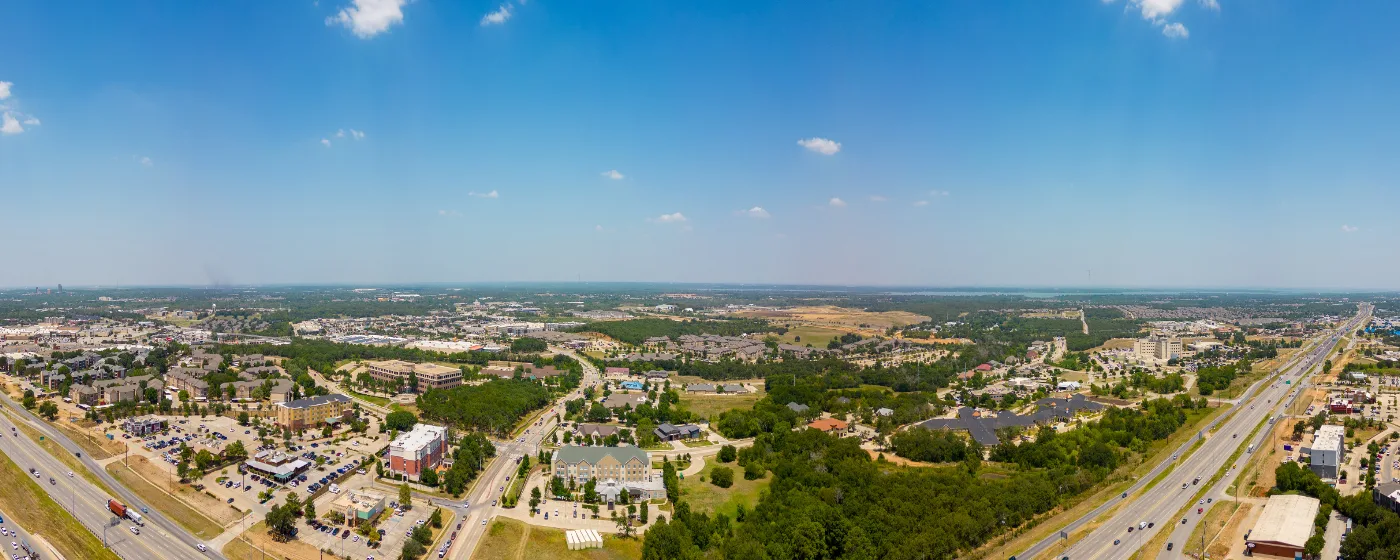
Here is the honest case for Denton: a SmartAsset study placed it as the most affordable major city in the Dallas–Fort Worth area, with overall costs running 3.9% below the national average. That headline number reflects a genuinely different price environment from what you find in Frisco, Flower Mound, or the closer-in Dallas suburbs. The city of 169,431 sits at the convergence of I-35E and I-35W — the two branches of the interstate that split here and carry commuters south toward Dallas and Fort Worth — which means you get DFW access without paying DFW prices on the things you buy every day.
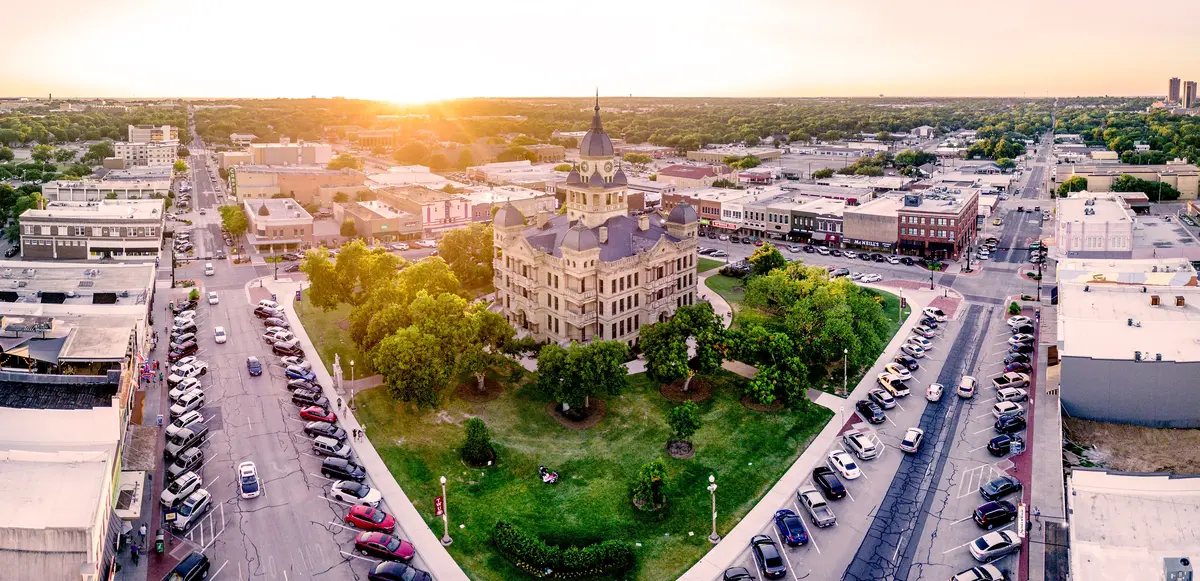
The economic backbone is rooted in education. The University of North Texas and Texas Woman's University together employ thousands and drive much of the rental market, the restaurant scene, and the cultural calendar centered on the Historic Denton County Courthouse-on-the-Square. Peterbilt Motors Company adds a manufacturing anchor, and the Denton Independent School District is itself one of the city's largest employers. That university-and-institution base keeps Denton's economy more diversified than a typical bedroom suburb, which matters when you're budgeting around job stability rather than just home prices.
Transportation costs run noticeably below the national average, groceries are slightly below it, and utilities — managed through the city's own municipal electric utility — come in roughly 10% below comparable national costs. The catch is property taxes: Texas funds its public schools heavily through local property levies, and Denton's effective rate is a real line item in any honest budget. No state income tax offsets some of that, but not all of it, and buyers coming from low-tax states need to run the full math before assuming Texas is always cheaper.
Whether you're weighing a first home, a rental while you feel out the area, or a comparison against Lewisville or Corinth to the south, the sections below break down Denton's housing market, everyday expenses, how it stacks up against nearby cities, and what the tax picture actually looks like for a household settling here.

What It Really Costs to Live in Denton
Denton's overall affordability story holds up when you look at the components. Groceries run slightly below the national average — and Texas exempts them from sales tax entirely, which compounds that advantage over time. Transportation costs come in roughly 12.6% below the national norm, a function of lower insurance rates, less urban congestion than core Dallas, and fuel costs that track closer to mid-size Texas city averages than to a dense metro. Utilities land about 10% below the national average, helped by the city-run Denton Municipal Electric, which keeps residential rates more stable than the deregulated Texas electricity market that most of the state navigates.
The honest caveat is housing cost relative to local income. The typical home price in Denton sits at $350,224 (Zillow Home Value Index, July 2026), and the median household income of $76,019 falls meaningfully short of what a standard mortgage on that price requires. That gap is real, and it's larger than it looks on paper once you add the effective property tax rate. Denton is affordable compared to Frisco, Plano, or Flower Mound — but it is not cheap relative to what the typical Denton household earns, and buyers should budget with that tension in mind.
Compared to the broader DFW metro, Denton remains a relative value. The question isn't whether it's cheaper than the Metroplex's pricier suburbs — it is — but whether the math works for your specific income, down payment, and lifestyle. For renters especially, the numbers are more forgiving, and the university economy keeps the rental supply healthier here than in many comparably sized Texas cities.
Housing: Rent vs Buy in Denton
The typical home price in Denton is $350,224 (Zillow Home Value Index, July 2026). Entry-level buyers can find older construction and smaller footprints below that figure — particularly in parts of the city that were developed before the university-area boom — while newer subdivisions and established master-planned neighborhoods push well above it. For specifics on which neighborhoods run above or below the city median, the best neighborhoods guide breaks that down in detail.
The effective property tax rate in Denton is approximately 1.73%. On a home at the typical price point, that rate is the single largest recurring cost a buyer takes on beyond the mortgage itself — and it's the number that most often surprises buyers relocating from states where property taxes are lower or where a state income tax exists to spread the public-services burden differently. Budget for it explicitly; don't let it be an afterthought after you've sized your mortgage.
Renting makes financial sense in Denton for anyone still building a down payment, anyone uncertain about a multi-year commitment, or anyone who wants to live near the university core before deciding which part of the city suits them. The city-wide typical rent is $1,533 per month (Zillow ZORI, July 2026), which is noticeably below the broader DFW and Texas averages. That gap gives renters in Denton real breathing room that you simply don't find in Flower Mound or Corinth at the same distance from the highway.
Buying, by contrast, makes the most sense for households who can absorb the property tax load and plan to stay long enough for the math to work. The income gap between what Denton households typically earn and what the typical home requires is real — but it is bridgeable for dual-income households, buyers with equity from a previous sale, or anyone coming from a pricier market. For first-time buyer programs and down payment options specific to Denton, the first-time homebuyer page covers those in detail.
Everyday Costs Beyond Housing in Denton
| Category | Typical Monthly Cost | Notes |
|---|---|---|
| Housing (typical rent) | $1,533/mo | City-wide typical rent. Buying? Use the calculator above for a mortgage estimate. |
| Utilities | $200–$290/mo | Electricity, gas, water, sewer, trash |
| Groceries | $520–$720/mo | Food at home, household of 2–3 |
| Transportation & Gas | $160–$300/mo | Fuel, and transit where it is a real option |
| Phone & Internet | $110–$185/mo | Mobile plan plus home broadband |
| Misc / Discretionary | $240–$480/mo | Dining out, entertainment, subscriptions |
Non-housing figures are estimates for a household of two to three, not a sourced index; housing is the city-wide typical rent (Zillow ZORI, July 2026). Refreshed with the rest of the city data.
Texas summers shape the utility bill more than almost anything else in a Denton household budget. The city averages 228 sunny days a year, and summer heat drives air conditioning loads that run hard from June through September. Denton Municipal Electric manages residential service for the city, and the average bundled monthly utility bill — covering electricity, water, wastewater, drainage, and solid waste combined — runs approximately $267.82, with a proposed increase to around $276 slated for late 2026. That figure is meaningfully lower than comparable bundled bills in deregulated Texas markets, where rate volatility adds unpredictability most Denton residents don't face.
Grocery costs in Denton track slightly below the national average, and the Texas exemption on food from sales tax keeps routine grocery runs cheaper than they would be in many other states. Most daily errands in Denton require a car — the Denton County Transportation Authority's Connect Bus provides local fixed-route service within the city, and the A-train commuter rail connects Denton to Carrollton for onward access to the DART Green Line, making car-free commuting to Dallas workable for some residents. But for groceries, school runs, and weekend life, the city is still largely drive-dependent, and transportation is a line item worth building carefully into any household budget.
Looking to buy in Denton? Estimate your payment.
Enter your numbers to see an estimated monthly mortgage payment.
Estimate only. Excludes HOA fees and mortgage insurance. The interest rate above is a starting point, not a quoted rate — replace it with your own to see real numbers. Insurance is a flat placeholder, not a Denton quote.
Denton vs Nearby Cities: Cost Comparison
| City | Typical Home Price | Typical Rent | Cost vs Denton |
|---|---|---|---|
| Denton (this city) | $350,224 | $1,533/mo | — |
| Lewisville | $392,721 | $1,569/mo | 12% higher |
| Corinth | $412,999 | $1,819/mo | 18% higher |
| Flower Mound | $610,100 | $2,431/mo | 74% higher |
Source — home prices: Zillow ZHVI, July 2026; rent: Zillow ZORI, July 2026. Nearby-city figures are the same series, refreshed together.
Denton holds a real cost advantage over most of its immediate neighbors — Corinth and Flower Mound both run noticeably higher on home prices, while Lewisville comes in somewhat higher — which makes it the entry point into the northern DFW market for buyers who want proximity to the interstate corridors without the premium that established suburbs carry.
Taxes & the Bottom Line for Denton
Texas levies no personal state income tax — a structural advantage that puts more of each paycheck into a household's hands compared to most other states. The Tax Foundation has ranked Texas among the lowest in the nation for combined state and local tax burden on individuals, and that ranking holds in Denton. For buyers relocating from California, the Pacific Northwest, or other high-income-tax states, the difference is immediate and substantial.
The sales tax rate in Denton is 8.25%, composed of a 6.25% Texas state base rate, a 1.5% city levy, and a 0.5% Denton County Transportation Authority special district tax. That rate applies to most retail purchases, but groceries are fully exempt from both state and city sales tax — a meaningful offset for families with larger household food budgets. Dining out and most services do carry the full 8.25%, so the distinction matters more for households that cook at home regularly.
Property tax is where the Texas model asks for its share back. The effective rate in Denton is approximately 1.73%, and at the price point described earlier, that levy becomes the second-largest housing cost for most buyers — behind the mortgage, ahead of insurance. Buyers coming from states with sub-1% property tax rates often find this the hardest number to internalize.
On balance, Denton's tax and cost structure fits households that earn at or above the median — particularly dual-income buyers, university employees with stable salaries, or anyone who can take full advantage of the income-tax savings. Households near the median income will find the property tax load tighter than the headline affordability number suggests. Renters are in a more comfortable position: the city-wide rent level leaves room in a budget that outright ownership at current prices does not. For a full read on how Denton's costs look from a retirement or fixed-income perspective, the retiring in Denton page goes deeper on that angle.

Local Expert Takeaway: Denton's cost advantage over the DFW suburbs is real, but it's most meaningful for renters and for buyers who can genuinely absorb the 1.73% effective property tax rate. The no-income-tax benefit is significant if you're moving from a state that collects one, and utility costs are cushioned by the city-run municipal electric system — which matters when Texas summer heat runs the AC for four straight months. The honest constraint is the gap between the typical household income and what it takes to carry a home at the city median. Run the full property tax math before you commit, not after.
Quick Takeaways & FAQs
✅ Denton's overall cost of living runs 3.9% below the national average — the most affordable major city in the Dallas–Fort Worth area, according to a SmartAsset study.
⚠️ The effective property tax rate of approximately 1.73% is the budget line item most newcomers underestimate, and it adds meaningfully to the true cost of homeownership here.
📍 The A-train commuter rail connects Denton to the DART Green Line at Carrollton, giving car-free commuters a real option for reaching Dallas — unusual for a city this far north in the metro.
Is Denton, TX affordable compared to other DFW cities?
What is the typical home price in Denton, TX?
How high are property taxes in Denton, TX?
Does Denton have public transit, or do you need a car?
What is the sales tax rate in Denton, TX, and are groceries taxed?
Moving to Texas?
Tell us what you need help with and we'll connect you with local resources.
