
Most people who end up in Redmond got here by being priced out of somewhere else. For years, Bend was Central Oregon's retirement magnet — the river trails, the breweries, the mountain views. Then prices went to a place that stopped making sense for fixed-income math, and people started looking just up US-97. Redmond sits about 20 minutes from Bend, close enough to use its hospitals, restaurants, and airport, but with a housing market that lands at a genuinely different price point. That gap is the engine behind most retirement decisions here.
Redmond is the 16th-largest incorporated city in Oregon, with a population of 38,199. It is not a retirement community in the traditional sense — it is a working town with a school district, a regional airport (Redmond Municipal Airport, roughly 2 miles out), and a hospital inside city limits. What it offers retirees is normalcy at Central Oregon's lower price tier, sunshine (162 sunny days a year, which is better than the coast and better than the valley), and access to the high desert outdoors that drew people to this region in the first place.
The honest tradeoff is this: Redmond is more affordable than Bend or Sisters, but Oregon's income tax structure is not particularly kind to retirees drawing from IRAs or pension plans, and the city itself is car-dependent for most daily errands. The Dry Canyon trail system and the senior center are genuine assets. The walkable downtown coffee and dining scene is modest but improving. Whether that package fits your retirement depends on specifics — and that is exactly what this guide works through.
The sections below cover who Redmond genuinely fits in retirement, what healthcare looks like inside the city, the Oregon tax picture on a fixed income, how daily life functions for seniors, the downsizing options currently on the market, and how Redmond stacks up against nearby retirement destinations across the region.
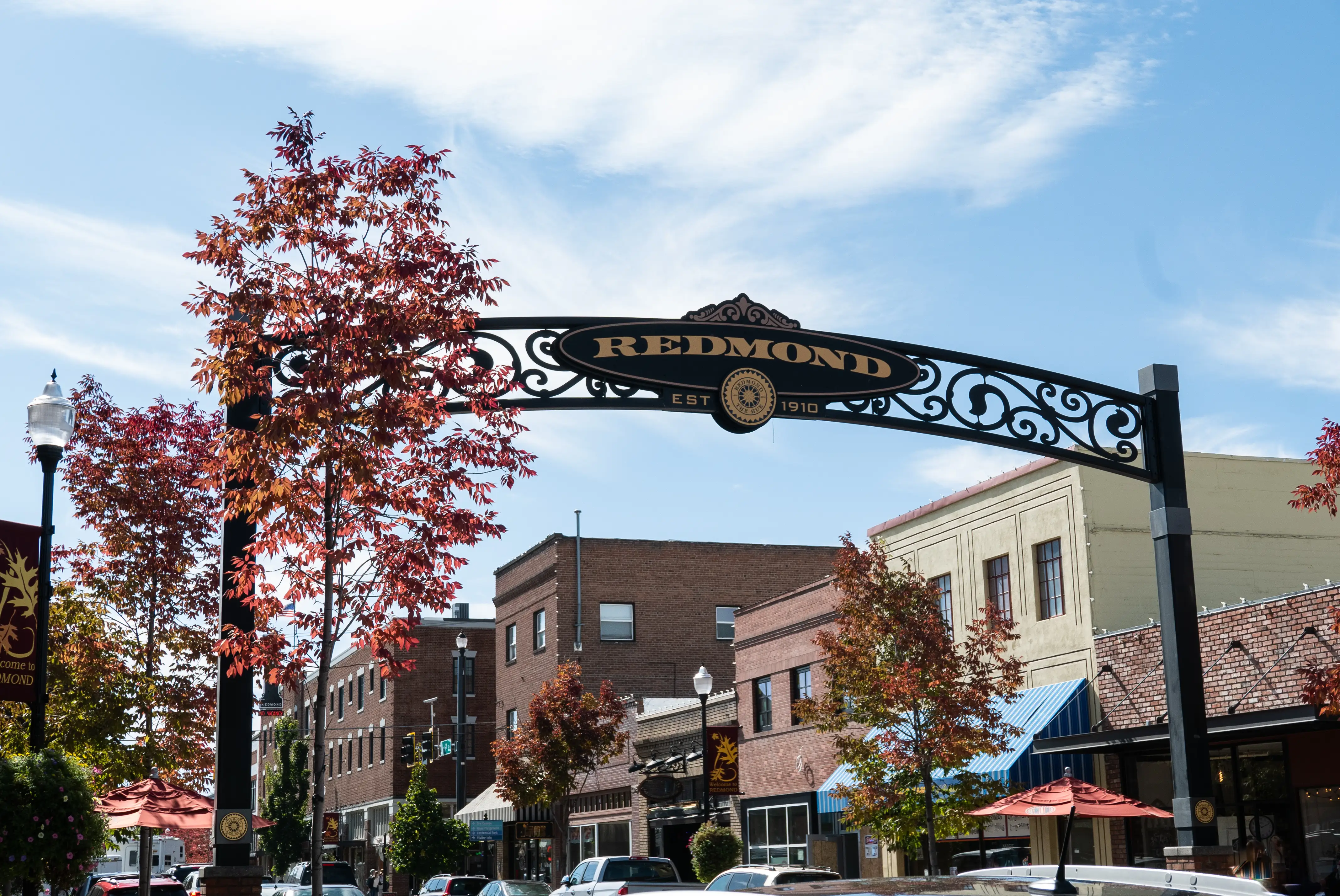
Why Retirees Are Choosing Redmond
The clearest case for Redmond is the price-to-access equation. The typical home price is $517,100 (Zillow Home Value Index, July 2026) — noticeably below Bend, the city most retirees originally targeted, and well below Sisters. For someone downsizing from a California suburb or a higher-cost Oregon metro, that delta can mean the difference between buying outright and carrying a mortgage in retirement. For more on how that compares to nearby markets, see the cost-of-living page.
Redmond fits retirees who want outdoor access without the outdoor-recreation premium. Smith Rock State Park is within easy reach, the Dry Canyon Trail runs through the city itself, and the high desert climate means you can walk or ride most of the year without rain gear. The Redmond Municipal Airport a couple of miles out makes visiting family genuinely convenient — a real quality-of-life factor that gets underweighted in most retirement analyses.
Who should look elsewhere? Retirees who want to walk to a pharmacy, a grocery, or a specialist without a car will find Redmond frustrating — it is a driving town, and that reality does not change with good weather. Retirees whose income comes heavily from taxable pension or IRA distributions need to run the Oregon tax numbers carefully before committing, because the state's top rate hits hard on upper-middle retirement incomes. And anyone who expects a dense arts, dining, or cultural calendar in-city will find Redmond modest — though Bend's offerings are a short drive away.
Healthcare & Medical Access in Redmond
Redmond has something most cities its size do not: a full hospital inside city limits. St. Charles Redmond is a non-profit community hospital and part of the St. Charles Health System, a four-hospital network that is the largest provider of medical care in Central Oregon. The Redmond facility functions as a Level III trauma center, which means it handles emergency care, surgical services, rehabilitation, and has an ICU and a medical-surgical unit — a meaningful baseline for retirees who want more than urgent care nearby.
The hospital's history here is long. Redmond was the first city in Oregon to form a public hospital district, in 1951, and a $30 million addition opened in 2006. Healthgrades recognized St. Charles Redmond with a Vascular Surgery Excellence Award and a Gastrointestinal Surgery Excellence Award in 2024, which speaks to genuine procedural depth in those specialties. For primary care, cardiology, orthopedics, and general surgery, the Redmond facility handles most of what a retiree needs day-to-day.
The honest limit is what a Level III trauma center is not. Complex cancer treatment, advanced cardiac procedures, neurosurgery, and subspecialty care at the highest level sit at larger academic or tertiary centers. For those, the realistic plan is a drive — Bend's St. Charles Medical Center is the next stop within the system, and that drive is about 20 minutes. Retirees managing a serious chronic condition should map out that distance before committing to Redmond, not as a dealbreaker but as a logistics reality worth building into the decision.
What This Means in Practice
For the majority of retirees — managing blood pressure, recovering from a joint replacement, seeing a primary care provider quarterly — Redmond's hospital covers the core of what you need without a drive. The St. Charles network means your records, your specialist referrals, and your care coordination stay inside one system whether you are seen in Redmond or Bend. That continuity matters more than most people expect when health gets complicated.

The Retiree Budget in Redmond
Oregon's treatment of Social Security is the first thing to know: the state fully exempts Social Security and Railroad Retirement benefits from state income tax. That is a meaningful advantage over states that tax Social Security at the state level. The complication is everything else. Pension income, 401(k) distributions, and IRA withdrawals are taxed at Oregon's graduated rates — which run from 4.75% up to 9.9%. That top rate is among the highest in the country, and it applies at income levels that many retirees drawing down investment accounts will reach.
Federal retirees whose service predates October 1991 retain a partial or full subtraction from Oregon taxable income for their federal pension — worth checking with a tax advisor if that applies to you. A Retirement Income Credit was available for lower-income seniors through tax year 2025, but it does not apply for 2026 or later, so any planning that assumed it should be revisited. Oregon also levies its own estate tax with a $1 million exemption — not indexed to inflation — which sits well below the federal threshold and can catch estates that would owe nothing federally.
On the property tax side, the effective rate is approximately 0.72%, which is moderate by Oregon standards. Oregon's Senior and Disabled Property Tax Deferral Program allows homeowners 62 or older to have the state cover their county property taxes annually, with a lien accruing 6% simple interest repaid on sale or transfer. The household income cap for the 2026 program year is $70,000. For retirees on a fixed income who own their home outright, this program can meaningfully smooth cash flow — it is worth understanding before assuming property taxes are a fixed monthly expense.
Daily costs in Redmond run below what you would pay in Bend or the Portland metro, and Oregon has no sales tax, which makes a real difference on ongoing purchases. The friction point is taxable retirement income, and retirees drawing primarily from pre-tax accounts should model the Oregon income tax load before deciding the state is affordable. An interactive calculator is available just below to model monthly payment estimates at current rates.
Looking to buy in Redmond? Estimate your payment.
Enter your numbers to see an estimated monthly mortgage payment.
Estimate only. Excludes HOA fees and mortgage insurance. The interest rate above is a starting point, not a quoted rate — replace it with your own to see real numbers. Insurance is a flat placeholder, not a Redmond quote.
Walkability, Community & Staying Active in Redmond
Redmond is honest car-dependent territory for most errands. The downtown core has improved — the Historic District along 6th Street has coffee, a handful of restaurants, and some retail — but a retiree who wants to walk to a pharmacy, a grocery, or a doctor's office from a typical Redmond address will usually need a car. The terrain itself is flat, which helps if walking is part of the routine; there are no real hills to navigate. But the street grid outside downtown is suburban, with distances that make on-foot access impractical for anything but local parks and trails.
Where Redmond Genuinely Delivers
The Dry Canyon Trail is the exception that changes the daily texture. This paved trail cuts through the city along a natural rimrock canyon — it is walkable from a significant portion of residential Redmond, and it connects to parks, benches, and viewpoints that make it a genuine amenity rather than a weekend trip. For retirees who want a daily walk built into their address, living within reach of the Dry Canyon corridor is the single most important location decision in Redmond.
The Redmond Senior Center is a real anchor. It provides approximately 31,720 meals a year to seniors at no charge, runs a Meals on Wheels program, offers wellness programs, social activities, and a monthly Wellbeing Series of workshops covering physical, emotional, and social health. This is not a nominal senior center — it is a functioning community hub with programming depth. For retirees who moved here without an existing social network, it is the fastest way in.
Beyond the senior center, the city's activity calendar leans outdoor. Eagle Crest Resort trails, Smith Rock State Park, and Cline Falls State Scenic Viewpoint are all within a short drive and see genuine use from the retirement-age population year-round. The Redmond Farmers Market runs through the warm months and draws a crowd. Volunteers are visible across the city — the library, the senior center, the fair and expo grounds — and many retirees find that rhythm of informal community involvement is what makes smaller cities work at this stage of life.
Right-Sizing: Downsizing in Redmond
Redmond's 55+ community inventory is more developed than most cities this size, and the two options are distinct enough to be worth understanding separately. Dry Canyon Village is a gated, active-adult community with 169 single-level homes on 40 acres, connected to Redmond's Dry Canyon trail system by a four-mile walking and cycling network. The clubhouse includes an indoor saline lap pool, yoga studio, cardio gym, pickleball courts, and bocce ball. For retirees who want an amenity-rich, maintenance-reduced lifestyle with immediate trail access baked into the address, this is Redmond's most purpose-built option.
The second development, also in the Dry Canyon corridor, is a newer Lennar community offering single-level homes across two collections ranging from approximately 1,219 to 2,317 square feet. Resort-style amenities including an indoor pool and pickleball courts were planned for completion in 2026. These are the two named 55+ communities in Redmond — if someone describes another development as a 55+ community, ask specifically what it is, because the broader senior housing category in Redmond also includes assisted living facilities, which are a different product entirely.
Single-Level Inventory Beyond 55+ Communities
Not every retiree wants a gated community with a homeowners association, and that is a reasonable position. Single-story homes exist across Redmond's general inventory — particularly in the Northwest Redmond and Fieldstone Crossing areas — but the supply is not overwhelming and well-maintained single-level homes at the right price point move. The broader challenge is that the median household income here sits below what is needed to carry the typical home price, which means the pool of qualified buyers is real but finite, and sellers of single-level homes are not always in a hurry.
For retirees planning ahead, assisted living in Central Oregon runs toward the higher end of what you would pay in smaller Oregon cities — memory care in particular is among the larger line items to plan for. That is relevant context for long-range retirement budgeting; Redmond is not the region's lowest-cost option for care transitions, even if its home purchase market is more accessible than Bend's.
Redmond vs Nearby Retirement Destinations
| City | Cost vs Redmond | Primary Hospital | Walkability | Senior Living Depth | Overall Retirement Fit |
|---|---|---|---|---|---|
| Redmond | Anchor | St. Charles Redmond (Level III, in city) | Car-dependent; Dry Canyon Trail a standout | Two active 55+ communities, senior center | Value Nature Strong for active, budget-conscious retirees |
| Bend | Noticeably higher | St. Charles Bend (larger facility, same system) | Better downtown walkability; Old Mill District | Wider senior living selection | Walkable Better amenities and healthcare depth; higher cost |
| Prineville | Noticeably lower | Pioneer Memorial Hospital (critical access) | Very limited; rural grid | Minimal 55+ inventory | Quiet Lowest cost in the region; thinner services |
| Sisters | Noticeably higher | No hospital in city; drive to Bend or Redmond | Small, walkable downtown core | Very limited dedicated senior housing | Views Beautiful setting; premium price without the hospital |
| Terrebonne | About the same | Drive to St. Charles Redmond | Rural; car essential | No known dedicated senior communities | Proximity to Smith Rock; fewer city services |
| Powell Butte | About the same | Drive to Redmond or Bend | Rural; no walkable center | No dedicated senior communities | Agricultural character; suited to rural retirees only |
Bend wins on healthcare depth, walkability, and cultural amenities — but retirees who make the Bend comparison should do the math honestly, because noticeably higher home prices compound into a meaningfully different retirement budget over time. Prineville is the region's lowest-cost option and genuinely fits retirees who prioritize affordability above all else, with the understanding that services are thinner and the hospital is a critical access facility rather than a full community hospital.
Sisters is where the trade-off is starkest: a beautiful small town with a walkable downtown and a premium price tag, but no hospital inside the city limits. Retirees who place healthcare access at the top of the list — which most should — will find Redmond's position meaningfully stronger. For anyone whose retirement picture is specifically about outdoor access and manageable cost in Central Oregon, Redmond is the most defensible all-around choice in the region.

Local Expert Takeaway: Redmond's retirement case is built on three things that hold up under scrutiny: a hospital inside city limits that belongs to the region's dominant health system, a 55+ community inventory that is genuinely purpose-built for active adults rather than just age-restricted apartments, and a home price that stays meaningfully below Bend's without putting you far from Bend's services. The friction points are real — Oregon taxes retirement income drawn from pre-tax accounts at rates that surprise people, the city requires a car for most daily errands, and assisted living costs in Central Oregon run toward the higher end of what smaller Oregon cities charge. The retirees who thrive here are the ones who did the Oregon tax math before they moved, chose an address near the Dry Canyon corridor, and plugged into the senior center early.
Quick Takeaways & FAQs
✅ St. Charles Redmond operates as a Level III trauma center inside city limits, part of the four-hospital St. Charles Health System — unusually strong hospital access for a city of 38,199.
⚠️ Oregon fully exempts Social Security from state income tax, but pension and IRA withdrawals face graduated rates up to 9.9% — retirees drawing heavily from pre-tax accounts should model the Oregon tax load carefully before committing.
📍 Dry Canyon Village and the newer Lennar Dry Canyon development are Redmond's two named active-adult 55+ communities, both single-level and both connected to the Dry Canyon trail corridor that runs through the city.
Does Oregon tax Social Security income for retirees living in Redmond?
What is the closest hospital to Redmond, Oregon?
Are there 55+ communities in Redmond, Oregon?
Is Redmond, Oregon affordable for retirees on a fixed income?
How is daily life in Redmond for retirees — can you get around without a car?
Moving to Oregon?
Tell us what you need help with and we'll connect you with local resources.
