
Most people researching a move to Redmond, Oregon come in with one of two assumptions: that a small high-desert city must be safer than wherever they're leaving, or that a fast-growing town must be getting rougher. The data supports neither extreme. Redmond — a city of 38,199 in Deschutes County, sitting about 20 minutes from Bend — has a crime picture that lands meaningfully below state and national benchmarks on the violent side, while property crime is the number that deserves a closer look before you settle on a neighborhood.
The numbers tell a story of a mid-sized Oregon city that has improved over time. Over the last five years, both violent and property crime have trended downward — not a dramatic collapse, but a steady, consistent arc in the right direction. That pattern fits the broader statewide trend: Oregon vehicle thefts, historically one of the state's headline crime problems, fell sharply in recent years. Redmond's improvement reflects a combination of a community-policing department that earned Oregon Accreditation Alliance certification and a city that opened a purpose-built $49 million Public Safety Facility in August 2025.
Where safety gets more nuanced is geography. Redmond has a real east-to-west gradient in crime risk that residents who've lived here a while understand intuitively, and that newcomers often miss entirely. The commercial corridors attract the bulk of property crime — larceny-theft and vehicle theft concentrated around parking, retail, and daytime foot traffic — while quieter residential areas on the west and north sides of the city show significantly lower incident rates. Choosing a neighborhood without understanding that divide is one of the more common mistakes people make when relocating here.
Whether you're weighing Redmond against Bend, considering specific neighborhoods like Eagle Crest or Canyon Rim Village, or simply trying to understand what the crime numbers actually mean day-to-day, the sections below break down the city-wide figures, the neighborhood-level safety picture, the local police department's approach, and the practical things worth knowing before you decide on an area.
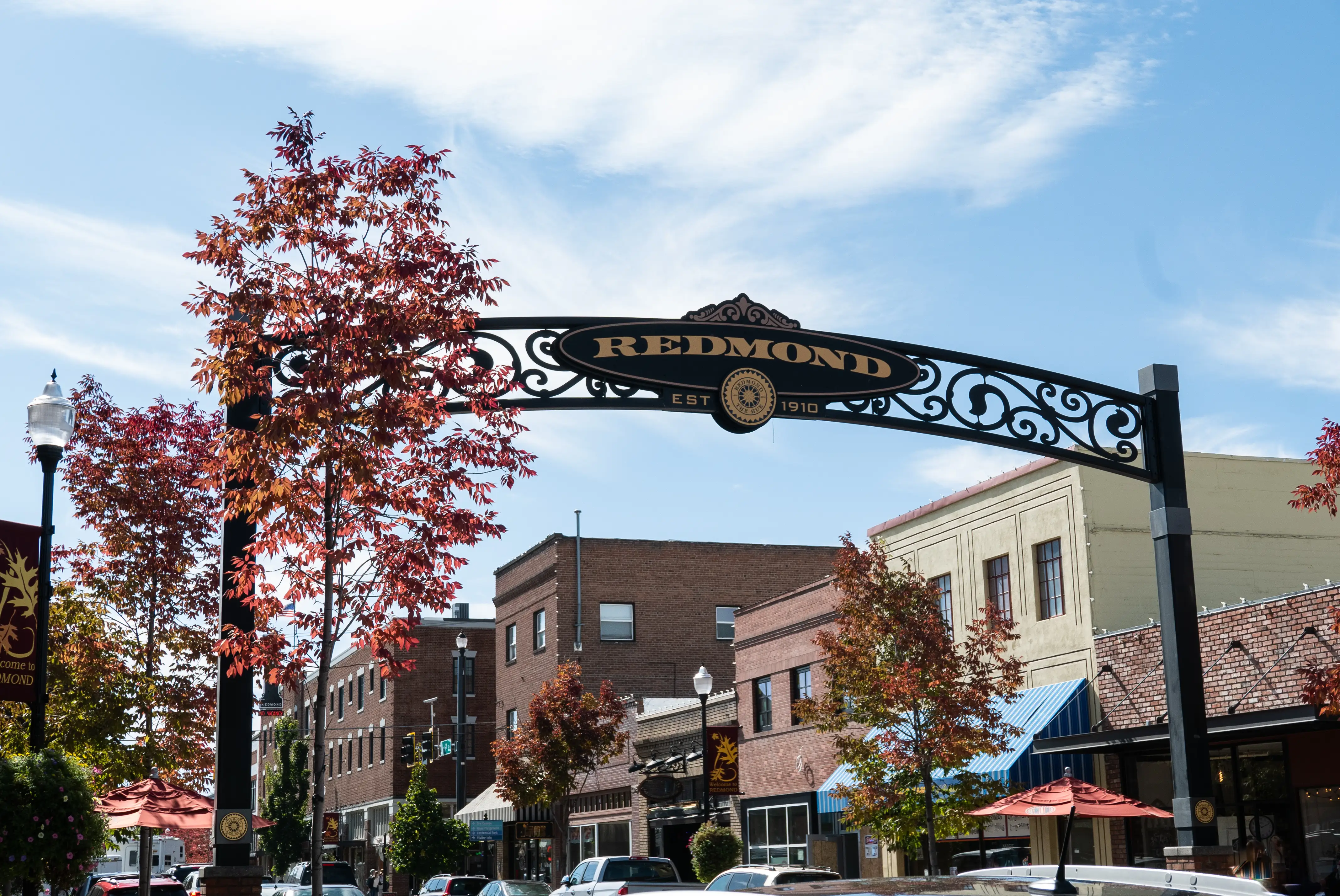
How Redmond's Crime Rates Compare to Oregon and the Nation
The headline figure is straightforward: Redmond carries a violent crime rate of 2.94 per 1,000 residents. For context, Oregon's state average sits at 3.3 per 1,000 and the national average at 3.7 per 1,000 — both from the Bureau of Justice Statistics, Crime Known to Law Enforcement, 2024 (tables 2 and 3). Redmond comes in below both.
That gap is meaningful, not marginal. A city whose violent crime rate runs noticeably below the state average, in a state that itself runs below the national figure, lands in a genuinely safer position than most American cities of comparable size.
Property crime is the more complicated half of the picture. Redmond carries a property crime rate of 14.77 per 1,000 residents. Oregon's state average is 24.5 per 1,000 and the national average is 18.4 per 1,000 — again from the Bureau of Justice Statistics, 2024. Redmond sits below both of those benchmarks as well, which surprises some people who've heard Central Oregon described as a high-theft region.
The engine renders a full comparison table from these figures immediately below this section — it lays out all four benchmarks side by side so you can scan the gaps at a glance.
What the table won't show is the composition of that property crime. Larceny-theft, vehicle theft, and burglary account for the bulk of incidents — a pattern consistent with Oregon statewide, where larceny-theft alone made up close to three-quarters of all property crimes in 2024. The practical implication: most of what the numbers count are opportunistic thefts rather than crimes that target people directly. That distinction matters when you're trying to understand what daily life here actually feels like.
The Long-Run Direction
Both violent and property crime have declined over the last five years in Redmond, suggesting a durable improvement rather than a single-year anomaly. That downward arc fits the statewide pattern: Oregon vehicle thefts, which drove much of the state's property crime numbers in prior years, fell sharply from 2024 to 2025. Redmond's trajectory tracked that improvement.
None of this means crime is absent. What it means is that the data, read carefully, describes a city that compares favorably to its benchmarks and has been moving in the right direction — a better starting point than most relocating buyers expect.
Where Crime Concentrates: The Geographic Reality
The single most useful thing to understand about crime in Redmond is that it is not evenly distributed. The commercial spine of the city — its main highway corridors, with their retail clusters, gas stations, and parking lots — accounts for a disproportionate share of property crime incidents. Heat maps consistently show elevated activity along those corridors compared to the surrounding residential neighborhoods.
That concentration has a practical implication: a crime rate calculated for the city as a whole will look worse than what most residents in quieter neighborhoods actually experience.
West and North vs. East
Residents who've lived here describe a clear gradient from west to east. The west and north parts of the city are generally considered the safest, with violent-crime risk in western neighborhoods running significantly lower than in eastern neighborhoods — roughly three times lower by some estimates. That gap is large enough to matter when you're comparing areas.
Eastern neighborhoods that sit closer to the main commercial corridor see higher incident rates, consistent with the commercial-corridor pattern described above. This isn't a reason to avoid the east side entirely, but it is a reason to look carefully at the specific blocks around any property you're considering rather than relying on city-wide averages alone.
What Locals Notice Day-to-Day
In community surveys and Nextdoor discussions, Redmond residents consistently describe the city as a safe place to live overall. The concerns that come up most often are practical rather than alarming: speeding on surface streets, vehicle theft (particularly in commercial parking areas and less-monitored spots), and fire safety in the dry season. None of those are small concerns, but they're a different category than violent crime.
Vehicle theft in particular is worth keeping in mind if you're parking near commercial areas or leaving a car overnight in a less-trafficked lot. The statewide decline in auto theft has improved the picture, but taking the basic precautions — not leaving valuables visible, using a steering-wheel lock — remains standard practice for residents here. For a full picture of which neighborhoods suit which lifestyles, see the Redmond neighborhoods guide.

Neighborhood Safety Snapshots
Redmond's neighborhoods each carry a distinct character, and that character shapes the safety picture as much as the raw numbers do. Here's what the data and resident accounts say about the areas most people are actually considering.
Eagle Crest
Eagle Crest, on the western edge of the city, consistently earns above-average safety ratings compared to other Oregon neighborhoods. Residents describe it as peaceful, quiet, and well-maintained — a resort-adjacent community built around golf courses and trail access where the sense of community is strong and the pace is slower than the commercial parts of town. The western location puts it in the lower-risk end of the city's east-to-west gradient.
Best for: Quiet Views Nature
Canyon Rim Village
Canyon Rim Village draws families and retirees who want proximity to the Dry Canyon Trail without being deep in the commercial corridor. Resident accounts describe it as peaceful, with the canyon geography creating a natural buffer from busier parts of town. It sits close enough to parks and open space to make outdoor access part of daily life here.
Best for: Families Quiet Nature
Dry Canyon Area
The neighborhoods immediately surrounding the Dry Canyon Trail corridor benefit from the trail itself — a 4.2-mile paved greenway managed by the city's Parks Division — and from the 285 acres of open space the city maintains around it. Trail access tends to correlate with active, eyes-on-the-street use that keeps the immediate area feeling lived-in and safe. This is one of the more walkable parts of Redmond's residential fabric.
Best for: Nature Walkable
Northwest Redmond
Northwest Redmond sits in the portion of the city that residents consistently place in the lower-risk tier. It's removed from the commercial concentrations that drive the property crime numbers along the main commercial spine, and it has grown in recent years as newer residential development pushed the city's footprint west and north. Quieter streets and lower through-traffic make it the kind of area where property crime numbers are closer to the residential baseline than the corridor average.
Best for: Families First-Time Buyers
Old Town / Downtown Redmond
Downtown Redmond — the Historic District along 5th Street — is the neighborhood that requires the most nuance. It's an improving area, and the city has invested in it, but its proximity to the main commercial corridor means it carries more of the commercial-corridor property crime pattern than quieter residential parts of town. That said, property crime near active, improving downtowns is almost always opportunistic and concentrated in parking rather than in residential blocks. People who move here knowing that tend to settle in without issue; people who expect it to feel like Eagle Crest are the ones who tend to be surprised.
Best for: Walkable Renters
Looking to buy in Redmond? Estimate your payment.
Enter your numbers to see an estimated monthly mortgage payment.
Estimate only. Excludes HOA fees and mortgage insurance. The interest rate above is a starting point, not a quoted rate — replace it with your own to see real numbers. Insurance is a flat placeholder, not a Redmond quote.
Redmond Police Department: Accreditation, Investment, and Community Engagement
The Redmond Police Department is accredited by the Oregon Accreditation Alliance (OAA) — a standard that requires departments to demonstrate compliance with professional policing practices and submit to ongoing review. Not every department in Oregon holds this certification, and for a city of Redmond's size, it's a meaningful signal about how the department is run.
A New Headquarters Built for Growth
In August 2025, the city opened a $49 million, 42,000-square-foot Public Safety Facility — a purpose-built headquarters designed to give the department room to operate at the scale Redmond's growth demands. The investment signals that the city is building infrastructure around public safety rather than retrofitting space that was never designed for it.
That kind of institutional commitment matters for a city adding residents at the pace Redmond has been. A department that outgrows its facilities tends to show it operationally before it shows it statistically.
Community Policing in Practice
The department operates on an explicit community-policing philosophy — officer partnerships with residents, a focus on addressing root problems rather than cycling through the same incidents repeatedly. That approach tends to produce better outcomes in property crime over time, which is exactly the category Redmond most needs to manage.
The department also runs a Citizen Academy open to all residents, designed to walk people through how the department functions and how local policing decisions get made. It's a direct community-engagement tool, and the fact that it draws applicants from across the city says something about the relationship between residents and the department here.
What a Newcomer Should Know
One thing that surprises people after a few months in Redmond: how present the policing feels in the residential neighborhoods, and how low-friction most interactions with the department are. The OAA accreditation and the community-policing model aren't just institutional talking points — residents notice the difference in how disputes and concerns get handled compared to larger metro departments. That said, response times to lower-priority calls in a growing city are what they are; if you're coming from a densely policed metro neighborhood, calibrate your expectations accordingly.
Practical Safety: What to Know Before You Choose a Neighborhood
The numbers tell one story; the practical, day-to-day texture of living here tells another. Both are worth reading together before you decide on an area.
The Commercial Corridor Is Not the Neighborhood
The single most common mistake people make when reading Redmond crime data is treating the city-wide property crime rate as representative of the residential neighborhood they're considering. It isn't. Property crime concentrates along commercial corridors — retail areas, parking lots, and blocks with high daytime foot traffic — at rates significantly higher than the surrounding residential streets. If you're looking at a house in Northwest Redmond or Canyon Rim Village, the relevant crime picture is closer to the residential baseline than to the corridor average.
Before you decide on a neighborhood, it's worth looking at a crime heat map for the specific blocks around any property rather than relying on the city-wide figure. CrimeGrade.org publishes neighborhood-level breakdowns that are worth cross-referencing with the BJS figures this page is built on — just keep in mind they use a different reporting series, so the numbers won't line up exactly.
Vehicle Theft: The Practical Precaution
Even as Oregon's overall vehicle theft numbers have dropped sharply, it remains the property crime category that Redmond residents mention most often in community discussions. The risk is highest around commercial parking areas and in spots with limited overnight visibility. Standard precautions — nothing visible on the seat, a deterrent device, parking under light when possible — have become routine for longer-term residents in a way that newcomers sometimes don't expect.
Dry Season Fire Safety
Central Oregon's high-desert climate means fire safety is a legitimate seasonal concern, particularly in neighborhoods that border open space and natural areas. Eagle Crest and Canyon Rim Village — two of the areas most desirable for their proximity to trails and open land — are also the neighborhoods where residents pay the most attention to defensible space and dry-vegetation management around their homes. This isn't a reason to avoid those areas; it's a reason to take the fire-safety orientation seriously when you move in.
The Practical Bottom Line
Redmond is not a zero-crime city, and the property crime rate — while below state and national averages — means opportunistic theft is a real part of the local picture. What it is not is a city with a violence problem. The violent crime numbers, the downward trend over five years, the accredited and newly-housed police department, and the resident sentiment all point in the same direction: a city where most people feel safe most of the time, and where the specific risk worth managing is property-related and concentrated in knowable places. For the full neighborhood character breakdown, see the best neighborhoods guide. For cost context, the cost of living page covers what the typical home price means in practice.

Local Expert Takeaway: Redmond's safety picture is better than many newcomers expect and more geographically specific than the city-wide numbers suggest. The violent crime rate runs below Oregon and national averages, property crime is concentrated along the main commercial corridor rather than in residential neighborhoods, and the trend has been moving in the right direction for five years. The west and north sides of the city — Eagle Crest, Canyon Rim Village, Northwest Redmond — consistently show lower incident rates than areas closer to the commercial spine. The Redmond Police Department is OAA-accredited and moved into a purpose-built $49 million headquarters in August 2025. The practical concerns residents actually talk about are speeding, vehicle theft in commercial parking areas, and dry-season fire safety near open space — worth knowing, but a different category than violent crime.
Quick Takeaways & FAQs
✅ Redmond carries a violent crime rate of 2.94 per 1,000 residents — below both the Oregon state average and the national average, making it among the safer mid-sized cities in the region.
⚠️ Property crime — particularly vehicle theft and larceny — concentrates along the main commercial corridor, so city-wide averages can overstate the risk in quieter residential neighborhoods.
📍 Eagle Crest and Canyon Rim Village, on the western side of the city, consistently show the lowest crime risk and highest resident satisfaction for safety — they are also the neighborhoods closest to open space and fire-risk terrain, so fire-safety awareness comes with the territory.
Is Redmond, Oregon a safe place to live?
Which neighborhoods in Redmond, Oregon have the lowest crime?
How does Redmond's crime rate compare to Bend?
What type of crime is most common in Redmond, OR?
What is the Redmond Police Department doing to address crime?
Moving to Oregon?
Tell us what you need help with and we'll connect you with local resources.
