
Redmond doesn't feel expensive until you try to buy a house. The rest of daily life — groceries, utilities, gas, a dinner out — runs close to what you'd pay in a mid-size American city. But housing is the engine that drives Redmond's overall cost picture well above the national average, and anyone relocating here from a lower-cost state or from rural Oregon will feel that gap immediately. The city sits in Deschutes County in Central Oregon, roughly midway between the high-desert plateau and the Cascade foothills, with US-97 carrying most of the commercial and commuter traffic through town.
Redmond's economy runs on a handful of anchor institutions — St. Charles Redmond, the Redmond School District, Deschutes County, and the City of Redmond itself — and a growing base of remote workers who discovered that about 20 minutes to Bend still puts them within reach of a metro lifestyle without paying metro prices. That combination has pushed demand and prices up steadily. With a population of 38,199, Redmond is the 16th-largest incorporated city in Oregon, large enough to support real retail and services but small enough that the cost of that lifestyle is still meaningfully below Bend.
Strip housing out of the equation and Redmond's cost picture softens considerably. Utilities track just below the national average, groceries run modestly above it, and gas is slightly cheaper here than in the Portland metro. Oregon's complete absence of a sales tax takes real dollars off everyday purchases. The tradeoff is a state income tax that is among the higher ones in the country, and a housing market where the median household income falls short of what's needed to comfortably carry the typical home price.
Whether you're running the numbers for the first time or deep into your relocation research, the sections below break down Redmond's housing costs, rent figures, everyday expenses, how the city compares to Bend, Prineville, and Sisters, and what the tax picture actually means for your bottom line.
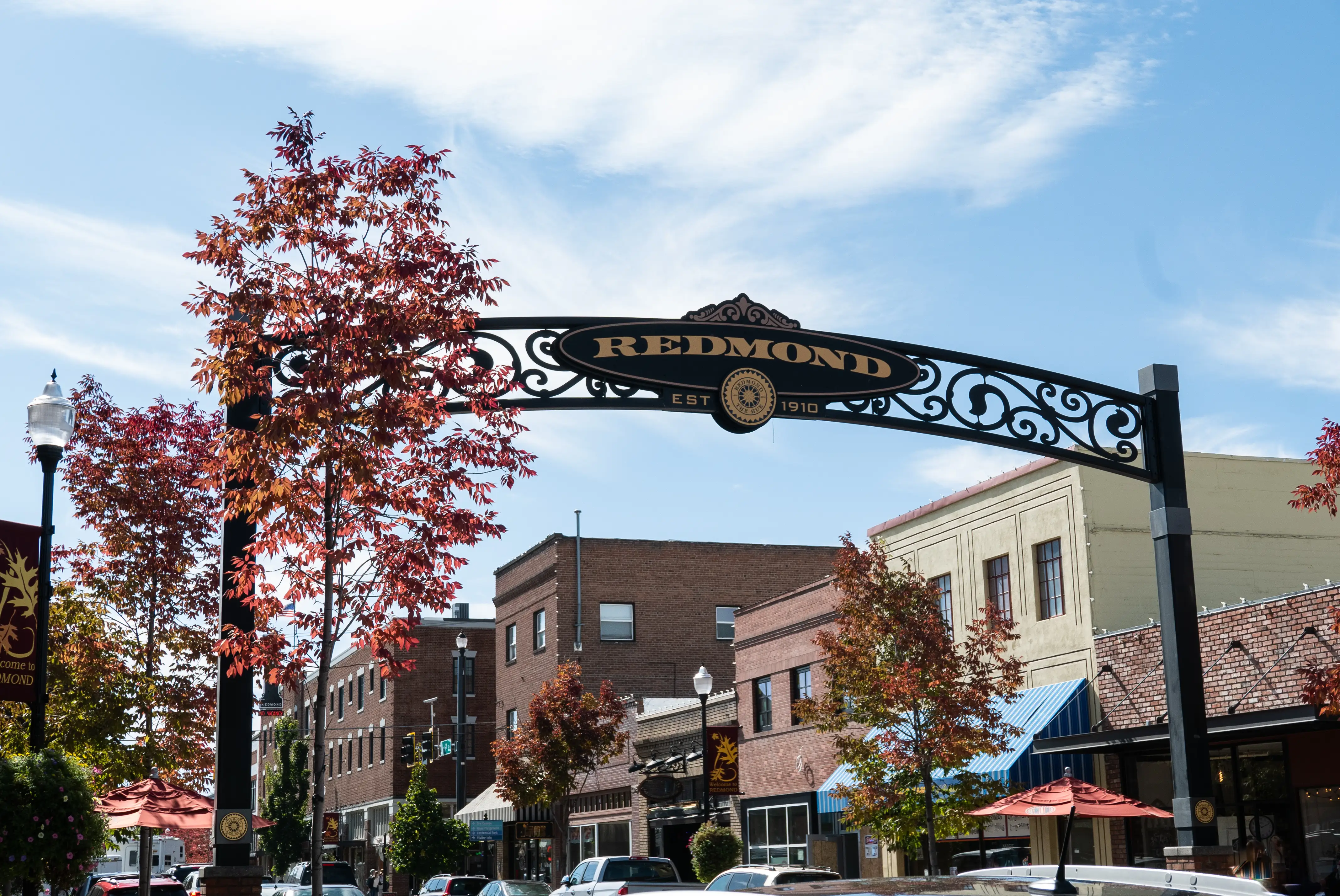
What It Really Costs to Live in Redmond
Redmond's overall cost of living runs approximately 15% above the national average — and housing is doing almost all of the work. Pull housing out of the index and the city lands close to national norms across every other category: utilities slightly below, groceries slightly above, services near average. That gap matters because it tells you exactly where the budget pressure is coming from, and it isn't your electric bill.
For context within the region, Redmond sits in a middle position. Bend is noticeably higher — it has absorbed a decade of in-migration from California and the Pacific Northwest tech corridor, and prices reflect that. Sisters is noticeably higher as well, driven by its resort-adjacent character and constrained supply. Prineville, about 19 miles east, is noticeably lower, though it comes with a longer commute to most jobs and fewer local amenities. Redmond's position is deliberate for many buyers: it's where you land when Bend's prices have pushed you out but you still want Central Oregon.
The affordability reality is worth stating plainly: Redmond's median household income of $84,164 falls short of what's needed to carry the typical home here by a meaningful margin. That gap is bridged in this market by dual-income households, remote workers earning out-of-state salaries, and buyers bringing equity from higher-cost markets. For a fuller look at how neighborhoods vary in price and character, or the mechanics of buying in this market, those pages go deeper than this one can.
Housing: Rent vs Buy in Redmond
The typical home in Redmond was priced at $517,100 as of July 2026 (Zillow Home Value Index). Entry-level homes — older construction, smaller lots, fewer updates — start in the mid-to-upper $300,000s. New construction and anything with a view toward the Cascades pushes well above the city-wide figure. The engine's mortgage calculator below this section will show you what those numbers translate to at current rates, since payment math changes faster than any prose can keep up with.
The effective property tax rate in Redmond is approximately 0.72% — one of the more favorable rates in the region, and notably lower than the national average. Oregon's Measure 5 and Measure 50 limitations on assessed-value growth mean long-term homeowners often pay taxes on an assessed value well below market, which is a real financial advantage for anyone planning to stay put. New buyers pay taxes on assessed value at purchase, but that 0.72% rate still compares well against most West Coast markets.
Renting is the more realistic near-term choice for many people arriving in Redmond. The typical two-bedroom rent runs $1,930–$2,350 per month, with a city-wide typical rent of $2,098 per month (Zillow ZORI, July 2026). That's meaningfully below comparable units in Bend, which makes Redmond attractive for people who want to live in Central Oregon while they build savings or wait for the right purchase. The catch is that the rental market has tightened alongside ownership demand — vacancy is not generous, and well-located units move. Renting makes the most sense here if you're new to the area and still learning which parts of the city fit your life; buying makes sense if you have a down payment, a stable income, and a three-plus-year horizon. The neighborhoods guide covers the geographic tradeoffs in more detail.
One thing worth flagging for buyers over 62: Oregon offers a Property Tax Deferral program that allows the state to pay property taxes on your behalf as a lien against the property, repaid when the home is sold or transferred. There's also a senior property tax exemption for qualifying low-income homeowners over 62 that can reduce assessed value. For the fuller picture on retirement-specific finances here, the retiring in Redmond page covers those programs in more depth.

Everyday Costs Beyond Housing in Redmond
| Category | Typical Monthly Cost | Notes |
|---|---|---|
| Housing (typical rent) | $2,098/mo | City-wide typical rent. Buying? Use the calculator above for a mortgage estimate. |
| Utilities | $190–$270/mo | Electricity, gas, water, sewer, trash |
| Groceries | $600–$800/mo | Food at home, household of 2–3 |
| Transportation & Gas | $220–$380/mo | Fuel, and transit where it is a real option |
| Phone & Internet | $110–$180/mo | Mobile plan plus home broadband |
| Misc / Discretionary | $250–$480/mo | Dining out, entertainment, subscriptions |
Non-housing figures are estimates for a household of two to three, not a sourced index; housing is the city-wide typical rent (Zillow ZORI, July 2026). Refreshed with the rest of the city data.
Central Oregon's high desert climate shapes two of the biggest non-housing line items. Heating season runs long — cold nights arrive in September and linger into May — and Pacific Power, the regional electric utility, has raised residential rates significantly in recent years: 21% in 2023, 11% in 2024, and another 9.8% in early 2025, driven by wildfire mitigation costs and infrastructure investment. Despite those increases, Redmond's utilities cost index sits at 98, just under the national average of 100. That's partly because the dry climate means no humidity load on cooling systems and relatively modest air conditioning use compared to hotter states.
Groceries run about 7% above the national average — a direct consequence of Central Oregon's geographic isolation from major distribution infrastructure west of the Cascades. Everything that doesn't come from a local farm or ranch has to cross the mountains, and that logistics reality shows up in the produce and protein aisles. Transportation costs index at 108, slightly above the national average, because a car is not optional here. Cascades East Transit (CET) operates flex-route A and B lines within Redmond and Route 24 connecting to Bend, and in June 2026 expanded service with new early-morning runs and extended hours — but for most errands, medical appointments, and recreation, you will be driving. The upside: gas in Central Oregon typically runs a bit below Portland metro prices, and parking is free and abundant throughout the city. The sample monthly budget below this section shows how these categories stack up for a typical Redmond household.
Looking to buy in Redmond? Estimate your payment.
Enter your numbers to see an estimated monthly mortgage payment.
Estimate only. Excludes HOA fees and mortgage insurance. The interest rate above is a starting point, not a quoted rate — replace it with your own to see real numbers. Insurance is a flat placeholder, not a Redmond quote.
Redmond vs Nearby Cities: Cost Comparison
| City | Typical Home Price | Typical Rent | Cost vs Redmond |
|---|---|---|---|
| Redmond (this city) | $517,100 | $2,098/mo | — |
| Bend | $732,894 | $2,302/mo | 42% higher |
| Prineville | $433,014 | $1,641/mo | 16% lower |
| Sisters | $790,765 | $2,059/mo | 53% higher |
Source — home prices: Zillow ZHVI, July 2026; rent: Zillow ZORI, July 2026. Nearby-city figures are the same series, refreshed together.
Redmond's position in the Central Oregon market becomes clearest when you line it up against its neighbors — Bend and Sisters come in noticeably higher, Prineville noticeably lower, and the table below shows the full picture including typical rent alongside home prices.
Taxes & the Bottom Line for Redmond
Oregon's tax structure has one headline advantage and one genuine drawback, and both are significant enough to affect your budget calculation. The advantage: there is no state or local sales tax in Oregon. Groceries, clothing, electronics, vehicles, and every other consumer purchase are bought tax-free. For a household that spends heavily on retail, that's real money — particularly relative to states like California or Washington where combined rates can top 9% or 10%.
The drawback is the income tax. Oregon uses a progressive four-bracket structure with rates from 4.75% to 9.9%. The top 9.9% rate kicks in above $125,000 of taxable income for single filers and above $250,000 for married couples filing jointly — and that top rate is among the highest in the nation. Remote workers earning Pacific Coast or tech-industry salaries will feel this immediately. It's the tax that most surprises people arriving from states with no income tax, and it's worth modeling against the sales-tax savings before assuming the math favors you.
One meaningful carve-out for retirees: Oregon does not tax Social Security income. That offsets some of the income-tax sting for fixed-income households, and combined with the property tax deferral program mentioned in the housing section, makes the overall picture more manageable for people in or near retirement.
The property tax rate of approximately 0.72% — applied against the home-price figure discussed earlier — is a genuine strength of the Redmond picture, sitting well below national norms. For buyers coming from higher-tax states, it's often the line item that surprises them most favorably.
Put it all together and Redmond's budget works best for households with stable dual incomes or remote-work wages that comfortably clear $100,000, buyers bringing equity from a higher-cost market, and retirees who have paid down their mortgage and benefit from Oregon's Social Security exemption and property-tax relief programs. It tends to be a stretch for single-income households earning at or near the local median, first-time buyers without significant savings, and anyone expecting the cost picture to resemble a smaller, more rural Oregon town. For a full read on which buyer profiles find Redmond the right fit, the living in Redmond overview covers that ground directly.

Local Expert Takeaway: Redmond's cost story is fundamentally about housing versus everything else. The Zillow Home Value Index put the typical home at $517,100 in July 2026 — real money for a city where the median household earns $84,164 — and that gap is what filters who actually lands here. But outside of housing, the daily numbers are reasonable: a 0.72% property tax rate, no sales tax on anything you buy, utilities that track just below the national average despite Pacific Power's recent rate increases, and gas that's a few cents cheaper than Portland. The buyers who make Redmond work are usually bringing something extra to the table — out-of-state equity, a remote paycheck, or a second income — rather than buying on local wages alone.
Quick Takeaways & FAQs
✅ Oregon's zero sales tax means every grocery run, clothing purchase, and hardware-store trip costs less here than in most other western states — a real, recurring benefit that adds up.
⚠️ The typical Redmond home priced at $517,100 (July 2026) sits well above what the local median household income can comfortably support — buyers relying on one local-market salary will find the math tight.
📍 Cascades East Transit expanded its Redmond-to-Bend Route 24 in June 2026 with new early-morning runs, but a car is still effectively required for most daily errands in Redmond.
Is Redmond, Oregon cheaper than Bend?
What is the property tax rate in Redmond, Oregon?
Does Oregon have a sales tax that affects Redmond residents?
What does rent cost in Redmond, Oregon?
How does Oregon's income tax affect the cost of living in Redmond?
Moving to Oregon?
Tell us what you need help with and we'll connect you with local resources.
