
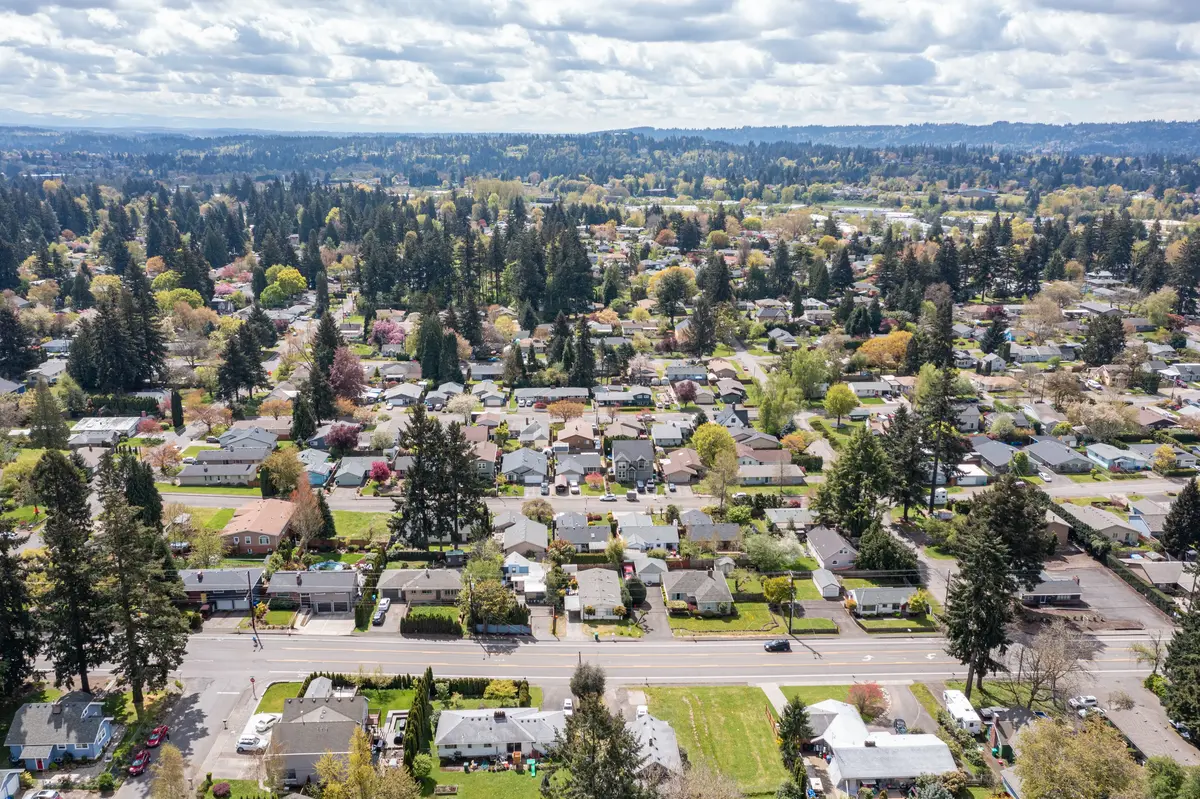
You've probably been priced out of Portland proper, or you're moving from somewhere more expensive and assuming anything in the Portland metro will feel like relief. Milwaukie sits just south of the city line — about 20 minutes to Portland — and its price tag lands somewhere in between: not cheap by any national standard, but meaningfully below the premium zip codes of Portland's west side and several of the faster-growing suburbs to the east. What actually drives the number here is simple geography and housing stock. Milwaukie is a dense, older city of 21,620 people with a mix of postwar bungalows, mid-century ranches, and the occasional riverfront property — the kind of supply that keeps prices grounded relative to newer-build suburbs, even as demand from Portland spillover keeps pushing upward.
The economic reality for most buyers is honest but not comfortable. The median household income in Milwaukie is $86,892, and the typical home costs more than that income can comfortably support without substantial equity or a dual income. That gap matters, and this guide won't minimize it. What Milwaukie offers in return is real transit access — the MAX Orange Line stops here, connecting riders directly to downtown Portland and Portland State University — plus the no-sales-tax advantage that applies to every grocery run and clothing purchase in Oregon. The North Clackamas School District, which holds a B rating according to Niche, serves the city and draws families looking for a stable district without the sticker shock of Lake Oswego or West Linn.
On the non-housing side, Oregon's costs run noticeably above the national average — housing is the biggest driver, but groceries are also elevated compared with the U.S. norm. Utilities, however, run slightly below the national average, which matters in a city where mild Pacific Northwest winters keep heating loads lower than in colder inland markets. Portland International Airport is approximately 14 miles out, and OR-99E and OR-224 carry most of the commuter traffic. For outdoor access, Milwaukie Riverfront Park and Elk Rock Island are right in the city — the kind of amenity that doesn't show up on a budget spreadsheet but matters enormously to daily quality of life.
Whether you're deciding between renting and buying, comparing Milwaukie to Portland or Happy Valley, or just trying to build an honest monthly budget, the sections below cover housing costs, everyday expenses, the tax picture, and how Milwaukie stacks up against its neighbors.
What It Really Costs to Live in Milwaukie
Milwaukie is a mid-range Portland suburb — pricier than the rural Willamette Valley, but noticeably more accessible than Happy Valley or Oregon City, and running about the same as Portland itself. The Zillow Home Value Index put the typical home at $522,702 as of July 2026, which places Milwaukie in the middle tier of the Portland metro. That number reflects a city where the housing stock is older and denser, not a market of new construction subdivisions inflating the median.
Oregon's overall cost of living runs roughly 12–18% above the national average, and housing is the primary reason. But Milwaukie doesn't compound that burden with California-style property taxes or a local sales tax — Oregon has neither a sales tax nor particularly punishing effective property-tax rates by West Coast standards. The honest posture: Milwaukie costs real money, the income-to-price gap is real, and buyers who move here successfully tend to bring equity from a prior home or carry a dual income.
What you're buying into financially isn't just the mortgage. It's a Clackamas County address with direct light rail to Portland, a walkable older downtown core, and access to the Willamette riverfront — without paying the Lake Oswego premium. For buyers priced out of inner SE Portland, that trade is often worth it. For renters on a single modest income, the math is tighter than the zip code's reputation might suggest.
Housing: Rent vs Buy in Milwaukie
Buying in Milwaukie means entering a market where entry-level homes — older ranches and smaller bungalows — start in the low-to-mid $400,000s, while the city-wide typical price sits at $522,702 (Zillow Home Value Index, July 2026). That entry point is real, but it buys you dated kitchens and deferred maintenance more often than not. Buyers who want move-in condition at that price should expect to be patient or flexible on location within the city; the best neighborhoods guide breaks down where the entry-level stock clusters.
The effective property tax rate in Milwaukie is approximately 0.96% of assessed value. That sits above Oregon's statewide average of 0.81% but remains well below comparable West Coast cities — a function of Clackamas County's assessment practices and Oregon's Measure 5 property-tax compression rules. The interactive calculator below this section will let you model total monthly ownership costs at current rates; the rate figure alone won't do that work for you.
Renting is the more practical short-term path for anyone not yet carrying equity. A two-bedroom apartment in Milwaukie runs $1,610–$1,960 per month, and the city-wide typical rent across all unit sizes is $1,749 per month (Zillow ZORI, July 2026). That range reflects a city where most rental inventory is smaller multi-family stock — fourplexes, converted duplexes, modest apartment complexes — rather than new luxury product.
Renting makes sense if you're testing the city before committing, or if you haven't yet accumulated a down payment that keeps the purchase workable. Buying makes sense if you have equity to deploy and plan to stay at least five years. The income-to-price gap here — the median household income falls meaningfully short of what most lenders want to see for the typical purchase — means many buyers either bring equity from a prior sale or use a two-income household to qualify. See the first-time homebuyer page for a breakdown of financing options relevant to this price range.

Everyday Costs Beyond Housing in Milwaukie
| Category | Typical Monthly Cost | Notes |
|---|---|---|
| Housing (typical rent) | $1,749/mo | City-wide typical rent. Buying? Use the calculator above for a mortgage estimate. |
| Utilities | $210–$290/mo | Electricity, gas, water, sewer, trash |
| Groceries | $580–$800/mo | Food at home, household of 2–3 |
| Transportation & Gas | $180–$340/mo | Fuel, and transit where it is a real option |
| Phone & Internet | $110–$185/mo | Mobile plan plus home broadband |
| Misc / Discretionary | $250–$480/mo | Dining out, entertainment, subscriptions |
Non-housing figures are estimates for a household of two to three, not a sourced index; housing is the city-wide typical rent (Zillow ZORI, July 2026). Refreshed with the rest of the city data.
Oregon's no-sales-tax policy is the most immediate everyday relief for Milwaukie residents. Every grocery run, clothing purchase, and household goods trip costs exactly what the shelf price says. Oregon grocery costs still run approximately 7% above the national average — the Portland metro grocery index sits at 107.9 against a U.S. baseline of 100 — but the absence of sales tax at the register pulls actual weekly spend back down. Oregon households average $249.31 per week on groceries, below the national average of $270.21, which reflects exactly that advantage.
Utilities are where Milwaukie gets a mild break. Portland General Electric serves the city, and Oregon's statewide utility costs run about 3% below the national average. PGE's average monthly residential bill ran approximately $136 based on 2025 EIA annual data — that's a system-wide PGE average, not a Milwaukie-specific figure, but it's the best available benchmark. PGE approved a 5% residential rate increase in April 2026, adding roughly $8 a month to that baseline. Mild winters keep heating loads manageable compared with inland Northwest cities, which partially offsets what is still a rising electricity cost trend. Transportation costs depend almost entirely on whether you drive or ride: the MAX Orange Line connects Milwaukie directly to downtown Portland, and TriMet bus routes run along OR-99E and OR-224, making car-free commuting genuinely viable in a way it isn't in most Portland suburbs at this distance from the city.
Looking to buy in Milwaukie? Estimate your payment.
Enter your numbers to see an estimated monthly mortgage payment.
Estimate only. Excludes HOA fees and mortgage insurance. The interest rate above is a starting point, not a quoted rate — replace it with your own to see real numbers. Insurance is a flat placeholder, not a Milwaukie quote.
Milwaukie vs Nearby Cities: Cost Comparison
| City | Typical Home Price | Typical Rent | Cost vs Milwaukie |
|---|---|---|---|
| Milwaukie (this city) | $522,702 | $1,749/mo | — |
| Portland | $534,270 | $1,723/mo | About the same |
| Oregon City | $605,330 | $1,955/mo | 16% higher |
| Happy Valley | $686,520 | $1,903/mo | 31% higher |
Source — home prices: Zillow ZHVI, July 2026; rent: Zillow ZORI, July 2026. Nearby-city figures are the same series, refreshed together.
Milwaukie lands in the middle of the Portland metro cost spectrum — running about the same as Portland, and noticeably below Happy Valley and Oregon City — a positioning that explains much of its appeal to buyers moving outward from the city.
Taxes & the Bottom Line for Milwaukie
Oregon's Income Tax
Oregon runs one of the more progressive income tax structures in the country. For tax year 2025, the state uses four brackets: 4.75%, 6.75%, 8.75%, and 9.9%. Single filers hit the top 9.9% rate above $125,000 of taxable income; married couples filing jointly hit it above $250,000. For most Milwaukie households earning near the $86,892 median, the effective rate lands in the 6.75%–8.75% range — meaningful, but offset by the complete absence of a state sales tax. Oregon does not tax Social Security benefits, which matters for retirees running the numbers on this city.
No Sales Tax
Oregon's zero sales tax is not a technicality — it is a genuine daily-life financial advantage. Every purchase from the Milwaukie Farmers Market, every hardware run, every clothing transaction happens at the sticker price. For households spending heavily on goods, this reliably offsets a portion of the income-tax bite.
Property Tax Rate
The effective property tax rate sits at approximately 0.96% of assessed value. That places Milwaukie above Oregon's statewide average of 0.81%, but well below what buyers coming from California or the Pacific Northwest's larger markets typically expect. Oregon's Measure 5 assessment cap limits how fast taxable value can rise, providing some predictability for long-term owners.
Whose Budget Milwaukie Fits
The honest bottom line: Milwaukie is well-suited to dual-income households, buyers arriving with equity from a prior sale, and renters who want Portland access without Portland's most competitive neighborhoods. The home price at the level described above is real and not trivially affordable — the median household income here falls short of what's typically needed to carry the typical purchase, and that gap doesn't shrink just because the suburb is smaller than Portland. Single buyers at lower incomes will find renting the more realistic path, at least initially. But for buyers who can make the numbers work, the combination of no sales tax, moderate utility costs, direct rail transit, and a price point noticeably below nearby higher-demand suburbs makes Milwaukie one of the more defensible purchases in the metro. The retiring page covers the retiree-specific tax picture in more detail, including the Social Security exemption.

Local Expert Takeaway: Milwaukie's value proposition comes into focus when you compare it honestly against its neighbors. You're paying about the same as Portland for a home, but getting a Clackamas County tax rate, direct MAX Orange Line access, and a city where Elk Rock Island and Milwaukie Riverfront Park are genuinely within reach on foot or by bike. The income-to-price gap is real — most buyers here need either equity or a dual income — but the combination of no sales tax and below-average utility costs makes the monthly non-housing picture more manageable than the Oregon cost-of-living headline suggests. Run your actual numbers with the calculator below before drawing any conclusions from the median alone.
Quick Takeaways & FAQs
✅ Milwaukie's typical home price sits noticeably below Happy Valley and Oregon City, making it one of the more accessible entry points into the Portland metro for buyers with equity.
⚠️ The median household income falls meaningfully short of what most lenders want to see for the typical purchase here — a dual income or prior-home equity is what makes the math work for most buyers.
📍 Milwaukie is in Clackamas County, not Multnomah County, which means residents are not subject to the Multnomah County Preschool for All income tax — a real dollar difference for some households.
What is the typical home price in Milwaukie, Oregon?
What is the property tax rate in Milwaukie?
Does Oregon have a sales tax? How does that affect living in Milwaukie?
How much does it cost to rent a two-bedroom apartment in Milwaukie?
Is Milwaukie more or less expensive than Portland?
Moving to Oregon?
Tell us what you need help with and we'll connect you with local resources.
